Chapter 1: Introduction to Philosophy
Introduction

For most college students, an Introduction to Philosophy course is their first encounter with the study of philosophy. Unlike most of your other courses, philosophy is not something usually covered in high school. Yet you are probably familiar with the term philosophy and may have some preconceived notion about what philosophy is and what philosophers do. Perhaps you have stayed up late at night talking with friends or family about topics like free will or the existence of God. Maybe you have a friend who always talks about big ideas or asks tough questions that sound like riddles. Perhaps you think of them as “philosophical”; you might be right.
In this chapter, we will provide a brief introduction to the field of philosophy as a historical and academic discipline. This first chapter should prepare you for your philosophy course and give you a better idea of what it means to be a philosopher. As with all introductions, this one is just a start. Your job is to explore more, think more, read more, and write more like a philosopher. Soon you may even find that you are doing philosophy.
1.1 What Is Philosophy?
Learning Objectives
By the end of this section, you will be able to:
- Identify sages (early philosophers) across historical traditions.
- Explain the connection between ancient philosophy and the origin of the sciences.
- Describe philosophy as a discipline that makes coherent sense of a whole.
- Summarize the broad and diverse origins of philosophy.
It is difficult to define philosophy. In fact, to do so is itself a philosophical activity, since philosophers are attempting to gain the broadest and most fundamental conception of the world as it exists. The world includes nature, consciousness, morality, beauty, and social organizations. So the content available for philosophy is both broad and deep. Because of its very nature, philosophy considers a range of subjects, and philosophers cannot automatically rule anything out. Whereas other disciplines allow for basic assumptions, philosophers cannot be bound by such assumptions. This open-endedness makes philosophy a somewhat awkward and confusing subject for students. There are no easy answers to the questions of what philosophy studies or how one does philosophy. Nevertheless, in this chapter, we can make some progress on these questions by (1) looking at past examples of philosophers, (2) considering one compelling definition of philosophy, and (3) looking at the way academic philosophers today actually practice philosophy.
Historical Origins of Philosophy
One way to begin to understand philosophy is to look at its history. The historical origins of philosophical thinking and exploration vary around the globe. The word philosophy derives from ancient Greek, in which the philosopher is a lover or pursuer (philia) of wisdom (sophia). But the earliest Greek philosophers were not known as philosophers; they were simply known as sages. The sage tradition provides an early glimpse of philosophical thought in action. Sages are sometimes associated with mathematical and scientific discoveries and at other times with their political impact. What unites these figures is that they demonstrate a willingness to be skeptical of traditions, a curiosity about the natural world and our place in it, and a commitment to applying reason to understand nature, human nature, and society better. The overview of the sage tradition that follows will give you a taste of philosophy’s broad ambitions as well as its focus on complex relations between different areas of human knowledge. There are some examples of women who made contributions to philosophy and the sage tradition in Greece, India, and China, but these were patriarchal societies that did not provide many opportunities for women to participate in philosophical and political discussions.
The Sages of India, China, Africa, and Greece
In classical Indian philosophy and religion, sages play a central role in both religious mythology and in the practice of passing down teaching and instruction through generations. The Seven Sages, or Saptarishi (seven rishis in the Sanskrit language), play an important role in sanatana dharma, the eternal duties that have come to be identified with Hinduism but that predate the establishment of the religion. The Seven Sages are partially considered wise men and are said to be the authors of the ancient Indian texts known as the Vedas. But they are partly mythic figures as well, who are said to have descended from the gods and whose reincarnation marks the passing of each age of Manu (age of man or epoch of humanity). The rishis tended to live monastic lives, and together they are thought of as the spiritual and practical forerunners of Indian gurus or teachers, even up to today. They derive their wisdom, in part, from spiritual forces, but also from tapas, or the meditative, ascetic, and spiritual practices they perform to gain control over their bodies and minds. The stories of the rishis are part of the teachings that constitute spiritual and philosophical practice in contemporary Hinduism.
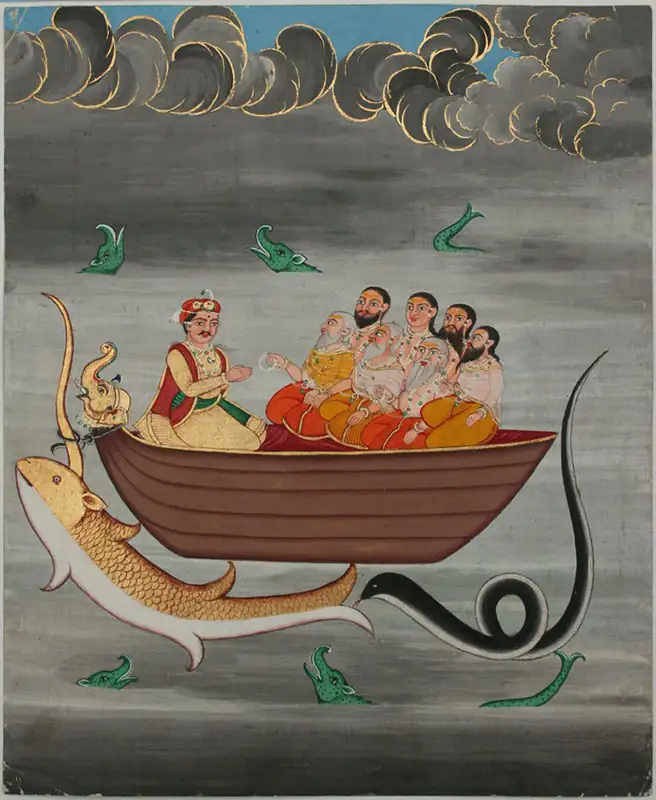
Figure 1.2 depicts a scene from the Matsya Purana, where Manu, the first man whose succession marks the prehistorical ages of Earth, sits with the Seven Sages in a boat to protect them from a mythic flood that is said to have submerged the world. The king of serpents guides the boat, which is said to have also contained seeds, plants, and animals saved by Manu from the flood.
Despite the fact that classical Indian culture is patriarchal, women figures play an important role in the earliest writings of the Vedic tradition (the classical Indian religious and philosophical tradition). These women figures are partly connected to the Indian conception of the fundamental forces of nature—energy, ability, strength, effort, and power—as feminine. This aspect of God was thought to be present at the creation of the world. The Rig Veda, the oldest Vedic writings, contains hymns that tell the story of Ghosha, a daughter of Rishi Kakshivan, who had a debilitating skin condition (probably leprosy) but devoted herself to spiritual practices to learn how to heal herself and eventually marry. Another woman, Maitreyi, is said to have married the Rishi Yajnavalkya (himself a god who was cast into mortality by a rival) for the purpose of continuing her spiritual training. She was a devoted ascetic and is said to have composed 10 of the hymns in the Rig Veda. Additionally, there is a famous dialogue between Maitreyi and Yajnavalkya in the Upanishads (another early, foundational collection of texts in the Vedic tradition) about attachment to material possessions, which cannot give a person happiness, and the achievement of ultimate bliss through knowledge of the Absolute (God).
Another woman sage named Gargi also participates in a celebrated dialogue with Yajnavalkya on natural philosophy and the fundamental elements and forces of the universe. Gargi is characterized as one of the most knowledgeable sages on the topic, though she ultimately concedes that Yajnavalkya has greater knowledge. In these brief episodes, these ancient Indian texts record instances of key women who attained a level of enlightenment and learning similar to their male counterparts. Unfortunately, this early equality between the sexes did not last. Over time Indian culture became more patriarchal, confining women to a dependent and subservient role. Perhaps the most dramatic and cruel example of the effects of Indian patriarchy was the ritual practice of sati, in which a widow would sometimes immolate herself, partly in recognition of the “fact” that following the death of her husband, her current life on Earth served no further purpose (Rout 2016). Neither a widow’s in-laws nor society recognized her value.
In similar fashion to the Indian tradition, the sage (sheng) tradition is important for Chinese philosophy. Confucius, one of the greatest Chinese writers, often refers to ancient sages, emphasizing their importance for their discovery of technical skills essential to human civilization, for their role as rulers and wise leaders, and for their wisdom. This emphasis is in alignment with the Confucian appeal to a well-ordered state under the guidance of a “philosopher-king.” This point of view can be seen in early sage figures identified by one of the greatest classical authors in the Chinese tradition, as the “Nest Builder” and “Fire Maker” or, in another case, the “Flood Controller.” These names identify wise individuals with early technological discoveries. The Book of Changes, a classical Chinese text, identifies the Five (mythic) Emperors as sages, including Yao and Shun, who are said to have built canoes and oars, attached carts to oxen, built double gates for defense, and fashioned bows and arrows (Cheng 1983). Emperor Shun is also said to have ruled during the time of a great flood, when all of China was submerged. Yü is credited with having saved civilization by building canals and dams.
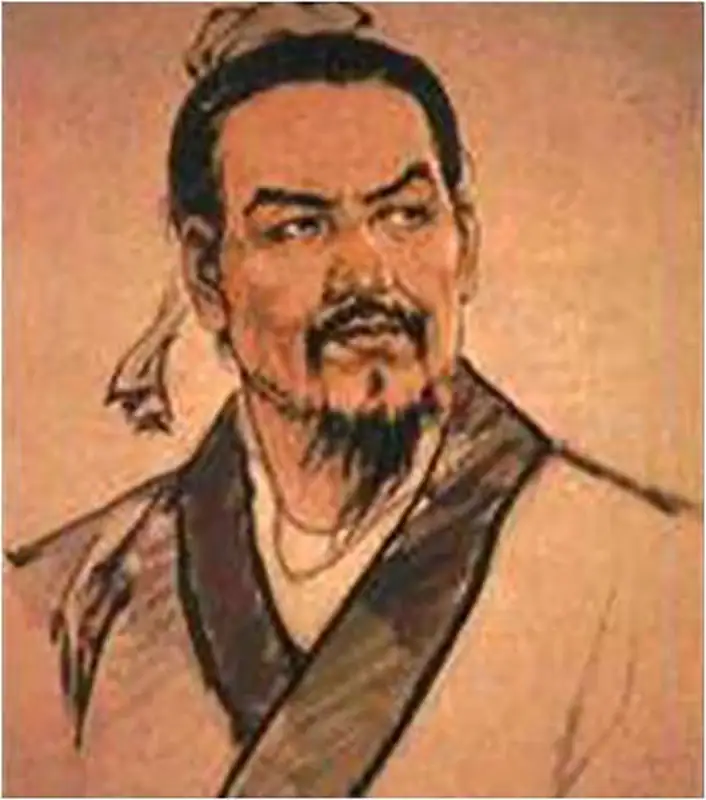
These figures are praised not only for their political wisdom and long rule, but also for their filial piety and devotion to work. For instance, Mencius, a Confucian philosopher, relates a story of Shun’s care for his blind father and wicked stepmother, while Yü is praised for his selfless devotion to work. In these ways, the Chinese philosophical traditions, such as Confucianism and Mohism, associate key values of their philosophical enterprises with the great sages of their history. Whether the sages were, in fact, actual people or, as many scholars have concluded, mythical forebearers, they possessed the essential human virtue of listening and responding to divine voices. This attribute can be inferred from the Chinese script for sheng, which bears the symbol of an ear as a prominent feature. So the sage is one who listens to insight from the heavens and then is capable of sharing that wisdom or acting upon it to the benefit of his society (Cheng 1983). This idea is similar to one found in the Indian tradition, where the most important texts, the Vedas, are known as shruti, or works that were heard through divine revelation and only later written down.
Although Confucianism is a venerable world philosophy, it is also highly patriarchal and resulted in the widespread subordination of women. The position of women in China began to change only after the Communist Revolution (1945–1952). While some accounts of Confucianism characterize men and women as emblematic of two opposing forces in the natural world, the Yin and Yang, this view of the sexes developed over time and was not consistently applied. Chinese women did see a measure of independence and freedom with the influence of Buddhism and Daoism, each of which had a more liberal view of the role of women (Adler 2006).
A detailed and important study of the sage tradition in Africa is provided by Henry Odera Oruka (1990), who makes the case that prominent folk sages in African tribal history developed complex philosophical ideas. Oruka interviewed tribal Africans identified by their communities as sages, and he recorded their sayings and ideas, confining himself to those sayings that demonstrated “a rational method of inquiry into the real nature of things” (Oruka 1990, 150). He recognized a tension in what made these sages philosophically interesting: they articulated the received wisdom of their tradition and culture while at the same time maintaining a critical distance from that culture, seeking a rational justification for the beliefs held by the culture.
Connections
The chapter on the early history of philosophy covers this topic in greater detail.
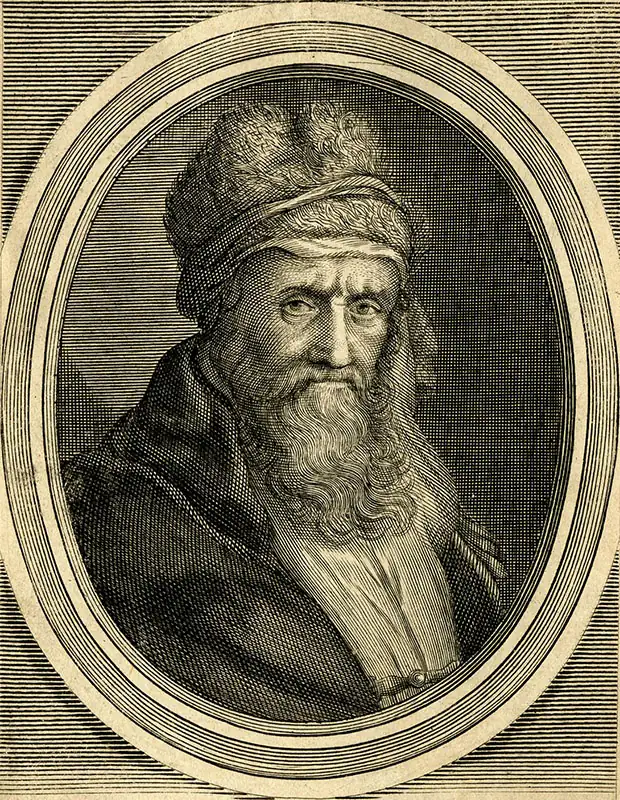
Among the ancient Greeks, it is common to identify seven sages. The best-known account is provided by Diogenes Laërtius, whose text Lives and Opinions of Eminent Philosophers is a canonical resource on early Greek philosophy. The first and most important sage is Thales of Miletus. Thales traveled to Egypt to study with the Egyptian priests, where he became one of the first Greeks to learn astronomy. He is known for bringing back to Greece knowledge of the calendar, dividing the year into 365 days, tracking the progress of the sun from solstice to solstice, and—somewhat dramatically—predicting a solar eclipse in 585 BCE. The eclipse occurred on the day of a battle between the Medes and Lydians. It is possible that Thales used knowledge of Babylonian astronomical records to guess the year and location of the eclipse. This mathematical and astronomical feat is one of Thales’s several claims to sagacity. In addition, he is said to have calculated the height of the pyramids using the basic geometry of similar triangles and measuring shadows at a certain time of day. He is also reported to have predicted a particularly good year for olives: he bought up all the olive presses and then made a fortune selling those presses to farmers wanting to turn their olives into oil. Together, these scientific and technical achievements suggest that at least part of Thales’s wisdom can be attributed to a very practical, scientific, and mathematical knowledge of the natural world. If that were all Thales was known for, he might be called the first scientist or engineer. But he also made more basic claims about the nature and composition of the universe; for instance, he claimed that all matter was fundamentally made of up water. He also argued that everything that moved on its own possessed a soul and that the soul itself was immortal. These claims demonstrate a concern about the fundamental nature of reality.
Another of the seven sages was Solon, a famed political leader. He introduced the “Law of Release” to Athens, which cancelled all personal debts and freed indentured servants, or “debt-slaves” who had been consigned to service based on a personal debt they were unable to repay. In addition, he established a constitutional government in Athens with a representative body, a procedure for taxation, and a series of economic reforms. He was widely admired as a political leader but voluntarily stepped down so that he would not become a tyrant. He was finally forced to flee Athens when he was unable to persuade the members of the Assembly (the ruling body) to resist the rising tyranny of one of his relatives, Pisistratus. When he arrived in exile, he was reportedly asked whom he considered to be happy, to which he replied, “One ought to count no man happy until he is dead.” Aristotle interpreted this statement to mean that happiness was not a momentary experience, but a quality reflective of someone’s entire life.
Beginnings of Natural Philosophy
The sage tradition is a largely prehistoric tradition that provides a narrative about how intellect, wisdom, piety, and virtue led to the innovations central to flourishing of ancient civilizations. Particularly in Greece, the sage tradition blends into a period of natural philosophy, where ancient scientists or philosophers try to explain nature using rational methods. Several of the early Greek schools of philosophy were centered on their respective views of nature. Followers of Thales, known as the Milesians, were particularly interested in the underlying causes of natural change. Why does water turn to ice? What happens when winter passes into spring? Why does it seem like the stars and planets orbit Earth in predictable patterns? From Aristotle we know that Thales thought there was a difference between material elements that participate in change and elements that contain their own source of motion. This early use of the term element did not have the same meaning as the scientific meaning of the word today in a field like chemistry. But Thales thought material elements bear some fundamental connection to water in that they have the capacity to move and alter their state. By contrast, other elements had their own internal source of motion, of which he cites the magnet and amber (which exhibits forces of static electricity when rubbed against other materials). He said that these elements have “soul.” This notion of soul, as a principle of internal motion, was influential across ancient and medieval natural philosophy. In fact, the English language words animal and animation are derived from the Latin word for soul (anima).
Similarly, early thinkers like Xenophanes began to formulate explanations for natural phenomena. For instance, he explained rainbows, the sun, the moon, and St. Elmo’s fire (luminous, electrical discharges) as apparitions of the clouds. This form of explanation, describing some apparent phenomenon as the result of an underlying mechanism, is paradigmatic of scientific explanation even today. Parmenides, the founder of the Eleatic school of philosophy, used logic to conclude that whatever fundamentally exists must be unchanging because if it ever did change, then at least some aspect of it would cease to exist. But that would imply that what exists could not exist—which seems to defy logic. Parmenides is not saying that there is no change, but that the changes we observe are a kind of illusion. Indeed, this point of view was highly influential, not only for Plato and Aristotle, but also for the early atomists, like Democritus, who held that all perceived qualities are merely human conventions. Underlying all these appearances, Democritus reasoned, are only atomic, unchanging bits of matter flowing through a void. While this ancient Greek view of atoms is quite different from the modern model of atoms, the very idea that every observable phenomenon has a basis in underlying pieces of matter in various configurations clearly connects modern science to the earliest Greek philosophers.
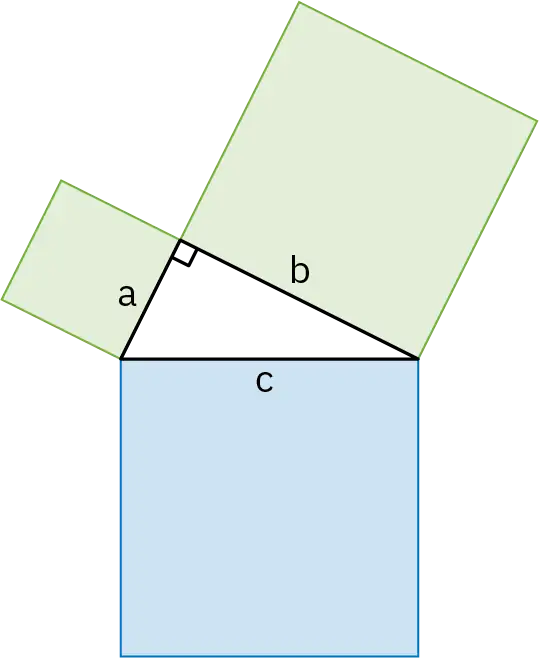
Along these lines, the Pythagoreans provide a very interesting example of a community of philosophers engaged in understanding the natural world and how best to live in it. You may be familiar with Pythagoras from his Pythagorean theorem, a key principle in geometry establishing a relationship between the sides of a right-angled triangle. Specifically, the square formed by the hypotenuse (the side opposite the right angle) is equal to the sum of the two squares formed by the remaining two sides. In the figure below, the area of the square formed by c is equal to the sum of the areas of the squares formed by a and b. The figure represents how Pythagoras would have conceptualized the theorem.
The Pythagoreans were excellent mathematicians, but they were more interested in how mathematics explained the natural world. In particular, Pythagoras recognized relationships between line segments and shapes, such as the Pythagorean theorem describes, but also between numbers and sounds, by virtue of harmonics and the intervals between notes. Similar regularities can be found in astronomy. As a result, Pythagoras reasoned that all of nature is generated according to mathematical regularities. This view led the Pythagoreans to believe that there was a unified, rational structure to the universe, that the planets and stars exhibit harmonic properties and may even produce music, that musical tones and harmonies could have healing powers, that the soul is immortal and continuously reincarnated, and that animals possess souls that ought to be respected and valued. As a result, the Pythagorean community was defined by serious scholarship as well as strict rules about diet, clothing, and behavior.
Additionally, in the early Pythagorean communities, it was possible for women to participate and contribute to philosophical thought and discovery. Pythagoras himself was said to have been inspired to study philosophy by the Delphic priestess Themistoclea. His wife Theano is credited with contributing to important discoveries in the realms of numbers and optics. She is said to have written a treatise, On Piety, which further applies Pythagorean philosophy to various aspects of practical life (Waithe 1987). Myia, the daughter of this illustrious couple, was also an active and productive part of the community. At least one of her letters has survived in which she discusses the application of Pythagorean philosophy to motherhood. The Pythagorean school is an example of how early philosophical and scientific thinking combines with religious, cultural, and ethical beliefs and practices to embrace many different aspects of life.
How It All Hangs Together
Closer to the present day, in 1962, Wilfrid Sellars, a highly influential 20th-century American philosopher, wrote a chapter called “Philosophy and the Scientific Image of Man” in Frontiers of Science and Philosophy. He opens the essay with a dramatic and concise description of philosophy: “The aim of philosophy, abstractly formulated, is to understand how things in the broadest possible sense of the term hang together in the broadest possible sense of the term.” If we spend some time trying to understand what Sellars means by this definition, we will be in a better position to understand the academic discipline of philosophy. First, Sellars emphasizes that philosophy’s goal is to understand a very wide range of topics—in fact, the widest possible range. That is to say, philosophers are committed to understanding everything insofar as it can be understood. This is important because it means that, on principle, philosophers cannot rule out any topic of study. However, for a philosopher not every topic of study deserves equal attention. Some things, like conspiracy theories or paranoid delusions, are not worth studying because they are not real. It may be worth understanding why some people are prone to paranoid delusions or conspiratorial thinking, but the content of these ideas is not worth investigating. Other things may be factually true, such as the daily change in number of the grains of sand on a particular stretch of beach, but they are not worth studying because knowing that information will not teach us about how things hang together. So a philosopher chooses to study things that are informative and interesting—things that provide a better understanding of the world and our place in it.
To make judgments about which areas are interesting or worthy of study, philosophers need to cultivate a special skill. Sellars describes this philosophical skill as a kind of know-how (a practical, engaged type of knowledge, similar to riding a bike or learning to swim). Philosophical know-how, Sellars says, has to do with knowing your way around the world of concepts and being able to understand and think about how concepts connect, link up, support, and rely upon one another—in short, how things hang together. Knowing one’s way around the world of concepts also involves knowing where to look to find interesting discoveries and which places to avoid, much like a good fisherman knows where to cast his line. Sellars acknowledges that other academics and scientists know their way around the concepts in their field of study much like philosophers do. The difference is that these other inquirers confine themselves to a specific field of study or a particular subject matter, while philosophers want to understand the whole. Sellars thinks that this philosophical skill is most clearly demonstrated when we try to understand the connection between the natural world as we experience it directly (the “manifest image”) and the natural world as science explains it (the “scientific image”). He suggests that we gain an understanding of the nature of philosophy by trying to reconcile these two pictures of the world that most people understand independently.
Read Like a Philosopher: “Philosophy and the Scientific Image of Man”
This essay, “Philosophy and the Scientific Image of Man” by Wilfrid Sellars, has been republished several times and can be found online. Read through the essay with particular focus on the first section. Consider the following study questions:
- What is the difference between knowing how and knowing that? Are these concepts always distinct? What does it mean for philosophical knowledge to be a kind of know-how?
- What do you think Sellars means when he says that philosophers “have turned other special subject-matters to non-philosophers over the past 2500 years”?
- Sellars describes philosophy as “bringing a picture into focus,” but he is also careful to recognize challenges with this metaphor as it relates to the body of human knowledge. What are those challenges? Why is it difficult to imagine all of human knowledge as a picture or image?
- What is the scientific image of man in the world? What is the manifest image of man in the world? How are they different? And why are these two images the primary images that need to be brought into focus so that philosophy may have an eye on the whole?
Unlike other subjects that have clearly defined subject matter boundaries and relatively clear methods of exploration and analysis, philosophy intentionally lacks clear boundaries or methods. For instance, your biology textbook will tell you that biology is the “science of life.” The boundaries of biology are fairly clear: it is an experimental science that studies living things and the associated material necessary for life. Similarly, biology has relatively well-defined methods. Biologists, like other experimental scientists, broadly follow something called the “scientific method.” This is a bit of a misnomer, unfortunately, because there is no single method that all the experimental sciences follow. Nevertheless, biologists have a range of methods and practices, including observation, experimentation, and theory comparison and analysis, that are fairly well established and well known among practitioners. Philosophy doesn’t have such easy prescriptions—and for good reason. Philosophers are interested in gaining the broadest possible understanding of things, whether that be nature, what is possible, morals, aesthetics, political organizations, or any other field or concept.
1.2 How Do Philosophers Arrive at Truth?
Learning Objectives
By the end of this section, you will be able to:
- Identify philosophical methods of inquiry.
- Explain the role of logical consequences in assessing a philosophical position.
- Define conceptual analysis, coherence, argument, intuition, and experimental philosophy.
- Explain the importance of trade-offs in establishing a philosophical position.
We have seen some examples of how philosophy emerged in antiquity, its relationship to natural philosophy and modern science, and one goal of philosophy, specifically—to provide a coherent story of how the world as it appears to us can be explained in a way that also makes sense of what the sciences tells us. In this section, we describe in greater detail the specific strategies and tools that philosophers use to arrive at truth.
Sources of Evidence
Even though philosophy is not an empirical science, philosophical claims require evidence, and philosophers ought to have reasons for the claims they make. There are many different types of philosophical evidence, some of which follow.
History
A basic but underappreciated source of evidence in philosophy is the history of philosophy. As we have already seen, philosophical thinking has its origins around the world, from the beginning of recorded history. Historical philosophers, sages, natural philosophers, and religious thinkers are often a source of insight, inspiration, and argument that can help us understand contemporary philosophical questions. For instance, the Greeks recognized early on that there is a difference between the way we use language to talk about things, with generic terms that apply to many different things at the same time (like cat, tree, or house), and the things as they actually exist—namely, as specific, individual beings or objects. Philosophers ask, what is the relationship between the general terms we use and the specific things that exist in the world? This sort of question is a perennial philosophical question. Today’s philosophers have their own response to this sort of question, and their answers often respond to and are informed by the historical treatment of these issues.
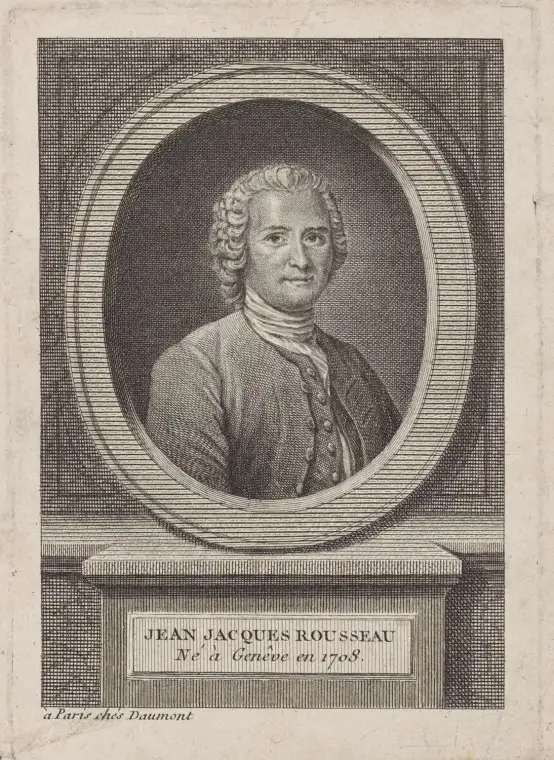
While you may expect questions about the natural world to change over time (and certainly they have changed due to scientific progress), questions of morality and social organization do not change as much. What constitutes the good life? How should communities be organized to benefit all the members of that community? These sorts of questions stay with us throughout time. In the United States, it is common for political leaders to appeal to the “founding fathers” of the US Constitution. People like Thomas Jefferson, Benjamin Franklin, and George Washington were heavily influenced by early modern European philosophers like John Locke, Jean-Jacques Rousseau, and Thomas Hobbes. In similar fashion, the current Chinese leader, Xi Jinping, is fond of reading and citing the foundational philosopher Confucius. Most of Xi’s addresses include quotations from Confucius, and Xi stresses the importance of reading classical Chinese philosophers (Zhang 2015). For Chinese political leaders, Confucius provides an important reminder of the role of virtue and a sense of belonging among the Chinese people. There is a widespread belief among the Chinese political class that their intellectual heritage is an important factor in their contemporary political success, in much the same way as American political leaders trace their success back to the founding fathers. Given the influence of philosophy on world history, it is worthwhile to engage with the writings of past philosophers to inform our understanding of pressing philosophical questions of today.
Intuition
One of the hallmarks of philosophical thinking is an appeal to intuition. What philosophers today mean by intuition can best be traced back to Plato, for whom intuition (nous) involved a kind of insight into the very nature of things. This notion has had religious connotations, as if the knowledge gained through intuition is like catching a glimpse of divine light. But intuition does not have to involve faith. René Descartes defined intuition in the following manner: “By intuition [I mean] . . . the conception of a clear and attentive mind, which is so easy and distinct that there can be no room for doubt about what we are understanding” (Descartes 1985, 14). This concept of intuition is clearest in mathematical examples. Importantly, it is quite different from the way that many people use the word intuition today to mean something like “gut feeling” or “hunch.” When philosophers talk about intuition, they mean something much more definite. Consider the equation 2 + 2 = 4. Examine the equation in your mind. Could it possibly be false? So long as we operate under the assumption that these numbers represent counting numbers, it seems impossible that this equation could be false. More than that, there is a kind of clarity and certainty about the equation. It is not just that you have learned 2 + 2 = 4 by habit. You could easily perform the counting operation in your head and verify that the answer is correct. The truth of this mathematical sentence is so clear that if it turned out to be wrong, you would have to give up core beliefs about the nature of numbers, addition, and equality. This kind of clarity is a paradigm of intuition.
Intuition operates in other realms besides mathematics, such as in the use of language. For instance, it is obvious that a three-legged stool has three legs or that the tallest building is taller than any other building. These statements are true in an obvious way that is similar to the mathematical sentence above. We can branch out further, to say, for instance, that a camel is a mammal. We might intuitively know this statement is true, but we may also recognize that we are on slightly less certain ground. After all, whether a camel is a mammal is based on some understanding of the anatomy of a camel as well as the biological classification system that assigns animals to different classes. So the definition of camel as “a mammal” is not the same as “a three-legged stool has three legs.” Here, we can see that some statements are intuitively true by virtue of their definition. Others are intuitively true by virtue of some mental operation that we can perform very easily. Still others are intuitively true in that they rely on a body of knowledge that is commonly accepted and foundational for our understanding of the world.
There are many other places outside of pure linguistic analysis and mathematics where intuitions are helpful. Consider morality: the proposition that “it is better to be good than to be bad” may seem similar to the statement that “a three-legged stool has three legs,” but the former introduces the words good and bad, which are fraught terms that produce disagreement among people. Nonetheless, while it may be difficult to agree on what constitutes “good” or “bad,” everyone probably recognizes that whatever is good ought to be better than what is bad. That seems intuitively true. On this basis, we might imagine that there are intuitive truths even in morality. As we gain confidence in the ability of intuition to reveal truth, we might be tempted to extend intuitions even further. However, when intuitions extend into areas where there is no consensus on what is true, we have to be cautious. At that point, we might be using the term intuition to stand in for belief or perspective. Such “intuitions” do not have the same force as the intuition that 2 + 2 = 4. It is not always easy to distinguish between intuitions that are certain and evident and those that are mere feelings or hunches; recognizing that distinction is part of the practical know-how philosophers try to develop.
Common Sense
We ought not to neglect a third source of evidence in philosophy, namely, common sense. The idea of common sense is frequently used to describe a basic set of facts or common knowledge that any adult human being ought to possess. But common sense is rarely defined. When philosophers talk about common sense, they mean specific claims based on direct sense perception, which are true in a relatively fundamental sense. In other words, philosophical champions of common sense deny that one can be skeptical of certain basic claims of sense perception.
Famously, early-20th-century British philosopher G. E. Moore argued that a perfectly rigorous proof of the external world could be given by simply making the appropriate gesture toward his right hand and saying, “Here is one hand.” So long as it is granted that the sensory perception of a hand is evidence of the existence of a hand and that there is such a thing as a hand in the external world, then it must be granted that there is an external world. Such an argument trades on the idea that knowledge of the existence of one’s own hands is something that does not need further proof; it is something we can know without proof. This idea is not something that all philosophers accept, but it is, in many cases, an important source of evidence in philosophical inquiry. At a certain point, it may be necessary to stop demanding proofs for the things we can plainly see, such as the fact that this is a hand (as we hold a hand in front of our faces and examine it). Common sense may be questioned by further philosophical interrogation, but the common-sense philosopher may respond that such interrogation is either unnecessary, excessive, or misses the point.
Experimental Philosophy
Experimental philosophy is a relatively recent movement in philosophy by which philosophers engage in empirical methods of investigation, similar to those used by psychologists or cognitive scientists. The basic idea motivating experimental philosophy is that philosophers use terms and concepts that can be tested in a laboratory. For instance, when philosophers talk about free will, they frequently cite the idea that free will is necessary to assign moral responsibility; thus, moral responsibility is one reason to believe in the existence of free will. Consequently, you might wonder whether most people do, in fact, believe that the existence of free will is necessary to assign moral responsibility. This claim can be tested, for instance, by posing problems or scenarios to research subjects and asking them whether the absence of free choice removes moral responsibility. Similar strategies have been applied to causation, philosophy of biology, consciousness, personal identity, and so forth. In these areas, philosophers use experimental methods to find out what average people think about philosophical issues. Since common sense and intuition are already a source of evidence in philosophical reasoning, it makes sense to confirm that what philosophers ascribe to common sense or intuition aligns with what people generally think about these things.
Such experimental research is subject to many of the same issues that confront experimentation in the social sciences. These studies need to be replicable and ought to fall within a psychological or biological theory that helps explain them. When philosophers tread into experimental philosophy, they behave a lot more like scientists than philosophers, and they are held to the same rigorous standards as other researchers in similar experimental disciplines.
Results from Other Disciplines
The relevance of experimental methods for philosophy suggests a broader source of evidence for philosophical claims, namely, the results of scientific disciplines. When philosophers make claims about the natural world, they ought to be aware of what the natural sciences say. When philosophers make claims about human nature, they ought to be aware of what biology and the social sciences say. As we have already seen, there is an important difference between philosophical investigation and these various disciplines. Yet, given that philosophers attempt to gain some understanding of truth as a whole, they ought to welcome evidence from other disciplines that can help them better understand portions of that whole truth.
Table 1.1 summarizes these different types of philosophical evidence.
Table 1.1 Types of Philosophical Evidence
| Type of Evidence | Description | Example |
|---|---|---|
| History | The insights of historical philosophers, sages, natural philosophers, and religious thinkers can help us understand contemporary philosophical questions. | The question “What is a good life?” is a perennial philosophical concern; attempts at answers from the past continue to have relevance for contemporary people. |
| Intuition | The philosophical meaning of intuition can best be traced back to Plato, for whom intuition involved a kind of insight into the very nature of things. | The truth of a mathematical sentence like “2+2=4” is so clear that if it turned out to be wrong, you would have to give up core beliefs about the nature of numbers, addition, and equality. |
| Common sense | When philosophers talk about common sense, they mean specific claims based on direct sense perception. | Someone who is holding their hand in front of their face can rightly claim “this is my hand” without having to resort to any further proofs. |
| Experimental philosophy | The basic idea motivating experimental philosophy is that philosophers use terms and concepts that can be tested in a laboratory. | A philosopher might pose scenarios to research subjects and ask them whether they believe an absence of free choice would remove moral responsibility in these scenarios, in order to test a philosophical claim about moral responsibility and free will. |
| Results from other disciplines | Evidence from other disciplines can help philosophers better understand portions of philosophical inquiries. | Information provided by other social scientists (e.g., sociologists, historians, anthropologists) can be used to inform philosophical claims about human nature. |
Logic
One of the first and most reliable ways that philosophers have of verifying and analyzing claims is by using logic, which is, in some sense, the science of reasoning. Logic attempts to formalize the process that we use or ought to use when we provide reasons for some claims. By interpreting the claims we make using logic, we can assess whether those claims are well founded and consistent or whether they are poorly reasoned. The chapter on logic and reasoning will provide much more detail about the nature of logic and how it is used by philosophers to arrive at truth.
Connections
The chapter on logic and reasoning covers this topic of logic in greater detail.
Argument
The first and most important move in logic is to recognize that claims are the product of arguments. In particular, a claim is just the conclusion of a series of sentences, where the preceding sentences (called premises) provide evidence for the conclusion. In logic, an argument is just a way of formalizing reasons to support a claim, where the claim is the conclusion and the reasons given are the premises. In normal conversation and even philosophical writing, arguments are rarely written so clearly that one can easily identify the premises and the conclusion. Nevertheless, it is possible to reconstruct any argument as a series of sentences with clearly identified premises and conclusions. This process is the first step in analyzing an argument: identify the claim that is being made, then identify the sentences that provide supporting evidence for the argument. This process will necessarily require some interpretation on the part of the reader. Therefore, it is important to try to remain faithful to the original intention of the argument and outline the premises and conclusions in such a way that they display the reasoning of the person making that claim.
Once the premises and conclusion are identified and written in order, it is possible to use formal techniques to evaluate the argument. Formal techniques will be covered in the chapter on logic and reasoning. For now, it is sufficient to note that there is a process for evaluating whether claims are well supported by using the techniques of logic. Poorly supported claims may be true, but without good reasons to accept those claims, a person’s support of them is irrational. In philosophy, we want to understand and evaluate the reasons for a claim. Just as a house that is built without a solid foundation will rapidly deteriorate and eventually fall, the philosopher who accepts claims without good reasons is likely to hold a system of beliefs that will crumble.
Explanation
While arguments can be thought of as building blocks to construct a solid foundation for beliefs about the world, arguments can also be understood as explanations for phenomena that are evident but not well understood. To generate well-founded beliefs, we start with evidence in the form of premises and infer a conclusion from that evidence. To explain observed phenomena, we start with a conclusion in the form of some observation and reason backward to the evidence that explains why the observation is true. For example, we infer that there is a fire based on the appearance of smoke, or we infer lightning when we hear thunder, even if we do not see the lightning. We can compare the way we reason about explanations to the way a detective might reconstruct a crime based on the evidence found at a crime scene. By reconstructing the premises that led to a given conclusion, a philosopher can explain the reasons for a conclusion that are evident through observation. In summary, logical reconstruction can be used to investigate the world around us, providing a rational explanation for why the world is the way it appears.
Coherence
Finally, logic provides philosophers with a powerful technique for assessing a set of claims or beliefs. We can ask whether a set of beliefs is logically consistent with one another. Given that we expect our beliefs to present to us a world that makes rational sense, we want those beliefs to be internally consistent. A set of beliefs or statements is coherent, or logically consistent, if it is possible for them to all be true at the same time. If it is not possible for statements or beliefs to be true at the same time, then they are contradictory. It seems unreasonable for a person to accept contradictory claims because a contradiction is a logical impossibility. If a person holds contradictory beliefs, then they must be wrong about at least some of their beliefs. Metaphorically, the house of beliefs in which they live must be poorly founded, at least in some places. When you are reading philosophy, you should be aware of places where the author says things that appear to be inconsistent. If you discover inconsistencies, that is a good indication that at least one of their claims is false. You may not know which claim is false, but you can know it is logically impossible for all claims to be true.
When faced with the possibility of incoherent beliefs, the philosopher will need to either revise those beliefs so that they become consistent, or they will need to give up some beliefs to preserve others. Logical consistency cannot tell us that a set of beliefs is true; a complete fiction might be logically consistent. But logical consistency can tell us what is not true. It is impossible for a logically inconsistent set of beliefs to be wholly true.
Conceptual Analysis
One of the techniques that philosophers use to clarify and understand philosophical statements (either premises or conclusions) is conceptual analysis. Conceptual analysis involves the analysis of concepts, notions, or ideas as they are presented in statements or sentences. The term analysis has been a part of philosophical terminology and methodology since its beginning. In its most basic sense, analysis refers to the process of breaking apart complex ideas into simpler ones. Analysis also involves a cluster of related strategies that philosophers use to discover truths. Each of these techniques attempts to arrive at a clearer and more workable definition of the concepts in question.
When students are asked to give a definition of some concept or term, they frequently go to a dictionary. But a dictionary provides only a description of how a concept is used in ordinary speech. A dictionary cannot tell us what the word means in a fundamental sense because dictionary definitions never ask whether that common usage is coherent, accurate, or precise. It is up to the person engaged in reflection on the concept to figure out what the term means and whether that meaning fits within a larger understanding of the world. The next section illustrates four methods of analysis.
Predicates
When philosophers today talk about concepts, they are usually referring to a notion that comes from the work on logic done by German philosopher Gottlob Frege. Frege demonstrated that any sentence in natural language could be translated into a formal, symbolic language, provided that we consider the sentence to be a kind of function that describes a relationship between names (or objects) and concepts. This symbolic language is what has become modern logic. Frege modeled his logic on mathematics, with the idea that he could eliminate the ambiguity and vagueness of natural language by translating it into a purely symbolic notation. Following Frege, we can break sentences into parts, including names, or object identifiers, and concepts, or predicates.
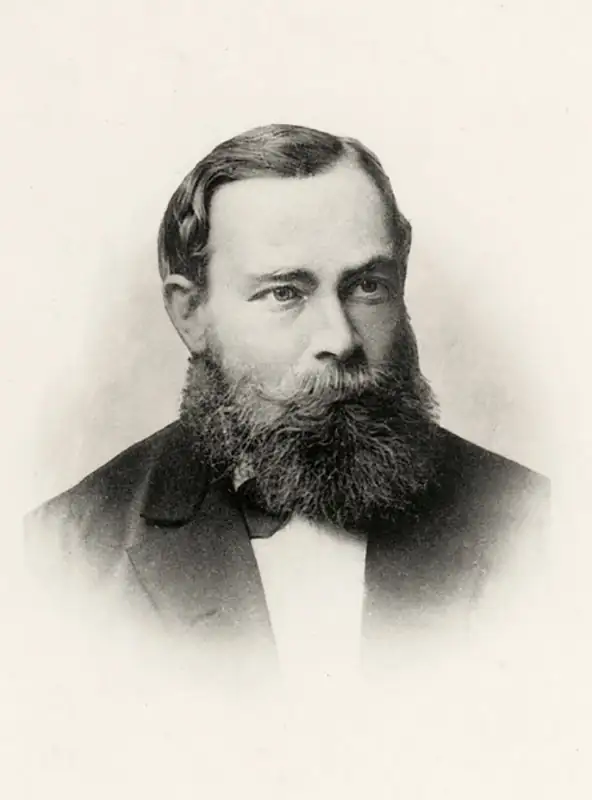
Predicates are descriptive terms, like “yellow,” “six feet tall,” or “faster than a speeding bullet.” Simple sentences like “the flower is yellow,” or “Superman is faster than a speeding bullet” can be easily analyzed into object terms and predicates. But any sentence can be analyzed in multiple ways. And some sentences express multiple relations between predicates and objects. So the role of conceptual analysis is to identify the right predicates for analysis and to clarify the relationship between them. Predicates can help us clarify statements. For any sentence, we can ask, what is being predicated, and how is it being predicated?
Descriptions
While the concepts that describe or categorize objects can be analyzed using predicates, the objects themselves can be analyzed by using descriptions. Bertrand Russell identified definite descriptions as the way to analyze proper names or objects. His idea is that in a sentence like “the flower is yellow” or “my dog likes naps,” the subject term—“flower” or “dog”—can be substituted with a descriptive sentence that uniquely identifies this particular flower or dog. There are unique characteristics that differentiate my dog from all others, for instance: my dog was born on a certain day, lives in a certain city, belongs to me, or occupies a specific location. Similarly, the flower can be identified by its position in a garden, field, or particular geographical location. One of Russell’s insights was that proper names, such as “Max” (suppose it is the name I use to call my dog), are definite descriptions in disguise. That is, any proper name can be substituted with a description that identifies the one and only thing named.
A definite description is a way of analyzing names and object terms for the purpose of making them more like predicates. This way we can clarify what we are talking about without resorting to gestures, context, or direct experience. You probably do this in your everyday life when you encounter confusion about a name. For instance, suppose a coworker says, “Kevin used up all the paper in the printer.” If there is more than one Kevin in the office, you might answer, “Which Kevin?” And your coworker may then respond, “The one with brown hair whose workspace is right next to the entrance.” “Oh,” you might reply, “You mean the one with the picture of his kids on his desk?” In a sense, this process of disambiguating the reference for the name “Kevin” is a process of seeking a more definite description to supplement the proper name. Understanding that language is composed of definite descriptions and predicates can help us remove some of the ambiguity and vagueness that is a natural part of speech.
Enumeration
Sometimes, to understand the meaning of a concept, it is helpful to enumerate its component parts. For instance, we may say that a governmental body is composed of its legislature, its executive, and its judicial branches. Or we might recognize that a cell is composed of a nucleus, a cell wall, and organelles. The process of enumeration can help us specify the nature of the thing we are talking about. In effect, we are identifying the parts that make up a whole. Since claims about the whole can be analyzed as claims about its parts and claims about how the parts pertain to the whole, it is helpful to enumerate the parts and consider how claims about the whole relate to claims about the parts.
Just as enumeration is helpful in understanding material things, it can be used to understand abstract concepts. For example, Aristotle says that wisdom is composed of scientific knowledge, plus understanding, where understanding is the grasp of first principles and scientific knowledge is the grasp of demonstrated reasoning that follows from first principles. Whether or not Aristotle is correct, his enumeration may help us understand the nature of wisdom.
Thought Experiments
When philosophers want to clarify the relationship between concepts, they often consider hypothetical scenarios meant to isolate one or more features of a concept and place it in the appropriate relationship with other concepts. Such hypothetical scenarios are called thought experiments. These imaginative scenarios allow us to test or compare concepts to better understand their connections and logical consequences. Philosophers have used thought experiments for as long as we have a written record of philosophical thought. For instance, Plato devised an elaborate thought experiment in The Republic, in which he depicts Socrates and several of his friends describing an ideal city. The premise of this thought experiment is that if the philosophers could describe an ideal city in detail, they would be able to identify which part of the city gives rise to justice.
Aristotle, a Greek philosopher who followed Plato, arrives at the famous claim that “nature abhors a vacuum” (i.e., nature would not allow empty space between matter) by constructing a thought experiment. To argue for this conclusion, Aristotle assumes that there is such a void and then asks, how could one know the distance between two points in a vacuum? If there is any distance between two points, Aristotle reasons, that distance would have to be the property of something. But, by hypothesis, there is nothing between the two points: it is a pure void. Aristotle bases his reasoning on the idea that it is impossible for properties to exist without something they are the property of. This argument reveals that Aristotle thinks distance is a property of matter. Accordingly, it is impossible to measure distance in a pure void. Therefore, Aristotle reasons, it is not possible for a void to exist because it would occupy a distance that has no measure. Puzzles like this one can prompt fruitful philosophical reflection. What do you think about it?
Thought experiments are also common in ethics as a way of testing out moral theories. A moral theory could be supported by a thought experiment if the result of applying the theory to a hypothetical case made good moral sense. On the other hand, the thought experiment might undermine the moral theory by demonstrating that when the theory is applied, it results in an absurd or immoral outcome. In any case, thought experiments can help us clarify the relationship between our concepts and theories.
Table 1.2 summarizes these four methods of conceptual analysis.
Table 1.2 Four Methods of Conceptual Analysis
| Type of Conceptual Analysis | Description | Application |
|---|---|---|
| Predicates | Predicates are descriptive terms, like “yellow” or “six feet tall”. The role of conceptual analysis is to identify the right predicates for analysis and to clarify the relationship between them. | Predicates can help us clarify statements. For any sentence, we can ask, what is being predicated, and how is it being predicated? |
| Descriptions | A definite description is a way of analyzing names and object terms for the purpose of making them more like predicates. This way we can clarify what we are talking about without resorting to gestures, context, or direct experience. | Understanding that language is composed of definite descriptions and predicates can help us remove some of the ambiguity and vagueness that is a natural part of speech. |
| Enumeration | The process of enumeration can help us specify the nature of the thing we are talking about. In effect, we are identifying the parts that make up a whole. | Since claims about the whole can be analyzed as claims about its parts and claims about how the parts pertain to the whole, it is helpful to enumerate the parts and consider how claims about the whole relate to claims about the parts. |
| Thought experiments | Thought experiments are hypothetical scenarios meant to isolate one or more features of a concept and place it in the appropriate relationship with other concepts. | Thought experiments allow us to test or compare concepts to better understand their connections and logical consequences. |
Trade-offs
Conceptual analysis, logic, and sources of evidence together help philosophers compose a picture of the world that helps them get a better grasp of truth. Recall that philosophers are attempting to understand how things hang together in the broadest possible sense. However, it is unlikely that any single philosophical picture of the world will turn out to be so obviously compelling that it completely satisfies all criteria of logic, evidence, and conceptual analysis. It is much more likely that there will be competing pictures, each with strong reasons for believing in it. This situation is the basis for philosophical discussions. No one picture is so obviously true that all others can be discarded. Instead, we have to evaluate each picture of the world and understand the trade-offs that these pictures impose on us. We have to consider the practical and logical implications of the beliefs we hold to fully understand whether those beliefs are true and right.
Read Like a Philosopher: Excerpt from “Thinking and Moral Considerations” by Hannah Arendt
Hannah Arendt was a German-Jewish philosopher who fled Germany in the 1930s and eventually settled in New York City, where she became a prominent public intellectual. She is best known for her work on totalitarianism, power, and the notion of evil. She coined the phrase “the banality of evil” when reporting for the New Yorker magazine on the Nuremberg trial of Nazi bureaucrat Adolf Eichmann. The Nuremberg trials were a series of trials held in Nuremberg, Germany, after World War II in which Nazi leaders were held accountable for their war crimes before the international community. Subsequently, Arendt wrote the article “Thinking and Moral Considerations,” in which she describes the ways that Eichmann’s inability or unwillingness to consider the real, moral consequences of his actions caused him to behave in radically immoral ways. Arendt diagnoses the core problem of a person like Eichmann as “not stupidity but a curious, quite authentic inability to think.” She considers thought to involve aesthetic and moral judgments; thus, for a person to engage in evil action, they must necessarily disregard self-reflection and conscientious thought.
Read this article, particularly focusing on the first two paragraphs and the last four paragraphs. You may be able to obtain a copy of the article through JSTOR if you access this database through your college library. Then consider the following questions:
- In what sense does thinking require consideration of moral and aesthetic concerns? What is the relationship between thought and judgment?
- How does the word conscience function in Arendt’s analysis? What is important about this word for understanding the nature of thought?
- How does the figure of Socrates function in Arendt’s analysis to reveal the role of thinking?
- Why is thinking, in the sense that Arendt considers it, so easily disregarded by society? When does thinking matter most?
“Biting the Bullet”
Sometimes when weighing the trade-offs of a particular view and its logical consequences, you may decide to “bite the bullet.” This means that you are willing to accept the negative consequences of the view because you find the view attractive for other reasons. For instance, on the topic of free will, a philosopher might be committed to the idea that past events fully determine the future. In such a case, the philosopher is willing to accept the negative implication that free will is an illusion. In ethics, some philosophers are committed to the view that morality is entirely determined by the total quantity of effects caused by an action. Such philosophers may be willing to accept things that would otherwise seem immoral, like harming an individual person, if that action results in a greater quantity of positive effects in the end. No view is going to be perfect, and it is difficult to make sense of the world in terms that we can explain and understand. Nonetheless, we must be honest about the logical and moral consequences of the views we hold. If you are ultimately willing to accept those consequences to maintain the view, then you can bite the bullet.
Reflective Equilibrium
Another method for assessing the logical and moral consequences of our thinking is to use judgments about particular cases to revise principles, rules, or theories about general cases. This process of going back and forth between an assessment of the coherence of the theory and judgments about practical, applied cases is called reflective equilibrium. This process requires the revision of a theoretical and principled stance based on practical judgments about particular cases. Reflective equilibrium is achieved when you are able to establish some coherence between your theoretical and practical beliefs. Reflective equilibrium is a kind of coherence method: that is, reflective equilibrium justifies beliefs by assessing their logical consistency. As opposed to a traditional coherence approach, however, reflective equilibrium encourages the use of practical and applied judgments about cases as part of the set of beliefs that is logically consistent. Reflective equilibrium is an important method for introductory students to understand because students are frequently tempted to think they need to solve theoretical issues first before they can consider applications. Or they may choose a theory and then try to apply it to cases. Reflective equilibrium emphasizes that this procedure is likely neither possible nor desirable. Instead, a philosopher should be aware of both the theoretical commitments and the practical concerns of their position and use their understanding of each to inform the final analysis of their beliefs.
1.3 Socrates as a Paradigmatic Historical Philosopher
Learning Objectives
By the end of this section, you will be able to:
- Explain Socrates’s appreciation for the limits of human knowledge.
- Identify Socrates’s primary moral principles.
- Describe Socrates’s life, death, and philosophical interests.
- Compare Socrates’s moral philosophy with classical Indian philosophy.
Socrates is a foundational figure for Western philosophy. Even though he did not write any works himself, his life and thought are captured by three different, contemporary sources whose works we still have. Socrates is depicted in several of Aristophanes’s comedic plays. Aristophanes, an accomplished Athenian playwright, won several dramatic competitions of his day. Eleven of his 40 plays survive, and in three of them—The Clouds, The Frogs, and The Birds—Socrates appears as a main character. Aristophanes’s depiction of Socrates is ridiculous, and Plato appears to think that this depiction is partially responsible for Socrates’s ultimate trial and death. Another contemporary of Socrates, the historian Xenophon, wrote an account of Socrates’s trial and death in his Memorabilia. Finally, and most important, Socrates’s student and friend Plato made Socrates the central figure in nearly all of his dialogues. Plato and Aristotle are the most influential of the Athenian philosophers and have had a profound influence on the development of Western philosophy. Plato wrote exclusively in the form of dialogues, where his characters engage in discussion centered on philosophical issues. Most of what we know about Socrates is derived from Plato’s depiction of him as the primary questioner in most of the dialogues. Therefore, even though Socrates did not write works of his own, his life—and death—remain a testament to his profound and impactful philosophical life. For that reason, it is useful for us to consider the figure of Socrates as a paradigm of the philosophical life.
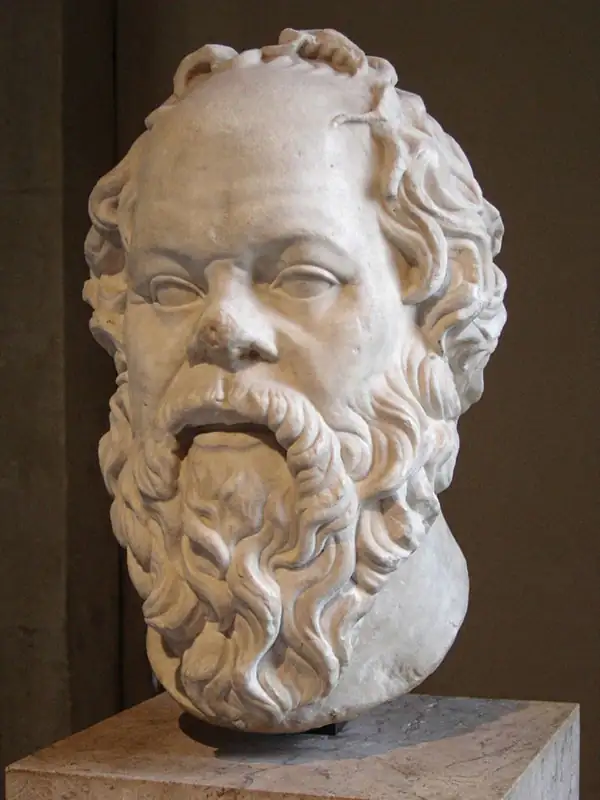
In particular, Socrates’s defense of himself during his trial is in many ways a defense of the philosophical life. Socrates was accused by a young, upstart politician named Meletus of corrupting the youth and undermining the gods of the city. These crimes were considered to be a kind of treason that undermined the legitimacy and future of Athenian democracy. The speech Socrates gave in his own defense to the Athenians, as recorded by Plato, remains a vivid and compelling defense of the sort of life he lived. In the end, his defense was not successful. He was convicted, imprisoned, and killed in 399 BCE. Plato provides accounts of the trial and death, not only in the Apology, but also in the Crito, where Socrates argues with his friend Crito that it would be unjust for him to escape from prison, and in the Phaedo, where Socrates engages in a debate with several close friends, arguing in his jail cell just before he dies that the soul is immortal.
Read Like a Philosopher
This excerpt from Plato’s Apology, translated by Benjamin Jowett, records one account of Socrates’s defense at his trial. He is responding to accusations made against him in front of the Assembly, which was the main governing body and jury for trials in Athens. This body was composed of 500 citizens.
“I dare say, Athenians, that someone among you will reply, “Why is this, Socrates, and what is the origin of these accusations of you: for there must have been something strange which you have been doing? All this great fame and talk about you would never have arisen if you had been like other men: tell us, then, why this is, as we should be sorry to judge hastily of you.” Now I regard this as a fair challenge, and I will endeavor to explain to you the origin of this name of “wise,” and of this evil fame. . . . I will refer you to a witness who is worthy of credit, and will tell you about my wisdom—whether I have any, and of what sort—and that witness shall be the god of Delphi. You must have known Chaerephon; he was early a friend of mine, and also a friend of yours, for he shared in the exile of the people, and returned with you. Well, Chaerephon, as you know, was very impetuous in all his doings, and he went to Delphi and boldly asked the oracle to tell him whether—as I was saying, I must beg you not to interrupt—he asked the oracle to tell him whether there was anyone wiser than I was, and the Pythian prophetess answered that there was no man wiser. Chaerephon is dead himself, but his brother, who is in court, will confirm the truth of this story. Why do I mention this? Because I am going to explain to you why I have such an evil name. When I heard the answer, I said to myself, “What can the god mean? and what is the interpretation of this riddle? for I know that I have no wisdom, small or great. What can he mean when he says that I am the wisest of men? And yet he is a god and cannot lie; that would be against his nature.” After a long consideration, I at last thought of a method of trying the question. I reflected that if I could only find a man wiser than myself, then I might go to the god with a refutation in my hand. I should say to him, “Here is a man who is wiser than I am; but you said that I was the wisest.” Accordingly I went to one who had the reputation of wisdom, and observed to him—his name I need not mention; he was a politician whom I selected for examination—and the result was as follows: When I began to talk with him, I could not help thinking that he was not really wise, although he was thought wise by many, and wiser still by himself; and I went and tried to explain to him that he thought himself wise, but was not really wise; and the consequence was that he hated me, and his enmity was shared by several who were present and heard me. So I left him, saying to myself, as I went away: “Well, although I do not suppose that either of us knows anything really beautiful and good, I am better off than he is—for he knows nothing, and thinks that he knows. I neither know nor think that I know. In this latter particular, then, I seem to have slightly the advantage of him.” Then I went to another, who had still higher philosophical pretensions, and my conclusion was exactly the same. I made another enemy of him, and of many others besides him. After this I went to one man after another, being not unconscious of the enmity which I provoked, and I lamented and feared this: but necessity was laid upon me—the word of God, I thought, ought to be considered first. And I said to myself, “Go I must to all who appear to know, and find out the meaning of the oracle.” And I swear to you, Athenians, by the dog I swear!—for I must tell you the truth—the result of my mission was just this: I found that the men most in repute were all but the most foolish; and that some inferior men were really wiser and better. I will tell you the tale of my wanderings and of the “Herculean” labors, as I may call them, which I endured only to find at last the oracle irrefutable. When I left the politicians, I went to the poets; tragic, dithyrambic, and all sorts. And there, I said to myself, you will be detected; now you will find out that you are more ignorant than they are. Accordingly, I took them some of the most elaborate passages in their own writings, and asked what was the meaning of them—thinking that they would teach me something. Will you believe me? I am almost ashamed to speak of this, but still I must say that there is hardly a person present who would not have talked better about their poetry than they did themselves. That showed me in an instant that not by wisdom do poets write poetry, but by a sort of genius and inspiration; they are like diviners or soothsayers who also say many fine things, but do not understand the meaning of them. And the poets appeared to me to be much in the same case; and I further observed that upon the strength of their poetry they believed themselves to be the wisest of men in other things in which they were not wise. So I departed, conceiving myself to be superior to them for the same reason that I was superior to the politicians. At last I went to the artisans, for I was conscious that I knew nothing at all, as I may say, and I was sure that they knew many fine things; and in this I was not mistaken, for they did know many things of which I was ignorant, and in this they certainly were wiser than I was. But I observed that even the good artisans fell into the same error as the poets; because they were good workmen they thought that they also knew all sorts of high matters, and this defect in them overshadowed their wisdom—therefore I asked myself on behalf of the oracle, whether I would like to be as I was, neither having their knowledge nor their ignorance, or like them in both; and I made answer to myself and the oracle that I was better off as I was. This investigation has led to my having many enemies of the worst and most dangerous kind, and has given occasion also to many calumnies, and I am called wise, for my hearers always imagine that I myself possess the wisdom which I find wanting in others: but the truth is, O men of Athens, that God only is wise; and in this oracle he means to say that the wisdom of men is little or nothing; he is not speaking of Socrates, he is only using my name as an illustration, as if he said, “He, O men, is the wisest, who, like Socrates, knows that his wisdom is in truth worth nothing.” And so I go my way, obedient to the god, and make inquisition into the wisdom of anyone, whether citizen or stranger, who appears to be wise; and if he is not wise, then in vindication of the oracle I show him that he is not wise; and this occupation quite absorbs me, and I have no time to give either to any public matter of interest or to any concern of my own, but I am in utter poverty by reason of my devotion to the god.”
“The Life Which Is Unexamined Is Not Worth Living”
After Socrates is convicted and has a chance to address the jury to persuade them to offer him a sentence or punishment other than death, he considers and then rejects the idea of exile. If he lived in exile, Socrates believed he would no longer be able to carry on his work as a philosopher because a foreign city would be even less welcoming of his strange questioning than his hometown. In speaking about this alternative, he says the following:
Someone will say: “Yes, Socrates, but cannot you hold your tongue, and then you may go into a foreign city, and no one will interfere with you?” Now I have great difficulty in making you understand my answer to this. For if I tell you that this would be a disobedience to a divine command, and therefore that I cannot hold my tongue, you will not believe that I am serious; and if I say again that the greatest good of man is daily to converse about virtue, and all that concerning which you hear me examining myself and others, and that the life which is unexamined is not worth living—that you are still less likely to believe. (Plato, Apology)
This idea—that a life that is “unexamined” is not worth living—strikes at the heart of what Socrates tells us motivates him to live a philosophical life. The statement ought to make us pause and reflect, not only because Socrates himself demonstrates his commitment to a particular kind of life, to the point of accepting death, but also because the charge that an unexamined life is not worth living rightly seems like such a serious thing. To have lived a life that is not worth living: What could be worse? Given the stakes, we ought to wonder, what does Socrates mean by an unexamined life? Or, alternatively, what would it look like to examine one’s life in the appropriate way?
Examination of the Self
The first form of examination that Socrates clearly advises is self-examination. At the temple to the oracle at Delphi, one of three maxims engraved in stone is the phrase “know thyself.” Like most oracular statements, it is not clear what is meant by this phrase. Plato suggests it may be a kind of warning to those who enter the oracle: “Know your position relative to the gods!” Alternatively, it may be a command to understand your own nature and your own mind before you seek to understand other people or the things of the world. Based on our reading of Socrates’s life and works, we can assume that he considers this saying to be a command to investigate our beliefs and knowledge, to appreciate the limits of our own knowledge, and to strive to eliminate inconsistencies. After all, Socrates’s method of questioning as it is described in Plato’s dialogues (and as Socrates himself describes in the excerpted passage) is exactly such an inquiry.
Socrates questions others about whether their beliefs are consistent and whether they have adequate justification for the beliefs they hold. This line of questioning suggests that Socrates holds such consistency and internal justification in high regard. We can imagine that Socrates considers an unexamined life to be one in which a person holds beliefs without justification or holds beliefs that are inconsistent with one another. We may then speculate that an unexamined is not worth living because it is dictated by beliefs and ideas that have never been tested, justified, or accounted for. You might respond that endless questioning is boring or difficult, or you may respond that “ignorance is bliss.” For a philosopher, this attitude is not only undesirable, but it also approaches irrationality. It seems that, whatever makes life worth living for creatures capable of rational thought, a minimum requirement is that we believe things worth believing in, hold positions we can defend, and understand why we do what we do. To do that, we need to engage in self-examination.
Examination of Nature
Even though Socrates himself did not develop an account of nature and the cosmos like many of the pre-Socratic philosophers, we may imagine that living an examined life requires us to understand the world around us. Socrates himself was well aware of the various natural philosophical accounts that were prominent in his day. Plato frequently records Socrates quoting or citing another philosopher’s account of the planets and stars, natural change, or other natural phenomenon when he is questioning others. Indeed, several of the dialogues place Socrates in conversations about the nature of the soul, the nature of causality, the classification of animals and plants, and so forth, all of which could fall under the examination of nature. Why might such a process of examination be important for a life worth living? We might speculate that it is important for us remain curious. The capacity to reason gives human beings the ability to investigate how things work—to discover truths about the world around them. Neglecting that drive to understand the world around us is like neglecting a natural skill. Methods of philosophical reflection can help us make sense of the world around us. Such investigation is characteristic of the ancient philosophers and may be considered part of a life worth living.
Human Wisdom Is Worth Little or Nothing
In the excerpt from Plato’s Apology, Socrates investigates the oracle’s strange response that he is the wisest of men. First, Socrates attempts to prove the oracle wrong by finding someone wiser than he. But, after a time, he comes to realize that the oracle’s response was a kind of riddle. He interprets the oracle as saying that Socrates is wisest because he alone realizes that human wisdom is worth little or nothing. This realization is important for Socrates’s own self-examination and provides an important lesson for philosophy students.
Understanding the Limits of Knowledge
Perhaps one of the greatest lessons you can learn from a well-rounded college education is just how much more there is to know about the world. Even the most respected scientists, philosophers, mathematicians, and historians recognize that the scope of their expertise is extremely limited. A lifetime of study can, at best, give a person deep insight into a tiny fraction of the universe of human knowledge. Beyond that, there is a vast domain of things that no human has yet discovered or understood. Consequently, it is a good idea to practice Socrates’s advice: to be aware of what you do not know and not to assert knowledge where you lack it. People are often resistant to taking this position because they want answers. Someone who can convince others that they know the solution to their problems or personal dilemmas can exert a great deal of power over them. But we ought to recognize the dangers of asserting knowledge where we lack it. In technical areas, a refusal to admit ignorance can result in the failure of equipment, the malfunctioning of machines, and in the worst cases, injury and loss of life. In the moral and political arenas, asserting knowledge where you lack it may lead to unnecessary disagreements and polarization, or it may result in ill-considered actions that result in ethical mistakes or harm to others. Most importantly, if you are not aware when you lack knowledge, you will not seek to acquire the knowledge you lack. If you believe you already know something, you will not listen to the evidence that disproves what you believe. As a result, you will miss out on learning the truth.
The Socratic Method
Socrates engaged in a particular method of questioning, sometimes known as the Socratic method, that was characterized by his asking questions of others rather than explaining his own beliefs. Socrates is typically hesitant to offer his own ideas about the topic under discussion. Instead, he asks the people he is questioning to supply the subject matter for their discussion. Socrates’s use of this strategy may be puzzling. One explanation may be that he is following the god’s command, as he says in the Apology. Another explanation is that he does not claim to have knowledge about the topic in question and is genuinely happy to learn from others. Yet another possibility is that Socrates feigns ignorance and is being insincere. Perhaps his true goal is to trap or humiliate the other person by discovering some inconsistency or obvious falsehood in what they believe. It is hard to know which of these is the most likely explanation, but we will focus for a moment on a fourth possibility, namely, a pedagogical one.
In two different Platonic dialogues, Socrates explains what he is doing by using an analogy: he compares his method of questioning to the role taken by a midwife during childbirth. In fact, Plato tells us that Socrates’s mother was a midwife and that he assumes her role in philosophical conversation. The goal of Socratic questioning, then, is to assist the person being questioned in discovering the truth on their own. By asking questions and examining the claims made by another person, Socrates allows that person to go through a process of self-discovery. This method provides an interesting lesson for teaching and learning. Often, students believe that their role is to simply receive knowledge from the teacher. But Socrates reminds us that real learning comes only through self-discovery and that the role of the teacher is to be an assistant, providing the kind of critical examination and evaluation necessary to help the student discover truth on their own.
The Importance of Doing No Harm
Even though many early philosophers were concerned with understanding nature, Socrates is much more concerned with ethics, or how to live a good life. He considers the primary purpose of philosophy to make one’s life better by making the philosopher a better person. Even though Socrates rarely claims to have knowledge about anything at all, the few instances where he does profess knowledge relate directly to morality. In particular, Socrates asserts a pair of moral principles that are quite controversial and may appear at first glance false. However, upon closer inspection, you may find that these principles bear some truth that is worth consideration.
Socrates’s Harm Principle
Socrates’s harm principle claims the following:
- No one willingly chooses what is harmful to themselves.
- When a person does harm to others, they actually harm themselves.
The first principle is sometimes stated as “no one intentionally chooses evil,” but for the purposes of this discussion, it will be clearer to consider the above formulation. The important thing to understand about the first principle is that Socrates believes that when people choose bad things, they do so out of ignorance. The reason he thinks so is that he believes all people desire what is good. For Socrates, it is intuitively true that whatever someone desires, that desire is always directed at something that appears good to them, which means a person cannot choose what is harmful for its own sake. Instead, Socrates reasons, when individuals do harmful things, they believe that what they are doing will bring about some good for them. In other words, when people choose evil, they do so in the belief that it is good or will bring about something good. If, in fact, they are wrong, then that was the fault of ignorance, not a desire to do evil. If they had better understood the consequences of their actions, Socrates reasons, they would not have chosen something harmful.
The second principle derives from the fact that Socrates thinks the greatest harm that can come to anyone is for their soul—or their character—to become corrupted. Since a corrupted soul is the result of making the kinds of choices that produce harm, it follows that whenever someone does something harmful, they corrupt their soul, so they harm themselves. At the end of the Apology, Socrates argues that it is not possible to harm a good man because, even though you might kill him, you cannot harm his character or make him do evil. Socrates seems to regard physical suffering, and even death, as a temporary and minor harm. Moreover, he regards the harm to one’s character by living a life of ignorance or malevolence as far worse than physical death.
Think Like a Philosopher
- Do you agree with the first principle of Socrates, which leads him to claim that no one willingly does harm? Why do you agree or disagree with him?
- Can you think of examples from your own life or experience that demonstrate that people deliberately do harm for harm’s sake?
- Is the second claim true or false? Can you think of examples to prove the second claim true? False?
- Why might Socrates believe that harm to one’s character is more significant than even death? Is Socrates mistaken? If you believe he is mistaken, on what do you base your claim?
When you answer these questions, be sure to give Socrates the benefit of the doubt. After all, there is no question that Socrates was a smart person. He lived at a different time and may appear strange to you, but you will find that his ideas are still relevant if you give them some consideration. After you take Socrates seriously, can you still find an error in Socrates’s thinking?
Comparison of Socrates’s Harm Principle with Ahimsa in the Indian Tradition
It may be instructive to consider the possible connection between the core concept of ahimsa in classical Indian philosophy and Socrates’s harm principle as discussed above. Etymologically, the word ahimsa, in Sanskrit, literally means “the absence of doing injury or harm.” The concept is found throughout Hindu, Jain, and Buddhist texts and likely has its origins deep in classical Indian thought. A well-known illustration of ahimsa comes from Jainism, where the concept is taken to what most of us would consider to be extreme measures—at least in the case of Jain ascetics observing ahimsa as one of the “great vows.” Such ascetic Jains must take the greatest possible care not to cause harm, intentionally or unintentionally, to any creature, including insects, plants, and microbes. At the end of their lives, a devout Jain may even fast to death (stop eating) in one final renunciation of doing harm. Another well-known example of ahimsa can be seen the philosophy of Mahatma Gandhi, who used the concept to establish a nonviolent civil disobedience movement that some say helped speed the colonial British departure from India.
Ahimsa is identified as one of the highest virtues in the Vedic tradition (the Vedas are the most sacred scriptures of India) and is one of the loftiest teachings in Indian philosophy. The idea of ahimsa informs animal ethics, just-war theory, and interpersonal relations. On a metaphysical level, ahimsa is connected with karma—the causal law that links causes to effects, even across lifetimes. This informs the belief that an individual will bear a future burden for harms committed in the present through the process of samsara, or transmigration and rebirth of the soul. According to this religious and philosophical theory, the soul brings both its good and bad karma (fruit of action) with it from life to life and will either enjoy the fruits of prior good actions or suffer the consequences of bad ones. Because of the laws of karma and reincarnation, any action resulting in violence, injury, or harm has the direct consequence of chaining an individual’s soul to a process of rebirth and material suffering. Insofar as a person causes injury and suffering to others, they increase the total negative effects in nature. In summary, the individual creates bad effects for themselves by acting badly. From the perspective of Indian philosophy, there is a natural connection among all beings, so causing harm or injury to one entity is like harming a family member or even a part of oneself. Additionally, because individual experience is governed by the laws of karma, harm and injury to others has the result of causing injury to oneself.
However, ahimsa does not focus only on the problem of causing harm. The practice of ahimsa also calls for the practice of love and compassion toward all beings. Following the same principles of karma and samsara, acts of love, kindness, and generosity have the effect of increasing the total amount of good in the world, of recognizing that we are, in the words of Martin Luther King Jr., “caught in an inescapable network of mutuality” and “tied in a single garment of destiny” (1963). The practice of love and compassion increases the possibility of liberation from material suffering.
It may be useful to consider possible comparisons between the Indian notion of ahimsa and Socrates’s harm principle. Both doctrines teach that by causing harm, acting through violence, or causing suffering to others, we actually harm ourselves. They describe different mechanisms for how that harm comes to us. Which do you think sounds more likely to be true? Are there other advantages or disadvantages to either view?
Additionally, Socrates says that no one directly desires to cause harm or do evil; harm is the product of ignorance. For Indian philosophers, there is a connection between harm or suffering and ignorance as well. For them, suffering is caused by attachment to temporary things, both material and immaterial, including feelings, goals, or ideals. The remedy for attachment is enlightenment, which comes from recognizing that all perceptions, feelings, and desires emerge from prior causes and that the chain of causes continues without end. All things that are part of the chain of causes, according to Indian philosophers, are temporary. Once a person has this realization, they ought to recognize the harm that comes from attachment, from trying to hold on to any product of the unending chain of causes. The connection between ignorance and harm is quite different for each philosophy, but it may be worthwhile to consider how and why they are different. It may also be worthwhile to reflect on whether there is a connection between harm and ignorance and what it might be.
1.4 An Overview of Contemporary Philosophy
Learning Objectives
By the end of this section, you will be able to:
- Identify the role of professional philosophers in academics and beyond.
- Identify the structure, organization, and thematic goals of the textbook.
Contemporary academic philosophy bears minimal resemblance to the classical traditions we have discussed in the previous sections. Philosophers today, like other academics, focus on specific areas of research expertise with the goal of producing new research that advances our philosophical understanding of specific problems or topic areas. That said, philosophical investigation is still motivated by the same desire to make sense of things in the most general way possible. In this section, we will introduce you to what philosophy majors do. Additionally, we will provide a brief summary of the themes and organization of the textbook.
What Can You Do with a Philosophy Major?
Majoring in philosophy is a great way to complete a liberal arts degree. Philosophy will introduce you to fascinating ideas and teach you to think analytically and creatively. If you enjoy the topics in this book, you should consider a philosophy major.
Becoming a Philosophy Teacher
To pursue a career in academic philosophy, you must major in philosophy as an undergraduate and continue your studies in the field by doing some graduate work. Community colleges and some four-year schools employ instructors with a master’s degree in philosophy. However, it is very common for these jobs to be occupied almost entirely by people with PhDs. Academic jobs, particularly in the humanities and liberal arts, are extremely competitive. Even with a PhD, it will be difficult to find a job in an academic department. That said, it is much more common to find jobs teaching than doing research, but many teaching jobs still require some research. A philosophy professor or instructor may be asked to teach on a wide variety of subjects, depending on the needs of the school. By contrast, when doing research, academic philosophers tend to focus on a very specific area with the goal of becoming an expert in that topic. Expertise is generally marked by the production of research work, such as a dissertation, book, or several research articles on the topic. Academic research jobs are typically secured with tenure, meaning that there are strong protections against unjustified firing. However, recent studies of federal data show that 73 percent of all academic jobs are not on the tenure track (meaning there is no chance to secure tenure). Additionally, 40 percent of all academic teaching positions are occupied by part-time faculty. The distribution of tenured, tenure-track, non-tenure track, and part-time employees varies greatly by institution type, with community colleges employing far more part-time instructors and far fewer tenured and tenure-track instructors. Meanwhile, research universities employ more tenured and tenure-track faculty and fewer part-time faculty (AAUP 2018).
Alternatives to Academic Philosophy
Philosophy undergraduate and graduate degree majors have many options outside of teaching and research in an academic environment. There is a widespread and somewhat mistaken belief that the purpose of selecting a college major is to prepare you for a specific career. While that may be true for some technical degrees, like engineering or nursing, it is generally not true for degrees in the liberal arts and sciences. Many students enter college with a desire to pursue a career in some area of business or commerce. Others plan to go on to a professional graduate school in medicine or law. While it may seem like the best career decision would be to major in business, premed, or prelaw, this notion is probably misguided.
The original idea behind a liberal arts and sciences education was that high school graduates could study a broad range of fields in the core areas of knowledge that are foundational for our culture, society, and civilization—areas like the natural and social sciences, literature, history, religion, and philosophy. By studying these fields, students gain insights into the key ideas, methods of investigation, questions, and discoveries that underlie modern civilization. Those insights give you a perspective on the world today that is informed by the history and learning that make today’s world possible. And that perspective can have a transformative effect that goes far beyond job preparation.
When philosophy majors are compared to other majors in terms of their long-term career earnings, it appears that philosophy majors do very well. While the starting salaries of philosophy majors are lower than some other majors, their mid-career salaries compare very favorably with majors in areas like finance, engineering, and math.

Additionally, philosophy majors have some of the highest LSAT and GMAT scores of any major (these are the tests generally required for admission to law school and business school, respectively). Quite a few former philosophy majors have gone on to become CEOs of large corporations, such as Reid Hoffman, cofounder of LinkedIn, and Carly Fiorina, CEO of Hewlett-Packard (Chideya 2015).
Many philosophers who have earned a graduate degree in philosophy and held positions as professors and instructors have made successful transitions to other careers, including start-ups, technology, business, ethics review boards, and public philosophy. Nigel Warburton, a former philosophy professor, started the philosophy podcast “Philosophy Bites” that is one of the most downloaded podcasts on academic topics. He also is an editor-in-chief of the online magazine Aeon. David Barnett, a former philosophy professor, founded the company PopSockets in 2012 after leaving academia. That company now employs over 200 people and generates hundreds of millions of dollars in annual revenue. Additionally, there are a growing number of technology, neuroscience, and medical firms that are specifically looking to hire philosophers to help with research and ethics reviews. Marcus Arvan maintains a public directory of academic philosophers who have found work outside of academia at Philosophers in Industry. In short, philosophers can be found nearly everywhere doing useful work and making good money. You should not let concerns about career prospects drive you away from studying philosophy.
An Overview of Your Philosophy Textbook
This textbook is organized in a way that generally reflects the broad areas of specialization in contemporary academic philosophy. Areas of specialization can be grouped into the following fields: historical traditions; metaphysics and epistemology; science, logic, and mathematics; and value theory. The fields of science, logic, and mathematics include research into contemporary symbolic logic as well as interdisciplinary work in the philosophy of mathematics and the sciences; these areas are closely related to metaphysics and epistemology. Value theory includes metaethics and the meaning of value, aesthetics, normative moral theories (ethics), and political philosophy. This textbook aims to provide a general overview of each of these areas. We give students a theoretical survey of each field in philosophy and introduce applications of these areas of study to contemporary issues of interest. Additionally, we have an explicitly multicultural focus. We emphasize that philosophy has been studied and practiced throughout the world since the beginning of recorded history. In doing so, we are attempting to confront the Eurocentric bias that has been inherent to the study of philosophy in the West and create a more inclusive curriculum.
Throughout this text, we introduce you to the stunning array of philosophers and ideas from ancient Greece, Rome, and China, the classical Islamic and the late medieval European worlds, Africa, India, Japan, and Latin America. We help situate you within the different regions and time periods using timelines and other tools.
Whether you go on to study philosophy or this is the only philosophy course you take, the habits of mind and techniques of philosophical thought you will learn can have a transformative effect. When you allow yourself to reflect on how a certain situation connects to the whole, when you critically examine your own biases and beliefs, when you investigate the world with an open mind, informed by rational methods of investigation, you will arrive at a richer sense of who you are and what your place is in the world.
Chapter Review
Key Terms
- Ahimsa
- one of the highest virtues of classical Indian religions. It is the practice of refraining from harming other living things.
- Argument
- a set of sentences, where some of those sentences (called premises) provide support for another sentence, called the conclusion.
- Coherence
- a situation in which it is possible for a set of beliefs or statements to be true at the same time.
- Common sense
- knowledge primarily derived from perception that seems clearly or obviously true.
- Conceptual analysis
- the process of taking apart and making sense of sentences or claims by examining their component parts.
- Definite description
- a method of conceptual analysis that substitutes a descriptive phrase that uniquely identifies the object or thing named for an object term or proper name.
- Enumeration
- the listing of the component parts of a concept, notion, or thing.
- Experimental philosophy
- philosophy that uses methods from experimental science to test claims made in philosophy.
- Intuition
- certain and evident cognition; the kind of knowledge that is so clear that it seems impossible for it to be false.
- Logic
- the formalization of reasoning.
- Milesians
- a school of early philosophers from Miletus; followers of Thales. They were known for examining the underlying causes of natural phenomena.
- Philosophy
- the “love of wisdom.” An academic discipline that attempts to grasp the broadest possible understanding of things. It is characterized by rational explanation and a willingness to question assumptions.
- Predicate
- the portion of a sentence that provides the description or characterization of an object or name. (A philosophical predicate is different from the predicate of grammar, and their definitions should not be confused.)
- Reflective equilibrium
- a process of reviewing a theoretical position by going back and forth between the theory and its practical applications. This process seeks coherence between theory and practice.
- Sage
- a wise person. Many ancient cultures designated important wise figures as “sages.”
- Sanatana dharma
- the core or absolute set of moral and religious duties ordained for all people of ancient India, regardless of class or caste, and that predate the term Hinduism.
- Socratic method
- a method of questioning used by Socrates (and named after him later) to help people understand what they were thinking and to arrive at some truth.
- Thought experiment
- an imaginative scenario that tests some philosophical theory or concept by considering how it might apply in the imagined situation.
Summary
1.1 What Is Philosophy?
The word “philosophy” derives from ancient Greek, in which the philosopher is a lover or pursuer (philia) of wisdom (sophia). The earliest Greek philosophers were not known as philosophers; they were simply known as sages. The sage tradition is a largely prehistoric tradition that provides a narrative about how intellect, wisdom, piety, and virtue lead to the innovations central to the flourishing of ancient civilizations. Particularly in Greece, the sage tradition blends into a period of natural philosophy, where ancient scientists or philosophers try to explain nature using rational methods.
Wilfrid Sellars emphasizes that philosophy’s goal is to understand a very wide range of topics—in fact, the widest possible range. That is to say, philosophers are committed to understanding everything insofar as it can be understood. A philosopher chooses to study things that are informative and interesting—things that provide a better understanding of the world and our place in it. To make judgments about which areas are interesting or worthy of study philosophers need to cultivate a special skill. Sellars describes this philosophical skill as a kind of know-how. Philosophical know-how has to do with knowing your way around the world of concepts and being able to understand and think about how concepts connect, link up, support, and rely upon one another—in short, how things hang together.
1.2 How Do Philosophers Arrive at Truth?
The goal of philosophy is to provide a coherent story of how the world as it appears to us can be explained in a way that also makes sense of what the sciences tells us. Given the influence of philosophy on world history, it is worthwhile to engage with the writings of past philosophers to inform our understanding of pressing philosophical questions of today.
What philosophers today mean by intuition can best be traced back to Plato, for whom intuition (nous) involved a kind of insight into the very nature of things. This notion has had religious connotations, as if the knowledge gained through intuition is like catching a glimpse of divine light.
When philosophers talk about common sense, they mean specific claims based on direct sense perception, which are true in a relatively fundamental sense. In other words, philosophical champions of common sense deny that one can be skeptical of certain basic claims of sense perception.
Experimental philosophy is a relatively recent movement in philosophy by which philosophers engage in empirical methods of investigation, similar to those used by psychologists or cognitive scientists. Philosophers use experimental methods to find out what average people think about philosophical issues. Since common sense and intuition are already a source of evidence in philosophical reasoning, it makes sense to confirm that what philosophers ascribe to common sense or intuition aligns with what people generally think about these things.
Logic attempts to formalize the process that we use or ought to use when we provide reasons for some claims. The first and most important move in logic is to recognize that claims are the product of arguments. In particular, a claim is just the conclusion of a series of sentences, where the preceding sentences (called premises) provide evidence for the conclusion. In logic, an argument is just a way of formalizing reasons to support a claim, where the claim is the conclusion and the reasons given are the premises.
A set of beliefs or statements is coherent, or logically consistent, if it is possible for them to all be true at the same time. If it is not possible for statements or beliefs to be true at the same time, then they are contradictory. It seems unreasonable for a person to accept contradictory claims because a contradiction is a logical impossibility. If a person holds contradictory beliefs, then they must be wrong about at least some of their beliefs.
One of the techniques that philosophers use to clarify and understand philosophical statements (either premises or conclusions) is conceptual analysis. Conceptual analysis involves the analysis of concepts, notions, or ideas as they are presented in statements or sentences. The term analysis has been a part of philosophical terminology and methodology since its beginning. In its most basic sense, analysis refers to the process of breaking apart complex ideas into simpler ones. Analysis also involves a cluster of related strategies that philosophers use to discover truths. Each of these techniques attempts to arrive at a clearer and more workable definition of the concepts in question.
1.3 Socrates as a Paradigmatic Historical Philosopher
Most of what we know about Socrates is derived from Plato’s depiction of him as the primary questioner in most of the dialogues. The idea that a life which is “unexamined” is not worth living strikes at the heart of what Socrates tells us motivated him to live a philosophical life. The first form of examination that Socrates clearly advises is self-examination. Even though Socrates rarely claims to have knowledge about anything at all, the few instances where he does profess knowledge relate directly to morality. In particular, Socrates asserts a pair of moral principles that are quite controversial and may appear at first glance false. Socrates claims the following: 1) No one willingly chooses what is harmful to themselves; 2) When a person does harm to others, they actually harm themselves.
Socrates engaged in a particular method of questioning, sometimes known as the “Socratic method,” which was characterized by his asking questions of others rather than explaining his own beliefs. The goal of Socratic questioning is to assist the person being questioned in discovering the truth on their own. By asking questions and examining the claims made by another person, Socrates allows that person to go through a process of self-discovery.
1.4 An Overview of Contemporary Philosophy
Contemporary academic philosophy is different from the classical traditions, although the motivation for doing philosophy remains the same. If you are interested in pursuing a career in academic philosophy, a graduate degree—most likely a PhD—is required. However, philosophy majors at any level can have fulfilling and rewarding careers in a variety of fields.
This textbook is organized in a way that generally reflects the broad areas of specialization in contemporary academic philosophy. Areas of specialization can be grouped into the following fields: historical traditions; metaphysics and epistemology; science, logic, and mathematics; and value theory. The fields of science, logic, and mathematics include research into contemporary symbolic logic as well as interdisciplinary work in the philosophy of mathematics and the sciences; these areas are closely related to metaphysics and epistemology. Value theory includes metaethics and the meaning of value, aesthetics, normative moral theories (ethics), and political philosophy. This textbook aims to provide a general overview of each of these areas.
Review Questions
1.1 What Is Philosophy?
1.
2.
3.
4.
5.
6.
1.2 How Do Philosophers Arrive at Truth?
7.
8.
9.
10.
11.
1.3 Socrates as a Paradigmatic Historical Philosopher
12.
13.
14.
15.
1.4 An Overview of Contemporary Philosophy
16.
References
References
1.1 What Is Philosophy?
Adler, Joseph A. 2006. “Daughter/Wife/Mother or Sage/Immortal/Bodhisattva? Women in the Teaching of Chinese Religions.” ASIANetwork Exchange 14 (2): 11–16.
Cheng, Julia. 1983. “The Ancient Sages (sheng): Their Identity and Their Place in Chinese Intellectual History.” Oriens Extremus 30:1–18.
Diogenes Laërtius. (1925) 1972. Lives of Eminent Philosophers. Translated by R. D. Hicks. New York: G.P. Putnam’s Sons. http://data.perseus.org/citations/urn:cts:greekLit:tlg0004.tlg001.perseus-eng1:1.prologue
Oruka, Henry Odera. 1990. Sage Philosophy: Indigenous Thinkers and Modern Debate on African Philosophy. Nairobi: African Center for Technological Studies (ACTS) Press; also published by Leiden, The Netherlands: Brill.
Plato. Apology. Translated by Benjamin Jowett. http://classics.mit.edu/Plato/apology.html.
———. The Republic. Translated by Allan Bloom. New York: Basic Books, 1968.
Rout, Naresh. 2016. “Role of Women in Ancient India.” Odisha Review, 72 (6): 42–47.
Sellars, Wilfred. 1962. “Philosophy in the Scientific Image of Man.” In Frontiers of Science and Philosophy, edited by Robert Colodny, 35–78. Pittsburgh: University of Pittsburgh.
Waithe, Mary Ellen, ed. 1987. A History of Women Philosophers, Vol. I: Ancient Women Philosophers, 600 BC–500 AD. Boston, MA: Martinus Nijhoff Publishers.
1.2 How Do Philosophers Arrive at Truth?
Descartes, René. “The Rules for the Direction of the Mind.” The Philosophical Writings of Descartes. Translated and edited by John Cottingham, Robert Stoothoff, and Dugald Murdoch, 7–78. Cambridge: Cambridge University Press, 1985.
Moore, G. E. 1939. “Proof of an External World.” Proceedings of the British Academy 25:273–300.
Zhang, Fenzhi. 2015. Xi Jinping: How to Read Confucius and Other Chinese Classical Thinkers. Beijing: CN Times Books.
1.3 Socrates as a Paradigmatic Historical Philosopher
King, Martin Luther, Jr. 1963. “Letter from Birmingham Jail.” April 16, 1963. https://letterfromjail.com/.
McCarthy, Julie. 2015. “Fasting to the Death: Is It a Religious Rite or Suicide?” NPR. September 2, 2015. https://www.npr.org/sections/goatsandsoda/2015/09/02/436820789/fasting-to-the-death-is-it-a-religious-rite-or-suicide.
Plato. Apology, translated by Benjamin Jowett. http://classics.mit.edu/Plato/apology.html
1.4 An Overview of Contemporary Philosophy
American Associate of University Professors (AAUP). 2018. “Data Snapshot: Contingent Faculty in US Higher Ed.” October 11, 2018. https://www.aaup.org/sites/default/files/10112018%20Data%20Snapshot%20Tenure.pdf.
Chideya, Farai. 2015. “Philosophers Don’t Get Much Respect, But Their Earnings Don’t Suck.” FiveThirtyEight. November 11, 2015. https://fivethirtyeight.com/features/philosophers-dont-get-much-respect-but-their-earnings-dont-suck/.
Further Reading
Arendt, Hannah. 1971. “Thinking and Moral Considerations.” Social Research 38 (3): 417–446.
Daniels, Norman. 2016. “Reflective Equilibrium.” The Stanford Encyclopedia of Philosophy. Updated October 14, 2016. https://plato.stanford.edu/archives/sum2020/entries/reflective-equilibrium/.
Knobe, Joshua. n.d. “Program in Cognitive Science and Department of Philosophy.” Department of Philosophy and Cognitive Science at Yale, Experimental Philosophy. http://experimental-philosophy.yale.edu/
Ludlow, Peter. 2018. “Descriptions.” The Stanford Encyclopedia of Philosophy. Updated April 5, 2018. https://plato.stanford.edu/archives/fall2018/entries/descriptions/.
Marques, Joan. 2012. “Consciousness at Work: A Review of Some Important Values, Discussed from a Buddhist Perspective.” Journal of Business Ethics 105 (1): 27–40.
Masolo, Dismas. 2016. “African Sage Philosophy.” The Stanford Encyclopedia of Philosophy. Updated February 22, 2016. https://plato.stanford.edu/archives/spr2016/entries/african-sage/.
Plato. “The Theaetetus.” Translated by Benjamin Jowett. http://classics.mit.edu/Plato/theatu.html.
Adapted from Introduction to Philosophy by OpenStax, licensed under CC BY 4.0. Access the original for free at openstax.org. Changes: converted to the web reading format of The Open Book Project.