Chapter 14: Accounting Software and Ethics
Computerised accounting, its controls, and the professional duties of those who prepare accounts
Learning outcomes
After studying this chapter you should be able to:
- Explain what changes, and what does not, when accounts are kept by computer.
- Design a simple coded chart of accounts and describe masters, vouchers and reports.
- Build a trial balance from journal data with spreadsheet formulas or a short program.
- Describe the main controls in a computerised accounting system, including the audit trail.
- State the fundamental principles of professional ethics and the main threats to them.
- Recognise window dressing and earnings management, and measure their effect on reported figures.
14.1 From books to software
Almost every business today keeps its accounts by computer, from a spreadsheet in a small shop to a large enterprise system that links sales, purchasing, inventory, payroll and accounting. Accounting software performs, in a fraction of a second, the steps that earlier chapters did by hand: it posts every voucher to the ledger, balances the accounts, prepares the trial balance and produces the financial statements.
What changes is the mechanics. Posting, casting, balancing and transferring are done by the program, so the errors of Chapter 6 that arise from them (wrong totals, postings to one side only, wrong balances carried forward) largely disappear. Reports can be produced for any date or period at any time, rather than once a year.
What does not change is the accounting. The software does not know whether a payment is for a machine or for repairs, whether a sale belongs to this year or next, or how much of the debtors will never pay. Every decision about which account to debit and credit, every year-end adjustment, every estimate, is still made by a person. A wrong entry is processed just as fast as a right one. The principles of the earlier chapters are therefore as necessary as ever: the computer only removes the drudgery.
Key idea
Software automates recording, posting and reporting. It does not automate judgement. Errors of principle and of original entry, and deliberate misstatements, pass through software untouched.
14.2 The chart of accounts
Before any transaction is entered, the business sets up its chart of accounts: the list of every ledger account, arranged in groups that correspond to the headings of the financial statements. Each account is often given a numeric code so that it can be sorted and reported consistently.
| Code range | Group | Examples of accounts (code) |
|---|---|---|
| 1000-1999 | Assets | Cash (1010), Bank (1020), Trade receivables (1100), Inventory (1200), Prepaid expenses (1300), Office equipment (1510), Accumulated depreciation: office equipment (1515) |
| 2000-2999 | Liabilities | Trade payables (2010), Outstanding expenses (2100), Bank loan (2500) |
| 3000-3999 | Capital (equity) | Capital (3010), Drawings (3020) |
| 4000-4999 | Revenue | Sales (4010), Sales returns (4020), Commission received (4500) |
| 5000-5999 | Cost of sales | Purchases (5010), Purchases returns (5020), Carriage inwards (5100) |
| 6000-6999 | Operating expenses | Salaries (6010), Rent (6020), Electricity (6030), Depreciation (6100) |
Table 14.1. A simple coded chart of accounts.
Good coding makes reports reliable: if every expense account sits within its group, the profit and loss account and the balance sheet are produced simply by adding the groups. The groups also reflect the rules of debit and credit: accounts in the asset and expense groups normally carry debit balances, those in the liability, capital and revenue groups credit balances.
14.3 Masters, vouchers and reports
Most accounting packages organise work in three layers.
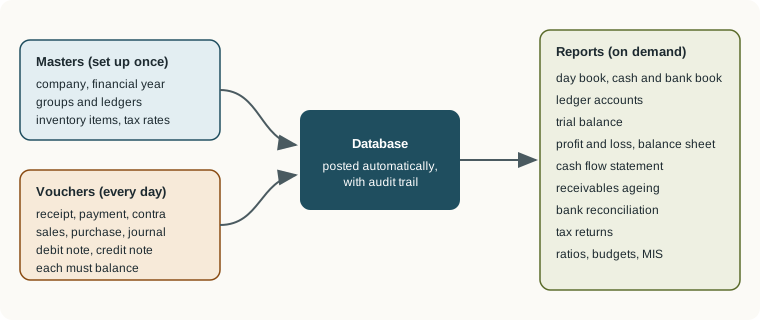
Masters are the standing data, entered once and changed rarely: the company's name and financial year, the groups and ledger accounts (with opening balances), customers and suppliers with their credit terms, inventory items, and tax rates.
Vouchers are the transactions, entered daily. Each voucher type corresponds to a book of original entry of Chapter 4:
| Voucher type | Used for | Manual equivalent |
|---|---|---|
| Receipt | Money received in cash or bank | Debit side of the cash book |
| Payment | Money paid in cash or by bank | Credit side of the cash book |
| Contra | Transfers between cash and bank | Contra entries |
| Sales | Credit (and cash) sales of goods | Sales book |
| Purchase | Credit (and cash) purchases of goods | Purchases book |
| Credit note | Goods returned by customers, allowances | Sales returns book |
| Debit note | Goods returned to suppliers | Purchases returns book |
| Journal | Adjustments, depreciation, rectification, other non-cash items | Journal proper |
Table 14.2. Voucher types and their manual equivalents.
Reports are produced from the posted data whenever needed: the day book, the cash and bank book, any ledger account, the trial balance, the profit and loss account and balance sheet, the cash flow statement, the ageing of receivables (how long each customer's balance has been outstanding), stock summaries, and the statements needed for tax returns.
Features that support the earlier chapters
- Bank reconciliation. The bank statement is imported or entered, and cleared items are matched with the cash book; the unmatched items are exactly the timing differences of Chapter 5.
- Fixed asset register. Assets are recorded with cost, date and rate, and depreciation is computed and posted (Chapter 7).
- Credit control. Ageing reports and reminders support the estimate of doubtful debts.
- Tax. Sales and purchase vouchers carry tax rates, and the tax accounts and returns are prepared from them (Chapter 4).
14.4 Spreadsheets
Many small businesses, and many accountants for analysis, use spreadsheets. A spreadsheet is not an accounting system (it does not stop unbalanced entries or keep an audit trail unless designed to), but it is an excellent tool for understanding one.
Example 14.1 A trial balance with spreadsheet formulas
Suppose the journal of Sharma Electricals (Example 3.1) is typed into a sheet named Journal, one entry per row: column A the date, column B the account debited, column C the account credited, column D the amount (rows 2 to 15). A second sheet, TB, lists the account names in column A from row 2. The formulas are:
B2  (net balance)  =SUMIF(Journal!$B$2:$B$15,A2,Journal!$D$2:$D$15)-SUMIF(Journal!$C$2:$C$15,A2,Journal!$D$2:$D$15)
C2  (debit)        =IF(B2>0,B2,0)
D2  (credit)       =IF(B2<0,-B2,0)
C15 (total debit)  =SUM(C2:C14)
D15 (total credit) =SUM(D2:D14)
E15 (check)        =IF(C15=D15,"Agrees","Does not agree")
The first formula adds every amount debited to the account and subtracts every amount credited to it, which is exactly what posting and balancing do. Copied down for the thirteen accounts, the sheet reproduces the trial balance of Example 3.4: total debits ₹3,03,000 and total credits ₹3,03,000.
14.5 A small program
The heart of any accounting program is short. The Python program below holds the vouchers of Sharma Electricals, refuses any voucher whose debits and credits differ, posts them to a ledger and prints the trial balance.
Example 14.2 Posting vouchers and printing a trial balance in Python
from collections import defaultdict

# Each voucher: (date, [(account, debit, credit), ...])
vouchers = [
    ("2025-04-01", [("Cash", 200000, 0), ("Capital", 0, 200000)]),
    ("2025-04-02", [("Bank", 120000, 0), ("Cash", 0, 120000)]),
    ("2025-04-03", [("Purchases", 80000, 0), ("Mehta & Co", 0, 80000)]),
    ("2025-04-05", [("Office Equipment", 30000, 0), ("Bank", 0, 30000)]),
    ("2025-04-08", [("Gupta Stores", 45000, 0), ("Sales", 0, 45000)]),
    ("2025-04-10", [("Cash", 25000, 0), ("Sales", 0, 25000)]),
    ("2025-04-12", [("Mehta & Co", 50000, 0), ("Bank", 0, 50000)]),
    ("2025-04-15", [("Cash", 30000, 0), ("Gupta Stores", 0, 30000)]),
    ("2025-04-18", [("Purchases", 12000, 0), ("Cash", 0, 12000)]),
    ("2025-04-20", [("Rent", 8000, 0), ("Cash", 0, 8000)]),
    ("2025-04-25", [("Drawings", 4000, 0), ("Cash", 0, 4000)]),
    ("2025-04-28", [("Cash", 3000, 0), ("Commission Received", 0, 3000)]),
    ("2025-04-30", [("Salaries", 10000, 0), ("Bank", 0, 10000)]),
    ("2025-04-30", [("Electricity", 2000, 0), ("Cash", 0, 2000)]),
]

def post(vouchers):
    """Post balanced vouchers to a ledger; a positive balance is a debit."""
    ledger = defaultdict(int)
    for date, lines in vouchers:
        dr = sum(d for _, d, _ in lines)
        cr = sum(c for _, _, c in lines)
        if dr != cr:                       # the software refuses an unbalanced voucher
            raise ValueError(f"Voucher of {date} does not balance: {dr} vs {cr}")
        for account, d, c in lines:
            ledger[account] += d - c
    return ledger

ledger = post(vouchers)
total_dr = total_cr = 0
print(f"{'Account':<22}{'Debit':>10}{'Credit':>10}")
for account, bal in ledger.items():
    dr, cr = (bal, 0) if bal > 0 else (0, -bal)
    total_dr += dr
    total_cr += cr
    print(f"{account:<22}{dr or '':>10}{cr or '':>10}")
print(f"{'Total':<22}{total_dr:>10}{total_cr:>10}")
Its output is the trial balance of Example 3.4:
Account                    Debit    Credit
Cash                      112000
Capital                             200000
Bank                       30000
Purchases                  92000
Mehta & Co                           30000
Office Equipment           30000
Gupta Stores               15000
Sales                                70000
Rent                        8000
Drawings                    4000
Commission Received                   3000
Salaries                   10000
Electricity                 2000
Total                     303000    303000
A voucher such as ("2025-05-01", [("Cash", 5000, 0), ("Sales", 0, 4500)]) is rejected with the message "Voucher of 2025-05-01 does not balance: 5000 vs 4500". Because every voucher must balance before it is posted, the trial balance of a computerised system always agrees; that is why, in software, the trial balance stops being a useful check on arithmetic, and the review of what was posted becomes all the more important.
14.6 Controls in a computerised system
Computerisation removes some risks and creates others: one careless or dishonest user can now change many records at once, and a single failure can destroy all the data. Good systems include:
- Access controls. Each user has a password and a role, and can see and do only what the role requires. A sales clerk can enter sales vouchers but not alter the bank ledger.
- Segregation of duties. No one person should be able to authorise a payment, record it and reconcile the bank account; dividing these tasks makes fraud harder.
- Authorisation and approval. Vouchers above a limit, or of certain kinds (write-offs, credit notes), need approval by a second person.
- Audit trail (edit log). The system records who entered or changed each transaction, when, and what the old and new values were, and the log cannot be switched off or altered. Company law in some countries, including India, now requires the accounting software used by companies to maintain such an audit trail.
- Period locking. Once a period has been closed and reported, it is locked so that entries cannot be back-dated into it without authorisation.
- Validation checks. The software rejects unbalanced vouchers, invalid dates and unknown account codes, and warns about unusual entries (a credit balance in cash, a duplicate invoice number).
- Backups and recovery. Data is copied regularly to a secure separate location, and the restore process is tested.
- Regular reconciliation and review. Bank reconciliations, confirmations from customers and suppliers, physical counts of inventory and review of unusual journal entries catch what validation cannot.
Caution
A balanced trial balance from software proves nothing about the correctness of the accounts. The errors that matter in a computerised system are those of principle, omission, wrong classification and wrong cut-off, plus deliberate manipulation. These are found only by review, reconciliation and audit.
14.7 Why ethics matters in accounting
Financial statements are used by people who cannot check them for themselves: investors, lenders, employees, the government. They rely on the people who prepare and audit them to act honestly and competently. When that trust fails, the damage spreads far beyond one business: investors lose savings, employees lose jobs, lenders lose money, and confidence in all financial reporting falls. Many of the rules of company law, the accounting standards and the audit profession were tightened after such failures.
Accounting also offers many opportunities for choice: estimates of useful lives and doubtful debts, the timing of revenue, the classification of an item as capital or revenue. Most of these choices are legitimate; the duty of the accountant is to make them honestly, so that the statements are a faithful representation (Chapter 1), not a picture that suits the preparer.
The fundamental principles
The international code of ethics for professional accountants, issued by the International Ethics Standards Board for Accountants (IESBA) and adopted, with modifications, by many national professional bodies including those in India, sets out five fundamental principles:
| Principle | What it requires |
|---|---|
| Integrity | Be straightforward and honest in all professional and business relationships; do not be associated with information you believe to be false or misleading |
| Objectivity | Do not allow bias, conflict of interest or undue influence of others to override professional judgement |
| Professional competence and due care | Keep knowledge and skill at the level required, and act diligently in accordance with applicable standards |
| Confidentiality | Respect the confidentiality of information acquired through professional work; do not disclose it without proper authority unless there is a legal or professional right or duty to do so, and do not use it for personal advantage |
| Professional behaviour | Comply with laws and regulations and avoid any conduct that discredits the profession |
Table 14.3. The fundamental principles of professional ethics.
Threats and safeguards
The same code groups the circumstances that can undermine these principles into categories of threats:
- Self-interest: a financial or other interest will inappropriately influence judgement (an accountant whose bonus depends on reported profit).
- Self-review: an accountant will not appropriately evaluate work that he or she did earlier (auditing a system one designed).
- Advocacy: an accountant promotes a client's or employer's position to the point that objectivity is compromised.
- Familiarity: a long or close relationship makes an accountant too sympathetic to the interests of others or too accepting of their work.
- Intimidation: an accountant is deterred from acting objectively by actual or perceived pressure, including threats of dismissal.
Safeguards reduce threats to an acceptable level: independent review by another person, rotation of staff, separating duties, clear policies, board audit committees, and, ultimately, refusing or withdrawing from the work.
14.8 Window dressing and earnings management
Window dressing means arranging transactions around the year end so that the financial statements look better than the underlying position. Earnings management means using the choices available in accounting, or the timing of transactions, to report a desired profit. Some timing choices are ordinary business decisions; the line is crossed when the purpose or effect is to mislead users. Recording sales that have not happened, or that belong to the next period, is plainly wrong.
Example 14.3 The effect of window dressing on reported figures
(a) Dressing the current ratio. On 30 March a company's current assets are ₹4,00,000 (including bank ₹1,80,000) and its current liabilities ₹2,50,000. On 31 March it pays ₹1,50,000 of trade payables from the bank, intending to buy on credit again in April.
| Before payment | After payment | |
|---|---|---|
| Current assets (₹) | 4,00,000 | 2,50,000 |
| Current liabilities (₹) | 2,50,000 | 1,00,000 |
| Current ratio | 1.6:1 | 2.5:1 |
Paying a genuine debt is not wrong in itself, but a ratio of 2.5 at the year end suggests far more liquidity than the business usually has. A reader who knows the trick looks at the cash flow statement and at the ratio during the year, not only at the year end.
(b) Bringing forward revenue. A business with a profit of ₹2,00,000 for 2025-26 records in March goods invoiced for ₹60,000 (cost ₹40,000) that are not dispatched until April.
| Correct | With early recording | |
|---|---|---|
| Profit for 2025-26 (₹) | 2,00,000 | 2,20,000 |
| Effect on 2026-27 profit (₹) | — | 20,000 lower |
| Trade receivables at 31 March (₹) | unaffected | 60,000 higher |
| Inventory at 31 March (₹) | unaffected | 40,000 lower |
Profit is overstated by ₹20,000 (10%) this year and understated by the same amount next year. Revenue recognition rules (Chapter 1) forbid this: the sale is not complete until control of the goods passes to the customer.
Example 14.4 Ethical dilemmas
Case 1. An accounts assistant is told by the sales manager to record next month's sales in this month "to meet the target", and is reminded that her contract is up for renewal. Threats: self-interest and intimidation. Principles at stake: integrity and objectivity. A proper response: decline, explain that the entry would breach revenue recognition, and if the pressure continues, raise it with a more senior person, the finance head or the audit committee, keeping a written record.
Case 2. An accountant preparing a client's accounts notices that a large debtor has gone into insolvency, but the client refuses to make any provision because "the bank must not see a loss". Principle at stake: integrity (being associated with misleading information) and professional competence (applying the standards). A proper response: explain that a provision is required by prudence and the standards; if the client refuses, decline to be associated with the statements.
Case 3. A friend asks an accountant whether a listed company she audits is about to report a large loss. Principle at stake: confidentiality. A proper response: refuse; using or passing on such information would also breach the law on insider trading.
14.9 Summary
Summary
- Software automates posting, balancing and reporting; it does not make accounting judgements. Errors of principle, omission and cut-off, and deliberate misstatements, pass through it.
- A coded chart of accounts, organised in groups that match the financial statements, is the foundation of a computerised system. Masters are standing data; vouchers are transactions; reports are produced on demand.
- A trial balance can be built with spreadsheet formulas (SUMIF of debits minus credits) or with a short program that rejects unbalanced vouchers.
- Controls include access controls, segregation of duties, authorisation, an unalterable audit trail, period locking, validation, backups and regular reconciliation.
- The fundamental ethical principles are integrity, objectivity, professional competence and due care, confidentiality and professional behaviour; the main threats are self-interest, self-review, advocacy, familiarity and intimidation.
- Window dressing and earnings management can flatter ratios and profit; they are detected by looking beyond year-end figures and are wrong when they mislead.
14.10 Exercises
Exercise 1
Assign each account to a group of the chart of accounts in Table 14.1 and suggest a code: (a) discount received; (b) delivery van; (c) outstanding salaries; (d) carriage inwards; (e) advertisement; (f) drawings.
Answer
(a) Revenue, for example 4600; (b) Assets, for example 1520 (with accumulated depreciation 1525); (c) Liabilities, for example 2110; (d) Cost of sales, 5100 in the table; (e) Operating expenses, for example 6200; (f) Capital, 3020 in the table.
Exercise 2
Name the voucher type used for: (a) cash withdrawn from the bank for office use; (b) depreciation for the year; (c) goods returned by a customer; (d) rent paid by cheque; (e) a credit sale.
Answer
(a) contra; (b) journal; (c) credit note; (d) payment; (e) sales.
Exercise 3
In the spreadsheet of Example 14.1, what would the formula in B2 return for Gupta Stores, and why?
Answer
15,000. Gupta Stores was debited ₹45,000 (the credit sale) and credited ₹30,000 (cash received), so the formula gives 45,000 − 30,000 = 15,000, a positive figure, which appears in the debit column.
Exercise 4
The accountant of a small firm authorises supplier payments, makes the payments through internet banking and prepares the monthly bank reconciliation. What control weakness does this show, and how could it be reduced?
Answer
There is no segregation of duties: one person could create a false supplier, pay it and hide the payment in the reconciliation. The owner (or a second person) should approve payments and review or prepare the bank reconciliation, and supplier master data should be changed only by someone other than the person who pays.
Exercise 5
A firm has current assets of ₹3,00,000 and current liabilities of ₹2,00,000. On the last day of the year it takes a 15-day bank loan of ₹1,00,000, keeping the money in its bank account. What happens to the current ratio? Is the loan a current or non-current liability?
Answer
The loan is repayable within a year, so it is a current liability. Current assets become ₹4,00,000 and current liabilities ₹3,00,000: the ratio falls from 1.5 to 1.33. (Borrowing short-term and holding the cash lowers a ratio that is above 1; window dressing usually does the opposite, paying off current liabilities.)
Exercise 6
Identify the ethical principle and threat: an auditor has audited the same company for twelve years and is a close friend of its finance director.
Answer
The threat is familiarity: the long and close relationship may make the auditor too accepting of the finance director's work. The principle at risk is objectivity. Safeguards include rotating the audit partner and having the work reviewed by another partner.
14.11 Quiz
Check your understanding of Chapter 14
Exercise 1
Which kind of error is most likely to remain in a computerised accounting system?
- An error in casting a total
- A posting to one side only
- An error of principle
- A wrong balance carried down
Answer
An error of principle
Exercise 2
Transfers between cash and bank are entered in software as a
- journal voucher
- contra voucher
- sales voucher
- debit note
Answer
contra voucher
Exercise 3
A record of who entered or changed each transaction, and when, is called
- a chart of accounts
- an audit trail
- a trial balance
- a master
Answer
an audit trail
Exercise 4
Which is one of the five fundamental principles of professional ethics?
- Profitability
- Confidentiality
- Conservatism
- Materiality
Answer
Confidentiality
Exercise 5
Match each situation with the threat it creates.
| A | B |
|---|---|
| Bonus depends on reported profit | intimidation |
| Auditing a system you designed | familiarity |
| Threat of dismissal | self-interest |
| Twelve years with the same client | self-review |
Answer
Bonus depends on reported profit — self-interest; Auditing a system you designed — self-review; Threat of dismissal — intimidation; Twelve years with the same client — familiarity
Exercise 6
Current assets ₹5,00,000 and current liabilities ₹3,00,000. A creditor of ₹1,00,000 is paid from the bank on the last day. What is the new current ratio? (write as a number, e.g. 1.5)
Answer
2 / 2.0 / 2:1
(5,00,000 − 1,00,000) ÷ (3,00,000 − 1,00,000) = 4,00,000 ÷ 2,00,000 = 2.