Chapter 11: Company Accounts
Share capital, the issue and forfeiture of shares, debentures, and the format of a company's financial statements
Learning outcomes
After studying this chapter you should be able to:
- Describe the main features of a company and how its accounts differ from those of a sole trader or partnership.
- Explain the categories of share capital and the kinds of shares.
- Journalise the issue of shares at par and at a premium, payable in instalments, including over-subscription.
- Journalise the forfeiture and reissue of shares.
- Distinguish debentures from shares and record their issue.
- Present a company's balance sheet and statement of profit and loss in the vertical format, with notes on share capital and reserves.
11.1 The company
A company is an association of persons formed and registered under company law. Its main features are:
- Separate legal entity. The company is a legal person distinct from its members. It owns property, makes contracts, sues and is sued in its own name. The business entity concept of Chapter 1 is, for a company, a fact of law.
- Limited liability. In a company limited by shares, a member's liability is limited to the amount unpaid on his shares. If the company fails, its creditors cannot reach the members' private property.
- Perpetual succession. The company continues to exist whatever happens to its members; shares change hands, members die, but the company goes on until it is wound up according to law.
- Transferable shares. The shares of a public company are, in general, freely transferable; those of a private company are subject to restrictions in its articles.
- Separation of ownership and management. The members (shareholders) own the company, but it is managed by a board of directors whom they elect. This separation is why company accounts are so closely regulated: the owners depend on accounts prepared by the managers.
Companies may be private or public, and public companies may be listed on a stock exchange. Company law requires every company to keep proper books of account, to prepare financial statements in a prescribed form that give a true and fair view and comply with the notified accounting standards, to have them audited, and to file them with the registrar. Listed companies have further disclosure duties under securities regulation. The details of these requirements change from time to time; this chapter describes them in general terms.
The ledger of a company is kept by the same double-entry rules as any other. What is distinctive is the owners' side of the balance sheet. Instead of a single capital account per owner, there is share capital, divided into many units called shares, and the profits kept in the business are shown separately as reserves and surplus.
11.2 Share capital
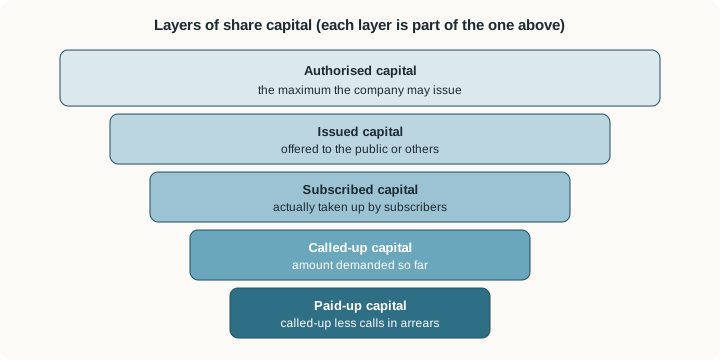
The capital of a company is divided into shares of a fixed amount, called the nominal (face or par) value, such as ₹10 or ₹100 each. Share capital is described at several levels:
- Authorised (nominal or registered) capital: the maximum amount of share capital the company is permitted to issue, as stated in its memorandum of association. It can be increased by following the procedure laid down in law.
- Issued capital: the part of the authorised capital that has been offered for subscription.
- Subscribed capital: the part of the issued capital that has actually been taken up (applied for and allotted).
- Called-up capital: the part of the subscribed capital that the company has asked shareholders to pay so far.
- Paid-up capital: the part of the called-up capital that shareholders have actually paid. The amount called up but not paid is calls in arrears; it is deducted from called-up capital.
Any part of subscribed capital not yet called is uncalled capital. A company may decide that part of its uncalled capital will be called only in the event of winding up; this is reserve capital.
Kinds of shares
- Preference shares carry a preferential right to a dividend at a fixed rate, and to repayment of capital on winding up, before the equity shareholders. They may be cumulative (unpaid dividends accumulate and must be paid before any equity dividend) or non-cumulative; participating (sharing in surplus profits beyond the fixed dividend) or non-participating; redeemable (repaid after a period) or irredeemable as the law permits; convertible into equity shares or not.
- Equity shares are all shares that are not preference shares. Equity shareholders bear the residual risk: they receive dividends only after preference dividends, and capital only after all creditors and preference shareholders have been paid. In return, they have voting rights and the benefit of all remaining profits.
11.3 The issue of shares
A company invites the public (or a selected group) to subscribe for shares, receives applications with application money, allots shares to the applicants (asking for allotment money), and later makes one or more calls for the balance. The amounts payable on application, on allotment and on each call are stated in the offer.
Shares may be issued:
- at par, at their nominal value;
- at a premium, at more than their nominal value. The premium is not share capital; it is credited to a separate Securities Premium Account, which company law allows to be used only for specified purposes, such as issuing fully paid bonus shares, writing off preliminary expenses or the expenses and discount of issues of shares and debentures, and buying back the company's own shares.
- at a discount, below nominal value. Company law generally prohibits this, apart from limited exceptions; it is not dealt with here.
The accounts used in the books of the company are: Share Application Account, Share Allotment Account, Share First Call Account (and further call accounts), Share Capital Account, Securities Premium Account, and Bank. The application, allotment and call accounts are temporary accounts that collect the amounts due and received; each should be closed when all money has been received.
| Event | Entry |
|---|---|
| Application money received | Bank Dr; To Share Application A/c |
| Shares allotted: application money transferred | Share Application A/c Dr; To Share Capital A/c |
| Allotment money due | Share Allotment A/c Dr; To Share Capital A/c (and To Securities Premium A/c for any premium) |
| Allotment money received | Bank Dr; To Share Allotment A/c |
| Call money due | Share Call A/c Dr; To Share Capital A/c |
| Call money received | Bank Dr; To Share Call A/c |
Table 11.1. Entries for an issue of shares payable in instalments.
11.4 Forfeiture and reissue
If a shareholder fails to pay an allotment or call, the directors may, after due notice and as the articles permit, forfeit the shares: the shareholder loses the shares and the money already paid on them. On forfeiture:
- Share Capital Account is debited with the amount called up on the forfeited shares (not their full nominal value, unless fully called);
- the allotment or call accounts are credited with the amounts unpaid;
- Share Forfeiture (Forfeited Shares) Account is credited with the amount already received on those shares;
- if the shares were issued at a premium and the premium has not been received, Securities Premium Account is debited with the unpaid premium; a premium already received is not touched.
Forfeited shares may be reissued at any price, but the price, plus the amount already credited to Share Forfeiture Account for them, must at least equal the amount credited to share capital as paid up. Any discount on reissue is debited to Share Forfeiture Account. After reissue, the balance remaining in Share Forfeiture Account on the reissued shares is a capital profit and is transferred to Capital Reserve.
Example 11.1 Issue at a premium, forfeiture and reissue
Sunrise Ltd has an authorised capital of ₹10,00,000 in equity shares of ₹10 each. It issues 50,000 equity shares at ₹12 per share (a premium of ₹2), payable:
| Instalment | Per share |
|---|---|
| On application | ₹3 |
| On allotment (including the premium of ₹2) | ₹5 |
| On first and final call | ₹4 |
| Total | ₹12 |
Applications were received for exactly 50,000 shares, and all were allotted. All money was received except the call on 1,000 shares held by Dev. These shares were forfeited and later reissued to Esha at ₹9 per share as fully paid.
Journal of Sunrise Ltd
| Particulars | Dr (₹) | Cr (₹) |
|---|---|---|
| Bank A/c ... Dr | 1,50,000 | |
| To Equity Share Application A/c | 1,50,000 | |
| (Being application money received on 50,000 shares at ₹3) | ||
| Equity Share Application A/c ... Dr | 1,50,000 | |
| To Equity Share Capital A/c | 1,50,000 | |
| (Being application money transferred to share capital on allotment) | ||
| Equity Share Allotment A/c ... Dr | 2,50,000 | |
| To Equity Share Capital A/c | 1,50,000 | |
| To Securities Premium A/c | 1,00,000 | |
| (Being allotment money due at ₹5, of which ₹2 is premium) | ||
| Bank A/c ... Dr | 2,50,000 | |
| To Equity Share Allotment A/c | 2,50,000 | |
| (Being allotment money received) | ||
| Equity Share First and Final Call A/c ... Dr | 2,00,000 | |
| To Equity Share Capital A/c | 2,00,000 | |
| (Being first and final call due at ₹4) | ||
| Bank A/c ... Dr | 1,96,000 | |
| To Equity Share First and Final Call A/c | 1,96,000 | |
| (Being call money received on 49,000 shares) | ||
| Equity Share Capital A/c ... Dr | 10,000 | |
| To Equity Share First and Final Call A/c | 4,000 | |
| To Share Forfeiture A/c | 6,000 | |
| (Being 1,000 shares forfeited for non-payment of the call; ₹6 per share received, excluding premium) | ||
| Bank A/c ... Dr | 9,000 | |
| Share Forfeiture A/c ... Dr | 1,000 | |
| To Equity Share Capital A/c | 10,000 | |
| (Being 1,000 forfeited shares reissued at ₹9 as fully paid) | ||
| Share Forfeiture A/c ... Dr | 5,000 | |
| To Capital Reserve A/c | 5,000 | |
| (Being the profit on reissue of forfeited shares transferred to capital reserve) |
Workings. Dev paid ₹3 on application and ₹5 on allotment, of which ₹2 was premium; so ₹6 per share was credited to share capital and is now forfeited: 1,000 × 6 = ₹6,000. The premium he paid stays in Securities Premium Account. On reissue at ₹9, the discount of ₹1 per share (₹1,000) is met from the forfeiture; the remaining ₹5,000 is a capital profit.
Equity Share Capital Account
| Particulars | ₹ | Particulars | ₹ |
|---|---|---|---|
| To Share Forfeiture A/c (Dev) | 10,000 | By Equity Share Application A/c | 1,50,000 |
| To Balance c/d | 5,00,000 | By Equity Share Allotment A/c | 1,50,000 |
| By First and Final Call A/c | 2,00,000 | ||
| By Bank and Share Forfeiture (reissue) | 10,000 | ||
| Total | 5,10,000 | Total | 5,10,000 |
Check of cash. Received: 1,50,000 + 2,50,000 + 1,96,000 + 9,000 = ₹6,05,000. This equals share capital ₹5,00,000 + securities premium ₹1,00,000 + capital reserve ₹5,000.
Over-subscription
When applications exceed the shares offered, the directors may reject some applications outright (refunding their money), allot shares pro rata (in proportion) to the rest, or combine the two. Excess application money from applicants who receive fewer shares than they applied for is usually kept and adjusted towards the allotment money due from them, with any amount beyond that refunded.
Example 11.2 Pro-rata allotment
Suppose Sunrise Ltd had received applications for 60,000 shares and allotted the 50,000 shares pro rata to all applicants. Application money received = 60,000 × ₹3 = ₹1,80,000. Of this, 50,000 × ₹3 = ₹1,50,000 is needed on application; the excess of ₹30,000 is adjusted towards allotment.
| Particulars | Dr (₹) | Cr (₹) |
|---|---|---|
| Bank A/c ... Dr | 1,80,000 | |
| To Equity Share Application A/c | 1,80,000 | |
| Equity Share Application A/c ... Dr | 1,80,000 | |
| To Equity Share Capital A/c | 1,50,000 | |
| To Equity Share Allotment A/c | 30,000 | |
| (Being application money transferred, the excess adjusted towards allotment) |
Allotment due is still ₹2,50,000, but only 2,50,000 − 30,000 = ₹2,20,000 is now to be received in cash.
11.5 Debentures
A company may borrow long-term money by issuing debentures (or bonds): written acknowledgements of a debt, usually carrying a fixed rate of interest and repayable on a stated date. Debenture holders are creditors of the company, not owners.
| Point | Shares | Debentures |
|---|---|---|
| Status of holder | Owner (member) | Creditor |
| Return | Dividend, out of profits, at the directors' recommendation | Interest at a fixed rate, payable whether or not there is a profit |
| In the accounts | Share capital, part of shareholders' funds | Long-term borrowing (non-current liability) |
| Return as an expense | Dividend is an appropriation of profit | Interest is a charge against profit (finance cost) |
| Voting rights | Equity shares carry votes | No votes |
| Security | Unsecured | Often secured on the company's assets |
| On winding up | Repaid after all creditors | Repaid before shareholders |
Table 11.2. Shares and debentures compared.
The issue of debentures at par for cash is recorded as: Bank Dr; To ..% Debentures A/c. Interest is debited to Debenture Interest Account and charged to the statement of profit and loss as a finance cost.
11.6 The financial statements of a company
Company law prescribes the form and content of a company's balance sheet and statement of profit and loss (in India, in a schedule to the Companies Act, 2013, with separate divisions for companies following Ind AS and those following the other Accounting Standards). The financial statements of a company include:
- a balance sheet at the end of the year;
- a statement of profit and loss for the year;
- a cash flow statement for the year (Chapter 12), subject to exemptions for certain small companies;
- a statement of changes in equity, where applicable (for companies following Ind AS);
- notes, including the significant accounting policies and the details behind the figures on the face of the statements.
Both main statements are presented in vertical form, with figures for the current and the previous year side by side, and with the details placed in numbered notes. The outline below follows the general structure for companies that do not follow Ind AS; companies following Ind AS use similar headings with some differences in terms (for example, "Equity" with "Equity share capital" and "Other equity" in place of "Shareholders' funds").
Balance sheet: main headings
| Heading | Main sub-headings |
|---|---|
| I. Equity and liabilities | |
| 1. Shareholders' funds | Share capital; Reserves and surplus |
| 2. Non-current liabilities | Long-term borrowings (debentures, term loans); Long-term provisions |
| 3. Current liabilities | Short-term borrowings; Trade payables; Other current liabilities; Short-term provisions |
| II. Assets | |
| 1. Non-current assets | Property, plant and equipment; Intangible assets; Non-current investments; Long-term loans and advances |
| 2. Current assets | Current investments; Inventories; Trade receivables; Cash and cash equivalents; Short-term loans and advances; Other current assets |
Table 11.3. Headings of a company balance sheet (outline).
Statement of profit and loss: main lines
| Line | Content |
|---|---|
| I. Revenue from operations | Sales of goods and services |
| II. Other income | Interest, dividends, rent, profit on sale of assets |
| III. Total income | I + II |
| IV. Expenses | Cost of materials consumed; purchases of stock-in-trade; changes in inventories; employee benefits expense; finance costs; depreciation and amortisation expense; other expenses |
| V. Profit before tax | III − IV (after exceptional items, if any) |
| VI. Tax expense | Current tax; deferred tax |
| VII. Profit for the period | V − VI |
| VIII. Earnings per share | Basic and diluted |
Table 11.4. Lines of the statement of profit and loss (outline).
Example 11.3 Financial statements of Sunrise Ltd
The following are the summarised figures of Sunrise Ltd for the year ended 31 March 2027, the year after the share issue of Example 11.1. The surplus in the statement of profit and loss was nil at 1 April 2026. Opening inventory was ₹1,00,000. The company has 10% debentures of ₹2,00,000. The directors transferred ₹10,000 to general reserve.
Statement of Profit and Loss of Sunrise Ltd for the year ended 31 March 2027
| Particulars | Note | ₹ |
|---|---|---|
| I. Revenue from operations | 12,00,000 | |
| II. Other income | 20,000 | |
| III. Total income | 12,20,000 | |
| IV. Expenses | ||
| Purchases of stock-in-trade | 7,50,000 | |
| Changes in inventories (1,00,000 − 1,10,000) | (10,000) | |
| Employee benefits expense | 1,60,000 | |
| Finance costs (10% on ₹2,00,000 debentures) | 20,000 | |
| Depreciation expense | 60,000 | |
| Other expenses | 1,20,000 | |
| Total expenses | 11,00,000 | |
| V. Profit before tax (III − IV) | 1,20,000 | |
| VI. Tax expense | 30,000 | |
| VII. Profit for the year | 90,000 | |
| VIII. Earnings per equity share (₹90,000 ÷ 50,000 shares) | ₹1.80 |
The change in inventories is negative because inventory increased: of the goods bought, ₹10,000 more than was sold remains in stock, so the cost of goods sold is 7,50,000 − 10,000 = ₹7,40,000.
Balance Sheet of Sunrise Ltd as at 31 March 2027
| Particulars | Note | ₹ |
|---|---|---|
| I. Equity and liabilities | ||
| 1. Shareholders' funds | ||
| (a) Share capital | 1 | 5,00,000 |
| (b) Reserves and surplus | 2 | 1,95,000 |
| 2. Non-current liabilities | ||
| Long-term borrowings (10% debentures) | 2,00,000 | |
| 3. Current liabilities | ||
| (a) Trade payables | 80,000 | |
| (b) Short-term provisions (provision for tax) | 25,000 | |
| Total | 10,00,000 | |
| II. Assets | ||
| 1. Non-current assets | ||
| (a) Property, plant and equipment | 6,20,000 | |
| (b) Non-current investments | 80,000 | |
| 2. Current assets | ||
| (a) Inventories | 1,10,000 | |
| (b) Trade receivables | 95,000 | |
| (c) Cash and cash equivalents | 85,000 | |
| (d) Short-term loans and advances | 10,000 | |
| Total | 10,00,000 |
Note 1: Share capital
| Particulars | ₹ |
|---|---|
| Authorised: 1,00,000 equity shares of ₹10 each | 10,00,000 |
| Issued, subscribed and fully paid up: 50,000 equity shares of ₹10 each | 5,00,000 |
Note 2: Reserves and surplus
| Particulars | ₹ |
|---|---|
| Securities premium | 1,00,000 |
| Capital reserve (on reissue of forfeited shares) | 5,000 |
| General reserve: transferred during the year | 10,000 |
| Surplus in statement of profit and loss: opening nil + profit 90,000 − transfer to general reserve 10,000 | 80,000 |
| Total | 1,95,000 |
Checks. Equity and liabilities: 5,00,000 + 1,95,000 + 2,00,000 + 80,000 + 25,000 = ₹10,00,000. Assets: 6,20,000 + 80,000 + 1,10,000 + 95,000 + 85,000 + 10,000 = ₹10,00,000. Total expenses: 7,50,000 − 10,000 + 1,60,000 + 20,000 + 60,000 + 1,20,000 = ₹11,00,000.
Note
Dividends declared to shareholders are an appropriation of profit, not an expense. A dividend proposed by the directors after the year end, and not yet approved by the shareholders, is under current standards disclosed in the notes rather than provided for in the balance sheet. The rules on the declaration of dividends (out of what profits, after what transfers) are set by company law.
11.7 Summary
Summary
- A company is a separate legal entity with limited liability, perpetual succession and transferable shares, managed by directors on behalf of shareholders; its accounts are regulated by company law and standards.
- Share capital is authorised, issued, subscribed, called-up and paid-up; calls in arrears are deducted from called-up capital. Shares are equity or preference.
- Application, allotment and call accounts collect the money due on shares; a premium is credited to Securities Premium Account, whose uses are restricted by law.
- On forfeiture, share capital is debited with the amount called up, unpaid calls are credited, and the amount received is credited to Share Forfeiture Account. On reissue, any discount is met from the forfeiture balance, and the remaining balance on reissued shares goes to Capital Reserve.
- Debentures are borrowings; their interest is a charge against profit.
- A company presents a vertical balance sheet (shareholders' funds, non-current liabilities, current liabilities; non-current and current assets) and a statement of profit and loss ending in profit for the period and earnings per share, with details in notes.
11.8 Exercises
Exercise 1
A company has an authorised capital of 2,00,000 equity shares of ₹10 each. It issued 1,20,000 shares, of which 1,00,000 were subscribed. ₹8 per share has been called up, and one shareholder holding 2,000 shares has not paid the last call of ₹2. Show how share capital appears in the note to the balance sheet.
Answer
| Particulars | ₹ |
|---|---|
| Authorised: 2,00,000 equity shares of ₹10 each | 20,00,000 |
| Issued: 1,20,000 equity shares of ₹10 each | 12,00,000 |
| Subscribed and not fully paid: 1,00,000 equity shares of ₹10 each, ₹8 called up | 8,00,000 |
| Less: Calls in arrears (2,000 × ₹2) | 4,000 |
| Paid-up capital | 7,96,000 |
Exercise 2
Moon Ltd issued 20,000 equity shares of ₹10 each at par, payable ₹4 on application, ₹4 on allotment and ₹2 on first and final call. All shares were applied for and allotted, and all money was received. Journalise.
Answer
| Particulars | Dr (₹) | Cr (₹) |
|---|---|---|
| Bank A/c ... Dr | 80,000 | |
| To Share Application A/c | 80,000 | |
| Share Application A/c ... Dr | 80,000 | |
| To Share Capital A/c | 80,000 | |
| Share Allotment A/c ... Dr | 80,000 | |
| To Share Capital A/c | 80,000 | |
| Bank A/c ... Dr | 80,000 | |
| To Share Allotment A/c | 80,000 | |
| Share First and Final Call A/c ... Dr | 40,000 | |
| To Share Capital A/c | 40,000 | |
| Bank A/c ... Dr | 40,000 | |
| To Share First and Final Call A/c | 40,000 |
Share capital = 20,000 × ₹10 = ₹2,00,000.
Exercise 3
Shares of ₹10 each were issued at par, payable ₹3 on application, ₹4 on allotment and ₹3 on call. A holder of 200 shares paid only the application money. His shares were forfeited after the call and reissued at ₹8 per share as fully paid. Journalise the forfeiture and reissue, and find the amount transferred to capital reserve.
Answer
| Particulars | Dr (₹) | Cr (₹) |
|---|---|---|
| Share Capital A/c (200 × ₹10) ... Dr | 2,000 | |
| To Share Allotment A/c (200 × ₹4) | 800 | |
| To Share Call A/c (200 × ₹3) | 600 | |
| To Share Forfeiture A/c (200 × ₹3) | 600 | |
| Bank A/c (200 × ₹8) ... Dr | 1,600 | |
| Share Forfeiture A/c (200 × ₹2) ... Dr | 400 | |
| To Share Capital A/c | 2,000 | |
| Share Forfeiture A/c ... Dr | 200 | |
| To Capital Reserve A/c | 200 |
Capital reserve = forfeited 600 − discount on reissue 400 = ₹200.
Exercise 4
Under which heading of a company balance sheet is each shown? (a) 9% debentures repayable in 2032; (b) securities premium; (c) bills payable due in two months; (d) patents; (e) stock of finished goods; (f) provision for tax.
Answer
(a) Non-current liabilities: long-term borrowings; (b) shareholders' funds: reserves and surplus; (c) current liabilities: trade payables; (d) non-current assets: intangible assets; (e) current assets: inventories; (f) current liabilities: short-term provisions.
Exercise 5
Why is the premium received on an issue of shares not treated as profit available for dividend?
Answer
The premium is part of the capital contributed by shareholders, not a profit earned from operations. Treating it as distributable profit would return capital to shareholders in the guise of dividends, to the detriment of creditors who rely on the company's capital. Company law therefore requires it to be kept in Securities Premium Account and used only for specified capital purposes.
Exercise 6
A company's profit after tax is ₹12,60,000. It has 4,20,000 equity shares and no preference shares. Find its earnings per share. How would the answer change if it also had preference shares with an annual dividend of ₹1,50,000?
Answer
EPS = 12,60,000 ÷ 4,20,000 = ₹3.00. With preference shares, the preference dividend is deducted first: (12,60,000 − 1,50,000) ÷ 4,20,000 = 11,10,000 ÷ 4,20,000 = ₹2.64 (to two decimals).
11.9 Quiz
Check your understanding of Chapter 11
Exercise 1
The maximum share capital a company may issue is its
- issued capital
- authorised capital
- paid-up capital
- called-up capital
Answer
authorised capital
Exercise 2
The premium received on the issue of shares is credited to
- Share Capital Account
- Securities Premium Account
- Statement of Profit and Loss
- Capital Reserve Account
Answer
Securities Premium Account
Exercise 3
500 shares of ₹10 each, ₹7 called up, are forfeited; the holder had paid ₹4 per share. How much is credited to Share Forfeiture Account, in rupees?
Answer
2000 / 2,000 / ₹2,000
500 × ₹4 received = 2,000.
Exercise 4
Interest on debentures is
- an appropriation of profit
- a charge against profit
- paid only if there is a profit
Answer
a charge against profit
Exercise 5
In a company balance sheet, trade payables are shown under
- shareholders' funds
- non-current liabilities
- current liabilities
Answer
current liabilities
Exercise 6
Profit for the year ₹4,50,000; 3,00,000 equity shares; no preference shares. What is the EPS in rupees?
Answer
1.50 / 1.5 / ₹1.50