Chapter 11: Amending the Constitution and the Basic Structure
How the Constitution is changed, the limits on that power, and the amendments that shaped it
Learning outcomes
When you have finished this chapter you should be able to:
- explain why a constitution needs a procedure for amendment, and why India's is described as partly rigid and partly flexible;
- describe the procedure of Article 368 step by step;
- classify proposed changes according to the three methods of amendment;
- trace the conflict between Parliament and the Supreme Court over the amending power, from Shankari Prasad to Minerva Mills;
- explain the basic structure doctrine and list the elements the courts have recognised;
- identify the most important amendments and what each did;
- weigh the main arguments for and against the basic structure doctrine.
11.1 Why constitutions change
A constitution is meant to last, but no generation can foresee every need of the generations after it. A constitution that cannot be changed may break; one that can be changed too easily offers no protection. Every constitution must strike a balance between stability and adaptability.
Constitutions are often classified by how easily they can be changed. A flexible constitution, like the British, can be changed by the ordinary process of law-making. A rigid constitution, like the American, can be changed only by a special procedure; the United States Constitution needs the approval of two-thirds of each House of Congress and three-quarters of the states, and has been amended fewer than thirty times.
The framers of the Indian Constitution chose a middle course. Jawaharlal Nehru told the Constituent Assembly that while the framers wanted the Constitution to be as solid and permanent as they could make it, there was no permanence in constitutions, and a certain flexibility was needed to allow the nation to grow. The result is a Constitution that can be amended by Parliament with a special majority, with the States joining in for provisions that affect the federal structure. It has been amended far more often than the American Constitution: 106 amendments had been made by 2023 (check the official text for any later ones).
11.2 The procedure under Article 368
Article 368, in Part XX, gives Parliament the power to amend the Constitution "by way of addition, variation or repeal of any provision", and lays down the procedure.
- A bill to amend the Constitution can be introduced only in Parliament, in either House. It cannot be introduced in a State legislature.
- It may be introduced by a minister or by a private member, and does not need the prior permission of the President.
- It must be passed in each House by a special majority: a majority of the total membership of the House and a majority of not less than two-thirds of the members present and voting.
- Each House must pass it separately. There is no joint sitting for a constitutional amendment bill if the Houses disagree.
- If the bill seeks to amend certain federal provisions, it must also be ratified by the legislatures of not less than half of the States, by resolutions passed by a simple majority. No time limit is fixed for ratification.
- The bill is then presented to the President, who must give assent (since the 24th Amendment, 1971). The President can neither withhold assent nor return the bill.
- The bill then becomes a Constitution (Amendment) Act, and the Constitution stands amended.
Worked example 11.1: Counting votes for an amendment
Situation. A constitutional amendment bill is put to the vote in the Rajya Sabha, which has a total membership of 245 (no vacancies). 200 members are present and voting; 140 vote in favour and 60 against. Is the bill passed in the Rajya Sabha?
Answer. Two conditions must both be satisfied. (1) A majority of the total membership: more than half of 245, that is at least 123. 140 is more than 123, so this is met. (2) Two-thirds of those present and voting: \(\tfrac{2}{3} \times 200 = 133.3\), so at least 134. 140 is more than 134, so this is met too. The bill is passed in the Rajya Sabha. (Had 210 members been present and voting with 140 in favour, condition (2) would have needed 140, and the bill would just pass; with 211 present it would need 141 and fail.)
11.3 Three methods of amendment
Although Article 368 describes one procedure, the Constitution in fact provides for three methods, shown in Figure 11.1.
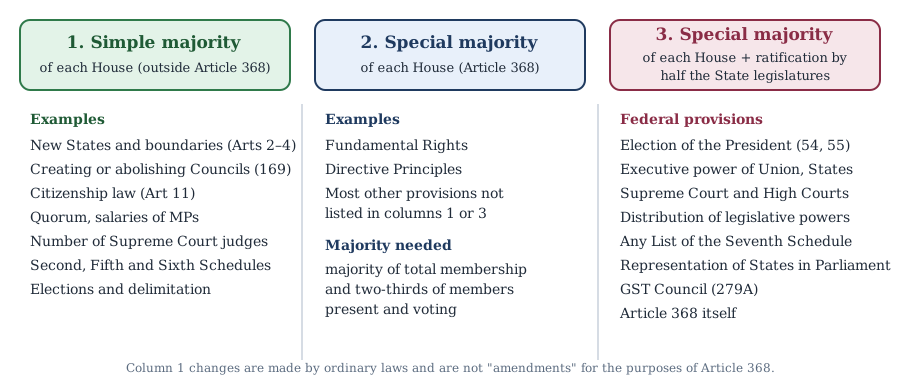
1. By a simple majority of Parliament
Several provisions can be changed by an ordinary law passed by a simple majority of each House. The Constitution itself says that such laws are not amendments for the purposes of Article 368. Examples include:
- admission or establishment of new States, and the formation of new States or alteration of areas, boundaries or names of existing States (Articles 2 to 4);
- creation or abolition of Legislative Councils in the States (Article 169);
- the Second Schedule (emoluments of the President, Governors, judges and others);
- quorum in Parliament, salaries and allowances of members, rules of procedure and privileges;
- the number of judges of the Supreme Court and the conferment of additional jurisdiction on it;
- the acquisition and termination of citizenship (Article 11);
- elections to Parliament and the State legislatures, and delimitation of constituencies;
- administration of the Union Territories, and the Fifth and Sixth Schedules.
2. By a special majority of Parliament
Most provisions, including the Fundamental Rights and the Directive Principles, are amended by the special majority of each House described in section 11.2, without ratification by the States.
3. By a special majority and ratification by the States
Provisions that concern the federal structure need, in addition, ratification by half of the State legislatures. The proviso to Article 368(2) lists them:
- the election of the President and its manner (Articles 54 and 55);
- the extent of the executive power of the Union and the States (Articles 73 and 162), and the High Courts for Union Territories (Article 241);
- the Goods and Services Tax Council (Article 279A, added in 2016);
- the Supreme Court and the High Courts (Chapter IV of Part V and Chapter V of Part VI);
- the distribution of legislative powers between the Union and the States (Chapter I of Part XI);
- any of the Lists in the Seventh Schedule;
- the representation of States in Parliament;
- the provisions of Article 368 itself.
Worked example 11.2: Which procedure?
Name the method needed for each change.
- Changing the name of a State.
- Adding a new Fundamental Right.
- Moving a subject from the State List to the Concurrent List.
- Increasing the number of judges of the Supreme Court.
- Changing the method of electing the President.
Answers. (1) Simple majority, by a law under Article 3 (with the President's recommendation and reference to the State legislature for its views); by Article 4 it is not an amendment. (2) Special majority of each House under Article 368. (3) Special majority and ratification by half the States, because it changes a List of the Seventh Schedule; the 42nd Amendment's transfer of five subjects in 1976 was ratified in this way. (4) Simple majority, by a law under Article 124(1). (5) Special majority and ratification, since Articles 54 and 55 are in the proviso.
11.4 Parliament, the courts and the amending power
Article 368 says how the Constitution may be amended. It does not say, in so many words, whether there are any limits on what may be amended. Could Parliament, by the special majority, take away Fundamental Rights altogether? Abolish judicial review? Replace the republic with a monarchy? For a quarter of a century this question was the centre of a struggle between Parliament and the Supreme Court.
First phase: unlimited power (1951–1967)
In Shankari Prasad v. Union of India (1951), the Supreme Court upheld the 1st Amendment, which had curtailed the right to property. It held that the word "law" in Article 13, which forbids laws that take away Fundamental Rights, refers to ordinary legislation, not to constitutional amendments. Parliament could therefore amend Part III. The Court took the same view in Sajjan Singh v. State of Rajasthan (1965), upholding the 17th Amendment, although two judges expressed doubts.
Second phase: no amendment of Fundamental Rights (1967–1973)
In Golaknath v. State of Punjab (1967), a bench of eleven judges held, by six to five, that a constitutional amendment is "law" under Article 13, and that Parliament therefore cannot amend Fundamental Rights so as to take away or abridge them. To avoid upsetting earlier amendments, the Court applied its ruling only to future amendments (a doctrine called prospective overruling).
Parliament responded with the 24th Amendment (1971), which declared that Parliament may amend any provision of the Constitution, including Fundamental Rights, under Article 368; that Article 13 does not apply to constitutional amendments (Article 13(4)); and that the President must give assent to an amendment bill. The 25th Amendment (1971) curtailed the right to property further and added Article 31C (Chapter 4).
Third phase: the basic structure (1973 onwards)
The validity of these amendments came before the largest bench in the Court's history: thirteen judges, in Kesavananda Bharati v. State of Kerala, decided on 24 April 1973. By a majority of seven to six, the Court held:
- Golaknath was overruled: Parliament can amend any part of the Constitution, including Fundamental Rights; the 24th Amendment was valid;
- but the power to amend is not a power to destroy: Parliament cannot alter the basic structure (or basic features, or framework) of the Constitution;
- the first part of Article 31C was valid, but the second part, which barred courts from examining whether a law actually gave effect to Article 39(b) and (c), was invalid.
The judges in the majority gave different examples of basic features, and the Court did not attempt a complete list. But the principle was clear: an amendment that damaged or destroyed the basic structure would be void.
Key idea
Kesavananda Bharati (1973) is the most important case in Indian constitutional law. Parliament can amend every part of the Constitution, but it cannot amend away its basic structure. The courts decide, case by case, what the basic structure includes.
The doctrine tested
The doctrine was soon applied. In Indira Nehru Gandhi v. Raj Narain (1975), the Court struck down a clause of the 39th Amendment that had placed disputes about the election of the Prime Minister and the Speaker beyond the reach of the courts and validated a disputed election. It held that free and fair elections and judicial review were part of the basic structure.
Parliament responded again. The 42nd Amendment (1976) added clauses (4) and (5) to Article 368, declaring that no amendment could be called in question in any court on any ground, and that there was no limitation whatever on Parliament's constituent power.
In Minerva Mills v. Union of India (1980), the Court struck down both clauses. It held that:
- limited amending power is itself a basic feature: since Parliament's power is limited, it cannot convert it into an unlimited power by amendment;
- judicial review is a basic feature;
- the harmony and balance between Fundamental Rights and Directive Principles is a basic feature, so the 42nd Amendment's extension of Article 31C to all Directive Principles was invalid.
In Waman Rao v. Union of India (1981), the Court held that the basic structure doctrine applies only to amendments made after 24 April 1973, the date of Kesavananda. Amendments before that date, and laws placed in the Ninth Schedule before that date, are not open to challenge on this ground. I. R. Coelho (2007) later confirmed that laws added to the Ninth Schedule after that date can be tested against the basic structure.
| Case | Year | Bench | Holding on the amending power |
|---|---|---|---|
| Shankari Prasad | 1951 | 5 | Parliament can amend Fundamental Rights; amendment is not "law" under Article 13 |
| Sajjan Singh | 1965 | 5 | Same, by majority |
| Golaknath | 1967 | 11 | Parliament cannot abridge Fundamental Rights (6:5) |
| Kesavananda Bharati | 1973 | 13 | Parliament can amend any part, but not the basic structure (7:6) |
| Indira Nehru Gandhi v. Raj Narain | 1975 | 5 | Free and fair elections and judicial review are basic |
| Minerva Mills | 1980 | 5 | Limited amending power, judicial review and balance of Parts III and IV are basic |
| Waman Rao | 1981 | 5 | Doctrine applies to amendments after 24 April 1973 |
Table 11.1. The amending power in the Supreme Court.
11.5 What is the basic structure?
The Supreme Court has never given an exhaustive list. Over the years, it has recognised a number of features as part of the basic structure, including:
- the supremacy of the Constitution;
- the sovereign, democratic and republican form of government;
- the secular character of the Constitution (S. R. Bommai, 1994);
- the federal character of the Constitution (S. R. Bommai, 1994);
- the separation of powers among the legislature, the executive and the judiciary;
- the unity and integrity of the nation;
- the rule of law and the principle of equality;
- the freedom and dignity of the individual;
- the parliamentary system of government;
- free and fair elections (Indira Nehru Gandhi, 1975);
- judicial review, including the powers of the High Courts under Articles 226 and 227 (Minerva Mills, 1980; L. Chandra Kumar, 1997) and of the Supreme Court under Article 32;
- the independence of the judiciary (Fourth Judges case, 2015);
- limited amending power (Minerva Mills, 1980);
- the harmony and balance between Fundamental Rights and Directive Principles (Minerva Mills, 1980);
- the welfare state and the objective of social and economic justice.
The doctrine has been used to strike down a constitutional amendment only rarely. The most notable recent example is the 99th Amendment (2014), establishing the National Judicial Appointments Commission, which was struck down in 2015 as violating judicial independence. In other cases the Court has upheld amendments against basic structure challenges; for example, in Janhit Abhiyan (2022) the majority held that the 103rd Amendment's reservation for economically weaker sections did not violate the basic structure.
Worked example 11.3: Applying the doctrine
Situation. Suppose Parliament, with the special majority and the ratification of half the States, passed an amendment providing that elections to the Lok Sabha would be held only once every fifteen years and that no court could hear any challenge to the result of an election. Would it survive?
Answer. Almost certainly not. The provision on fifteen-year intervals would undermine democracy and free and fair elections, which are part of the basic structure; and excluding all judicial challenge to election results is very close to the provision struck down in Indira Nehru Gandhi v. Raj Narain (1975), which also offends judicial review. Following the special procedure, even with State ratification, does not save an amendment that damages the basic structure. The test is not the procedure followed but the effect of the change on the identity of the Constitution.
11.6 Amendments that shaped the Constitution
Most amendments make modest, technical changes. A small number have reshaped the Constitution. The table lists those met most often in this book.
| Amendment (year) | Main changes |
|---|---|
| 1st (1951) | Added Article 15(4), Articles 31A and 31B and the Ninth Schedule; added grounds of restriction on speech (public order, friendly relations with foreign States, incitement to an offence) |
| 7th (1956) | Reorganised the States on linguistic lines; abolished Part A, B, C and D States; allowed one Governor for two or more States |
| 24th (1971) | Affirmed Parliament's power to amend any part, including Fundamental Rights; made the President's assent compulsory |
| 25th (1971) | Replaced "compensation" with "amount" for acquisition of property; added Article 31C |
| 26th (1971) | Abolished the privy purses and privileges of former rulers |
| 36th (1975) | Made Sikkim a full State |
| 42nd (1976) | Added "socialist", "secular" and "integrity" to the Preamble; Fundamental Duties; five subjects moved to the Concurrent List; ministerial advice made binding on the President; tribunals; new Directive Principles; Article 368(4) and (5) (later struck down); many other changes, which led to its being called a "mini-constitution" |
| 44th (1978) | Removed the right to property from Part III (Article 300A); emergency safeguards; Articles 20 and 21 not to be suspended; President may return ministerial advice once; restored many provisions changed in 1976 |
| 52nd (1985) | Anti-defection law (Tenth Schedule) |
| 61st (1988) | Lowered the voting age from 21 to 18 |
| 69th (1991) | Special provisions for Delhi (Article 239AA) |
| 73rd and 74th (1992) | Panchayats and municipalities (Parts IX and IXA; Eleventh and Twelfth Schedules) |
| 86th (2002) | Right to education (Article 21A); new Article 45; Fundamental Duty (k) |
| 91st (2003) | Size of Councils of Ministers limited to 15 per cent; split exception removed from the Tenth Schedule |
| 97th (2011) | Co-operative societies: Article 19(1)(c), Article 43B and Part IXB |
| 99th (2014) | National Judicial Appointments Commission (struck down in 2015) |
| 100th (2015) | Land boundary agreement with Bangladesh |
| 101st (2016) | Goods and Services Tax and the GST Council |
| 102nd (2018) | Constitutional status for the National Commission for Backward Classes (Article 338B) |
| 103rd (2019) | Reservation for economically weaker sections (Articles 15(6), 16(6)) |
| 104th (2019) | Extended reservation of seats for SCs and STs in legislatures to 2030; ended nomination of Anglo-Indians |
| 105th (2021) | Restored the power of States to identify socially and educationally backward classes |
| 106th (2023) | One-third of seats in the Lok Sabha and State Assemblies reserved for women, after the next delimitation |
Table 11.2. Some important amendments.
Part IXB and the States
The 97th Amendment (2011) added Part IXB on co-operative societies. In 2021, the Supreme Court held that the parts of Part IXB dealing with co-operative societies within a State were invalid, because the amendment affected a State List subject and had not been ratified by half the State legislatures as the proviso to Article 368(2) requires. The provisions relating to multi-State co-operative societies survived. The case shows that the ratification requirement is enforced.
11.7 Assessing the basic structure doctrine
The basic structure doctrine is not written in the Constitution; it is a creation of the Supreme Court. It has been both praised and criticised.
Arguments against the doctrine.
- It allows unelected judges to override the considered will of the people's representatives, expressed by a large special majority and sometimes with the approval of the States.
- It is vague: since there is no complete list of basic features, Parliament cannot know in advance what it may and may not do.
- It is not found in the text of Article 368, which speaks of amending "any provision".
Arguments for the doctrine.
- It protects the identity of the Constitution: the power to "amend" implies that the Constitution should survive the amendment, not be replaced by a different one.
- It guards against the abuse of temporary majorities, as the experience of 1975–77 showed: without it, Parliament could have amended away elections, rights and judicial review.
- In practice, the Court has used it sparingly, upholding the great majority of amendments, and it has gained wide acceptance. Courts in some other countries have adopted similar reasoning.
A balanced view is that the doctrine is a form of constitutional self-defence. It leaves Parliament very wide power to adapt the Constitution, as more than a hundred amendments show, while denying it the power to destroy the democratic, federal, secular and rights-based framework on which everything else rests.
Summary
- Article 368 (Part XX) lets Parliament amend the Constitution by special majority of each House: a majority of total membership and two-thirds of those present and voting. Bills start only in Parliament, in either House; there is no joint sitting; the President must assent.
- There are three methods: simple majority (for matters outside Article 368, such as new States and citizenship), special majority (most provisions), and special majority with ratification by half the States (federal provisions listed in the proviso to Article 368(2)).
- The courts first held the amending power unlimited (Shankari Prasad, 1951; Sajjan Singh, 1965), then held that Fundamental Rights could not be abridged (Golaknath, 1967). Parliament replied with the 24th Amendment (1971).
- Kesavananda Bharati (1973) held that Parliament can amend any part but not the basic structure; Indira Nehru Gandhi (1975), Minerva Mills (1980) and Waman Rao (1981) developed the doctrine.
- Recognised basic features include supremacy of the Constitution, democracy, secularism, federalism, separation of powers, rule of law, free and fair elections, judicial review, independence of the judiciary and limited amending power.
- Major amendments include the 1st, 7th, 24th, 42nd, 44th, 52nd, 61st, 73rd, 74th, 86th, 101st, 103rd and 106th.
11.8 Exercises
Exercise 1
State four features of the procedure under Article 368 that distinguish an amendment bill from an ordinary bill.
Answer
Any four of: it can be introduced only in Parliament, not in a State legislature; it needs a special majority in each House (majority of total membership and two-thirds of those present and voting); there is no joint sitting if the Houses disagree; it may need ratification by half the States; it needs no prior recommendation of the President; the President must give assent and cannot return it.
Exercise 2
Which of the following require ratification by half the States? (a) An amendment to Article 21; (b) an amendment to the Union List; (c) an amendment to Article 368; (d) an amendment to Article 44.
Answer
(b) and (c). Amendments to Article 21 (a Fundamental Right) and Article 44 (a Directive Principle) need only the special majority of each House.
Exercise 3
What did Golaknath (1967) decide, and how did Parliament respond?
Answer
By six to five, an eleven-judge bench held that a constitutional amendment is "law" under Article 13, so Parliament cannot take away or abridge Fundamental Rights, though it applied this only prospectively. Parliament responded with the 24th Amendment (1971), which declared that Parliament can amend any part of the Constitution including Part III, that Article 13 does not apply to amendments, and that the President must assent to amendment bills.
Exercise 4
Why is 24 April 1973 an important date?
Answer
It is the date of the judgment in Kesavananda Bharati, which established the basic structure doctrine. Under Waman Rao (1981) and I. R. Coelho (2007), amendments made, and laws placed in the Ninth Schedule, after that date can be challenged for violating the basic structure.
Exercise 5
Name the case and the amendment involved in each: (a) striking down clauses (4) and (5) of Article 368; (b) striking down the National Judicial Appointments Commission.
Answer
(a) Minerva Mills (1980), the 42nd Amendment. (b) The Fourth Judges case, Supreme Court Advocates-on-Record Association v. Union of India (2015), the 99th Amendment.
Exercise 6
Give one argument for and one against the basic structure doctrine.
Answer
For (any one): it preserves the identity of the Constitution and protects democracy, rights and judicial review against temporary majorities, as 1975–77 showed; it has been applied sparingly. Against (any one): it lets unelected judges override a large elected majority; it is vague and not found in the text of Article 368.
11.9 Quiz
Check yourself: amendment and the basic structure
Exercise 1
In which Part of the Constitution is Article 368?
- Part XV
- Part XVIII
- Part XX
- Part XXII
Answer
Part XX
Exercise 2
How many judges decided Kesavananda Bharati?
- 7
- 9
- 11
- 13
Answer
13
Exercise 3
Which amendment made it compulsory for the President to give assent to a constitutional amendment bill?
- 1st
- 24th
- 42nd
- 44th
Answer
24th
Exercise 4
Which case held that limited amending power is itself part of the basic structure?
- Golaknath
- Indira Nehru Gandhi v. Raj Narain
- Minerva Mills
- Waman Rao
Answer
Minerva Mills
Exercise 5
Which amendment lowered the voting age from 21 to 18?
- 42nd
- 52nd
- 61st
- 73rd
Answer
61st
Exercise 6
Can a joint sitting be held if the two Houses disagree on a constitutional amendment bill?
- True
- False
- Only with the President's permission
- Only for federal provisions
Answer
False
Exercise 7
Match each amendment with its subject.
| A | B |
|---|---|
| 52nd | Right to education |
| 101st | Reservation of seats for women |
| 86th | Anti-defection |
| 106th | Goods and Services Tax |
Answer
52nd — Anti-defection; 101st — Goods and Services Tax; 86th — Right to education; 106th — Reservation of seats for women