Chapter 14: The Constitution in Practice
Separation of powers, conventions, citizens and the debates that keep the Constitution alive
Learning outcomes
When you have finished this chapter you should be able to:
- explain why the working Constitution is more than its text, and name the sources that shape it;
- describe the separation of powers in India and the checks and balances among the three organs;
- give examples of constitutional conventions and explain the idea of constitutional morality;
- use the main tools available to citizens: the vote, the Right to Information, grievance and court remedies, and participation in local government;
- set out, in a balanced way, the main debates about the working of the Constitution;
- analyse a new constitutional problem step by step, using the whole book.
14.1 A living document
The previous thirteen chapters described what the Constitution says and how the courts have read it. But a constitution in practice is more than its text. When the Constitution came into force in 1950, nobody knew exactly how the President and the Prime Minister would get on, how far the courts would go in protecting rights, or how much the Centre would leave to the States. These questions were answered over decades, by a combination of four things:
- The text, amended more than a hundred times.
- Judicial interpretation, which has given meaning to broad phrases such as "personal liberty", "equality before the law" and "the basic structure".
- Conventions: unwritten rules of political practice that are followed because they are regarded as binding.
- Political practice and public opinion: how governments, parties, officials and citizens actually behave.
The Constitution has survived wars, the assassination of national leaders, an emergency, many changes of government at the Centre and in the States, and great social and economic change. Every transfer of power at the Centre since 1950 has taken place through elections and parliamentary procedure. This is a considerable achievement, and it is worth asking what has made it possible, and what continues to test it.
14.2 Separation of powers and checks and balances
The doctrine of the separation of powers, associated with the French philosopher Montesquieu, holds that the three functions of government, making laws, carrying them out and judging disputes under them, should be given to separate organs, so that no single body has all power. In its strictest form, as in the United States, the three organs are separate in personnel as well as in function.
India does not follow the doctrine rigidly. In a parliamentary system the executive is drawn from the legislature and responsible to it, so the two are fused rather than separated. The Supreme Court observed in Ram Jawaya Kapur v. State of Punjab (1955) that the Constitution does not recognise the doctrine in its absolute rigidity, but that the functions of the different organs have been sufficiently differentiated, and one organ should not assume the essential functions of another. The judiciary, at least, is kept separate: Article 50 directs the State to separate the judiciary from the executive, and judicial independence is part of the basic structure. In Indira Nehru Gandhi v. Raj Narain (1975) and later cases, the separation of powers itself was recognised as a basic feature.
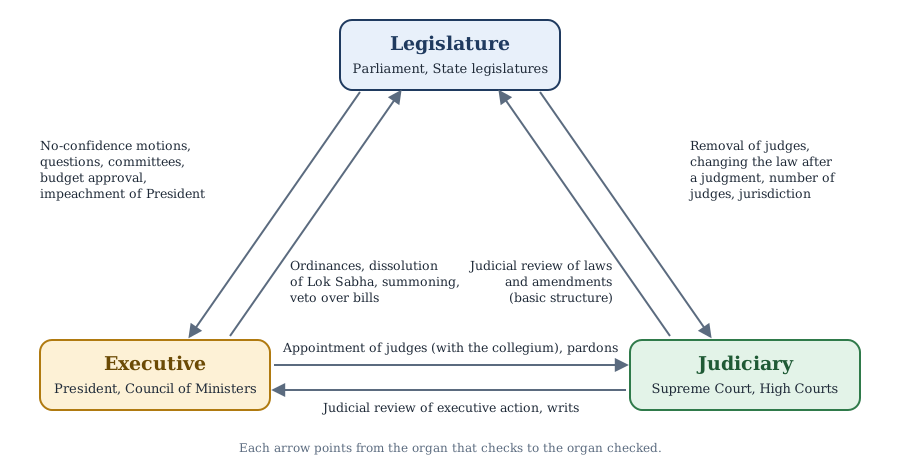
What India has, instead of a strict separation, is a system of checks and balances, in which each organ can limit the others. Figure 14.1 shows the main checks.
Key idea
India combines a fusion of the legislature and the executive (the parliamentary system) with a separate and independent judiciary that reviews both. No organ is supreme: Parliament is limited by the Constitution and judicial review; the courts are limited by the procedure for removal, by Parliament's power to change the law, and by their own self-restraint; the executive is limited by both.
Worked example 14.1: A judgment and a response
Situation. The Supreme Court interprets a statute in a way the government considers contrary to its policy. What constitutional responses are available, and what limits apply?
Answer. (1) If the judgment interprets an ordinary law, Parliament can amend the law to change its effect for the future (and sometimes retrospectively), provided the new law is within its competence and does not violate Fundamental Rights. It cannot simply declare the judgment void; it must change the legal basis on which the judgment rested. (2) If the judgment rests on the Constitution itself, Parliament can amend the Constitution by the procedure of Article 368, but the amendment will be reviewed against the basic structure. (3) The government may also seek a review of the judgment, or ask for a reference to a larger bench. These responses have all been used at different times. The relationship is one of dialogue, not of one organ simply overruling the other.
14.3 Conventions and constitutional morality
Conventions
A constitutional convention is an unwritten rule of political behaviour that is generally followed because those concerned regard it as binding, even though no court would enforce it directly. Conventions fill gaps in the text and adapt it to circumstances. Examples in India include:
- the President invites the leader of the party or coalition with a majority in the Lok Sabha to be Prime Minister;
- the President acts on the advice of the Council of Ministers (now also required by Article 74);
- the chairman of the Public Accounts Committee is from the opposition;
- the Speaker, once elected, conducts the House impartially;
- the Governor of a State is from outside that State, and the Chief Minister is consulted on the appointment;
- the senior-most judge of the Supreme Court is appointed Chief Justice of India.
Conventions are only as strong as the willingness of political actors to observe them. Some have been broken at times, which has led to calls for them to be written into law or the Constitution.
Constitutional morality
In the Constituent Assembly, Dr Ambedkar drew attention to the idea of constitutional morality, a phrase he took from the historian George Grote. He meant a habit of respect for the forms of the Constitution and for the limits it places on power, combined with freedom of criticism. Such a habit, he warned, is not natural; it has to be cultivated, and a democratic constitution can be undermined without changing its text if those who work it do not have it.
In recent decades the Supreme Court has used the phrase in a somewhat wider sense: the duty of the State to act according to the values of the Constitution (dignity, equality, liberty and fraternity), even where these conflict with prevailing social attitudes. Both senses point to the same truth: the Constitution depends on the conduct and values of those who work it, not only on its words.
14.4 The citizen and the Constitution
The Constitution is not only for governments and judges. It gives every citizen tools to take part in government and to defend their rights.
| Tool | What it allows | Where it comes from |
|---|---|---|
| The vote | Choosing representatives at every level, and removing them at the next election | Articles 325, 326; Representation of the People Acts |
| Right to Information | Obtaining information held by public authorities | Right to Information Act, 2005; Article 19(1)(a) |
| Writ petitions and PIL | Going to the High Court or Supreme Court when rights are violated, including on behalf of others who cannot | Articles 32, 226 |
| Gram Sabha and ward committees | Taking part directly in local planning and oversight | Articles 243A, 243S |
| Commissions and ombudsmen | Complaints to human rights commissions, the commissions for SCs, STs and Backward Classes, the Lokpal and Lokayuktas | Constitution and statutes (Chapter 12) |
| Free legal aid and Lok Adalats | Access to justice for those who cannot afford it; quick settlement of disputes | Article 39A; Legal Services Authorities Act, 1987 |
| Free speech, assembly and association | Criticising the government, organising and protesting peacefully | Article 19(1)(a)–(c) |
Table 14.1. A citizen's constitutional toolkit.
Worked example 14.2: Asking a question of the government
Situation. Meena wants to know how much her municipality spent on repairing the roads in her ward last year, and which contractors were paid.
Answer. Under the Right to Information Act, 2005, she may write to the Public Information Officer of the municipality, stating the information she wants; she need not give reasons. A reply is due within 30 days (48 hours where the information concerns the life or liberty of a person). If she receives no reply or an unsatisfactory one, she may file a first appeal with a senior officer of the municipality, and after that a second appeal or complaint to the State Information Commission. The Commission can order disclosure and impose penalties on officers who refuse information without reasonable cause. If the information reveals irregularities, she can raise them in the ward committee, with her elected councillor, with the State's audit authorities or, in serious cases, before the courts or anti-corruption bodies. This is the toolkit of Table 14.1 in action.
14.5 Debates about the working of the Constitution
A study of the Constitution would be incomplete without the debates that surround its working. The following are among the most discussed. In each case there are serious arguments on more than one side, and the aim here is to state them, not to decide them.
- The role of Governors. Governors are appointed by the Centre and hold office at its pleasure. Some States have complained that Governors have delayed assent to bills, intervened in the formation of governments, or acted as agents of the Union government. Others argue that the Governor's role as a link between the Centre and the States is an essential part of the federal design. The Sarkaria and Punchhi Commissions, S. R. Bommai and B. P. Singhal have all tried to define limits (Chapters 8, 9 and 10).
- Federal balance. States seek more financial autonomy and a larger say in national policy; the Union stresses the need for national standards and unity. GST and the GST Council, the Finance Commissions' devolution and NITI Aayog are all part of this debate.
- Judicial appointments and accountability. The collegium system protects judicial independence but has been criticised for lack of transparency; the attempt to replace it with the National Judicial Appointments Commission was struck down in 2015 (Chapter 7). Pendency of cases is a separate and pressing problem.
- Anti-defection law and the presiding officers. The Tenth Schedule has curbed frequent defections, but critics say it has reduced the independence of individual legislators, and the decisions of presiding officers on defection petitions have sometimes been delayed or contested (Chapter 6).
- Ordinances. The power to make ordinances is meant for urgent situations when the legislature is not in session. Its frequent use, and re-promulgation, has been criticised by the Supreme Court (Chapter 5).
- The functioning of Parliament. Observers and parliamentary research groups have noted fewer sitting days, frequent disruptions and a smaller share of bills referred to committees than in earlier decades. Others point to the continued vitality of question time, committee reports and debate on major issues.
- Reservation. The extent and basis of reservation (caste, economic criteria, the 50 per cent ceiling, sub-classification within groups) continue to be debated, in Parliament and in the courts (Chapter 3).
- Liberty and security. Laws on preventive detention, sedition-type offences and unlawful activities raise questions about the balance between national security and personal liberty, a balance the Constitution leaves to Parliament subject to judicial review.
Avoid one-sided answers
Examination questions on these debates often ask you to "critically examine" or "discuss". A good answer states the constitutional provisions, the relevant cases, the arguments on each side, and a reasoned conclusion. It does not treat any political party or government as simply right or wrong.
14.6 The framers' warnings
On 25 November 1949, the day before the Constitution was adopted, Dr Ambedkar made a speech in the Constituent Assembly that is still often quoted. He offered three warnings.
- Hold fast to constitutional methods. Now that the people had a democratic constitution, he argued, methods such as civil disobedience and non-cooperation, justified under foreign rule, should give way to constitutional methods of seeking change; otherwise disorder would follow.
- Beware of hero-worship. He warned against laying the people's liberties at the feet of any individual, however great. Gratitude to great leaders was natural, but devotion to a person in politics, he said, was a sure road to degradation and dictatorship.
- Make political democracy a social democracy. The Constitution gave every citizen one vote and one value, but Indian society remained deeply unequal. Ambedkar observed that India was "going to enter into a life of contradictions": political equality alongside social and economic inequality. Unless the contradiction was removed, he warned, those who suffered from inequality would one day blow up the structure of political democracy.
These warnings explain why the Constitution contains not only the machinery of government but also Directive Principles, reservations, the abolition of untouchability and the protection of the weaker sections. Seventy-five years on, they remain a useful test for judging how the Constitution is working.
14.7 Analysing a constitutional problem
The best way to consolidate what you have learnt is to use it. Faced with any new question ("Can the government do this?" "Is this law valid?"), work through a sequence of steps that draws on the whole book.
- Who is acting? The Union or a State? The legislature, the executive or a local body? (Chapters 5, 6, 9)
- Do they have the power? For a law: which list of the Seventh Schedule does it fall in, by pith and substance? For an executive act: is there a law or constitutional provision authorising it? (Chapter 8)
- Was the right procedure followed? The right majority, the right House, the President's or Governor's assent, consultation where required. (Chapters 6, 11)
- Does it violate a Fundamental Right? If it restricts a right, is the restriction on a permitted ground, by law, reasonable and proportionate? (Chapter 3)
- What do the Directive Principles and Fundamental Duties say? They may support the law's reasonableness. (Chapter 4)
- If it is a constitutional amendment, does it touch the basic structure? (Chapter 11)
- What remedy is available, and before which forum? Writs under Articles 32 or 226, a commission, an election petition, or political means. (Chapters 3, 7, 12, 13)
Worked example 14.3: A ban on single-use plastic
Situation. A State legislature passes a law banning the manufacture, sale and use of certain single-use plastic items in the State, with fines for violation. A manufacturer challenges it.
Answer. Work through the steps.
- Who is acting? A State legislature.
- Power. In pith and substance, the law concerns public health and sanitation, which is in the State List (and may also touch trade within the State). The State therefore has competence, even if the law incidentally affects trade and industry. If Parliament has made a law or rules on the same subject (for example, under the Environment (Protection) Act, 1986, made under Article 253), the court will examine whether the two can stand together, and whether any part of the State law is repugnant to Union law.
- Procedure. Passed by the legislature and assented to by the Governor; no special procedure appears to be needed.
- Fundamental Rights. The law restricts the manufacturer's freedom to carry on trade under Article 19(1)(g). Restrictions are permitted under Article 19(6) in the interests of the general public. The court will ask whether the ban is reasonable and proportionate: does it serve a legitimate aim (protecting health and the environment), is it suited to that aim, are less restrictive means available, and is a reasonable time allowed for compliance? Under Article 14, it will check that the items banned are chosen on an intelligible basis connected with the aim.
- Directive Principles and Duties. Article 48A (protection of the environment) and Article 47 (public health), together with the citizen's duty under Article 51A(g), support the reasonableness of the law.
- Basic structure. Not relevant: this is an ordinary law, not an amendment.
- Remedy. The manufacturer may file a writ petition in the High Court under Article 226, alleging violation of Article 19(1)(g) and lack of competence.
Likely result. If the ban is properly framed, gives notice and is not arbitrary in the items it covers, it is likely to be upheld as a reasonable restriction in the public interest. This conclusion depends on the facts; the method is what matters.
Summary
- The working Constitution is shaped by its text, judicial interpretation, conventions and political practice. Its endurance since 1950, through many crises and changes of government, is a significant achievement.
- India does not follow a rigid separation of powers: the executive and legislature are fused in the parliamentary system, while the judiciary is separate and independent. Each organ checks the others.
- Conventions fill gaps in the text; constitutional morality, the habit of respecting constitutional limits, is necessary for the Constitution to work.
- Citizens have a constitutional toolkit: the vote, the Right to Information, writ petitions and PIL, participation in Gram Sabhas and ward committees, commissions and ombudsmen, legal aid and Lok Adalats, and the freedoms of speech, assembly and association.
- Continuing debates concern Governors, the federal balance, judicial appointments, anti-defection, ordinances, the functioning of Parliament, reservation, and liberty and security.
- Dr Ambedkar's warnings of 1949 (constitutional methods, no hero-worship, social democracy) remain a test for the Constitution's working.
- A constitutional problem can be analysed in seven steps: actor, power, procedure, Fundamental Rights, Directive Principles and Duties, basic structure, and remedy.
14.8 Exercises
Exercise 1
Does India follow the doctrine of separation of powers? Answer with reference to one case.
Answer
Not in a rigid form. In the parliamentary system the executive is drawn from and responsible to the legislature. But the functions of the organs are differentiated, the judiciary is separate and independent (Article 50), and no organ may usurp the essential functions of another. Ram Jawaya Kapur (1955) said the Constitution does not recognise the doctrine in absolute rigidity; Indira Nehru Gandhi v. Raj Narain (1975) recognised separation of powers as part of the basic structure.
Exercise 2
Give three examples of constitutional conventions in India.
Answer
Any three of: the President appoints as Prime Minister the leader of the majority in the Lok Sabha; the President acts on ministerial advice; the Public Accounts Committee is chaired by an opposition member; the Speaker acts impartially; the Governor is from outside the State and the Chief Minister is consulted; the senior-most Supreme Court judge becomes Chief Justice of India.
Exercise 3
What did Dr Ambedkar mean by the "life of contradictions" that India would enter on 26 January 1950?
Answer
He meant that India would have political equality (one person, one vote, one value) while its social and economic life remained deeply unequal. He warned that if this contradiction was not removed, those who suffered from inequality might destroy the structure of political democracy. Political democracy had to be made a social democracy.
Exercise 4
A citizen's application under the Right to Information Act gets no reply in 30 days. What should she do next?
Answer
File a first appeal with the designated senior officer of the same public authority. If that fails, file a second appeal (or complaint) with the Central Information Commission or the State Information Commission, as appropriate, which can order disclosure and penalise the officer.
Exercise 5
Using the seven-step method, outline how you would analyse a Union law requiring all citizens to register their religion in a national database.
Answer
(1) Actor: Parliament. (2) Power: identify the list entry (for example, census or a residuary subject); likely within Union competence. (3) Procedure: ordinary law, simple majority. (4) Rights: the law affects privacy, recognised under Article 21 in K. S. Puttaswamy (2017), and freedom of conscience under Article 25; the court would apply the tests of legality, legitimate aim, necessity and proportionality, and look at safeguards for data. It may also raise Article 14 questions. (5) Directive Principles and Duties offer little support for compulsion in this area. (6) Basic structure: not relevant for an ordinary law. (7) Remedy: a writ petition under Article 32 in the Supreme Court. The outcome would depend on the law's purpose, necessity and safeguards; the method is to test it against each step.
Exercise 6
Choose one of the debates in section 14.5 and write a balanced paragraph stating the main argument on each side.
Answer
Example, on the collegium system. Supporters argue that letting senior judges choose judges protects the judiciary from political influence, which is essential since governments are the largest litigants before the courts, and that the Supreme Court found the alternative, the National Judicial Appointments Commission, to threaten judicial independence. Critics argue that the system is opaque, that it is not provided for in the text of the Constitution, and that it lacks accountability and diversity; they propose a transparent process with published criteria and a role for other branches. Many observers favour retaining judicial primacy while improving transparency, as even the 2015 judgment suggested. (Any other debate, treated with the same balance, is acceptable.)
14.9 Quiz
Check yourself: the Constitution in practice
Exercise 1
Which article directs the State to separate the judiciary from the executive?
- Article 39A
- Article 44
- Article 50
- Article 51
Answer
Article 50
Exercise 2
Which case observed that the Constitution does not recognise the separation of powers in its absolute rigidity?
- Ram Jawaya Kapur
- Kesavananda Bharati
- Maneka Gandhi
- S. R. Bommai
Answer
Ram Jawaya Kapur
Exercise 3
An unwritten rule of political practice that is regarded as binding is called...
- an ordinance
- a convention
- a directive
- a schedule
Answer
a convention
Exercise 4
Within how many days should a Public Information Officer normally reply to an RTI application?
- 7
- 15
- 30
- 60
Answer
30
Exercise 5
Who drew on the historian George Grote to speak of constitutional morality in the Constituent Assembly?
- Jawaharlal Nehru
- B. R. Ambedkar
- Rajendra Prasad
- B. N. Rau
Answer
B. R. Ambedkar
Exercise 6
Match each check with the organ that exercises it.
| A | B |
|---|---|
| No-confidence motion | Judiciary |
| Judicial review of laws | Executive |
| Ordinances | Legislature |
Answer
No-confidence motion — Legislature; Judicial review of laws — Judiciary; Ordinances — Executive