Chapter 14: Global Justice and Human Rights
Do justice and rights stop at the border?
Learning outcomes
When you have finished this chapter you should be able to:
- describe the origins and content of the Universal Declaration of Human Rights and the main international human rights instruments;
- discuss the debate between universalism and cultural relativism, including the "Asian values" debate;
- compare cosmopolitan, statist and nationalist positions on global justice;
- explain Singer's argument about famine and affluence, Pogge's argument about institutional harm and Rawls's Law of Peoples;
- discuss humanitarian intervention and the responsibility to protect;
- apply theories of global justice to climate change and migration.
14.1 From domestic to global justice
Most of this book has asked what justice and rights require within a political community. Yet we live in a world of about two hundred states with vastly different levels of wealth, security and freedom. A child's chances of surviving to adulthood, going to school or living free from violence depend heavily on the country of birth, a fact as morally arbitrary, in Rawls's sense, as the family or class into which one is born. Problems such as climate change, pandemics, financial crises and refugee flows cross borders. Political theorists have therefore asked whether principles of justice apply globally, and what we owe to people in other countries.
Two developments shape the discussion: the creation, after the Second World War, of an international system of human rights; and the growth, from the 1970s, of philosophical debate about global justice.
14.2 Human rights in international law
The Universal Declaration
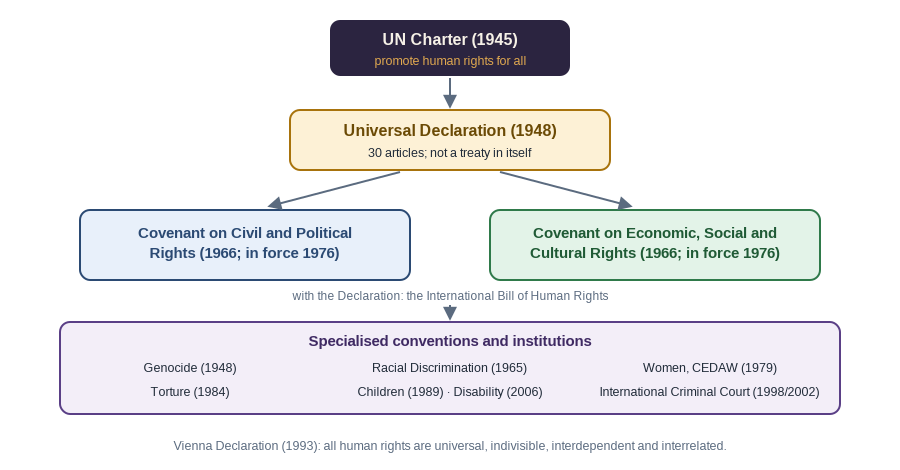
The horrors of the Second World War, including the Holocaust, convinced many that the treatment of people by their own governments could no longer be left entirely to those governments. The Charter of the United Nations (1945) committed member states to promote respect for human rights and fundamental freedoms for all without distinction as to race, sex, language or religion.
The Universal Declaration of Human Rights (UDHR) was adopted by the United Nations General Assembly on 10 December 1948, a date now observed as Human Rights Day. It was drafted by a commission chaired by Eleanor Roosevelt, with important contributions from members from many countries, including the Lebanese philosopher Charles Malik, the Chinese diplomat Peng-chun Chang, the French jurist René Cassin and the Indian educator Hansa Mehta, who is credited with helping to change the draft wording "all men are born free and equal" to "all human beings are born free and equal". The Declaration was adopted with no votes against and eight abstentions.
Its 30 articles proclaim civil and political rights (life, liberty, security, freedom from slavery and torture, equality before the law, fair trial, privacy, freedom of movement, asylum, nationality, marriage, property, thought, conscience, religion, opinion, expression, assembly and participation in government) and economic, social and cultural rights (social security, work, rest and leisure, an adequate standard of living, education and participation in cultural life). Its first article states that all human beings are born free and equal in dignity and rights.
The Declaration was not a treaty and did not create binding legal obligations by itself. It was followed by two binding covenants adopted in 1966 and in force from 1976: the International Covenant on Civil and Political Rights (ICCPR) and the International Covenant on Economic, Social and Cultural Rights (ICESCR). Together with the UDHR they are often called the International Bill of Human Rights.
Other instruments and institutions
Further conventions address particular rights or groups, among them the Convention on the Prevention and Punishment of the Crime of Genocide (1948), the Convention on the Elimination of All Forms of Racial Discrimination (1965), the Convention on the Elimination of All Forms of Discrimination against Women (1979), the Convention against Torture (1984), the Convention on the Rights of the Child (1989) and the Convention on the Rights of Persons with Disabilities (2006). Regional systems include the European Convention on Human Rights (1950) with its court, and inter-American and African systems.
The International Criminal Court, established by the Rome Statute (1998) and operating since 2002, can try individuals for genocide, crimes against humanity, war crimes and the crime of aggression, where national courts are unwilling or unable to do so. Not all states are parties to it; India, for example, is not.
The Vienna Declaration of the World Conference on Human Rights (1993) affirmed that all human rights are universal, indivisible, interdependent and interrelated (Chapter 7).
14.3 Universalism and cultural relativism
Are human rights truly universal, or are they the expression of one culture, the liberal West, imposed on others?
The relativist challenge
Cultural relativists argue that moral values are rooted in particular cultures and that there is no neutral standpoint from which to judge them all. In 1947, while the UDHR was being drafted, the American Anthropological Association submitted a statement warning that a declaration conceived only in terms of the values of Western Europe and America could not be applicable to all human beings. Critics argue that human rights, with their focus on individuals, reflect Western liberal individualism, while many cultures emphasise duties, community and harmony.
In the 1990s some political leaders in East and Southeast Asia advanced the idea of "Asian values": that Asian societies give priority to family, community, order and economic development over individual rights and political freedoms, so that Western criticism of their human rights records was cultural imperialism.
Universalist replies
- Overlapping consensus. Human rights need not rest on Western philosophy. People from many traditions can endorse them for their own reasons, as the drafters of the UDHR, drawn from many cultures, did.
- Diversity within cultures. Cultures are not uniform. Every culture contains debates and dissenters, and the people who invoke "culture" to deny rights are often those who hold power. Amartya Sen, in essays such as "Human Rights and Asian Values" (1997), pointed out that Asian traditions contain strong defences of tolerance and freedom (he cited Aśoka and Akbar, among others), while Western traditions contained much authoritarianism; there is no single set of "Asian" or "Western" values.
- The victims' perspective. Those whose rights are violated rarely accept that their suffering is justified by their culture.
- Relativism undermines itself. If all values are relative, the value of respecting other cultures is relative too, and the relativist cannot criticise cultural imperialism either.
Moderate positions
Many theorists take a middle position. Human rights express universal moral standards, but their interpretation and implementation may legitimately vary between societies. Rights should be few and basic enough to command broad agreement, and the language of rights can be translated into, and enriched by, other traditions. The philosopher Abdullahi An-Na'im, for example, has argued for an internal cultural dialogue in which human rights are legitimated from within religious and cultural traditions.
Key idea
Universalists hold that human rights apply to all people by virtue of their humanity; relativists that values depend on culture. Most theorists defend universal basic rights while allowing variety in how they are interpreted and realised, and point out that cultures are internally diverse.
14.4 Theories of global justice
What do the rich owe to the poor across borders? Positions can be grouped in three broad families.
| Position | Main claim | Key thinkers | Implication |
|---|---|---|---|
| Cosmopolitanism | Every human being has equal moral standing; principles of justice apply to all people, whatever their nationality | Peter Singer, Thomas Pogge, Charles Beitz, Simon Caney | Strong duties to reduce global poverty and inequality; reform of global institutions |
| Statism (or political conception) | Demanding principles of distributive justice apply only within states, where people share coercive institutions | Thomas Nagel, the later Rawls | Duties of humanitarian assistance abroad, but not global equality |
| Nationalism (liberal nationalism) | Nations are ethical communities whose members owe special duties to one another | David Miller, Yael Tamir | Basic human rights for all; deeper redistributive duties among co-nationals |
Table 14.1. Three positions on global justice.
Cosmopolitanism
The word comes from the Greek for "citizen of the world", a phrase associated with the ancient Cynic philosopher Diogenes. In modern philosophy Immanuel Kant, in Perpetual Peace (1795), proposed a federation of free states and a "cosmopolitan right" of hospitality to strangers. Contemporary cosmopolitans hold that what matters morally is individual human beings, each counting equally, and that national borders have no fundamental moral significance for justice.
Peter Singer's argument. In "Famine, Affluence, and Morality" (1972), written during the famine and refugee crisis accompanying the war of 1971 in what became Bangladesh, the philosopher Peter Singer argued from a simple case. If you pass a shallow pond and see a child drowning, you ought to wade in and save the child, even if it means ruining your clothes. The cost to you is small compared with the death of a child. Singer then argued that distance and the number of other people who could help make no moral difference. If we can prevent something very bad from happening without sacrificing anything of comparable moral importance, we ought to do it. Since people in affluent countries can, by giving money to effective aid agencies, prevent deaths from poverty at modest cost, they are morally obliged to give much more than they do; giving is a duty, not an act of charity.
Criticisms: the argument seems extremely demanding, potentially requiring people to give until they are nearly as poor as those they help; critics also question whether aid is as effective as the argument assumes, and whether individual giving is the right response to problems that are institutional and political.
Pogge's argument. Thomas Pogge, in World Poverty and Human Rights (2002), argued that the relation between rich and poor countries is not one of mere failure to help, but of harm. The global institutional order, shaped by powerful states (rules of trade, intellectual property, lending and the recognition of governments' rights to sell their countries' resources and borrow in their name, whoever those governments are), foreseeably contributes to severe poverty. Since we are harming the poor by imposing these institutions, we have negative duties, the strongest kind, to reform them, not merely positive duties of charity. Criticisms: critics dispute Pogge's empirical claims about how much global institutions cause poverty, as opposed to domestic factors such as governance and conflict.
Beitz and the global original position. Charles Beitz (Political Theory and International Relations, 1979) argued that if Rawls's reasoning is sound, it should be applied globally: since the world economy is a scheme of cooperation and the natural resources a country happens to have are as morally arbitrary as natural talents, parties in a global original position would choose a global difference principle.
Statism and Rawls's Law of Peoples
John Rawls himself rejected a global difference principle. In The Law of Peoples (1999) he imagined a second original position in which representatives of peoples (not individuals) choose principles for relations among them. The principles include respect for peoples' independence, observance of treaties, non-intervention except in self-defence and to protect human rights, observance of the laws of war, honouring of a short list of basic human rights, and a duty of assistance to "burdened societies" whose unfavourable conditions prevent them from having just or decent institutions. The duty of assistance has a target: once a society can manage its own affairs as a just or decent society, the duty ends. Rawls argued that a country's wealth depends mainly on its political culture and institutions rather than its resources, and that requiring continuing redistribution between peoples would fail to respect their responsibility for their own choices.
Thomas Nagel ("The Problem of Global Justice", 2005) argued that demanding principles of justice, such as equality, arise only among people who are jointly subject to a coercive state in whose name laws are made; absent a world government, there is no global justice in this full sense, though there are humanitarian duties to relieve extreme suffering.
Criticisms: cosmopolitans reply that the global economy and international institutions are already coercive and shape people's lives deeply, so the conditions that trigger duties of justice exist globally; and that Rawls's view of the causes of poverty underestimates international factors.
Liberal nationalism
David Miller (National Responsibility and Global Justice, 2007) argued that nations are ethical communities whose members share a public culture and have special obligations to one another, and that nations can be held responsible for their own choices and outcomes. Everyone, everywhere, is owed respect for basic human rights, which generates real duties for outsiders when rights are not met; but deeper principles of distributive equality apply within nations. Criticisms: cosmopolitans ask why the accident of nationality should determine one's share of the world's resources, and whether it is fair to hold individuals responsible for the decisions of their nations.
Worked example 14.1: Three answers to one question
Question. A wealthy country is considering whether to increase its foreign aid budget substantially, at the cost of slightly higher taxes for its citizens.
Singer (cosmopolitan, utilitarian): yes, and individuals should give privately too; preventing deaths from poverty at modest cost is a moral duty.
Pogge (cosmopolitan, institutional): aid is welcome, but the main duty is to reform the trade, finance and resource rules from which the country benefits and which harm the poor.
Rawls (Law of Peoples): the country has a duty of assistance to help burdened societies build just or decent institutions, but not a duty to equalise wealth between countries; aid should aim at institutional capacity, and ends when that target is met.
Miller (liberal nationalist): the country must help ensure that basic human rights are met everywhere, but may legitimately give priority to its own citizens beyond that threshold.
14.5 Humanitarian intervention and the responsibility to protect
What should the international community do when a government commits mass atrocities against its own people, or fails to prevent them? The principle of sovereignty and the UN Charter's prohibition on the use of force (except in self-defence or when authorised by the Security Council) seem to forbid intervention. Yet the failure to prevent the genocide in Rwanda in 1994 and the massacre at Srebrenica in Bosnia in 1995 led many to ask whether sovereignty should shield such crimes.
In 2001 an International Commission on Intervention and State Sovereignty proposed the doctrine of the responsibility to protect (often abbreviated R2P). The 2005 World Summit of the United Nations endorsed a version of it:
- each state has the responsibility to protect its population from genocide, war crimes, ethnic cleansing and crimes against humanity;
- the international community should help states fulfil this responsibility;
- if a state is manifestly failing to protect its population, the international community should be prepared to take collective action, through the Security Council, in accordance with the UN Charter, using peaceful means first and force as a last resort.
R2P reframes sovereignty as responsibility rather than merely a right to non-interference.
Arguments for and against intervention
For: there is a moral duty to prevent mass atrocities; sovereignty exists to protect people and loses its moral force when a government turns on them; failure to act in Rwanda showed the cost of indifference.
Against: intervention can be a cover for powerful states' strategic interests; it may make matters worse, causing civilian deaths and prolonged instability; it is applied selectively, depending on the interests of the permanent members of the Security Council; it threatens the sovereignty that protects weaker states. Many countries of the global South, with memories of colonial rule, have been wary of doctrines that license intervention by powerful states. Just war theory, which goes back to Augustine and Aquinas, offers criteria often used in these debates: just cause, right intention, last resort, legitimate authority, proportionality and reasonable prospect of success.
14.6 Two global problems
Climate justice
Climate change raises questions of justice between countries, between generations and between rich and poor. The United Nations Framework Convention on Climate Change (1992) recognised the principle of common but differentiated responsibilities and respective capabilities: all countries share responsibility for addressing climate change, but developed countries, which have emitted most greenhouse gases historically and have greater resources, should take the lead. The Paris Agreement (2015) set the goal of holding the rise in global average temperature to well below 2 °C above pre-industrial levels and pursuing efforts to limit it to 1.5 °C, with each country setting its own nationally determined contributions.
Theorists have proposed several principles for sharing the burden.
- Polluter pays (or contribution): those who caused the problem should bear the cost, in proportion to historical emissions. Objection: past emitters often did not know the harm, and many are dead.
- Beneficiary pays: those who benefited from emission-intensive development should pay, whether or not they caused it.
- Ability to pay: the burden should fall on those best able to bear it.
- Equal per-capita shares: each person has an equal right to the atmosphere's capacity to absorb emissions, so countries' allowances should be proportional to population.
Worked example 14.2: Comparing burden-sharing principles
Situation. Imagine two countries. Country N has a small population, high income per person and high historical and current emissions per person. Country S has a large population, low income per person and low emissions per person, but its total current emissions are growing as it develops.
Analysis. Under polluter pays (historical) and ability to pay, most of the burden of reducing emissions and financing adaptation falls on N. Under equal per-capita shares, S is entitled to a much larger total allowance because of its population, while N must cut its emissions per person sharply. A principle that looked only at current total emissions would put more pressure on S, which S would reject as unfair given its lower historical responsibility and its need for development. The principle of common but differentiated responsibilities is an attempt to combine these considerations.
Migration
Do states have the right to control who enters their territory? Most states and many theorists say yes: self-determination includes deciding who becomes a member, as clubs and families choose their members (Michael Walzer, Spheres of Justice, 1983). Supporters of this view add arguments from the protection of a national culture, the integrity of welfare systems and democratic control. Cosmopolitan critics such as Joseph Carens ("Aliens and Citizens: The Case for Open Borders", 1987) argue that citizenship in a rich country is like feudal privilege, an inherited status that greatly enhances one's life chances, and that restrictions on movement are hard to justify given the equal moral worth of all persons; at least, there is a strong presumption in favour of freedom of movement. Between these positions lie views that accept state control of borders but insist on duties to refugees (Chapter 9), on fair treatment of migrants already resident, and on the effects of migration policies on poorer countries.
Summary
- The UN Charter (1945), the Universal Declaration of Human Rights (10 December 1948) and the two Covenants (1966, in force 1976) form the core of international human rights law; specialised conventions, regional courts and the International Criminal Court (Rome Statute, 1998) extend it. The Vienna Declaration (1993) affirmed that rights are universal and indivisible.
- Relativists and proponents of "Asian values" question the universality of human rights; universalists reply with overlapping consensus, the internal diversity of cultures (Sen) and the perspective of victims.
- Cosmopolitans (Singer, Pogge, Beitz) extend principles of justice to all humanity; Singer argues from the drowning child, Pogge from institutional harm, Beitz for a global difference principle. Statists (Nagel, the later Rawls) confine full distributive justice to states; Rawls's Law of Peoples includes a duty of assistance with a target. Liberal nationalists (Miller) defend basic rights for all and special duties among co-nationals.
- The responsibility to protect (endorsed in 2005) treats sovereignty as responsibility and permits collective action through the Security Council against genocide, war crimes, ethnic cleansing and crimes against humanity; intervention remains controversial.
- Climate justice debates how to share burdens (polluter pays, beneficiary pays, ability to pay, equal per-capita shares) under the principle of common but differentiated responsibilities; migration debates set self-determination against freedom of movement.
14.7 Exercises
Exercise 1
Why is the Universal Declaration of Human Rights not legally binding by itself, and which instruments made its rights binding?
Answer
The UDHR was adopted as a resolution of the General Assembly, which does not create binding treaty obligations. Its rights were made binding through treaties, above all the International Covenant on Civil and Political Rights and the International Covenant on Economic, Social and Cultural Rights (both 1966, in force 1976), and through later specialised conventions. Many of its provisions are also widely regarded as part of customary international law.
Exercise 2
State the "Asian values" argument and Sen's reply to it.
Answer
The Asian values argument held that Asian societies prioritise family, community, order and development over individual rights and political freedoms, so Western human rights criticism is cultural imperialism. Sen replied that there is no single set of Asian (or Western) values: Asian traditions include strong defences of tolerance and freedom (e.g. Aśoka, Akbar), Western traditions include much authoritarianism, and those who invoke cultural values to deny rights are often those in power.
Exercise 3
Summarise Singer's drowning-child argument and one objection to it.
Answer
If you can save a child drowning in a shallow pond at the cost of ruining your clothes, you ought to do so. Distance and the presence of others who could help make no moral difference. So if we can prevent something very bad without sacrificing anything of comparable moral importance, we ought to: affluent people should give much more to relieve poverty abroad. Objection: the argument is extremely demanding, seeming to require giving until one is nearly as badly off as those helped; others question aid effectiveness or prefer institutional reform to individual charity.
Exercise 4
How does Pogge's argument differ from Singer's?
Answer
Singer argues from positive duties to help those in need, whatever the cause of their need. Pogge argues that the affluent are harming the poor by imposing a global institutional order (trade, lending, resource and intellectual property rules) that foreseeably produces severe poverty; this violates negative duties not to harm, the strongest kind of duty, and requires institutional reform.
Exercise 5
What is Rawls's duty of assistance, and why does it have a "target"?
Answer
In The Law of Peoples, well-ordered peoples have a duty of assistance to burdened societies whose unfavourable conditions prevent them from having just or decent institutions. It has a target: to help them become able to manage their own affairs as just or decent societies. Once that is achieved the duty ends, because Rawls held that a society's wellbeing depends mainly on its political culture and that continuing redistribution between peoples would not respect their responsibility for their own choices.
Exercise 6
State the three elements of the responsibility to protect as endorsed in 2005, and give one argument against humanitarian intervention.
Answer
(1) Each state is responsible for protecting its population from genocide, war crimes, ethnic cleansing and crimes against humanity. (2) The international community should help states meet this responsibility. (3) If a state manifestly fails, the international community should be prepared to take collective action through the Security Council, peacefully first and by force as a last resort. Argument against: intervention may serve the strategic interests of powerful states, is applied selectively, and can worsen the situation it aims to remedy.
Exercise 7
Explain the principle of common but differentiated responsibilities, and why a poorer, populous country might reject a burden-sharing rule based on current total emissions.
Answer
The principle (UNFCCC, 1992) holds that all countries share responsibility for addressing climate change, but developed countries, with greater historical emissions and capabilities, should take the lead. A poorer, populous country might reject a rule based on current total emissions because its emissions per person and its historical emissions are low, it needs development to reduce poverty, and such a rule would ignore the responsibility of countries that grew rich by emitting earlier.
14.8 Quiz
Check yourself: global justice and human rights
Exercise 1
On what date was the Universal Declaration of Human Rights adopted?
- 24 October 1945
- 10 December 1948
- 16 December 1966
- 25 June 1993
Answer
10 December 1948
Exercise 2
How many articles does the Universal Declaration of Human Rights contain?
Answer
30 / thirty
Exercise 3
Which Indian member of the drafting commission is credited with changing "all men" to "all human beings"?
- Hansa Mehta
- Sarojini Naidu
- Vijaya Lakshmi Pandit
- Rajkumari Amrit Kaur
Answer
Hansa Mehta
Exercise 4
Match each thinker with an argument.
| A | B |
|---|---|
| Singer | Duty of assistance with a target |
| Pogge | The case for open borders |
| Rawls | The drowning child |
| Carens | Global institutions harm the poor |
Answer
Singer — The drowning child; Pogge — Global institutions harm the poor; Rawls — Duty of assistance with a target; Carens — The case for open borders
Exercise 5
The responsibility to protect was endorsed by the UN World Summit in
- 1948
- 1993
- 2005
- 2015
Answer
2005
Exercise 6
Which treaty of 1992 sets out the principle of common but differentiated responsibilities?
- The Kyoto Protocol
- The UN Framework Convention on Climate Change
- The Paris Agreement
- The Rome Statute
Answer
The UN Framework Convention on Climate Change
Exercise 7
Who argued that full principles of distributive justice apply only among people jointly subject to a coercive state?
- Charles Beitz
- Thomas Nagel
- Peter Singer
- Simon Caney
Answer
Thomas Nagel