Chapter 10: Secularism
Religion, the state and equal citizenship: models, debates and the Indian case
Learning outcomes
When you have finished this chapter you should be able to:
- distinguish secularism as a political doctrine from secularisation as a social process;
- explain the historical origins of secularism and the argument for religious toleration;
- compare the main models of the relation between state and religion: established religion, strict separation, laïcité and the Indian model of principled distance;
- describe the constitutional provisions on religion in India and the main judicial statements on secularism;
- state the main criticisms of secularism, including those made in the Indian debate, fairly;
- apply different models to concrete cases such as religious dress, funding of religious schools and personal laws.
10.1 The problem
Every society with more than one religion, or with religious and non-religious citizens, faces a basic question: how should the state relate to religion? Should it support one religion, all religions or none? Should it stay out of religious matters entirely, or intervene to reform religious practices that harm people? Should religious arguments have a place in public debate? These questions have produced wars, persecutions and revolutions, and they remain among the most contested in politics.
Secularism is a family of answers to these questions. In its most general sense it is the political doctrine that the state should not be governed by or identified with any religion, and that citizens' rights and status should not depend on their religious beliefs. But, as this chapter shows, secular states differ greatly in how they put the doctrine into practice.
Secularism and secularisation
Two words are often confused.
- Secularisation is a social process: the declining influence of religion over social institutions and individual belief, which sociologists once expected to accompany modernisation. Whether it is happening, and where, is an empirical question; the expectation of universal secularisation has been widely questioned since the late twentieth century.
- Secularism is a political doctrine about the proper relation between state and religion. A deeply religious society can have a secular state, and a largely non-religious society can have an established church. The United Kingdom has an established Church of England while being one of the less religious societies in Europe; the United States has strict constitutional separation and a comparatively religious population.
The word "secularism" was coined in English in 1851 by George Jacob Holyoake, as a name for an ethics based on reason and concern for this world, independent of religion.
10.2 Origins: from toleration to secularism
Modern secularism in Europe grew from the wars of religion of the sixteenth and seventeenth centuries, which followed the Protestant Reformation. When Catholics and Protestants fought for control of states, and each regarded the other as heretics, peace required some way of living together.
The first answer was the principle cuius regio, eius religio ("whose realm, his religion") of the Peace of Augsburg (1555): each prince chose the religion of his territory. This ended some wars but not persecution of minorities.
A deeper answer was toleration. John Locke, in A Letter Concerning Toleration (1689), argued that the business of civil government is limited to protecting life, liberty, health and possessions; the care of souls does not belong to the magistrate. Coercion cannot produce genuine belief, since true religion consists in inward persuasion of the mind; so persecution is both wrong and futile. Locke's toleration was limited by the standards of later times: he did not extend it to atheists, whose oaths he thought could not be trusted, or to Catholics, whom he suspected of allegiance to a foreign power.
Toleration means putting up with beliefs and practices one disapproves of. Secularism goes further: it seeks a state that does not take sides among religions at all, treating all citizens as equals regardless of belief. This idea was expressed in the First Amendment to the United States Constitution (1791), which forbids Congress to make any law respecting an establishment of religion or prohibiting its free exercise, and in the French Revolution's attack on the privileges of the Catholic Church.
Toleration in Indian history
Ideas of tolerance and coexistence also have deep roots in Indian history. The edicts of the Mauryan emperor Aśoka (third century BCE) urged respect for all religious sects and restraint in speech about other faiths. The Mughal emperor Akbar (reigned 1556–1605) held discussions among scholars of many religions and promoted a policy of sulh-i kul (peace with all). Historians debate how far such examples anticipate modern secularism, which rests on equal citizenship rather than the benevolence of a ruler, but they show that the problem of religious diversity was addressed in many traditions.
10.3 Models of state and religion
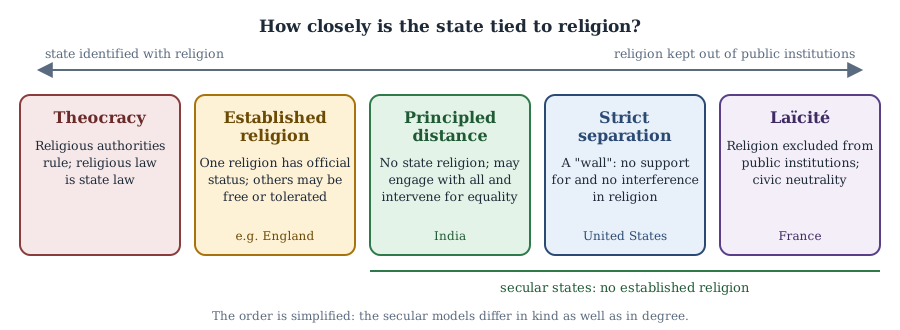
States can be placed along a range, from full identification with a religion to strict exclusion of religion from public life.
Theocracy and established religion
In a theocracy religious authorities rule, and religious law is state law. In a state with an established religion one religion has official status and privileges (for example in the head of state's role, in education or in state funding), while others may be tolerated or enjoy full freedom. Many democratic states have mild forms of establishment, such as the Church of England, or state churches in some Scandinavian countries, combined with complete religious freedom.
Strict separation: the American model
The American model is often summed up in Thomas Jefferson's phrase, in a letter of 1802 to the Danbury Baptists, describing a "wall of separation between church and state". The state may neither establish nor favour any religion, nor interfere in religious affairs. Religion is treated mainly as a private matter of individual conscience and voluntary association. In practice the wall has many gaps and has been interpreted differently over time by the courts, for example on prayer in public schools and public funding for religious schools. A distinctive feature of the American model is mutual protection: separation protects the state from religion and religion from the state.
Laïcité: the French model
French laïcité, established by the law of 1905 separating the churches and the state, emerged from a long struggle against the political power of the Catholic Church. The Republic neither recognises, pays nor subsidises any religion. More than the American model, laïcité seeks to keep religion out of public institutions and public space, in the name of a shared civic identity and the freedom of individuals from religious pressure. A law of 2004 bans the wearing of conspicuous religious symbols (such as headscarves, large crosses, turbans and skullcaps) by pupils in state schools. Supporters see this as protecting the neutrality of the school and the freedom of children; critics argue that it restricts religious freedom and in practice falls hardest on religious minorities.
The Indian model: principled distance
The framers of the Constitution of India faced a society of deep and pervasive religious diversity, a history of communal conflict culminating in the violence of Partition, and religious practices (such as untouchability) that denied equality. They did not adopt either strict separation or laïcité. The political theorist Rajeev Bhargava has described the resulting model as principled distance. Its main features are:
- No established religion. The state does not identify with any religion.
- Equal respect, not equal indifference. The state may engage with all religions, for example by funding educational institutions run by religious communities on a non-discriminatory basis, or by managing religious endowments.
- Intervention for equality. The state may intervene in religious practices to promote social reform, equality and dignity. The Constitution itself abolishes untouchability and allows the state to throw open Hindu religious institutions of a public character to all classes and sections of Hindus.
- Context-sensitive distance. The state decides when to engage with or keep away from religion, not by a fixed rule of separation, but by asking what the values of liberty and equality require in each case. It may treat different religions differently if that serves those values.
A related idea is sarva dharma samabhāva, "equal regard for all religions", often associated with Gandhi. Supporters of the Indian model argue that it is better suited to deeply religious, diverse societies than models developed in largely Christian Western countries. Its critics argue that the flexibility of principled distance makes it inconsistent and open to political manipulation (section 10.5).
| Strict separation (USA) | Laïcité (France) | Principled distance (India) | |
|---|---|---|---|
| Established religion | None | None | None |
| State funding of religious institutions | Generally not for religious activities; contested for schools | Not for worship; some support for private schools under contract | Permitted on a non-discriminatory basis, e.g. aid to minority educational institutions |
| Religion in public institutions | Limited; no state-led prayer in public schools | Strongly excluded; ban on conspicuous symbols in state schools | Accommodated; religious symbols generally allowed |
| State intervention in religion | Avoided | Limited | Permitted for social reform and equality |
| Main aim | Freedom of conscience; mutual protection | Civic unity and individual freedom from religious pressure | Equality and freedom in a deeply plural society |
Table 10.1. Three models of secularism compared.
Key idea
Secular states share a refusal to establish or be governed by any religion, but they differ in how they relate to religion: the American model builds a wall, laïcité keeps religion out of public institutions, and the Indian model keeps a principled, flexible distance that allows engagement and intervention for the sake of equality.
10.4 Secularism in the Constitution of India
The original Constitution of 1950 did not use the word "secular", though its provisions embodied a secular state. The word was added to the Preamble by the 42nd Amendment (1976), which describes India as a "sovereign socialist secular democratic republic". The main provisions are these.
- Article 14 (equality before the law) and Article 15 (no discrimination on grounds of religion, race, caste, sex or place of birth).
- Article 16: equality of opportunity in public employment, without discrimination on grounds of religion.
- Article 25: freedom of conscience and the right freely to profess, practise and propagate religion, subject to public order, morality and health and to the other Fundamental Rights. The state may regulate secular activities associated with religious practice and provide for social welfare and reform.
- Article 26: the right of every religious denomination to manage its own affairs in matters of religion.
- Article 27: no person may be compelled to pay taxes the proceeds of which are specifically used for promoting any particular religion.
- Article 28: no religious instruction in educational institutions wholly maintained out of state funds.
- Articles 29 and 30: the right of minorities to conserve their language, script or culture, and to establish and administer educational institutions of their choice.
- Article 44 (a Directive Principle): the state shall endeavour to secure for citizens a uniform civil code throughout the territory of India.
In S. R. Bommai v. Union of India (1994) the Supreme Court held that secularism is part of the basic structure of the Constitution, which cannot be destroyed even by constitutional amendment. The Court has also developed the essential religious practices test: the protection of Article 25 extends to practices that are essential or integral to a religion, which the courts decide. This test has been criticised by scholars for requiring judges to decide questions of theology.
Personal laws and the uniform civil code
In India, matters such as marriage, divorce, inheritance and adoption are governed largely by personal laws that differ by religious community. The Hindu personal law was codified and reformed by Parliament in the 1950s (the Hindu Marriage Act, 1955, and related acts); the personal laws of other communities have been changed less by legislation. Article 44 sets the goal of a uniform civil code.
The debate is long-standing and has thoughtful participants on several sides.
- For a uniform code: equal citizenship and gender justice require the same civil laws for all; differing personal laws may disadvantage women; a uniform code would strengthen national integration and secularism.
- Against imposing a uniform code, or for caution: personal laws are part of the cultural and religious identity protected by the Constitution; reform should come from within communities and with their consent; a uniform code might in practice reflect the customs of the majority; gender justice can be pursued by reforming each personal law.
- Middle positions include an optional uniform code (as in the Special Marriage Act, 1954, which allows any couple to marry under a common civil law), and reform of personal laws to remove gender discrimination one by one.
10.5 Criticisms of secularism
Secularism is criticised from several directions, and each criticism deserves to be stated at its strongest.
Religious criticisms
Some religious believers argue that secularism privatises religion, treating faith as a matter of personal preference rather than truth, and so marginalises believers in public life. Requiring citizens to give only secular reasons in political debate (Rawls's public reason, Chapter 6) may, they argue, ask believers to leave their deepest convictions at the door. Defenders of secularism reply that a secular state protects all religions, including minority ones, from domination by any one of them, and that many religious citizens support secularism for exactly this reason. Some theorists, such as Jürgen Habermas in later work, have proposed that religious citizens may use religious language in public debate, provided that formal state decisions are justified in terms all can share.
Critiques of Western secularism
Scholars such as Talal Asad and Charles Taylor (A Secular Age, 2007) have argued that secularism is not a neutral framework but a product of the particular history of Christian Europe, carrying assumptions (for example that religion is essentially a matter of private belief) that may not fit other traditions. Applied elsewhere, it may be experienced as alien.
The Indian debate
In the Indian context secularism has been criticised from quite different directions, and the debate is politically sensitive. The criticisms commonly made in scholarly and public debate include the following.
- Secularism as alien to Indian society. The sociologist T. N. Madan argued in the 1980s that secularism, as a doctrine that confines religion to private life, is a product of the history of Western Christianity that cannot easily be transplanted to South Asia, where religion pervades social life. For the great majority of South Asians, who are active adherents of a faith, he held that it is unworkable as a way of life and impracticable as a basis for state action. The psychologist and social theorist Ashis Nandy argued that the modern state's secularism, imposed from above by elites, can provoke rather than prevent religious conflict, and drew instead on traditions of everyday religious tolerance.
- Secularism as inconsistent. Critics argue that the state's flexibility in engaging with religions has led to unequal treatment, for example in the different degrees to which various personal laws have been reformed, or in state management of the religious institutions of some communities but not others. Some describe this as favouring minorities; others argue that the state has in practice favoured the majority.
- Secularism as insufficiently defended. Other critics argue that the secular state has failed to protect minorities against communal violence and discrimination, and that secular principles have been weakened in practice.
Defenders of the Indian model, such as Bhargava, reply that the model's flexibility is a principled response to deep diversity, that inconsistency in practice is a failure to apply the principle, not a defect in it, and that the alternatives (an established religion, or strict separation that would forbid needed reforms) would be worse for both equality and freedom.
10.6 Hard cases
Secularism is tested by concrete cases in which the freedom of religion, the equality of citizens and the authority of the state pull in different directions.
Worked example 10.1: Religious dress in schools
Situation. A government school prescribes a uniform. Some pupils wish to wear a religious head covering with it.
Analysis. Under laïcité (as in the French law of 2004), conspicuous religious symbols are banned in state schools to keep the school a neutral space; the pupils would not be allowed to wear the covering. Under strict separation, the state would generally accommodate individual religious expression, as long as the school does not itself endorse religion. Under principled distance, the question would be whether accommodation respects the pupils' freedom and equal dignity without undermining any important educational purpose or the rights of others. The essential practices test used by Indian courts would ask whether the practice is essential to the religion, a question critics say courts are ill-equipped to answer. The case shows how the same principle, a secular state, can yield opposite conclusions under different models.
Worked example 10.2: Funding religious schools
Situation. A state offers grants to private schools that meet educational standards. Some applicants are run by religious organisations and include religious instruction for pupils who choose it.
Analysis. Strict separation has historically been wary of public funds supporting religious education, though courts in the United States have increasingly allowed neutral programmes that include religious schools. Laïcité forbids funding of worship but allows funding of private (including religious) schools that teach the national curriculum under contract with the state. Principled distance permits non-discriminatory aid: in India, Article 30 protects the right of minorities to establish educational institutions, Article 30(2) forbids the state to discriminate against them in giving aid, and Article 28(3) provides that no one attending a state-aided institution may be required to take part in religious instruction without consent. The key secular requirement in each model is non-discrimination among religions and freedom of the individual pupil.
Summary
- Secularism is a political doctrine about the relation between state and religion; secularisation is a social process of declining religious influence.
- Secularism grew from the European wars of religion and the argument for toleration (Locke's Letter Concerning Toleration, 1689); Indian history also contains traditions of tolerance (Aśoka, Akbar).
- Models range from theocracy and established religion to strict separation (the American "wall of separation"), laïcité (France, 1905) and India's principled distance (Bhargava), which allows engagement with all religions and intervention for equality.
- The Constitution of India protects religious freedom (Articles 25–28) and minority rights (29–30), forbids religious discrimination, and sets the goal of a uniform civil code (Article 44); "secular" was added to the Preamble in 1976, and S. R. Bommai (1994) made secularism part of the basic structure.
- Secularism is criticised by some religious thinkers, by critics of its Western origins (Asad, Taylor) and in the Indian debate by Madan and Nandy, and by those who see it as inconsistently or insufficiently applied; defenders argue that principled distance suits deep diversity.
10.7 Exercises
Exercise 1
Distinguish secularism from secularisation, and give an example showing that the two can come apart.
Answer
Secularism is a political doctrine about the state's relation to religion; secularisation is a social process in which religion's influence declines. They can come apart: the United Kingdom has an established church but a relatively non-religious population; the United States has strict constitutional separation but a comparatively religious population.
Exercise 2
State Locke's main arguments for toleration and two limits of his view.
Answer
Locke argued that (1) the civil government's business is limited to life, liberty, health and possessions, not the care of souls; and (2) coercion cannot produce genuine belief, which depends on inward persuasion, so persecution is futile as well as wrong. Limits: he excluded atheists, whose oaths he thought untrustworthy, and Catholics, whom he suspected of allegiance to a foreign power.
Exercise 3
Compare the American, French and Indian models of secularism on (a) state funding for religious schools and (b) religious symbols in state schools.
Answer
(a) USA: historically wary of funding religious education, though neutral programmes including religious schools have increasingly been allowed. France: no funding of worship, but contract funding for private schools teaching the national curriculum. India: non-discriminatory aid permitted, and minority institutions protected under Article 30. (b) USA: individual religious expression generally accommodated. France: conspicuous symbols banned for pupils in state schools (2004). India: religious symbols generally accommodated, subject to case-by-case judgement.
Exercise 4
What does Bhargava mean by "principled distance"? How does it differ from equal indifference to all religions?
Answer
Principled distance means that the state keeps no fixed distance from religion; it decides when to engage with or keep away from religions according to whether this promotes liberty and equality. It may support religious communities on a non-discriminatory basis or intervene to reform practices that deny equality (e.g. untouchability). Equal indifference (strict separation) would forbid both support and intervention; principled distance allows equal respect and active engagement.
Exercise 5
List four articles of the Constitution of India that bear on secularism, with one sentence on each.
Answer
Any four: Article 15 forbids discrimination on grounds of religion. Article 25 guarantees freedom of conscience and to profess, practise and propagate religion, subject to limits and to social reform. Article 26 lets religious denominations manage their own religious affairs. Article 27 forbids compelling anyone to pay taxes used to promote a particular religion. Article 28 forbids religious instruction in wholly state-funded institutions. Article 30 gives minorities the right to establish and administer educational institutions. Article 44 directs the state to endeavour to secure a uniform civil code.
Exercise 6
Set out one argument for and one argument against a uniform civil code, in a way that its supporters would accept.
Answer
For: equal citizenship and gender justice require that all citizens be governed by the same civil laws on marriage, divorce and inheritance, and some personal laws disadvantage women. Against (or for caution): personal laws are part of the religious and cultural identity that the Constitution protects; change should come with the consent and participation of communities, and a uniform code might in practice reflect majority customs; gender justice can be pursued by reforming each personal law.
Exercise 7
Summarise T. N. Madan's criticism of secularism in India and one reply to it.
Answer
Madan argued that secularism, understood as confining religion to private life, is a product of Western Christian history and is unsuited to South Asia, where religion pervades social life; for most people, who are religious, it is unworkable as a way of life and impracticable as a basis for state action. Reply: the Indian model is not privatisation of religion; principled distance accepts religion's public presence and asks only that the state not be identified with any religion and that it protect equal citizenship, which many religious people themselves support.
10.8 Quiz
Check yourself: secularism
Exercise 1
Whose phrase was "a wall of separation between church and state"?
- John Locke
- Thomas Jefferson
- George Holyoake
- Alexis de Tocqueville
Answer
Thomas Jefferson
Exercise 2
In which year did France pass its law separating the churches and the state?
- 1789
- 1848
- 1905
- 2004
Answer
1905
Exercise 3
Which amendment added the word "secular" to the Preamble of the Constitution of India?
- 1st
- 24th
- 42nd
- 44th
Answer
42nd
Exercise 4
Which 1994 case held that secularism is part of the basic structure of the Constitution of India? (short name)
Answer
Bommai / S. R. Bommai / SR Bommai
Exercise 5
Match each model with its country.
| A | B |
|---|---|
| Laïcité | United States |
| Wall of separation | India |
| Principled distance | France |
Answer
Laïcité — France; Wall of separation — United States; Principled distance — India
Exercise 6
Who wrote A Letter Concerning Toleration (1689)?
- Hobbes
- Locke
- Rousseau
- Mill
Answer
Locke
Exercise 7
Which article of the Constitution of India directs the state to endeavour to secure a uniform civil code?
- Article 25
- Article 30
- Article 44
- Article 51A
Answer
Article 44