Lesson 10: Irregular Verbs: tener, ir, hacer, querer, poder
Los verbos irregulares
In Lesson 6 you learned the regular present tense: take the infinitive, remove -ar, -er or -ir, add the endings. Unfortunately, the verbs people use most often are exactly the ones that do not follow the rules. This lesson takes five of them, tener (to have), ir (to go), hacer (to do, to make), querer (to want) and poder (to be able to), and shows that their irregularity is not chaos. Most irregular verbs belong to a few families with predictable patterns, and once you know the patterns you know dozens of verbs. With these five you can make plans, talk about the weather, say what you have to do and what you can and cannot do.
Learning outcomes
By the end of this lesson you will be able to:
- conjugate tener, ir, hacer, querer and poder in the present tense;
- recognise the two main families of stem-changing verbs, e → ie and o → ue, and the "boot" pattern they share;
- use tener in expressions of feeling and need (tengo hambre, tengo que estudiar);
- say where you are going with ir a, and talk about the weather with hace;
- make requests and offers with ¿puedo …?, ¿puedes …? and ¿quieres …?;
- recognise the "yo-go" verbs: salgo, pongo, vengo, digo.
10.1 Dialogue: plans for the weekend
It is Friday. Lucía and Daniel are leaving class.
- Lucía: ¿Qué haces este fin de semana? — What are you doing this weekend?
- Daniel: No sé. El sábado por la mañana tengo que estudiar. Tenemos un examen el lunes. — I don't know. On Saturday morning I have to study. We have an exam on Monday.
- Lucía: Sí, es verdad. ¿Y por la tarde? ¿Quieres ir al cine? — Yes, that's true. And in the afternoon? Do you want to go to the cinema?
- Daniel: Por la tarde no puedo. Juego al fútbol con unos amigos. — I can't in the afternoon. I'm playing football with some friends.
- Lucía: ¿Y el domingo? Mis primos y yo vamos a la sierra. Hacemos una ruta por la montaña. — And on Sunday? My cousins and I are going to the mountains. We're doing a walk in the hills.
- Daniel: ¡Qué bien! ¿Puedo ir con vosotros? — Great! Can I come with you?
- Lucía: ¡Claro que sí! Salimos a las ocho de la mañana. — Of course! We leave at eight in the morning.
- Daniel: ¿A las ocho? ¡Qué temprano! Los domingos duermo hasta las diez. — At eight? That's early! On Sundays I sleep until ten.
- Lucía: Es que en verano hace mucho calor a mediodía. Por la mañana hace fresco. — The thing is, in summer it's very hot at midday. In the morning it's cool.
- Daniel: Vale. ¿Qué tengo que llevar? — OK. What do I have to bring?
- Lucía: Agua, un bocadillo y una gorra. Y si quieres, puedes traer la cámara. — Water, a sandwich and a cap. And if you want, you can bring your camera.
- Daniel: Perfecto. ¿Cuándo volvemos? — Perfect. When do we come back?
- Lucía: Volvemos por la tarde, a las seis o así. — We come back in the afternoon, at about six.
Notice:
- Spanish often uses the present tense for arrangements in the near future: el sábado juego al fútbol, "on Saturday I'm playing football".
- tengo que estudiar: tener que + infinitive means "to have to".
- puedo, duermo, juego have ue where the infinitives poder, dormir, jugar have o or u. But volvemos, with nosotros, keeps the o of volver. This is the boot pattern of section 10.4.
- Weather uses hacer: hace calor, literally "it makes heat".
10.2 Vocabulary: feelings, weather and free time
Tener: what you feel and need
| Spanish | Literally | English |
|---|---|---|
| tener hambre | to have hunger | to be hungry |
| tener sed | to have thirst | to be thirsty |
| tener frío | to have cold | to be (feel) cold |
| tener calor | to have heat | to be (feel) hot |
| tener sueño | to have sleep | to be sleepy |
| tener prisa | to have hurry | to be in a hurry |
| tener miedo (de) | to have fear | to be afraid (of) |
| tener razón | to have reason | to be right |
| tener suerte | to have luck | to be lucky |
| tener … años | to have … years | to be … years old |
| tener que + infinitive | to have that | to have to, must |
| tener ganas de + infinitive | to have desires of | to feel like (doing) |
Table 10.1. Expressions with tener. Where English says "be", Spanish often says "have".
Since hambre, sed, frío and the rest are nouns, "very" is mucho or mucha, not muy: tengo mucha hambre (hambre is feminine), tengo mucho frío, tienes mucha razón.
Hacer: the weather
| Spanish | Sounds like | English |
|---|---|---|
| ¿Qué tiempo hace? | [keh TYEHM-poh AH-seh] | What's the weather like? |
| hace calor | [AH-seh kah-LOR] | it's hot |
| hace frío | [AH-seh FREE-oh] | it's cold |
| hace fresco | [AH-seh FREHS-koh] | it's cool, chilly |
| hace sol | [AH-seh SOHL] | it's sunny |
| hace viento | [AH-seh BYEHN-toh] | it's windy |
| hace buen tiempo | [AH-seh bwehn TYEHM-poh] | the weather is good |
| hace mal tiempo | [AH-seh mahl TYEHM-poh] | the weather is bad |
| llueve | [YWEH-beh] | it's raining, it rains (llover) |
| nieva | [NYEH-bah] | it's snowing, it snows (nevar) |
| está nublado | [ehs-TAH noo-BLAH-doh] | it's cloudy |
| hay niebla | [ai NYEH-blah] | it's foggy |
Table 10.2. The weather. hace is the third person of hacer; llueve and nieva are verbs of their own.
Free time: hacer and ir
| Spanish | English |
|---|---|
| hacer deporte | to do sport |
| hacer los deberes (Spain), hacer la tarea (Latin America) | to do homework |
| hacer la compra (Spain), hacer las compras (Latin America) | to do the food shopping |
| hacer la cama | to make the bed |
| hacer una ruta, hacer senderismo | to go for a walk, to go hiking |
| hacer un viaje | to take a trip |
| hacer una foto (Spain), tomar una foto (Latin America) | to take a photo |
| ir de compras | to go shopping (for pleasure) |
| ir de vacaciones | to go on holiday |
| ir de excursión | to go on an outing |
| ir a la playa, ir a la montaña | to go to the beach, to the mountains |
| jugar al fútbol, jugar al tenis | to play football, tennis |
| el fin de semana | the weekend |
Table 10.3. Free-time activities. In much of Latin America people say jugar fútbol, without al.
10.3 Grammar: tener, ir and hacer
Tener: to have
| Person | tener | English |
|---|---|---|
| yo | tengo | I have |
| tú | tienes | you have |
| él, ella, usted | tiene | he, she has; you have |
| nosotros, nosotras | tenemos | we have |
| vosotros, vosotras | tenéis | you have (Spain) |
| ellos, ellas, ustedes | tienen | they, you have |
Table 10.4. tener. Two irregularities: a g in the yo form, and e → ie in the boot (section 10.4).
tener is used for possession (tengo un coche), family (tiene tres hijos), age (tenemos veinte años), the expressions of Table 10.1, and obligation:
- Tengo que trabajar el sábado. — I have to work on Saturday.
- ¿Tienes que irte ya? — Do you have to go already?
- No tenemos que pagar. — We don't have to pay.
- Tienen que coger el tren de las nueve. — They have to catch the nine o'clock train. (Latin America: tomar el tren)
Common mistake: I am hungry
Do not translate "I am hungry" as Estoy hambre or Soy hambre. Hunger is something you have: Tengo hambre. In the same way, "I am 25" is Tengo veinticinco años, and "I'm cold" is Tengo frío.
Ir: to go
| Person | ir | English |
|---|---|---|
| yo | voy | I go, I'm going |
| tú | vas | you go |
| él, ella, usted | va | he, she goes; you go |
| nosotros, nosotras | vamos | we go |
| vosotros, vosotras | vais | you go (Spain) |
| ellos, ellas, ustedes | van | they, you go |
Table 10.5. ir. Completely irregular, but with the regular -ar endings after the v.
ir is followed by a before a destination, and a + el contracts to al (Lesson 4). Transport takes en (Lesson 9).
- Voy al cine. — I'm going to the cinema.
- ¿Vas a la playa en coche o en tren? — Are you going to the beach by car or by train?
- Los niños van al colegio a pie. — The children walk to school.
- ¿Adónde vais este verano? — Where are you going this summer?
To ask "where to?", use ¿adónde? (also written ¿a dónde?). ¿Dónde? alone asks where something is. ¡Vamos! on its own means "Let's go!", and ¡Vamos a la playa! "Let's go to the beach!"
Coming soon: ir a + infinitive
ir a followed by an infinitive, as in voy a estudiar ("I'm going to study"), is the everyday way to talk about the future. It is the subject of Lesson 14. In this lesson, ir a is always followed by a place.
Hacer: to do, to make
| Person | hacer | English |
|---|---|---|
| yo | hago | I do, I make |
| tú | haces | you do |
| él, ella, usted | hace | he, she does; you do |
| nosotros, nosotras | hacemos | we do |
| vosotros, vosotras | hacéis | you do (Spain) |
| ellos, ellas, ustedes | hacen | they, you do |
Table 10.6. hacer. Only the yo form is irregular: hago.
hacer covers both English "do" and "make": hago la cena ("I make dinner"), hago ejercicio ("I do exercise"). It is also the verb of the weather (Table 10.2). The question ¿Qué haces? ("What are you doing? What do you do?") is usually answered with a different verb: ¿Qué haces los domingos? — Duermo mucho y leo.
Common mistake: muy calor
In weather expressions calor, frío and sol are nouns, so "very" is mucho: hace mucho calor, hace mucho frío. Never hace muy calor. And keep three ideas apart: hace calor (the weather is hot), tengo calor (I feel hot), la sopa está caliente (the soup is hot).
10.4 Grammar: stem-changing verbs, querer and poder
The boot pattern
Many verbs keep the regular endings of Lesson 6 but change a vowel in their stem, the part before the ending. The change happens only when that vowel is stressed, which is in four of the six forms: yo, tú, él and ellos. In nosotros and vosotros the stress moves to the ending, and the stem stays as it is in the infinitive. Drawn in a table, the four changed forms make the shape of a boot.
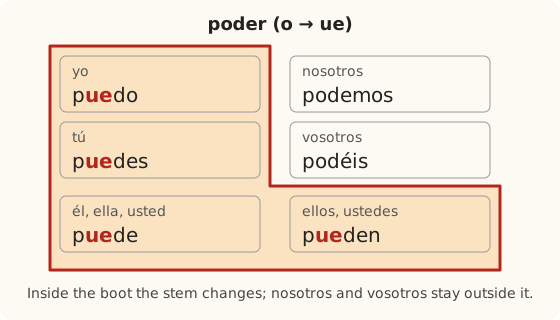
There are two big families:
- e → ie: querer → quiero, pensar → pienso.
- o → ue: poder → puedo, dormir → duermo.
Dictionaries and verb lists show the change in brackets: querer (ie), poder (ue). There is nothing in the infinitive itself that tells you whether a verb changes (comer does not, volver does), so learn the bracket with the verb.
Querer (e → ie): to want, to love
| Person | querer | pensar | preferir |
|---|---|---|---|
| yo | quiero | pienso | prefiero |
| tú | quieres | piensas | prefieres |
| él, ella, usted | quiere | piensa | prefiere |
| nosotros, nosotras | queremos | pensamos | preferimos |
| vosotros, vosotras | queréis | pensáis | preferís |
| ellos, ellas, ustedes | quieren | piensan | prefieren |
Table 10.7. e → ie verbs: one -er, one -ar and one -ir verb. The endings are regular.
Other common e → ie verbs: empezar (to begin: empiezo), cerrar (to close: cierro), entender (to understand: entiendo), and tener and venir, which add a g in the yo form as well.
querer is used with a noun or an infinitive:
- Quiero un café. — I want a coffee.
- ¿Quieres venir a la fiesta? — Do you want to come to the party? (an invitation)
- No queremos salir esta noche. — We don't want to go out tonight.
With people, querer means "to love": Te quiero ("I love you") is said to partners, family and close friends. Te amo is stronger and more romantic, used more in Latin America and in songs.
Poder (o → ue): can, to be able to
| Person | poder | dormir | volver |
|---|---|---|---|
| yo | puedo | duermo | vuelvo |
| tú | puedes | duermes | vuelves |
| él, ella, usted | puede | duerme | vuelve |
| nosotros, nosotras | podemos | dormimos | volvemos |
| vosotros, vosotras | podéis | dormís | volvéis |
| ellos, ellas, ustedes | pueden | duermen | vuelven |
Table 10.8. o → ue verbs.
Other common o → ue verbs: costar (to cost: ¿Cuánto cuesta?, ¿Cuánto cuestan?), encontrar (to find: encuentro), recordar (to remember: recuerdo), almorzar (to have lunch: almuerzo). The verb jugar (to play) is the only verb with u → ue: juego, juegas, juega, jugamos, jugáis, juegan.
poder is followed by an infinitive. It expresses ability and permission, and it is the verb of polite requests:
| Use | Example | English |
|---|---|---|
| ability, possibility | No puedo ir el sábado. | I can't go on Saturday. |
| asking permission | ¿Puedo abrir la ventana? | Can I open the window? |
| asking a favour (tú) | ¿Puedes ayudarme? | Can you help me? |
| asking a favour (usted) | ¿Puede repetir, por favor? | Could you repeat that, please? |
| is it allowed? | ¿Se puede pagar con tarjeta? | Can one pay by card? |
Table 10.9. Uses of poder.
Can and know how
For a skill you have learned, Spanish uses saber, not poder: Sé nadar ("I can swim, I know how to swim"). No puedo nadar means you are unable to at the moment: the pool is closed, or you have hurt your arm.
A third family: e → i
A smaller group of -ir verbs changes e → i in the boot: pedir (to ask for, to order: pido, pides, pide, pedimos, pedís, piden), repetir (to repeat), servir (to serve), seguir (to follow, to continue: sigo). You met siga and sigue in Lesson 9.
The yo-go verbs
tengo and hago belong to a group of very common verbs whose yo form ends in -go. Learn to recognise them; the other forms are regular, or follow the stem changes you already know.
| Infinitive | yo | tú | English |
|---|---|---|---|
| salir | salgo | sales | to go out, to leave |
| poner | pongo | pones | to put |
| traer | traigo | traes | to bring |
| venir | vengo | vienes | to come (also e → ie) |
| decir | digo | dices | to say, to tell (also e → i) |
| tener | tengo | tienes | to have (also e → ie) |
| hacer | hago | haces | to do, to make |
Table 10.10. The yo-go verbs. Full tables are in the Verb Tables at the end of the book.
Worked example: conjugating a new verb
You meet the verb encontrar (ue), "to find". Give the yo and nosotros forms.
- It is an -ar verb, so the endings are those of hablar: -o, -as, -a, -amos, -áis, -an.
- The bracket says o → ue in the boot. yo is inside the boot: encuentro.
- nosotros is outside the boot, so the stem is unchanged: encontramos.
Check: No encuentro mis llaves. — I can't find my keys. Siempre encontramos sitio. — We always find a place.
10.5 Practice
Inside or outside the boot?
| Infinitive | yo | nosotros | ellos |
|---|---|---|---|
| cerrar (ie) | cierro | cerramos | cierran |
| entender (ie) | entiendo | entendemos | entienden |
| empezar (ie) | empiezo | empezamos | empiezan |
| costar (ue) | — | — | cuestan |
| recordar (ue) | recuerdo | recordamos | recuerdan |
| jugar (ue) | juego | jugamos | juegan |
| venir (ie, -go) | vengo | venimos | vienen |
Table 10.11. Stem-change drill. costar is used almost only in the third person: el libro cuesta, los libros cuestan.
What is the weather like?
Say what the weather is like, and what you feel, in each case.
- En agosto, en Sevilla, hace mucho calor. Tengo calor y tengo sed. — In August, in Seville, it's very hot. I'm hot and thirsty.
- En enero, en Madrid, hace frío y a veces nieva. — In January, in Madrid, it's cold and sometimes it snows.
- En Londres llueve mucho y está nublado. — In London it rains a lot and it's cloudy.
- Hoy hace sol, pero hace viento. — Today it's sunny, but it's windy.
Requests and invitations
- ¿Puedes cerrar la puerta, por favor? — Can you close the door, please?
- ¿Quieres un café? — Sí, gracias. — Would you like a coffee? — Yes, thanks.
- ¿Quieres ir a la playa mañana? — No puedo, tengo que trabajar. — Do you want to go to the beach tomorrow? — I can't, I have to work.
- ¿Puedo hacer una pregunta? — Can I ask a question?
Say it
Invite a friend to do something this weekend. Your friend says no, gives a reason with tener que, and suggests another day. For example:
— ¿Quieres ir al cine el sábado? — Lo siento, no puedo. Tengo que estudiar. ¿Puedes el domingo? — Sí, el domingo puedo.
10.6 Culture: weather and free time in Spain and Latin America
Opposite seasons. Spain and Mexico are in the northern hemisphere, so their summer is from June to September, as in Britain or the United States. Argentina, Chile, Uruguay and Paraguay are in the southern hemisphere: there, el verano is December to February, and Christmas is a summer holiday, often spent at the beach or with a barbecue (el asado).
Altitude, not season. In the countries near the equator, such as Colombia, Ecuador and Venezuela, temperatures change little through the year. What matters is height above sea level: Bogotá and Quito, high in the Andes, are cool all year round, while the coast is hot all year round. People there speak of la temporada de lluvias (the rainy season) and la temporada seca (the dry season) rather than four seasons.
The paseo. In Spain and much of Latin America, an evening stroll, el paseo or dar un paseo, is a social custom: families and friends walk slowly round the square or along the seafront, greet neighbours and stop for a drink. In hot weather, streets that are empty in the afternoon fill with people after eight in the evening.
The siesta. The afternoon nap is famous, but most people who work in cities do not have time for it on working days. What survives, especially in smaller Spanish towns, is the long midday break: many shops close from about two until five and stay open until eight or later in the evening.
Football. el fútbol is the most popular sport in almost every Spanish-speaking country, and a match between great rivals, such as Real Madrid and FC Barcelona in Spain, or Boca Juniors and River Plate in Argentina, can stop a whole country. Baseball (el béisbol) is the leading sport in Cuba, the Dominican Republic and Venezuela.
Regional verbs. Spaniards say coger el autobús for "to catch the bus"; in much of Latin America tomar el autobús is the normal expression, and you should use tomar there. tomar is understood everywhere, so it is the safe choice.
10.7 Summary
Summary
- tener: tengo, tienes, tiene, tenemos, tenéis, tienen. Expressions: tener hambre, sed, frío, calor, sueño, prisa, razón, … años; tener que + infinitive = to have to.
- ir: voy, vas, va, vamos, vais, van; ir a + place (voy al cine), ir en + transport.
- hacer: hago, haces, hace, hacemos, hacéis, hacen; weather: hace calor, frío, sol, viento, buen tiempo, but llueve, nieva. "Very" with these nouns is mucho.
- Stem changes happen in the boot (yo, tú, él, ellos), never in nosotros or vosotros: e → ie (querer: quiero; pensar, empezar, preferir, cerrar, entender) and o → ue (poder: puedo; dormir, volver, costar, encontrar; jugar: juego).
- querer + noun or infinitive; te quiero = I love you. poder + infinitive: ¿Puedo …? ¿Puedes …? ¿Se puede …?
- yo-go verbs: salgo, pongo, traigo, vengo, digo, tengo, hago.
10.8 Exercises
Exercise 1
Give the yo form of tener.
Answer
tengo. tengo
Exercise 2
Give the nosotros form of ir.
Answer
vamos. vamos
Exercise 3
Complete: Mis hermanos ___ al fútbol los sábados. (jugar)
Answer
juegan. Mis hermanos juegan al fútbol los sábados. ellos is inside the boot: u → ue.
Exercise 4
Complete: Nosotros no ___ venir mañana. (poder)
Answer
podemos. Nosotros no podemos venir mañana. nosotros is outside the boot, so there is no change.
Exercise 5
Say "I'm very thirsty."
Answer
Tengo mucha sed. Tengo mucha sed. sed is a feminine noun, so mucha.
Exercise 6
Say "It's very cold today."
Answer
Hoy hace mucho frío. Hoy hace mucho frío. Never muy frío in this expression.
Exercise 7
Say "I have to work." (two verbs and a small word)
Answer
Tengo que trabajar. Tengo que trabajar.
Exercise 8
Complete with the right form of ir and the right preposition: ¿Tú ___ ___ cine esta noche?
Answer
vas al. ¿Tú vas al cine esta noche? a + el = al.
Exercise 9
Correct the mistakes: Yo hace los deberes y después yo salo con mis amigos.
Answer
Yo hago los deberes y después salgo con mis amigos. hacer and salir are yo-go verbs; the second yo is not needed.
Exercise 10
Write three sentences about your weekend: one thing you have to do, one thing you want to do, and one thing you cannot do.
Answer
A model answer: El sábado tengo que hacer la compra. Quiero ir a la playa con mis amigos. No puedo salir el domingo por la noche porque el lunes trabajo.
10.9 Quiz
Quiz: irregular verbs
Exercise 11
Los domingos yo ___ hasta las diez. (dormir)
- dormo
- duermo
- dormimos
- duerme
Answer
duermo
dormir is o → ue, and yo is inside the boot.
Exercise 12
"I'm hungry" in Spanish:
- Estoy hambre.
- Soy hambre.
- Tengo hambre.
- Hago hambre.
Answer
Tengo hambre.
Hunger is something you have, tener hambre.
Exercise 13
¿___ (tú) venir a mi fiesta? (querer)
Answer
Quieres
querer is e → ie; tú is inside the boot.
Exercise 14
Hoy ___ sol, pero mañana ___. (hacer, llover)
Answer
hace · llueve
Exercise 15
Give the yo form of salir.
Answer
salgo
Exercise 16
Match each infinitive to its yo form.
| A | B |
|---|---|
| poner | digo |
| ir | puedo |
| decir | pongo |
| poder | voy |
Answer
poner — pongo; ir — voy; decir — digo; poder — puedo
Exercise 17
Tap the wrong word.
Nosotros pueden jugar al tenis el lunes.
Answer
Wrong word: pueden.
Corrected: Nosotros podemos jugar al tenis el lunes.
With nosotros the form is podemos, outside the boot.
Exercise 18
Put the words in order.
Words: que / deberes / los / Tenemos / hacer
Answer
Tenemos que hacer los deberes
Exercise 19
Write what you hear.
Dictation. Have someone read the sentence aloud, then write it down.
Hace mucho calor y tengo mucha sed.
Answer
Hace mucho calor y tengo mucha sed.
Exercise 20
Say it aloud.
¿Puedes ayudarme, por favor?
Answer
Say: ¿Puedes ayudarme, por favor?