Lesson 9: The City and Directions
La ciudad y las direcciones
Even with a phone in your pocket, you will often need to ask the way: the battery is flat, the map shows two cathedrals, or the station has three entrances. Asking a stranger is also one of the easiest ways to start a real conversation in Spanish. In this lesson you learn the names of the places in a town, how to ask where something is and whether there is one nearby, how to say where things are with prepositions of place, and how to understand the answer: straight on, turn left, take the second street, cross the square.
Learning outcomes
By the end of this lesson you will be able to:
- name the main places and features of a town;
- ask ¿Dónde está …? about a particular place and ¿Hay un … por aquí? about any place of a kind;
- say where things are with cerca de, lejos de, al lado de, enfrente de, entre and other prepositions;
- understand and give directions in the usted and tú forms;
- use the ordinal numbers primero to quinto and say how to get somewhere by transport or on foot.
masculinefeminineplural
9.1 Dialogue: where is the museum?
Daniel has arrived in a small town for the weekend. He has just got off the bus and stops a woman in the street. The places are on the map in Figure 9.1.
- Daniel: Perdone, señora. ¿Dónde está el museo, por favor? — Excuse me, madam. Where is the museum, please?
- Señora: ¿El museo? Está muy cerca. Siga todo recto por la calle Mayor. — The museum? It's very close. Go straight on along Calle Mayor.
- Daniel: ¿Todo recto? — Straight on?
- Señora: Sí. Pase la primera calle y continúe hasta la segunda. El museo está en la esquina, a la derecha, enfrente de la iglesia. — Yes. Go past the first street and carry on to the second. The museum is on the corner, on the right, opposite the church.
- Daniel: ¿Está lejos? — Is it far?
- Señora: No, está a cinco minutos a pie. — No, it's five minutes on foot.
- Daniel: Muchas gracias. Y otra pregunta: ¿hay una farmacia por aquí? — Thank you very much. And another question: is there a chemist's near here?
- Señora: Sí, hay una aquí mismo, a la derecha, en la esquina. — Yes, there's one right here, on the right, on the corner.
- Daniel: ¡Perfecto! ¿Y la estación de tren? — Perfect! And the railway station?
- Señora: Para la estación, tome la segunda calle a la derecha. La estación está al final de la calle, a la izquierda. — For the station, take the second street on the right. The station is at the end of the street, on the left.
- Daniel: Muy amable. ¡Adiós! — That's very kind of you. Goodbye!
- Señora: De nada. ¡Que disfrute del museo! — You're welcome. Enjoy the museum!
Notice:
- Daniel says ¿Dónde está el museo? about a particular museum, but ¿Hay una farmacia? when any chemist's will do.
- The woman uses the polite usted form for directions: siga, pase, tome. Between friends you would hear sigue, pasa, toma.
- Location uses estar, as you learned in Lesson 5: el museo está en la esquina.
- al lado del hotel: de + el contracts to del (Lesson 4).
9.2 Vocabulary: places in town
Places
| Spanish | Sounds like | English |
|---|---|---|
| la ciudad | [syoo-DAHD] | town, city |
| el centro | [SEHN-troh] | the centre |
| el barrio | [BAH-rryoh] | neighbourhood, district |
| la calle | [KAH-yeh] | street |
| la avenida | [ah-beh-NEE-dah] | avenue |
| la plaza | [PLAH-sah] | square |
| el parque | [PAR-keh] | park |
| el banco | [BAHN-koh] | bank; also bench |
| el cajero automático | [kah-HEH-roh ow-toh-MAH-tee-koh] | cash machine, ATM |
| la farmacia | [far-MAH-syah] | chemist's, pharmacy |
| el hospital | [ohs-pee-TAHL] | hospital (the h is silent) |
| el museo | [moo-SEH-oh] | museum |
| la iglesia | [ee-GLEH-syah] | church |
| la catedral | [kah-teh-DRAHL] | cathedral |
| el ayuntamiento | [ah-yoon-tah-MYEHN-toh] | town hall |
| el mercado | [mehr-KAH-doh] | market |
| el supermercado | [soo-pehr-mehr-KAH-doh] | supermarket |
| la estación de tren | [ehs-tah-SYOHN deh TREHN] | railway station |
| la estación de autobuses | [ow-toh-BOO-sehs] | bus station |
| la parada de autobús | [pah-RAH-dah] | bus stop |
| la oficina de turismo | [oh-fee-SEE-nah deh too-REES-moh] | tourist office |
| la biblioteca | [bee-blyoh-TEH-kah] | library |
| el cine, el teatro | [SEE-neh, teh-AH-troh] | cinema, theatre |
| el aeropuerto | [ah-eh-roh-PWEHR-toh] | airport |
Table 9.1. Places in town.
False friend: la librería
la librería is a bookshop. A library, where you borrow books, is la biblioteca.
Features of the street
| Spanish | English | Spanish | English |
|---|---|---|---|
| la esquina | corner | el semáforo | traffic lights |
| el cruce | crossroads | la rotonda | roundabout |
| el puente | bridge | el río | river |
| el paso de peatones | pedestrian crossing | la acera | pavement, sidewalk |
| el final de la calle | the end of the street | la entrada, la salida | entrance, exit |
Table 9.2. Features of the street.
Getting about
| Spanish | English |
|---|---|
| en autobús | by bus |
| en metro | by underground, subway |
| en tren | by train |
| en taxi | by taxi |
| en coche (Spain), en carro, en auto (Latin America) | by car |
| en bicicleta, en bici | by bicycle |
| a pie | on foot |
| andando (Spain), caminando (everywhere) | walking |
Table 9.3. Transport. Spanish says "in" a vehicle (en autobús) but "to foot" (a pie).
9.3 Grammar: where things are
¿Dónde está …? or ¿Hay …?
You met both estar for location (Lesson 5) and hay, "there is, there are" (Lesson 4). In the street they divide the work cleanly:
| You want | Ask | Example |
|---|---|---|
| a particular place you know exists | ¿Dónde está + el / la …? | ¿Dónde está la catedral? — Where is the cathedral? |
| any place of a kind | ¿Hay + un / una … por aquí? | ¿Hay un cajero por aquí? — Is there a cash machine near here? |
| several particular places | ¿Dónde están + los / las …? | ¿Dónde están los servicios? — Where are the toilets? |
Table 9.4. Asking where. hay never changes: hay un banco, hay dos bancos.
The answers follow the same pattern: La catedral está en la plaza. Sí, hay uno en la esquina. Notice that un becomes uno when it stands alone without its noun: ¿Hay un banco? — Sí, hay uno allí. The feminine stays una.
Common mistake: hay el …
Do not use hay with the definite article. Not Hay el museo en la plaza, but El museo está en la plaza (a particular museum) or Hay un museo en la plaza (there is a museum there).
To be polite, start with Perdone or Disculpe ("Excuse me", to usted), or with Perdona or Disculpa to a young person you would call tú. Another useful opener is ¿Sabe dónde está …? — "Do you know where … is?"
Prepositions of place
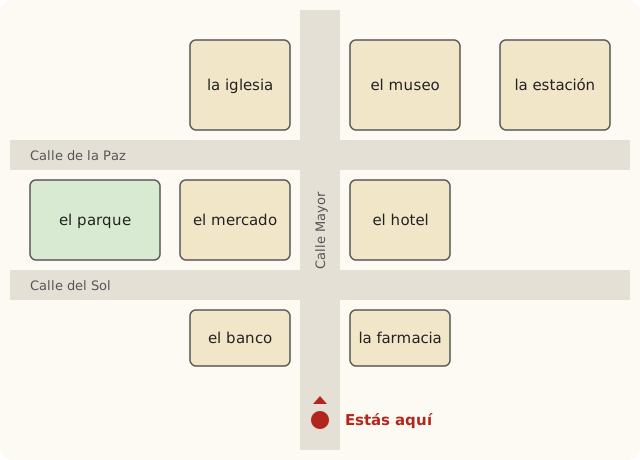
| Spanish | English | Example from Figure 9.1 |
|---|---|---|
| cerca de | near | El banco está cerca de la farmacia. |
| lejos de | far from | La estación está lejos del banco. |
| al lado de | next to | El parque está al lado del mercado. |
| enfrente de | opposite | El museo está enfrente de la iglesia. |
| delante de | in front of | La parada está delante del hotel. |
| detrás de | behind | El aparcamiento está detrás del mercado. |
| entre … y … | between … and … | El hotel está entre la farmacia y el museo. |
| a la derecha de | to the right of | La estación está a la derecha del museo. |
| a la izquierda de | to the left of | El parque está a la izquierda del mercado. |
| en la esquina | on the corner | La farmacia está en la esquina. |
| al final de | at the end of | La estación está al final de la calle. |
| en | in, on, at | El hotel está en la calle Mayor. |
Table 9.5. Prepositions of place. The parking and the bus stop are not drawn on the map.
Almost all of these end in de, and de + el becomes del: al lado del hotel, but al lado de la farmacia, al lado de los bancos. Without a noun after them, the de disappears: Está cerca. Está a la derecha. Está enfrente.
Aquí means "here", ahí "there" (near you), and allí "over there". Aquí mismo is "right here".
How far is it?
Distance and time are introduced with a:
- ¿Está lejos? — No, está a cinco minutos. — Is it far? — No, it's five minutes away.
- Está a diez minutos a pie. — It's ten minutes on foot.
- Está a dos kilómetros del centro. — It's two kilometres from the centre.
- Está a veinte minutos en autobús. — It's twenty minutes by bus.
To ask how to get somewhere, use ¿Cómo llego a …? ("How do I get to …?"), from the regular verb llegar, "to arrive". Remember a + el = al: ¿Cómo llego al museo?, ¿Cómo llego a la estación?
9.4 Grammar: giving and understanding directions
Direction phrases, usted and tú
Directions use a verb form called the imperative, the form for instructions. You will study it properly later; for now, learn these phrases as they are. The usted form is what a stranger will usually say to you; the tú form is what friends say to each other.
| To usted | To tú | English |
|---|---|---|
| siga todo recto | sigue todo recto | go straight on |
| gire a la derecha | gira a la derecha | turn right |
| gire a la izquierda | gira a la izquierda | turn left |
| tome la primera calle | toma la primera calle | take the first street |
| cruce la plaza | cruza la plaza | cross the square |
| pase el semáforo | pasa el semáforo | go past the traffic lights |
| continúe hasta el puente | continúa hasta el puente | carry on as far as the bridge |
| suba la calle | sube la calle | go up the street |
| baje la calle | baja la calle | go down the street |
Table 9.6. Directions. Practice hides the verbs.
Notice the swap of vowels: for an -ar verb, the usted instruction ends in -e (girar → gire) and the tú instruction in -a (gira, the same as "he turns"). For seguir ("to follow, continue"), an irregular -ir verb, the forms are siga and sigue.
Derecha and derecho
a la derecha means "to the right". todo derecho or siga derecho means "straight on", and is the usual expression in Latin America; in Spain people mostly say todo recto. In Latin America you will also hear doble a la derecha ("turn right", from doblar) instead of gire. Listen for the last vowel: derecha is a side, derecho is ahead.
Many people avoid the imperative altogether and simply describe the route in the present tense, which you already know from Lesson 6:
- Sigues todo recto, giras a la izquierda y el banco está allí. — You go straight on, you turn left and the bank is there.
- Usted cruza la plaza y toma la segunda calle. — You cross the square and take the second street.
Ordinal numbers
| Number | Masculine | Feminine | English |
|---|---|---|---|
| 1.º / 1.ª | primero (primer) | primera | first |
| 2.º / 2.ª | segundo | segunda | second |
| 3.º / 3.ª | tercero (tercer) | tercera | third |
| 4.º / 4.ª | cuarto | cuarta | fourth |
| 5.º / 5.ª | quinto | quinta | fifth |
Table 9.7. Ordinal numbers. They are adjectives, so they agree with the noun.
- Ordinals usually come before the noun and agree with it: la segunda calle, el cuarto piso, las primeras casas.
- primero and tercero drop the -o before a masculine singular noun, like bueno (Lesson 7): el primer semáforo, el tercer piso, but la primera calle.
- They are abbreviated with a raised o or a: 1.º, 2.ª. Above about tenth, people use ordinary numbers: el piso doce.
Worked example: from the start to the station
Use Figure 9.1. You are at "Estás aquí". Give directions to the station, first to a stranger (usted), then to a friend (tú).
- Start: you face up Calle Mayor. Siga todo recto por la calle Mayor.
- The first street is Calle del Sol; the station is on Calle de la Paz, the second. Tome la segunda calle a la derecha.
- Walking right along Calle de la Paz, the station is on your left, at the end: La estación está al final de la calle, a la izquierda.
To a friend: Sigue todo recto, toma la segunda calle a la derecha, y la estación está al final, a la izquierda.
9.5 Practice
Where is it?
Look at Figure 9.1 and answer each question aloud. Then listen to the answer.
| Question | Answer |
|---|---|
| ¿Dónde está la farmacia? | Está en la calle Mayor, en la esquina, enfrente del banco. |
| ¿Dónde está el hotel? | Está entre la farmacia y el museo. |
| ¿Hay un parque por aquí? | Sí, hay uno al lado del mercado. |
| ¿Dónde está la iglesia? | Está enfrente del museo. |
| ¿Está lejos la estación? | No, está a cinco minutos a pie. |
Table 9.8. Questions and answers about the map.
Follow the directions
Start at "Estás aquí" each time. Listen and find where you end up.
- Siga todo recto y tome la primera calle a la izquierda. Está a la derecha, en la esquina. — (the market)
- Siga todo recto, pase la calle del Sol, y está a la derecha, antes de la calle de la Paz. — (the hotel)
- Está aquí mismo, a la izquierda, en la esquina. — (the bank)
- Siga todo recto hasta la calle de la Paz y cruce. Está a la izquierda. — (the church)
Say it
Choose a place near where you live or study. Explain to a visitor (usted) how to get there from your front door, in three or four instructions. For example:
Al salir, gire a la izquierda. Siga todo recto hasta el semáforo. Cruce la calle y tome la segunda calle a la derecha. El supermercado está al final, enfrente del parque.
9.6 Culture: towns in Spain and Latin America
The square at the heart. Most Spanish towns have a main square, often called la plaza mayor, with the town hall and the main church around it; the one in Salamanca, where our characters study, is among the most admired in Spain. Many Latin American cities founded during the colonial period were laid out on a grid of straight streets around a central square. In Peru, Chile and several other countries it is called la plaza de armas; in Mexico City and other Mexican cities, el zócalo. Life happens in the square: people meet there, children play there in the evening, and it is the natural landmark for any directions.
Blocks. In Latin America, distances in town are often given in blocks: está a tres cuadras, "it's three blocks away". In Spain a block of buildings is una manzana (the same word as "apple"), but people more often count streets: la tercera calle.
Addresses. A Spanish address puts the street first and the number after it, followed by the floor and the door: Calle Mayor, 12, 3.º izquierda means number 12, third floor, the flat on the left. Spaniards call the ground floor la planta baja, so their "first floor" is one floor up, as in British English. In much of Latin America the ground floor is el primer piso, as in American English.
Transport words. The bus has different names in different places:
| Place | Bus | Underground |
|---|---|---|
| Spain | el autobús, el bus | el metro |
| Mexico | el camión, el autobús | el metro |
| Argentina | el colectivo | el subte (Buenos Aires) |
| Cuba, Puerto Rico, the Canary Islands | la guagua | — |
Table 9.9. Words for the bus and the underground.
Asking a stranger. People in Spain and Latin America are generally happy to help, and sometimes they will walk with you part of the way. Speak slowly and politely, use usted with older people, and if the answer is too fast, say Más despacio, por favor ("More slowly, please") or ¿Puede repetir, por favor? ("Could you repeat, please?").
9.7 Summary
Summary
- Asking: ¿Dónde está el museo? (a particular place); ¿Hay una farmacia por aquí? (any place of a kind). Answer with está or hay. ¿Cómo llego a …? = How do I get to …?
- Prepositions of place: cerca de, lejos de, al lado de, enfrente de, delante de, detrás de, entre … y …, a la derecha de, a la izquierda de, en la esquina, al final de. de + el = del.
- Distance: Está a cinco minutos a pie; está a dos kilómetros.
- Directions (usted / tú): siga / sigue todo recto; gire / gira a la derecha; tome / toma la primera calle; cruce / cruza la plaza. Latin America also: siga derecho, doble.
- Ordinals: primero, segundo, tercero, cuarto, quinto, agreeing with the noun; primer, tercer before a masculine singular noun.
- Transport: en autobús, en metro, en tren, en coche, a pie.
9.8 Exercises
Exercise 1
Give the Spanish for "the railway station".
Answer
la estación de tren. la estación de tren
Exercise 2
You need any cash machine. Ask if there is one near here.
Answer
¿Hay un cajero por aquí? ¿Hay un cajero automático por aquí?
Exercise 3
Complete with está or hay: ¿Dónde ___ la catedral?
Answer
está. ¿Dónde está la catedral? A particular place takes estar.
Exercise 4
Complete: El banco está al lado ___ hotel.
Answer
del. El banco está al lado del hotel. de + el = del.
Exercise 5
A friend asks the way. Tell them "turn left" (tú).
Answer
Gira a la izquierda. Gira a la izquierda. To usted: Gire a la izquierda.
Exercise 6
Translate "the first traffic lights" (one set of lights: el semáforo).
Answer
el primer semáforo. el primer semáforo. primero loses its -o before a masculine singular noun.
Exercise 7
Say "It's ten minutes on foot."
Answer
Está a diez minutos a pie. Está a diez minutos a pie. Also andando or caminando.
Exercise 8
What is the difference between a la derecha and todo derecho?
Answer
a la derecha means "on the right, to the right"; todo derecho means "straight on" (Spain usually says todo recto).
Exercise 9
Correct the mistake: Hay el museo enfrente de la iglesia.
Answer
El museo está enfrente de la iglesia. A particular place, with el, goes with estar. Alternatively, Hay un museo enfrente de la iglesia.
Exercise 10
Using Figure 9.1, tell a stranger (usted) how to get from "Estás aquí" to the park.
Answer
Siga todo recto y tome la primera calle a la izquierda. El parque está a la derecha, después del mercado. (Walking left along Calle del Sol, you pass the market and then reach the park, both on your right; después de means "after".)
9.9 Quiz
Quiz: the city and directions
Exercise 11
You want any chemist's, not a particular one. You ask:
- ¿Dónde está la farmacia?
- ¿Hay una farmacia por aquí?
- ¿Está una farmacia?
- ¿Hay la farmacia?
Answer
¿Hay una farmacia por aquí?
Any place of a kind takes hay with un or una.
Exercise 12
"Go straight on" to a stranger (usted), in Spain:
- Sigue todo recto.
- Siga todo recto.
- Gire todo recto.
- Siga a la derecha.
Answer
Siga todo recto.
Exercise 13
La parada está enfrente ___ museo.
Answer
del
enfrente de + el museo = enfrente del museo.
Exercise 14
Tome la ___ calle a la izquierda. (second)
Answer
segunda
calle is feminine, so segunda.
Exercise 15
Say "the third floor" (piso is masculine).
Answer
el tercer piso
Exercise 16
Match the Spanish to the English.
| A | B |
|---|---|
| al lado de | behind |
| enfrente de | far from |
| detrás de | next to |
| lejos de | opposite |
Answer
al lado de — next to; enfrente de — opposite; detrás de — behind; lejos de — far from
Exercise 17
Tap the wrong word.
El hotel está en el primero piso.
Answer
Wrong word: primero.
Corrected: El hotel está en el primer piso.
Before a masculine singular noun primero becomes primer.
Exercise 18
Put the words in order.
Words: llego / estación? / la / ¿Cómo / a
Answer
¿Cómo llego a la estación?
Exercise 19
Write what you hear.
Dictation. Have someone read the sentence aloud, then write it down.
Gire a la derecha y cruce la plaza.
Answer
Gire a la derecha y cruce la plaza.
Exercise 20
Say it aloud.
Perdone, ¿dónde está la oficina de turismo?
Answer
Say: Perdone, ¿dónde está la oficina de turismo?