Lesson 5: Ser and Estar
Ser y estar: two ways to be
English has one verb "to be". Spanish has two, ser and estar, and they are not interchangeable. "I am English" uses ser; "I am tired" uses estar; "I am in Madrid" uses estar again. The difference is one of the first things that makes Spanish feel like Spanish, and once you see the logic it is less mysterious than it looks: roughly, ser says what something is, estar says where it is and how it is at the moment. In this lesson you learn both verbs in full, the uses of each, a few adjectives that change their meaning with the verb, and how to choose between hay and está.
Learning outcomes
By the end of this lesson you will be able to:
- conjugate ser and estar in the present tense;
- use ser for identity, origin, jobs, characteristics, time, material and events;
- use estar for location, feelings and temporary conditions;
- recognise adjectives whose meaning changes with ser and estar, such as listo and aburrido;
- choose between hay and está when you talk about places.
masculinefeminineplural
5.1 Dialogue: a phone call
Lucía phones Daniel on a Thursday afternoon.
- Lucía: ¡Hola, Daniel! ¿Dónde estás? — Hi, Daniel! Where are you?
- Daniel: Estoy en un café cerca de la catedral. ¿Y tú? — I'm in a café near the cathedral. And you?
- Lucía: Estoy en casa. ¿Estás solo? — I'm at home. Are you on your own?
- Daniel: No, estoy con Marta, una amiga. Es de Valencia. — No, I'm with Marta, a friend. She's from Valencia.
- Lucía: ¿Es estudiante también? — Is she a student too?
- Daniel: No, es médica. Trabaja en el hospital. — No, she's a doctor. She works at the hospital.
- Lucía: ¿Y cómo es? — And what's she like?
- Daniel: Es muy simpática y muy inteligente. Pero hoy está muy cansada. — She's very nice and very clever. But today she's very tired.
- Lucía: Claro, los médicos trabajan mucho. Oye, la fiesta de Pablo es el sábado. — Of course, doctors work a lot. Listen, Pablo's party is on Saturday.
- Daniel: ¿Dónde es la fiesta? — Where's the party?
- Lucía: Es en su casa. La casa está en la calle Toro, número doce. — It's at his house. The house is at number twelve, Calle Toro.
- Daniel: ¿A qué hora es? — What time is it?
- Lucía: Es a las nueve. ¡Es una sorpresa! — It's at nine. It's a surprise!
- Daniel: ¡Qué bien! Estoy muy contento. Hasta el sábado. — Great! I'm really pleased. See you on Saturday.
Look at every "is" and "am" in the dialogue and ask: is the speaker saying what someone or something is, or where and how they are?
- ser: Marta es de Valencia (origin), es médica (job), es simpática (character); the party es el sábado, es en su casa, es a las nueve (an event: when and where it takes place); es una sorpresa (what it is).
- estar: estoy en un café, la casa está en la calle Toro (location); está cansada, estoy contento (how someone feels now).
5.2 Vocabulary: describing people, states and feelings
Character and appearance (usually with ser)
| Spanish | Sounds like | English |
|---|---|---|
| simpático, simpática | [seem-PAH-tee-koh] | nice, friendly |
| antipático, antipática | [ahn-tee-PAH-tee-koh] | unfriendly, unpleasant |
| inteligente | [een-teh-lee-HEHN-teh] | intelligent, clever |
| trabajador, trabajadora | [trah-bah-hah-DOR] | hard-working |
| alto, alta | [AHL-toh] | tall |
| bajo, baja | [BAH-hoh] | short |
| joven | [HOH-behn] | young |
| mayor | [mah-YOR] | old, elderly (polite); older |
| grande / pequeño, pequeña | [GRAHN-deh / peh-KEH-nyoh] | big / small |
| divertido, divertida | [dee-behr-TEE-doh] | fun, funny |
| serio, seria | [SEH-ryoh] | serious |
Table 5.1. Adjectives of character and appearance.
States and feelings (with estar)
| Spanish | Sounds like | English |
|---|---|---|
| cansado, cansada | [kahn-SAH-doh] | tired |
| contento, contenta | [kohn-TEHN-toh] | happy, pleased |
| triste | [TREES-teh] | sad |
| enfadado, enfadada | [ehn-fah-DAH-doh] | angry (Spain) |
| enojado, enojada | [eh-noh-HAH-doh] | angry (Latin America) |
| nervioso, nerviosa | [nehr-BYOH-soh] | nervous |
| enfermo, enferma | [ehn-FEHR-moh] | ill, sick |
| ocupado, ocupada | [oh-koo-PAH-doh] | busy |
| preocupado, preocupada | [preh-oh-koo-PAH-doh] | worried |
| abierto, abierta / cerrado, cerrada | [ah-BYEHR-toh / seh-RRAH-doh] | open / closed |
| sucio, sucia / limpio, limpia | [SOO-syoh / LEEM-pyoh] | dirty / clean |
| lleno, llena / vacío, vacía | [YEH-noh / bah-SEE-oh] | full / empty |
Table 5.2. States and feelings. Like all adjectives, they agree with the person or thing: Marta está cansada, los chicos están cansados.
Jobs
| Masculine | Feminine | English |
|---|---|---|
| médico | médica | doctor |
| profesor | profesora | teacher |
| enfermero | enfermera | nurse |
| abogado | abogada | lawyer |
| camarero | camarera | waiter, waitress (mesero, mesera in Mexico) |
| ingeniero | ingeniera | engineer |
| estudiante | estudiante | student |
| periodista | periodista | journalist |
Table 5.3. Some jobs.
5.3 Grammar: the two verbs
Both verbs are irregular, and both are used constantly, so learn them perfectly.
| Person | ser | estar | English |
|---|---|---|---|
| yo | soy | estoy | I am |
| tú | eres | estás | you are |
| él, ella, usted | es | está | he, she is; you are |
| nosotros, nosotras | somos | estamos | we are |
| vosotros, vosotras | sois | estáis | you are (Spain) |
| ellos, ellas, ustedes | son | están | they are; you are |
Table 5.4. Ser and estar in the present tense. Switch on Practice and write the forms from memory.
- Soy, eres, es, somos, sois, son. — Say the whole of ser aloud three times.
- Estoy, estás, está, estamos, estáis, están. — Then estar.
Pay attention to the written accents of estar. está [ehs-TAH] ("is") and esta [EHS-tah] ("this", feminine) are different words: the accent marks the stress on the last syllable. All the forms of estar except estoy and estamos carry one.
5.4 Grammar: when to use which
Uses of ser
| Use | Example | English |
|---|---|---|
| identity, who or what | Soy Daniel. Es una sorpresa. | I'm Daniel. It's a surprise. |
| origin, nationality | Marta es de Valencia. Es española. | Marta is from Valencia. She's Spanish. |
| job, religion, membership | Es médica. Somos estudiantes. | She's a doctor. We're students. |
| characteristics | Es alta y simpática. | She's tall and nice. |
| relationship | Pablo es mi primo. | Pablo is my cousin. |
| possession (ser de) | El libro es de Ana. | The book is Ana's. |
| material (ser de) | La mesa es de madera. | The table is (made of) wood. |
| time, days, dates | Son las tres. Hoy es lunes. | It's three o'clock. Today is Monday. |
| events: when and where | La fiesta es en mi casa. | The party is at my house. |
| prices, totals | ¿Cuánto es? Son diez euros. | How much is it? It's ten euros. |
Table 5.5. The uses of ser.
Common mistake: un or una with jobs
After ser, a job, nationality or religion takes no article: Es médica, "She's a doctor", not es una médica. The article comes back when you add an adjective: Es una médica excelente, "She's an excellent doctor".
Uses of estar
| Use | Example | English |
|---|---|---|
| location of people and things | Estoy en un café. Madrid está en el centro de España. | I'm in a café. Madrid is in the centre of Spain. |
| how you are | ¿Cómo estás? — Estoy bien. | How are you? — I'm well. |
| feelings and moods | Estamos contentos. Está nerviosa. | We're happy. She's nervous. |
| physical states | Están cansados. Estoy enfermo. | They're tired. I'm ill. |
| conditions of things | La sopa está fría. La puerta está abierta. | The soup is cold. The door is open. |
| with bien and mal | Está bien. Está mal. | It's fine. It's wrong. |
Table 5.6. The uses of estar.
Estar is also the verb of the "-ing" form, Estoy estudiando ("I am studying"). You do not need it yet; it is mentioned here so that you recognise it.
Permanent and temporary: a useful idea, not the whole rule
You will often read that ser is for permanent things and estar for temporary ones. That is a good first guide, and it explains es alta (she is tall: a lasting trait) against está cansada (she is tired: right now). But it is not the real rule, as two examples show:
- Location always takes estar, even when it is permanent: Madrid está en España. Madrid is not going anywhere.
- Time takes ser, even though it changes every minute: Son las tres.
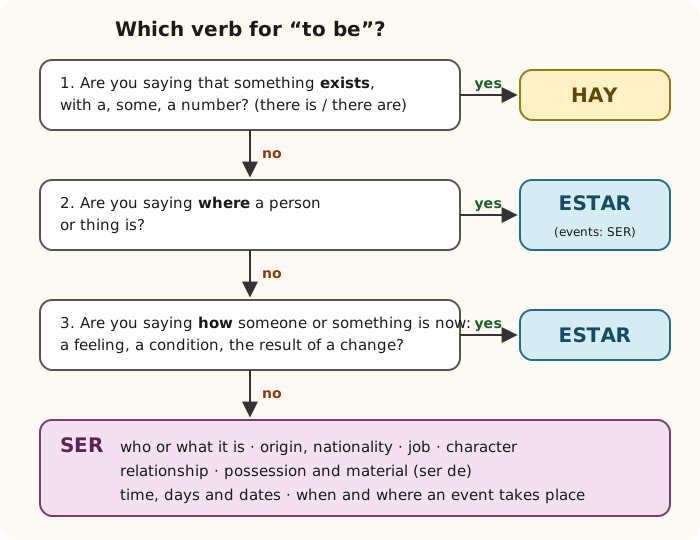
So think of it this way: ser classifies and defines (what, who, what kind, from where, when an event happens); estar locates and describes a state or condition (where something is, how someone or something is now).
The same adjective with both verbs
With most descriptive adjectives you can use either verb, and the verb changes the message:
- Luis es nervioso. — Luis is a nervous person. (his character)
- Luis está nervioso. — Luis is nervous. (now, before his exam)
- La sopa es buena aquí. — The soup is good here. (as a rule)
- ¡La sopa está muy buena! — The soup tastes really good! (this soup, now)
- ¡Qué guapa eres! — How pretty you are!; ¡Qué guapa estás! — How pretty you look (today)!
A few adjectives change their meaning altogether:
| Adjective | with ser | with estar |
|---|---|---|
| listo | es listo — he is clever | está listo — he is ready |
| aburrido | es aburrido — he is boring | está aburrido — he is bored |
| malo | es malo — he is bad, wicked | está malo — he is ill (Spain); it has gone off (food) |
| rico | es rico — he is rich | está rico — it is tasty (food) |
| verde | es verde — it is green | está verde — it is unripe |
Table 5.7. Adjectives that change meaning with ser and estar.
Common mistake: es bien
"It's fine", "it's OK" and "it's wrong" are está bien and está mal, never es bien. bien and mal are adverbs, and they go with estar. With ser use the adjectives: Es bueno ("It's good"), Es malo ("It's bad").
Two special cases
Death is grammatically a state, so it takes estar: El pez está muerto ("The fish is dead"). Marital status is often said with estar, Estoy casado ("I'm married"), though Soy casado is also heard, especially in Latin America. With feliz ("happy"), both verbs are common.
Hay or está?
Both can translate "is" when you talk about places, and they are easy to confuse. The difference is the difference between "a" and "the":
| Use | Example | |
|---|---|---|
| something new, not yet mentioned: a, some, numbers, no article | hay | Hay un banco en la plaza. — There's a bank in the square. |
| a particular, known thing or person: the, my, names | está / están | El banco está en la plaza. — The bank is in the square. |
Table 5.8. Hay or está?
- ¿Hay un baño por aquí? — Is there a toilet around here? (any toilet)
- ¿Dónde está el baño? — Where is the toilet? (the one I know exists)
- Hay dos farmacias en esta calle. — There are two chemists in this street.
- Mis llaves están en la mesa. — My keys are on the table.
Worked example: choosing the verb
Translate: "My brother is a teacher. He's from Bilbao, but now he's in Mexico. He's very happy there. The school is in the centre, and there's a park near the school."
- My brother is a teacher: job, no article → Mi hermano es profesor.
- He's from Bilbao: origin → Es de Bilbao,
- but now he's in Mexico: location → pero ahora está en México.
- He's very happy there: feeling → Está muy contento allí.
- The school is in the centre: location of a known thing → El colegio está en el centro,
- and there's a park near the school: something new → y hay un parque cerca del colegio.
5.5 Practice
Ser or estar?
| Sentence | Verb | Why |
|---|---|---|
| Ana ___ de Chile. | Ana es de Chile. | origin |
| Yo ___ cansado. | Yo estoy cansado. | state |
| Nosotros ___ en clase. | Nosotros estamos en clase. | location |
| Mis padres ___ abogados. | Mis padres son abogados. | job |
| ¿Qué hora ___? | ¿Qué hora es? | time |
| La ventana ___ abierta. | La ventana está abierta. | condition |
| El concierto ___ en el teatro. | El concierto es en el teatro. | event |
| ¿Cómo ___ tú? | ¿Cómo estás tú? | how you are |
| La casa ___ muy grande. | La casa es muy grande. | characteristic |
Table 5.9. Practice: choose and conjugate the verb.
Who are they, and how are they?
Read each pair aloud. The first sentence says what the person is like; the second says how they are today.
- Carmen es muy alegre, pero hoy está triste. — Carmen is a very cheerful person, but today she's sad.
- Jorge es tranquilo, pero hoy está nervioso: tiene un examen. — Jorge is calm by nature, but today he's nervous: he has an exam.
- Mis abuelos son mayores, pero están muy bien. — My grandparents are old, but they're very well.
Say it
Describe a friend in four sentences: who they are, where they are from, what they are like, and how they are today. For example:
Mi amiga se llama Elena. Es de Lima. Es muy simpática y trabajadora. Hoy está un poco cansada.
5.6 Culture: "How are you?" and "What are you like?"
¿Cómo estás? and ¿Cómo eres? These two questions show the difference between the verbs perfectly. ¿Cómo estás? means "How are you?" (today, now); ¿Cómo eres? means "What are you like?" (as a person). In a job interview or on a language exchange you might hear ¿Cómo eres? Descríbete. ("What are you like? Describe yourself.")
Being ill in Spain and in Latin America. In Spain estoy malo is the everyday way to say "I'm ill", and estoy enfermo is a little more formal. In much of Latin America estoy enfermo is the normal phrase, and estar malo is used less for people.
Angry and annoyed. Spain says estar enfadado for "to be angry"; Latin America says estar enojado. Both are understood everywhere.
Polite descriptions. Spanish speakers often soften descriptions of people. Instead of viejo ("old"), they say mayor ("older"): Mi abuela es mayor. And nicknames based on looks, such as gordo ("fatty") or flaco ("skinny"), are used affectionately between friends and family in many Latin American countries in a way that surprises many English speakers. Listen to how they are used before trying them yourself.
¿Dónde está…? The phrase ¿Dónde está…? is one of the most useful in any trip: ¿Dónde está la estación? ¿Dónde está el museo? Add perdone (to someone you call usted) or perdona (tú) in front to stop someone politely in the street: Perdone, ¿dónde está la estación? Lesson 9 shows how to understand the answer.
5.7 Summary
Summary
- ser: soy, eres, es, somos, sois, son. estar: estoy, estás, está, estamos, estáis, están.
- ser classifies and defines: identity, origin, nationality, job (no article), characteristics, relationships, possession and material (ser de), time and dates, events (la fiesta es en mi casa), prices.
- estar locates and describes a state: location of people and things (even permanent), how you are, feelings, physical states, conditions; always with bien and mal.
- The same adjective can go with both verbs: es nervioso (by nature) / está nervioso (now). Some change meaning: listo, aburrido, malo, rico, verde.
- hay introduces something new (a, some, numbers); está / están locates something known (the, my, names).
5.8 Exercises
Exercise 1
Complete with ser: Nosotros ___ de Irlanda.
Answer
somos. Nosotros somos de Irlanda. Origin uses ser.
Exercise 2
Complete with estar: ¿Dónde ___ mis llaves?
Answer
están. ¿Dónde están mis llaves? Location, and the subject (mis llaves) is plural.
Exercise 3
Ser or estar? Mi madre ___ enfermera.
Answer
es. Mi madre es enfermera. A job, with no article.
Exercise 4
Ser or estar? El café ___ frío. (The coffee in your cup has gone cold.)
Answer
está. El café está frío. The condition of the coffee now.
Exercise 5
Ser or estar? La reunión ___ en la sala dos. (la reunión = the meeting)
Answer
es. La reunión es en la sala dos. The place where an event takes place uses ser.
Exercise 6
Hay or está? ___ un supermercado cerca de mi casa.
Answer
Hay. Hay un supermercado cerca de mi casa. Something new, with un.
Exercise 7
How do you say "The children are bored"? (the children: los niños)
Answer
Los niños están aburridos. Los niños están aburridos. With estar, aburrido means bored; with ser, it would mean boring.
Exercise 8
Translate "I'm ready" for a woman.
Answer
Estoy lista. Estoy lista. Estar listo means to be ready; ser listo means to be clever.
Exercise 9
Correct the mistakes: Pedro está un estudiante. Es en la biblioteca y es muy cansado.
Answer
Pedro es estudiante. Está en la biblioteca y está muy cansado. A job takes ser and no article; location and tiredness take estar.
Exercise 10
Write four sentences about yourself: your name, where you are from, what you are like, and where you are now.
Answer
Model answer: Soy Laura. Soy de Dublín. Soy alegre y un poco tímida. Ahora estoy en casa. Check that you used ser for the first three and estar for the last.
5.9 Quiz
Quiz: ser and estar
Exercise 11
Madrid ___ en el centro de España.
- es
- está
- hay
- son
Answer
está
Location takes estar, even when it is permanent.
Exercise 12
Hoy ___ martes.
- es
- está
- estoy
- hay
Answer
es
Days, dates and the time take ser.
Exercise 13
Which sentence means "He is ready"?
- Es listo.
- Está listo.
- Hay listo.
- Son listos.
Answer
Está listo.
estar listo = to be ready; ser listo = to be clever.
Exercise 14
Vosotros ___ muy simpáticos, pero hoy ___ cansados.
Answer
sois · estáis / estais
Character with ser (sois); a state now with estar (estáis).
Exercise 15
Say "She is a doctor" in Spanish.
Answer
Es médica / Ella es médica / Es médico / Ella es médico
No article before a job after ser.
Exercise 16
Match each sentence to the reason for the verb.
| A | B |
|---|---|
| Soy de Perú. | time |
| Estoy en el hotel. | feeling |
| Son las dos. | origin |
| Estoy triste. | location |
Answer
Soy de Perú. — origin; Estoy en el hotel. — location; Son las dos. — time; Estoy triste. — feeling
Exercise 17
Tap the wrong word.
La fiesta está en casa de Pablo.
Answer
Wrong word: está.
Corrected: La fiesta es en casa de Pablo.
Where an event takes place uses ser.
Exercise 18
Put the words in order: "There is a bank near the station."
Words: Hay / banco / estación. / de / la / un / cerca
Answer
Hay un banco cerca de la estación.
Exercise 19
Write what you hear.
Dictation. Have someone read the sentence aloud, then write it down.
Mi hermana es médica y está en el hospital.
Answer
Mi hermana es médica y está en el hospital.