Lesson 5: Articles, the Nominative, sein and haben
Artikel, Nominativ, sein und haben
With nouns and their genders in place, you can now build real sentences about people and things. This lesson brings together four essentials. The first is the word for "a", which, like the word for "the", has a form for each gender: ein, eine, ein. The second is kein, "no, not a", German's way of saying that something is not there. The third is the idea of case, which explains why these words sometimes change; you meet the first case, the nominative, here. And the fourth is the pair of verbs you will use in almost every conversation: sein ("to be") and haben ("to have").
Learning outcomes
By the end of this lesson you will be able to:
- use the indefinite article ein, eine, ein and the negative article kein, keine, kein, keine;
- use the possessives mein, dein and Ihr with nouns of every gender;
- recognise the subject of a sentence and use the nominative case;
- conjugate sein and haben, and use them where German and English differ (Ich habe Hunger, Ich bin zwanzig);
- say what your job is, without an article: Ich bin Lehrerin;
- choose between nicht and kein.
masculinefeminineneuterplural
5.1 Dialogue: the birthday party
Emma and Ravi arrive at Jonas's birthday party.
- Jonas: Emma, Ravi, hallo! Kommt rein! — Emma, Ravi, hi! Come in!
- Emma: Alles Gute zum Geburtstag, Jonas! Hier, ein Geschenk für dich. — Happy birthday, Jonas! Here, a present for you.
- Jonas: Oh, danke! Das ist ein Buch! Super. — Oh, thanks! It's a book! Great.
- Ravi: Wer ist die Frau da? Ist das deine Freundin? — Who is the woman there? Is that your girlfriend?
- Jonas: Nein, das ist keine Freundin, das ist meine Schwester Lena. Sie ist Ärztin. — No, that's not a girlfriend, that's my sister Lena. She's a doctor.
- Ravi: Und der Mann? Ist er auch Arzt? — And the man? Is he a doctor too?
- Jonas: Nein, das ist mein Bruder Tim. Er ist Koch. Habt ihr Hunger? — No, that's my brother Tim. He's a cook. Are you hungry?
- Ravi: Ja, ich habe Hunger! Und Durst. — Yes, I'm hungry! And thirsty.
- Jonas: Die Pizza ist in der Küche, und die Getränke auch. — The pizza is in the kitchen, and the drinks too.
- Lena: Hallo! Ich bin Lena. Bist du Emma aus England? — Hi! I'm Lena. Are you Emma from England?
- Emma: Ja, genau. Und du bist Ärztin, oder? — Yes, exactly. And you're a doctor, aren't you?
- Lena: Ja. Und was bist du von Beruf? — Yes. And what do you do for a living?
- Emma: Ich bin Lehrerin, aber jetzt bin ich Studentin. Ich habe ein Jahr frei. — I'm a teacher, but now I'm a student. I have a year off.
- Lena: Toll! Dein Deutsch ist sehr gut. — Great! Your German is very good.
- Emma: Danke, du bist sehr nett. Aber ich habe noch viele Probleme mit der Grammatik! — Thanks, you're very kind. But I still have lots of problems with grammar!
Notice:
- "a" is ein or eine: ein Buch, ein Geschenk, ein Jahr. "Not a" is kein or keine: keine Freundin.
- "My" and "your" also change with the gender: mein Bruder, meine Schwester, deine Freundin, dein Deutsch.
- Jobs have no article: Sie ist Ärztin. Er ist Koch. ("She is a doctor. He is a cook.")
- German says "I have hunger": Ich habe Hunger.
5.2 Vocabulary: jobs, states and phrases with haben
Jobs
| Man | Woman | English |
|---|---|---|
| der Arzt | die Ärztin | doctor |
| der Lehrer | die Lehrerin | teacher |
| der Student | die Studentin | student (at university) |
| der Schüler | die Schülerin | pupil (at school) |
| der Koch | die Köchin | cook, chef |
| der Kellner | die Kellnerin | waiter, waitress |
| der Verkäufer | die Verkäuferin | shop assistant |
| der Ingenieur | die Ingenieurin | engineer |
| der Informatiker | die Informatikerin | computer scientist, IT specialist |
| der Krankenpfleger | die Krankenpflegerin | nurse |
| der Polizist | die Polizistin | police officer |
| der Mechaniker | die Mechanikerin | mechanic |
| der Rentner | die Rentnerin | pensioner, retired person |
| der Beruf | job, profession |
Table 5.1. Jobs. The feminine adds -in, sometimes with an umlaut: Arzt → Ärztin, Koch → Köchin.
How are you? States and descriptions
| German | English |
|---|---|
| müde | tired |
| krank / gesund | ill / healthy |
| glücklich / traurig | happy / sad |
| nervös | nervous |
| nett | nice, kind |
| fertig | finished, ready; also "exhausted" |
| verheiratet / ledig | married / single |
| zu Hause | at home |
| da | here, present; there |
| arbeitslos | unemployed |
Table 5.2. Words to use with sein.
Phrases with haben
| German | English |
|---|---|
| Hunger haben | to be hungry |
| Durst haben | to be thirsty |
| Zeit haben | to have time, to be free |
| keine Zeit haben | to be busy |
| Lust haben | to feel like (doing something) |
| Glück haben | to be lucky |
| Angst haben | to be afraid |
| recht haben | to be right |
| Geburtstag haben | to have one's birthday |
| Kopfschmerzen haben | to have a headache |
| frei haben | to be off work, have time off |
Table 5.3. Phrases with haben where English uses "to be".
Other words
| German | English |
|---|---|
| das Geschenk, die Geschenke | the present, gift |
| das Getränk, die Getränke | the drink |
| das Problem, die Probleme | the problem |
| die Schwester, die Schwestern | the sister |
| der Bruder, die Brüder | the brother |
| genau | exactly; that's right |
| oder? | … isn't it? … don't you? (at the end of a sentence) |
| noch | still |
| viele | many, lots of |
Table 5.4. Other words from the dialogue.
5.3 Grammar: articles and the nominative case
What a case is
In English, he and him are the same person in different roles: He sees the dog but The dog sees him. These roles are called cases. English shows them only in a few pronouns (I / me, he / him, she / her, we / us, they / them, who / whom). German shows them also in the articles and possessives before nouns. German has four cases:
| Case | Main job | Taught in |
|---|---|---|
| nominative | the subject: who or what does or is something | this lesson |
| accusative | the direct object: who or what is affected | Lesson 8 |
| dative | the indirect object, and after many prepositions | Lesson 11 |
| genitive | possession ("of"), mostly in writing | for recognition only |
Table 5.5. The four cases.
The nominative is the case of the subject, the person or thing that does the action or that the sentence is about. It is also the case after sein ("to be") and heißen: in Das ist ein Buch, both das and ein Buch are in the nominative. All the forms you have learnt so far are nominative forms, and the nominative is the form in which nouns are listed in dictionaries.
To find the subject, ask who? (wer?) or what? (was?) before the verb: Mein Bruder ist Koch. Who is a cook? Mein Bruder: the subject, nominative.
The indefinite article: ein, eine, ein
The word for "a" or "an" has a form for each gender. Masculine and neuter look the same; feminine adds -e. There is no plural, as in English: "a book", but "books".
| Masculine | Feminine | Neuter | Plural | |
|---|---|---|---|---|
| definite: the | der Tisch | die Lampe | das Buch | die Bücher |
| indefinite: a | ein Tisch | eine Lampe | ein Buch | Bücher |
| negative: no, not a | kein Tisch | keine Lampe | kein Buch | keine Bücher |
| possessive: my | mein Tisch | meine Lampe | mein Buch | meine Bücher |
Table 5.6. The articles and possessives in the nominative. Switch on Practice and fill them in.
The rule to remember: ein, kein and the possessives add -e for feminine and plural, and nothing for masculine and neuter. Learn one line and you have them all.
The negative article kein
kein means "no", "not a" or "not any". It is the negative of ein and of nouns with no article, and it takes the same endings as ein, with a plural form keine:
- Das ist ein Problem. → Das ist kein Problem. — That's no problem.
- Das ist eine Freundin. → Das ist keine Freundin. — That's not a girlfriend.
- Ich habe Zeit. → Ich habe keine Zeit. — I have no time.
- Hier sind Stühle. → Hier sind keine Stühle. — There are no chairs here.
The possessives mein, dein, Ihr
"My", "your" (familiar) and "your" (polite) are mein, dein and Ihr, and they take the same endings as ein:
- mein Bruder, meine Schwester, mein Kind, meine Eltern
- dein Name, deine Adresse, dein Handy, deine Freunde
- Ihr Name, Ihre Adresse, Ihr Handy, Ihre Freunde
The ending depends on the noun that follows, not on the owner: Emma's brother is mein Bruder when she speaks, and Jonas's sister is meine Schwester when he speaks. Lesson 9 gives the possessives for every person (his, her, our, their).
Jobs and nationalities without an article
After sein and werden ("to become"), German uses no article before a job, a nationality or a religion:
- Ich bin Lehrerin. — I'm a teacher.
- Er ist Koch. — He's a cook.
- Sie ist Engländerin. — She's English (an Englishwoman).
To ask about someone's job, say Was sind Sie von Beruf? or Was bist du von Beruf? ("What are you by profession?"), or simply Was machst du beruflich?. The article comes back when you add an adjective: Er ist ein guter Koch. ("He's a good cook.")
Common mistake: Ich bin ein Lehrer
Ich bin ein Lehrer is a direct translation of I am a teacher, and it sounds wrong in German. Leave out the article: Ich bin Lehrer. And use the feminine form for a woman: Ich bin Lehrerin.
5.4 Grammar: sein and haben
The forms
sein and haben are irregular, as to be and to have are in English. They are the two most common verbs in the language, and you will also need them to form the past tense in Lesson 14. Learn them by heart.
| Person | sein (to be) | haben (to have) |
|---|---|---|
| ich | bin | habe |
| du | bist | hast |
| er, sie, es | ist | hat |
| wir | sind | haben |
| ihr | seid | habt |
| sie, Sie | sind | haben |
Table 5.7. The present of sein and haben.
Notice that ihr seid ("you are", plural) is spelt with a d, and that seit with a t is a different word ("since"). In haben, only the du and er forms are irregular: the b disappears, du hast, er hat.
Sie, sie and sie
You can now see the three meanings of sie from Lesson 2 at work. The verb tells "she" apart from the other two; only the capital letter tells "they" from "you".
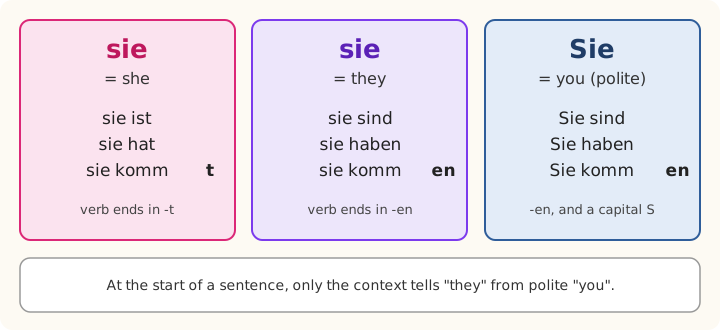
At the start of a sentence, where every word has a capital, only the context tells "they" from polite "you": Sie sind sehr nett. can mean "They are very nice" or "You are very nice".
Using sein
sein links the subject to a description, a job, a place, an age or a name:
- Ich bin müde. — I'm tired.
- Lena ist Ärztin. — Lena is a doctor.
- Wir sind in Leipzig. — We are in Leipzig.
- Das ist mein Bruder. — This is my brother.
- Jonas ist dreiundzwanzig. — Jonas is twenty-three.
The word after sein that describes the subject is in the nominative, like the subject itself: Der Mann ist mein Bruder.
Using haben
haben means "to have", for what you own, your family, your time, and in many fixed phrases:
- Ich habe ein Auto. — I have a car.
- Hast du eine Schwester? — Have you got a sister?
- Wir haben zwei Kinder. — We have two children.
- Habt ihr heute Zeit? — Are you free today?
The thing you have is not the subject but the object of the sentence, and it is in a different case, the accusative. With feminine, neuter and plural nouns the accusative looks exactly like the nominative, so all the examples above are already correct. Only a masculine noun changes: ein becomes einen, kein becomes keinen, mein becomes meinen:
- Ich habe einen Bruder. — I have a brother.
- Er hat keinen Computer. — He has no computer.
Use these phrases as they are for now; Lesson 8 explains the accusative fully.
Where German and English differ
Three everyday situations take haben or another construction in German where English uses "to be", or the other way round:
| English | German | Not |
|---|---|---|
| I'm hungry, I'm thirsty | Ich habe Hunger. Ich habe Durst. | Ich bin hungrig (possible, but much less common) |
| I'm twenty | Ich bin zwanzig. | Ich habe zwanzig Jahre (as in French or Spanish) |
| I'm cold, I'm hot | Mir ist kalt. Mir ist warm. | Ich bin kalt (this means "I am a cold person") |
| I'm lucky | Ich habe Glück. | Ich bin glücklich (this means "I'm happy") |
| You're right | Du hast recht. | Du bist richtig |
Table 5.8. Differences between German and English. Learn Mir ist kalt as a fixed phrase: mir is "to me" (Lesson 11).
Nicht or kein?
German has two words for "not". Choose by looking at what you are negating:
- Use kein before a noun that would otherwise have ein or no article: Ich habe kein Auto. Das ist keine gute Idee. Wir haben keine Zeit.
- Use nicht for everything else: with verbs, adjectives, names, and nouns with der, die, das or a possessive: Ich bin nicht müde. Das ist nicht mein Buch. Er ist nicht Jonas. Ich verstehe das nicht.
Worked example: negating sentences
Make each sentence negative.
- Das ist ein Problem. The noun has ein → kein: Das ist kein Problem.
- Ich habe Geschwister. ("brothers and sisters", plural, no article) → keine: Ich habe keine Geschwister.
- Das ist meine Tasche. The noun has a possessive → nicht: Das ist nicht meine Tasche.
- Lena ist verheiratet. An adjective → nicht: Lena ist nicht verheiratet.
- Ich habe einen Bruder. Masculine, accusative einen → keinen: Ich habe keinen Bruder.
5.5 Practice
Sein and haben
| Sentence | Verb |
|---|---|
| Ich bin Studentin. | sein |
| Hast du Zeit? | haben |
| Wir haben Hunger. | haben |
| Ihr seid sehr nett. | sein |
| Lena ist Ärztin. | sein |
| Tim hat Kopfschmerzen. | haben |
| Sind Sie Herr Becker? | sein |
| Ihr habt Glück. | haben |
Table 5.9. Practice: sein or haben, in the right form.
Ein or eine, kein or keine?
| Noun | a | not a |
|---|---|---|
| das Geschenk | ein Geschenk | kein Geschenk |
| die Idee | eine Idee | keine Idee |
| der Beruf | ein Beruf | kein Beruf |
| die Wohnung | eine Wohnung | keine Wohnung |
| die Probleme | Probleme | keine Probleme |
Table 5.10. Practice: ein and kein in the nominative.
Who is it?
Read the description aloud, then describe two people you know in the same way.
- Das ist meine Freundin Sophie. — This is my friend Sophie.
- Sie ist sechsundzwanzig und wohnt in Wien. — She's twenty-six and lives in Vienna.
- Sie ist Ingenieurin. — She's an engineer.
- Sie hat einen Bruder, aber keine Schwester. — She has a brother, but no sister.
- Sie ist nicht verheiratet. — She's not married.
Say it
Introduce yourself with sein and haben: your name, age, job, family, and how you feel today. For example:
Ich bin Ravi. Ich bin zweiunddreißig Jahre alt. Ich bin Informatiker. Ich habe eine Schwester. Heute bin ich müde, und ich habe Hunger.
5.6 Culture: work and job titles
What do you do? Germans tend to introduce themselves with their job more readily than with their hobbies, and a training is valued as much as a degree. Many young people in Germany, Austria and Switzerland learn a trade or profession through a dual vocational training (die duale Ausbildung): for two to three and a half years they work in a company and attend a vocational school at the same time. Cooks, mechanics, bank clerks, nurses, electricians and hundreds of other professions are trained this way, and the system is widely admired. A person in training is an Azubi, short for Auszubildende or Auszubildender.
Job titles for women and men. Almost every job title has a feminine form in -in, and it is normal to use it: a woman says Ich bin Ingenieurin, not Ingenieur. Job advertisements must be open to all and usually show this in the title, for example Verkäufer (m/w/d), for männlich, weiblich, divers (male, female, diverse).
Talking about groups. When speaking of a mixed group, German traditionally used the masculine plural: die Lehrer for all teachers. Today many speakers, institutions and newspapers prefer forms that name both, and you will meet several of them: Lehrerinnen und Lehrer; neutral words such as die Lehrkräfte (teaching staff) or die Studierenden (those who study); and written forms with a sign in the middle, such as Lehrer*innen or Lehrer:innen. These forms are the subject of lively public debate, and usage differs between people and organisations. As a learner, you should recognise them; in your own German, Lehrerinnen und Lehrer is always correct and polite.
5.7 Summary
Summary
- Cases: nominative (subject), accusative, dative, genitive. The nominative is used for the subject and after sein and heißen.
- Indefinite article: ein (m), eine (f), ein (n); no plural.
- Negative article: kein, keine, kein; plural keine. Possessives mein, dein, Ihr take the same endings.
- sein: bin, bist, ist, sind, seid, sind. haben: habe, hast, hat, haben, habt, haben.
- Jobs without article: Ich bin Lehrerin. Was sind Sie von Beruf?
- German vs English: Ich habe Hunger / Durst. Ich bin zwanzig. Mir ist kalt. Du hast recht.
- haben + masculine object: einen, keinen, meinen (Lesson 8).
- kein for nouns with ein or no article; nicht for the rest.
5.8 Exercises
Exercise 1
Complete with the right form of sein: Ihr ___ sehr nett.
Answer
seid. Ihr seid sehr nett. Spelt with d.
Exercise 2
Complete with the right form of haben: ___ du Durst?
Answer
Hast. Hast du Durst?
Exercise 3
Complete with ein or eine: Das ist ___ Wohnung.
Answer
eine. eine Wohnung. Wohnung is feminine.
Exercise 4
Complete with mein or meine: Das ist ___ Handy.
Answer
mein. mein Handy. Handy is neuter: no ending.
Exercise 5
Make negative with kein: Ich habe Zeit.
Answer
Ich habe keine Zeit. Ich habe keine Zeit. Zeit is feminine, so keine.
Exercise 6
Make negative: Das ist mein Kuli.
Answer
Das ist nicht mein Kuli. Das ist nicht mein Kuli. A noun with a possessive is negated with nicht.
Exercise 7
Translate: "She is a nurse."
Answer
Sie ist Krankenpflegerin. Sie ist Krankenpflegerin. No article, and the feminine form.
Exercise 8
Translate: "I'm hungry, but I'm not tired."
Answer
Ich habe Hunger, aber ich bin nicht müde.
Exercise 9
Correct the mistakes: Ich habe dreißig Jahre. Ich bin ein Arzt. Ich bin kalt.
Answer
Ich bin dreißig Jahre alt. Ich bin Arzt. Mir ist kalt. Age with sein; no article before a job; feeling cold is Mir ist kalt.
Exercise 10
Write four sentences about Tim: he is Jonas's brother, he is a cook, he has a car but no flat, and today he is happy.
Answer
Tim ist der Bruder von Jonas. Er ist Koch. Er hat ein Auto, aber keine Wohnung. Heute ist er glücklich.
5.9 Quiz
Quiz: articles, sein and haben
Exercise 11
Wir ___ aus Indien.
- bin
- ist
- sind
- seid
Answer
sind
Exercise 12
Was ist richtig? (She's a teacher.)
- Sie ist eine Lehrerin.
- Sie ist Lehrerin.
- Sie hat Lehrerin.
- Sie ist Lehrer.
Answer
Sie ist Lehrerin.
No article before a job, and the feminine form for a woman.
Exercise 13
Er ___ zwei Kinder. (haben)
Answer
hat
Exercise 14
Das ist ___ Problem. (not a)
Answer
kein
Problem is neuter: kein.
Exercise 15
Match the English to the German.
| A | B |
|---|---|
| I'm hungry. | Ich habe Glück. |
| I'm cold. | Du hast recht. |
| I'm lucky. | Ich habe Hunger. |
| You're right. | Mir ist kalt. |
Answer
I'm hungry. — Ich habe Hunger.; I'm cold. — Mir ist kalt.; I'm lucky. — Ich habe Glück.; You're right. — Du hast recht.
Exercise 16
Ich habe ___ Bruder.
- ein
- eine
- einen
- einer
Answer
einen
A masculine object after haben takes einen (the accusative, Lesson 8).
Exercise 17
Tap the wrong word.
Das ist keine mein Buch.
Answer
Wrong word: keine.
Corrected: Das ist nicht mein Buch.
A noun with a possessive is negated with nicht.
Exercise 18
Say it aloud.
Was sind Sie von Beruf?
Answer
Say: Was sind Sie von Beruf?
Exercise 19
Write what you hear.
Dictation. Have someone read the sentence aloud, then write it down.
Meine Schwester ist Ärztin.
Answer
Meine Schwester ist Ärztin.