Lesson 15: Travel, Weather and Plans
Reisen, Wetter und Pläne
Travelling is the reward for learning a language. This lesson takes Emma and Jonas from a ticket counter in Leipzig to Vienna, where Sophie shows them her city in the snow. You learn to buy a train ticket, book a room, talk about the weather and make plans. On the grammar side, you complete the picture of the cases: the two-way prepositions of Lesson 11 also take the accusative, when they describe a movement towards a place (Wir gehen in die Stadt) rather than a position (Wir sind in der Stadt). You also learn the future with werden, and the common verbs that take a dative object, such as gefallen: Wien gefällt mir, "I like Vienna".
Learning outcomes
By the end of this lesson you will be able to:
- buy a train ticket, ask about connections and platforms, and book a hotel room;
- describe the weather and understand a simple forecast;
- choose between the accusative (wohin?) and the dative (wo?) after in, an, auf and the other two-way prepositions;
- say where you are going: nach Wien, in die Schweiz, ins Kino, an den See, zu Sophie;
- talk about the future with the present tense and with werden, and about plans with vorhaben;
- use the dative verbs gefallen, schmecken, helfen, gehören, passen and give things to people.
masculinefeminineneuterplural
15.1 Dialogue: a trip to Vienna
At the ticket office in Leipzig
- Emma: Guten Tag. Zwei Fahrkarten nach Wien, bitte. — Hello. Two tickets to Vienna, please.
- Mitarbeiter: Für wann? — For when?
- Emma: Für Freitag, am Vormittag. — For Friday, in the morning.
- Mitarbeiter: Einfach oder hin und zurück? — Single or return?
- Emma: Hin und zurück, bitte. Zurück am Sonntag. — Return, please. Coming back on Sunday.
- Mitarbeiter: Es gibt einen Zug um acht Uhr vierzig. Sie müssen einmal umsteigen, in Nürnberg. Ankunft in Wien um sechzehn Uhr zehn. — There's a train at 8.40. You have to change once, in Nuremberg. Arrival in Vienna at 16.10.
- Emma: Gut. Und von welchem Gleis fährt der Zug ab? — Good. And which platform does the train leave from?
- Mitarbeiter: Von Gleis zwölf. Möchten Sie Plätze reservieren? — From platform twelve. Would you like to reserve seats?
- Emma: Ja, bitte, am Fenster. — Yes, please, by the window.
Arrival in Vienna
Sophie meets them at the station.
- Sophie: Herzlich willkommen in Wien! Wie war die Reise? — Welcome to Vienna! How was the journey?
- Jonas: Lang! Der Zug hatte eine halbe Stunde Verspätung. — Long! The train was half an hour late.
- Emma: Aber die Landschaft war wunderschön. Und hier liegt ja schon Schnee! — But the scenery was beautiful. And there's already snow here!
- Sophie: Ja, seit gestern schneit es. Morgen scheint die Sonne, aber es wird kalt: minus fünf Grad. — Yes, it's been snowing since yesterday. Tomorrow the sun will shine, but it's going to be cold: minus five degrees.
- Jonas: Und was haben wir morgen vor? — And what are we doing tomorrow?
- Sophie: Am Vormittag gehen wir in die Stadt, auf den Christkindlmarkt. Am Nachmittag gehen wir ins Museum, und am Abend in ein Kaffeehaus. — In the morning we'll go into town, to the Christmas market. In the afternoon we'll go to a museum, and in the evening to a coffee house.
- Emma: Super! Und wie gefällt dir Wien, Jonas? — Great! And how do you like Vienna, Jonas?
- Jonas: Sehr gut! Ich glaube, ich werde später hier studieren. — Very much! I think I'll study here later.
- Sophie: Dann kannst du bei mir wohnen! — Then you can live at my place!
Notice:
- Going to a place uses the accusative after in and auf: in die Stadt, auf den Christkindlmarkt, ins Museum (in das). Being at a place uses the dative (Lesson 11).
- Wie gefällt dir Wien? means "How do you like Vienna?", literally "How does Vienna please you?": the city is the subject, and the person is in the dative.
- The future is usually expressed with the present (Morgen scheint die Sonne), and sometimes with werden + infinitive (ich werde hier studieren).
- umsteigen (to change trains) and abfahren are separable: Der Zug fährt von Gleis zwölf ab.
15.2 Vocabulary: trains, hotels and weather
Travelling by train
| German | English |
|---|---|
| die Reise, die Reisen | the journey, trip |
| die Fahrkarte, die Fahrkarten | the ticket |
| einfach / hin und zurück | single / return |
| das Gleis, die Gleise | the platform, track |
| die Verbindung | the connection |
| die Abfahrt / die Ankunft | departure / arrival |
| die Verspätung | the delay |
| Der Zug hat zehn Minuten Verspätung. | The train is ten minutes late. |
| pünktlich | on time, punctual |
| umsteigen (ist umgestiegen) | to change (trains) |
| einsteigen / aussteigen | to get on / to get off |
| reservieren | to reserve |
| der Platz, die Plätze | the seat; the square |
| der Koffer, die Koffer | the suitcase |
| der Reisepass | the passport |
Table 15.1. Travelling by train.
At the hotel
| German | English |
|---|---|
| das Hotel / die Jugendherberge | the hotel / the youth hostel |
| das Einzelzimmer / das Doppelzimmer | the single room / the double room |
| mit Frühstück / mit Dusche | with breakfast / with a shower |
| die Übernachtung | the overnight stay |
| die Rezeption | the reception desk |
| buchen | to book |
| Haben Sie ein Zimmer frei? | Do you have a room free? |
| Ich habe ein Zimmer reserviert. | I have reserved a room. |
| Für wie viele Nächte? | For how many nights? |
| Was kostet eine Nacht? | How much is it per night? |
| Ist das Frühstück inklusive? | Is breakfast included? |
| der Urlaub / die Ferien | holiday (from work) / holidays (school, university) |
Table 15.2. At the hotel. Ferien is plural only.
The weather
| German | English |
|---|---|
| Wie ist das Wetter? | What's the weather like? |
| Die Sonne scheint. / Es ist sonnig. | The sun is shining. / It's sunny. |
| Es regnet. | It's raining. |
| Es schneit. | It's snowing. |
| Es ist bewölkt. | It's cloudy. |
| Es ist windig. / Es ist neblig. | It's windy. / It's foggy. |
| Es ist warm / heiß / kühl / kalt. | It's warm / hot / cool / cold. |
| Es gibt ein Gewitter. | There's a thunderstorm. |
| Es sind zwanzig Grad. | It's twenty degrees. |
| Es sind minus fünf Grad. | It's minus five. |
| das Wetter / der Wetterbericht | the weather / the weather forecast |
| die Sonne / der Regen / der Schnee | the sun / the rain / the snow |
| der Wind / die Wolke | the wind / the cloud |
Table 15.3. The weather. Temperatures are in degrees Celsius.
15.3 Grammar: wo? and wohin? – the two-way prepositions
Position or movement
In Lesson 11 you used nine prepositions with the dative to say where something is: in, an, auf, neben, vor, hinter, über, unter, zwischen. These are called two-way prepositions, because they can take either of two cases, and the choice depends on the meaning:
- Wo? (where?): a position, a place where something is or happens → dative.
- Wohin? (where to?): a movement towards a place, a change of position → accusative.
| Wohin? + accusative (movement) | Wo? + dative (position) |
|---|---|
| Wir gehen in die Stadt. | Wir sind in der Stadt. |
| Ich gehe in den Park. | Ich bin in dem Park (im Park). |
| Wir gehen ins Museum. | Wir sind im Museum. |
| Sie fahren an den See. | Sie sind am See. |
| Wir fahren auf den Markt. | Wir sind auf dem Markt. |
| Ich lege das Buch auf den Tisch. | Das Buch liegt auf dem Tisch. |
| Ich hänge das Bild an die Wand. | Das Bild hängt an der Wand. |
Table 15.4. Accusative for movement, dative for position. Practice: hide the articles and put them back.
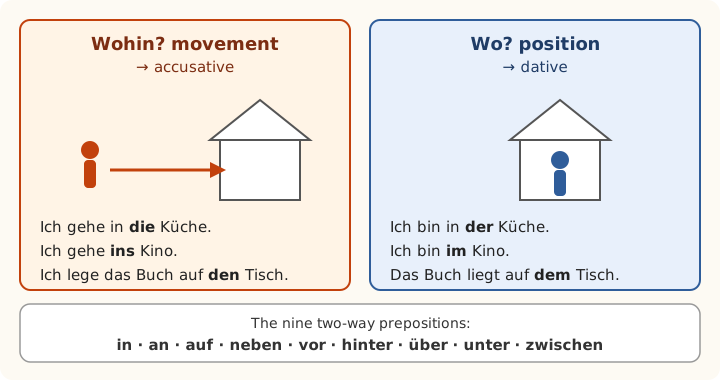
The accusative forms are those of Lesson 8: only the masculine changes (den, einen). There are contractions in the accusative too: in das → ins, an das → ans, and in speech auf das → aufs.
Verb pairs: legen and liegen, stellen and stehen
German has pairs of verbs for putting something somewhere (movement, accusative) and for where it then is (position, dative):
| Movement (wohin? + accusative) | Position (wo? + dative) |
|---|---|
| legen, to lay, put (flat) | liegen, to lie, be (lying) |
| stellen, to stand, put (upright) | stehen, to stand, be (standing) |
| hängen, to hang (something up) | hängen, to hang, be hanging |
| sich setzen, to sit down | sitzen, to sit, be sitting |
Table 15.5. Verb pairs. Germans say where things lie, stand or hang, where English simply says "is".
- Ich stelle die Flasche auf den Tisch. – Die Flasche steht auf dem Tisch.
- Er setzt sich neben mich. – Er sitzt neben mir.
Where to? A summary: nach, in, zu, an, auf
Now you can choose the right word for "to" in every common situation:
| Destination | Preposition | Example |
|---|---|---|
| towns; countries without an article | nach | nach Wien, nach Österreich |
| home | nach Hause | Ich fahre nach Hause. |
| countries with an article | in + accusative | in die Schweiz, in die Türkei, in die USA |
| into a building or an area | in + accusative | ins Kino, in die Stadt, in die Berge |
| people; a building as a destination | zu + dative | zu Sophie, zum Arzt, zum Bahnhof |
| water: a lake, the sea, a river | an + accusative | an den See, ans Meer, an die Donau |
| open places, events; up onto something | auf + accusative | auf den Markt, auf eine Party, auf den Berg |
Table 15.6. Going places. The matching positions: in Wien, in der Schweiz, im Kino, bei Sophie, am See, auf dem Markt.
Common mistake: Ich fahre nach die Schweiz
A country with an article never takes nach: Ich fahre in die Schweiz. Wir fliegen in die USA. And going into a building is in + accusative, not zu, when you mean going inside to do something there: Ich gehe ins Kino ("I'm going to the cinema", to see a film), but Ich gehe zum Kino ("I'm going to the cinema", as far as the building, perhaps to meet someone outside).
Worked example: wo or wohin?
Complete each sentence with in and the article of die Küche, der Garten or das Wohnzimmer.
- Emma geht ___ Küche. Movement → accusative, feminine: in die Küche.
- Jonas ist ___ Garten. Position → dative, masculine: im Garten (in dem).
- Die Kinder laufen ___ Garten. Movement → accusative, masculine: in den Garten.
- Wir sitzen ___ Wohnzimmer. Position → dative, neuter: im Wohnzimmer.
- Kommt ___ Wohnzimmer! Movement → accusative, neuter: ins Wohnzimmer (in das).
15.4 Grammar: the future, plans, and verbs with the dative
Talking about the future
As you saw in Lesson 6, German usually talks about the future with the present tense and a time expression: Morgen fahren wir nach Wien. Nächste Woche habe ich Urlaub.
German also has a future tense, formed with werden + infinitive at the end. It is used for predictions, intentions and promises, and when the time is not clear from the context:
| Person | werden + infinitive |
|---|---|
| ich | werde … fahren |
| du | wirst … fahren |
| er, sie, es | wird … fahren |
| wir | werden … fahren |
| ihr | werdet … fahren |
| sie, Sie | werden … fahren |
Table 15.7. The future with werden.
- Morgen wird es kalt. — It's going to be cold tomorrow. (werden alone: "become")
- Morgen wird es schneien. — It's going to snow tomorrow. (prediction)
- Ich werde dich anrufen. — I'll call you. (promise)
- Ich werde später in Wien studieren. — I'm going to study in Vienna later. (intention)
Plans: vorhaben
vorhaben ("to plan, to have on") is a separable verb, and the usual way to ask about plans: Was hast du am Wochenende vor? ("What are you doing at the weekend?"). Hast du heute Abend schon etwas vor? ("Are you doing anything this evening?"). Wir haben viel vor. ("We've got a lot planned.") der Plan, plural die Pläne, is "the plan".
Verbs with a dative object
A few common verbs take their object in the dative, not the accusative. Learn them with a pronoun:
| Verb | Example | English |
|---|---|---|
| gefallen (gefällt) | Wien gefällt mir. | I like Vienna. (Vienna pleases me.) |
| schmecken | Der Kuchen schmeckt mir. | I like the cake. (it tastes good to me) |
| helfen (hilft) | Kannst du mir helfen? | Can you help me? |
| danken | Ich danke dir. | Thank you. |
| gehören | Der Koffer gehört mir. | The suitcase belongs to me. |
| passen | Passt dir Freitag? | Does Friday suit you? |
| stehen | Die Jacke steht dir. | The jacket suits you. |
Table 15.8. Verbs with the dative. Wie geht es dir? and Mir ist kalt follow the same pattern.
With gefallen and schmecken, the thing liked is the subject, so the verb agrees with it: Die Berge gefallen mir. ("I like the mountains.") Compare the three ways of liking: Ich mag Wien (mögen + accusative), Wien gefällt mir (what you see, hear or experience), Das schmeckt mir (food and drink).
Giving things to people
Verbs of giving, showing and telling have two objects: the thing in the accusative and the person in the dative, the indirect object, like English I give my brother a book:
- Ich gebe dem Kellner das Geld. — I give the waiter the money.
- Sophie zeigt ihren Freunden die Stadt. — Sophie shows her friends the city.
- Was schenkst du deiner Mutter? — What are you giving your mother (as a present)?
- Kannst du mir den Weg erklären? — Can you explain the way to me?
When both objects are nouns, the dative usually comes first, as in these examples.
15.5 Practice
Accusative or dative?
| Sentence | Case |
|---|---|
| Wir fahren in die Berge. | accusative (wohin?) |
| Im Sommer sind wir in den Bergen. | dative (wo?) |
| Stell die Tasche auf den Stuhl! | accusative |
| Die Tasche steht auf dem Stuhl. | dative |
| Wir gehen heute ins Theater. | accusative |
| Am Wochenende fahren wir an den See. | accusative |
| Sophie wohnt in der Nähe vom Bahnhof. | dative |
| Ich fliege in die Schweiz. | accusative |
Table 15.9. Practice: wohin or wo?
At the hotel reception
Read aloud.
- Guten Abend! Haben Sie ein Zimmer frei? — Good evening! Do you have a room free?
- Für wie viele Nächte? — For how many nights?
- Für zwei Nächte. Ein Einzelzimmer mit Dusche, bitte. — For two nights. A single room with a shower, please.
- Ja, das geht. Eine Nacht kostet neunzig Euro, mit Frühstück. — Yes, that's possible. One night costs ninety euros, with breakfast.
- Gut, ich nehme das Zimmer. Wann gibt es Frühstück? — Fine, I'll take the room. When is breakfast?
- Von sieben bis zehn Uhr. Hier ist Ihr Schlüssel. Zimmer 214, im zweiten Stock. — From seven to ten. Here is your key. Room 214, on the second floor.
The weather forecast
Read the forecast aloud, then say what the weather is like where you are today.
- Morgen wird es im Norden bewölkt, und es regnet. — Tomorrow it will be cloudy in the north, with rain.
- Im Süden scheint die Sonne. — In the south the sun will shine.
- In den Alpen schneit es. — In the Alps it will snow.
- Die Temperaturen liegen zwischen minus zwei und fünf Grad. — Temperatures will be between minus two and five degrees.
Say it
Plan a weekend trip and tell a friend about it: where you are going (nach …, in die …, an den …), how you are travelling, where you will stay, what the weather will be like, and what you are going to do there. Use werden at least once. For example:
Am Wochenende fahre ich mit dem Zug nach Salzburg. Ich habe ein Zimmer in einer Jugendherberge gebucht. Es wird kalt, aber sonnig. Am Samstag gehe ich in die Altstadt, und am Sonntag fahre ich in die Berge. Ich werde viele Fotos machen!
15.6 Culture: travelling in the German-speaking countries
By train. Germany, Austria and Switzerland have dense railway networks. The national companies are Deutsche Bahn in Germany, the Austrian Federal Railways (ÖBB) in Austria and the Swiss Federal Railways (SBB) in Switzerland. Fast trains such as the German ICE and the Austrian Railjet connect the big cities, and regional trains reach the smaller towns. Swiss trains are famous for their punctuality and for timetables designed so that connections meet at the main stations. Tickets bought in advance are often much cheaper, and young people and students can get reduced fares. A train has Verspätung when it is late; delays are a favourite topic of conversation in Germany.
By road. Germany is known for its motorways (die Autobahn), long stretches of which have no general speed limit, only a recommended speed of 130 km/h; many other sections do have limits. To use the motorways in Austria and Switzerland, drivers need a toll sticker or digital toll, the Vignette.
Three countries, one lake. Lake Constance (der Bodensee) is bordered by Germany, Austria and Switzerland, and you can travel round it by boat, train or bicycle, crossing two borders in a day. All three countries belong to the Schengen area, where there are in principle no regular border controls, although checks are sometimes reintroduced; always carry a passport or identity card. Switzerland is not in the European Union, and it uses the Swiss franc.
Capitals and cities. The capital of Germany is Berlin; the capital of Austria is Vienna (Wien), which has a long imperial history and is known for its music, coffee houses and Christmas markets. Switzerland has no capital in its constitution: Bern is the seat of the government, the "federal city" (die Bundesstadt), while Zurich and Geneva are larger. Christmas markets (der Weihnachtsmarkt, in Austria and parts of southern Germany often der Christkindlmarkt), with mulled wine (der Glühwein) and gingerbread, are held in December in almost every town.
Holidays. Workers in the German-speaking countries have a generous legal minimum of paid holiday, and many people take several weeks in summer. In Germany, each federal state sets its own school holiday dates, so that not all families travel at the same time.
15.7 Summary
Summary
- Train: Eine Fahrkarte nach Wien, einfach / hin und zurück. Von welchem Gleis? Ich muss umsteigen. Der Zug hat Verspätung.
- Hotel: Haben Sie ein Zimmer frei? Ein Einzelzimmer / Doppelzimmer mit Frühstück. Für zwei Nächte.
- Weather: Die Sonne scheint. Es regnet. Es schneit. Es ist kalt. Es sind zwanzig Grad.
- Two-way prepositions: in, an, auf, neben, vor, hinter, über, unter, zwischen: wohin? + accusative (Ich gehe in die Stadt / ins Kino), wo? + dative (Ich bin in der Stadt / im Kino).
- Verb pairs: legen / liegen, stellen / stehen, hängen / hängen, sich setzen / sitzen.
- Going places: nach Wien; in die Schweiz; ins Kino; zu Sophie, zum Arzt; an den See; auf den Markt.
- Future: present + time word; werden + infinitive at the end: Ich werde dich anrufen. Plans: Was hast du vor?
- Dative verbs: gefallen, schmecken, helfen, danken, gehören, passen: Wien gefällt mir. Giving: Ich gebe dem Kellner das Geld.
15.8 Exercises
Exercise 1
Ask for a return ticket to Munich (München).
Answer
Eine Fahrkarte nach München, hin und zurück, bitte.
Exercise 2
Complete: Wir gehen heute Abend ___ Kino.
Answer
ins. ins Kino: movement, accusative, in das → ins.
Exercise 3
Complete: Die Kinder spielen ___ Garten.
Answer
im. im Garten: position, dative, in dem → im.
Exercise 4
nach or in? Im Sommer fahren wir ___ die Schweiz.
Answer
in. in die Schweiz: a country with an article.
Exercise 5
legen or liegen? Das Handy ___ auf dem Tisch.
Answer
liegt. Das Handy liegt auf dem Tisch. Position, with the dative.
Exercise 6
Complete with the right form of werden: Morgen ___ es regnen.
Answer
wird. Morgen wird es regnen.
Exercise 7
Translate: "I like the city." Use gefallen.
Answer
Die Stadt gefällt mir. Die Stadt gefällt mir.
Exercise 8
Translate: "It's snowing, and it's minus three degrees."
Answer
Es schneit, und es sind minus drei Grad.
Exercise 9
Correct the mistakes: Am Wochenende fahre ich nach die Berge. Ich lege meinen Koffer in dem Auto.
Answer
Am Wochenende fahre ich in die Berge. Ich lege meinen Koffer ins Auto. Into the mountains is in + accusative; putting into the car is movement: accusative, in das → ins.
Exercise 10
Write three sentences about your next holiday: where you will go, how you will travel, and what you will do. Use werden in one of them.
Answer
A model answer: Im August fahre ich an die Ostsee. Ich fahre mit dem Zug. Ich werde jeden Tag schwimmen und viel lesen. (Die Ostsee is the Baltic Sea.)
15.9 Quiz
Quiz: travel, weather and plans
Exercise 11
Wir fahren morgen an ___ See.
- der
- dem
- den
- des
Answer
den
Movement towards (wohin?): accusative. der See → den See.
Exercise 12
Wo bist du? – Ich bin ___ Bahnhof.
- zum
- am
- ans
- nach
Answer
am
Position (wo?): an + dative, an dem → am.
Exercise 13
Wie ___ dir Wien? – Sehr gut! (gefallen)
Answer
gefällt / gefaellt
Exercise 14
Im Winter fahren viele Leute in ___ Berge.
Answer
die
Exercise 15
Match the German to the English.
| A | B |
|---|---|
| Es regnet. | The sun is shining. |
| Es schneit. | It's cloudy. |
| Die Sonne scheint. | It's raining. |
| Es ist bewölkt. | It's snowing. |
Answer
Es regnet. — It's raining.; Es schneit. — It's snowing.; Die Sonne scheint. — The sun is shining.; Es ist bewölkt. — It's cloudy.
Exercise 16
Put the words in order: "I will call you tomorrow."
Words: morgen / Ich / dich / werde / anrufen.
Answer
Ich werde dich morgen anrufen.
Exercise 17
Tap the wrong word.
Im Sommer fliegen wir nach die USA.
Answer
Wrong word: nach.
Corrected: Im Sommer fliegen wir in die USA.
Countries with an article take in + accusative.
Exercise 18
Listen. Which platform does the train leave from?
Read this aloud or have someone read it to you:
Der Zug nach Wien fährt heute von Gleis vierzehn ab.
- 4
- 14
- 40
- 41
Answer
14
Transcript: “Der Zug nach Wien fährt heute von Gleis vierzehn ab.”
Exercise 19
Write what you hear.
Dictation. Have someone read the sentence aloud, then write it down.
Wir müssen in Nürnberg umsteigen.
Answer
Wir müssen in Nürnberg umsteigen.