Lesson 9: Family and Describing People
Die Familie und Personen beschreiben
Talking about your family is one of the first real conversations you have in a new language: who is in the photo, how old your sister is, what your parents do, what your best friend is like. In this lesson you learn the words for family members, for what people look like and for what they are like, and the grammar you need to talk about them: the possessives for every person (his, her, our, their), the ways of saying Jonas's sister, adjectives after sein, and comparisons such as older than and as tall as.
Learning outcomes
By the end of this lesson you will be able to:
- name the members of your family and say how they are related to you;
- use the possessives mein, dein, sein, ihr, unser, euer, ihr, Ihr in the nominative and accusative;
- say whose something is: Jonas' Schwester, Emmas Bruder, die Schwester von Jonas;
- describe what people look like and what they are like, with sehr, ziemlich, ein bisschen and zu;
- compare people with älter als, so groß wie and am größten;
- talk about a family photo.
masculinefeminineneuterplural
9.1 Dialogue: the family photo
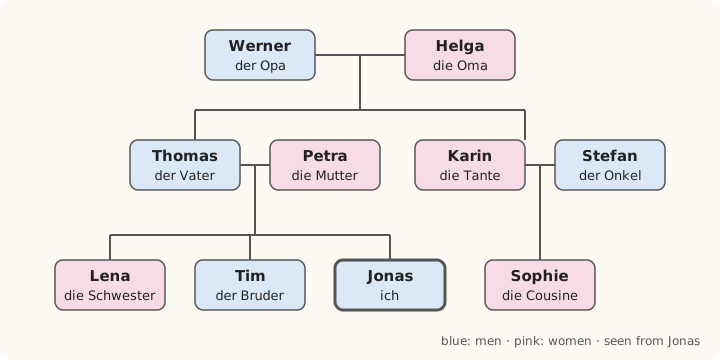
Jonas's cousin Sophie has come from Vienna for the weekend. Jonas shows Emma a family photo.
- Sophie: Servus, Emma! Ich bin Sophie, die Cousine von Jonas. — Hi, Emma! I'm Sophie, Jonas's cousin.
- Emma: Hallo, Sophie! Freut mich. Du wohnst in Wien, oder? — Hi, Sophie! Nice to meet you. You live in Vienna, don't you?
- Sophie: Ja, genau. Mein Vater ist Österreicher, und meine Mutter ist die Schwester von Jonas' Vater. — Yes, exactly. My father is Austrian, and my mother is the sister of Jonas's father.
- Emma: Jonas, ist das deine Familie? — Jonas, is this your family?
- Jonas: Ja. Das sind meine Eltern, Thomas und Petra. Mein Vater ist Ingenieur, und meine Mutter ist Lehrerin. — Yes. These are my parents, Thomas and Petra. My father is an engineer, and my mother is a teacher.
- Emma: Und wer ist der Mann hier, mit dem Bart? — And who is the man here, with the beard?
- Jonas: Das ist mein Onkel Stefan, Sophies Vater. Er ist sehr lustig. — That's my uncle Stefan, Sophie's father. He's very funny.
- Sophie: Ja, mein Vater ist lustig, aber auch ziemlich laut! — Yes, my father is funny, but also quite loud!
- Emma: Und die Frau neben ihm? Sie hat lange, rote Haare. — And the woman next to him? She has long red hair.
- Sophie: Das ist meine Mutter, Karin. Und das hier bin ich, mit zehn. — That's my mother, Karin. And this is me, at ten.
- Emma: Und das Baby? — And the baby?
- Jonas: Das bin ich! Und das sind meine Geschwister, Lena und Tim. Sie sind beide älter als ich. Ich bin am jüngsten. — That's me! And these are my brother and sister, Lena and Tim. They're both older than me. I'm the youngest.
- Emma: Hast du auch Geschwister, Sophie? — Do you have brothers and sisters too, Sophie?
- Sophie: Nein, ich bin Einzelkind. Aber Jonas ist wie ein Bruder für mich. Und deine Familie, Emma? — No, I'm an only child. But Jonas is like a brother to me. And your family, Emma?
- Emma: Ich habe einen Bruder, Oliver. Er ist groß und schlank und hat kurze, blonde Haare. Er ist sehr sportlich, aber ein bisschen schüchtern. Er ist verheiratet, und seine Frau heißt Aisha. — I have a brother, Oliver. He's tall and slim and has short blond hair. He's very sporty, but a bit shy. He's married, and his wife's name is Aisha.
Notice:
- "His" is sein and "her" is ihr, and they take endings like mein: seine Frau, ihr Vater.
- "Sophie's father" is Sophies Vater, with an s and no apostrophe; "Jonas's father" is Jonas' Vater, with only an apostrophe; and in speech, der Vater von Jonas.
- Adjectives after sein have no ending: Er ist lustig. Er ist groß und schlank.
- "Older than" is älter als; "the youngest" is am jüngsten.
9.2 Vocabulary: family, looks and character
The family
| Singular | Plural | English |
|---|---|---|
| die Familie | die Familien | the family |
| — | die Eltern | the parents |
| der Vater | die Väter | the father |
| die Mutter | die Mütter | the mother |
| der Sohn | die Söhne | the son |
| die Tochter | die Töchter | the daughter |
| der Bruder | die Brüder | the brother |
| die Schwester | die Schwestern | the sister |
| — | die Geschwister | brothers and sisters, siblings |
| der Großvater, der Opa | die Großväter, die Opas | the grandfather, grandpa |
| die Großmutter, die Oma | die Großmütter, die Omas | the grandmother, grandma |
| — | die Großeltern | the grandparents |
| der Enkel / die Enkelin | die Enkel / die Enkelinnen | the grandson / granddaughter |
| der Onkel | die Onkel | the uncle |
| die Tante | die Tanten | the aunt |
| der Cousin / die Cousine | die Cousins / die Cousinen | the cousin (man / woman) |
| der Neffe / die Nichte | die Neffen / die Nichten | the nephew / niece |
| der Mann / die Frau | die Männer / die Frauen | the husband / wife (also man / woman) |
| der Partner / die Partnerin | die Partner / die Partnerinnen | the partner |
| das Einzelkind | die Einzelkinder | the only child |
| der Hund / die Katze | die Hunde / die Katzen | the dog / cat |
Table 9.1. The family. Mein Mann and meine Frau are the normal words for "my husband" and "my wife".
What people look like
| German | English |
|---|---|
| groß / klein | tall / short (small) |
| schlank | slim |
| jung / alt | young / old |
| hübsch | pretty, good-looking |
| gut aussehend | handsome, good-looking |
| Er hat kurze Haare. | He has short hair. |
| Sie hat lange, blonde Haare. | She has long blond hair. |
| braune, schwarze, graue, rote Haare | brown, black, grey, red hair |
| Er hat blaue Augen. | He has blue eyes. |
| braune, grüne, graue Augen | brown, green, grey eyes |
| Er hat einen Bart. | He has a beard. |
| Sie trägt eine Brille. | She wears glasses. |
Table 9.2. Appearance. German usually says hair in the plural: die Haare.
What people are like
| German | English | German | English |
|---|---|---|---|
| nett, freundlich | nice, friendly | unfreundlich | unfriendly |
| sympathisch | likeable, pleasant | unsympathisch | unpleasant |
| lustig | funny, cheerful | ernst | serious |
| ruhig | quiet, calm | laut | loud |
| fleißig | hard-working | faul | lazy |
| geduldig | patient | ungeduldig | impatient |
| klug, intelligent | clever, intelligent | schüchtern | shy |
| sportlich | sporty | kreativ | creative |
| ehrlich | honest | hilfsbereit | helpful |
Table 9.3. Character. The prefix un- makes many adjectives negative, as in English.
False friends: sympathisch and eventuell
sympathisch does not mean "sympathetic" (understanding someone's troubles, which is mitfühlend or verständnisvoll). It means "likeable, pleasant": Dein Bruder ist sehr sympathisch. is a compliment. Words that look like English but mean something different are called false friends; the Review lesson collects the most common ones.
9.3 Grammar: possessives
The possessives for every person
Each personal pronoun has a possessive. All of them take the same endings as ein and mein (Lessons 5 and 8).
| Pronoun | Possessive | English | Example |
|---|---|---|---|
| ich | mein | my | mein Vater, meine Mutter |
| du | dein | your | dein Vater, deine Mutter |
| er | sein | his | sein Vater, seine Mutter |
| sie | ihr | her | ihr Vater, ihre Mutter |
| es | sein | its | sein Vater, seine Mutter |
| wir | unser | our | unser Vater, unsere Mutter |
| ihr | euer | your (plural) | euer Vater, eure Mutter |
| sie | ihr | their | ihr Vater, ihre Mutter |
| Sie | Ihr | your (polite) | Ihr Vater, Ihre Mutter |
Table 9.4. The possessives. euer loses its second e when an ending is added: eure, euren.
Two decisions: which word, and which ending
Choosing a possessive takes two steps, and English speakers often mix them up:
- The owner decides the word. If the owner is a man or a masculine noun, use sein; if a woman, a feminine noun or a group, use ihr. This is the same as English his and her.
-
The noun that follows decides the ending. sein and ihr take the endings of ein, according to the gender, number and case of the thing owned.
-
Jonas and his sister: Jonas und seine Schwester (owner a man → sein; Schwester feminine → -e).
- Lena and her brother: Lena und ihr Bruder (owner a woman → ihr; Bruder masculine nominative → no ending).
- Lena visits her brother: Lena besucht ihren Bruder (accusative masculine → -en).
- Emma and Oliver visit their parents: Emma und Oliver besuchen ihre Eltern (owner a group → ihr; plural → -e).
| Case | Masculine | Feminine | Neuter | Plural |
|---|---|---|---|---|
| nominative | unser Sohn | unsere Tochter | unser Kind | unsere Kinder |
| accusative | unseren Sohn | unsere Tochter | unser Kind | unsere Kinder |
| nominative | ihr Sohn | ihre Tochter | ihr Kind | ihre Kinder |
| accusative | ihren Sohn | ihre Tochter | ihr Kind | ihre Kinder |
Table 9.5. Possessive endings: the same as ein (and keine in the plural).
Common mistake: sein and ihr
In some languages, the word for "his" or "her" agrees only with the thing owned, so French sa mère can be "his mother" or "her mother". German, like English, also looks at the owner. "Lena and her father" is Lena und ihr Vater, never Lena und sein Vater, even though Vater is masculine. The ending looks at Vater; the word looks at Lena.
Whose? Names with s, and von
To say whose something is with a name, German adds -s to the name, without an apostrophe, and puts it before the noun:
- Sophies Vater — Sophie's father
- Emmas Bruder — Emma's brother
- Frau Wagners Kurs — Frau Wagner's course
When the name already ends in an s sound (-s, -ß, -x, -z), only an apostrophe is written: Jonas' Vater, Max' Schwester.
In speech, and with nouns that are not names, the most common way is von ("of, from") + the owner: die Schwester von Jonas, der Vater von Sophie, das Auto von meinem Bruder. After von, an article is in the dative (von meinem Bruder, von meiner Schwester), which Lesson 11 explains. With names, it needs no endings at all.
In writing you will also meet the genitive case, with des and der: das Auto meines Bruders ("my brother's car"), die Wohnung meiner Schwester. Learn to recognise it; at this level you can always use von instead.
9.4 Grammar: describing and comparing people
Adjectives after sein
An adjective that comes after sein (or werden) has no ending, whatever the gender or number of the noun:
- Mein Onkel ist lustig. Meine Tante ist lustig. Das Kind ist lustig. Meine Cousins sind lustig.
An adjective before a noun takes an ending: ein lustiger Onkel, eine lustige Tante. The full system of adjective endings is a subject for the next stage of your German; for now, use adjectives after sein, and learn two useful patterns as they are:
- Plural noun without an article: adjective + -e. Sie hat lange Haare. Er hat blaue Augen. Ich habe nette Kollegen. This covers hair and eyes.
- Two adjectives before a noun are separated by a comma, and both take the same ending: kurze, blonde Haare.
Sehr, ziemlich, ein bisschen, zu
These words make an adjective stronger or weaker. They come before it:
| German | English | Example |
|---|---|---|
| sehr | very | Er ist sehr nett. |
| ziemlich | quite, rather | Sie ist ziemlich groß. |
| ein bisschen | a bit | Er ist ein bisschen schüchtern. |
| nicht so | not very | Das Baby ist nicht so ruhig. |
| gar nicht | not at all | Er ist gar nicht faul. |
| zu | too | Die Musik ist zu laut. |
Table 9.6. Words before adjectives. zu ("too") is always critical: zu groß means bigger than it should be.
Comparing: older than, as tall as
To compare two people or things, add -er to the adjective and use als ("than"):
- Lena ist alt. → Lena ist älter als Jonas. — Lena is older than Jonas.
- Tim ist groß. → Tim ist größer als sein Vater. — Tim is taller than his father.
- Meine Schwester ist ruhiger als ich. — My sister is quieter than me.
Many short adjectives with a, o, u take an umlaut: alt → älter, jung → jünger, groß → größer, kurz → kürzer, lang → länger. A few are irregular: gut → besser, viel → mehr, gern → lieber.
To say two things are equal, use so … wie ("as … as"): Tim ist so groß wie sein Vater. Ich bin nicht so sportlich wie mein Bruder.
To say who is the most, use am + adjective + -sten (the superlative): Jonas ist am jüngsten. ("Jonas is the youngest.") Lena ist am ältesten. Wer ist am größten? Adjectives ending in -t, -d, -s, -ß, -z add -esten: am ältesten, am kürzesten; but groß gives am größten. Irregular: am besten, am meisten, am liebsten.
| Adjective | Comparative | Superlative |
|---|---|---|
| klein | kleiner | am kleinsten |
| alt | älter | am ältesten |
| jung | jünger | am jüngsten |
| groß | größer | am größten |
| gut | besser | am besten |
| viel | mehr | am meisten |
| gern | lieber | am liebsten |
Table 9.7. Comparison of adjectives.
Common mistake: more older, als and wie
German never uses a word for "more" with short adjectives: älter, not mehr alt. And even long adjectives take -er: intelligenter, interessanter. Keep als for "than" after a comparative and wie for "as" after so: älter als, so alt wie.
Worked example: describing a person
Describe Lena from these notes: Jonas's sister; 29; doctor in Leipzig; tall, short brown hair, glasses; patient and very hard-working; older than Tim.
- Relation, with a possessive: Das ist Lena, die Schwester von Jonas. or Das ist Jonas' Schwester Lena.
- Age and job: Sie ist neunundzwanzig und Ärztin in Leipzig.
- Looks, with adjectives after sein and the hair pattern: Sie ist groß und hat kurze, braune Haare. Sie trägt eine Brille.
- Character, with sehr: Sie ist geduldig und sehr fleißig.
- Comparison: Sie ist älter als Tim. (She is in fact the oldest: Sie ist am ältesten.)
9.5 Practice
Sein or ihr?
| Sentence | Possessive |
|---|---|
| Jonas zeigt Emma seine Familie. | his |
| Sophie liebt ihren Vater. | her |
| Tim besucht seine Oma. | his |
| Emma und Oliver besuchen ihre Eltern. | their |
| Das ist Lena. Ihr Mann heißt Paul. | her |
| Wir besuchen unseren Onkel. | our |
| Kinder, wo ist euer Hund? | your (plural) |
Table 9.8. Practice: the possessives.
Comparisons
| Facts | Comparison |
|---|---|
| Lena 29, Tim 26 | Lena ist älter als Tim. |
| Tim 1,90 m, Jonas 1,80 m | Tim ist größer als Jonas. |
| Sophie 24, Jonas 23 | Jonas ist jünger als Sophie. |
| Oliver 1,85 m, his father 1,85 m | Oliver ist so groß wie sein Vater. |
| Jonas: the youngest | Jonas ist am jüngsten. |
Table 9.9. Practice: comparing people. Heights are written with a comma: 1,90 m is read ein Meter neunzig.
My family
Read the text aloud, then write a similar text about your own family.
- Meine Familie ist nicht sehr groß. — My family isn't very big.
- Mein Vater heißt David und ist Ingenieur. Er ist ruhig und sehr geduldig. — My father is called David and is an engineer. He is quiet and very patient.
- Meine Mutter heißt Claire. Sie ist Ärztin und ziemlich ernst, aber auch lustig. — My mother is called Claire. She is a doctor and rather serious, but also funny.
- Mein Bruder Oliver ist drei Jahre älter als ich. — My brother Oliver is three years older than me.
- Unsere Großeltern wohnen in Schottland. Wir besuchen sie jeden Sommer. — Our grandparents live in Scotland. We visit them every summer.
Say it
Take a photo of your family or friends, or imagine one, and describe three people in it: who they are, how old they are, what they look like and what they are like. Compare two of them. For example:
Das ist meine Schwester. Sie ist fünfundzwanzig. Sie hat lange, schwarze Haare und braune Augen. Sie ist sehr kreativ und ein bisschen laut. Sie ist jünger als ich, aber größer.
9.6 Culture: family life
Grandparents, aunts and Sunday afternoons. Family ties in the German-speaking countries are close, though families today are often small and spread across the country. Grandparents, Oma and Opa, often play an important part in looking after grandchildren. A traditional family occasion is Kaffee und Kuchen on a Sunday afternoon: coffee and homemade cake around three or four o'clock, with grandparents, aunts and uncles. Birthdays, Christmas and Easter are the great family festivals.
Kindergarten. The word kindergarten, "children's garden", is German; it was coined in the nineteenth century by the educator Friedrich Fröbel, who founded the first one. In Germany today, children usually go to a day-care centre, the Kita (short for Kindertagesstätte), and then start school at about six. Parents in Germany and Austria are entitled to paid parental leave, and many fathers take part of it too.
Many kinds of family. As elsewhere in Europe, families take many forms: married and unmarried couples, single parents, same-sex couples (marriage for same-sex couples has been legal in Germany since 2017, in Austria since 2019 and in Switzerland since 2022), and stepfamilies, which are often called Patchworkfamilien, a borrowing from English.
Names. Germans have a first name (der Vorname) and a surname (der Nachname or der Familienname). When a couple marries, they may choose either partner's surname as the family name, keep their own names, or add one name to the other with a hyphen. Many common surnames come from old trades: Müller (miller), Schmidt (smith), Schneider (tailor), Fischer, Weber (weaver), Becker (baker) and Wagner (cartwright).
9.7 Summary
Summary
- Family: die Eltern, der Vater, die Mutter, der Sohn, die Tochter, die Geschwister, die Großeltern, der Onkel, die Tante, der Cousin, die Cousine.
- Possessives: mein, dein, sein, ihr, sein, unser, euer, ihr, Ihr, with the endings of ein: seine Frau, ihren Bruder, eure Eltern.
- Two decisions: the owner chooses sein (his) or ihr (her, their); the noun chooses the ending.
- Whose: Sophies Vater (no apostrophe); Jonas' Vater; spoken der Vater von Jonas.
- Adjectives after sein: no ending. Patterns: Sie hat lange Haare. Er hat blaue Augen.
- Degree: sehr, ziemlich, ein bisschen, nicht so, gar nicht, zu.
- Comparison: älter als, so alt wie, am ältesten; umlaut in short adjectives; gut, besser, am besten.
9.8 Exercises
Exercise 1
What is your mother's sister to you?
Answer
Tante. meine Tante, my aunt.
Exercise 2
Complete: Lena und ___ Mann wohnen in Leipzig. (her)
Answer
ihr. Lena und ihr Mann. Owner a woman: ihr; Mann masculine nominative: no ending.
Exercise 3
Complete: Jonas besucht ___ Oma. (his)
Answer
seine. Jonas besucht seine Oma.
Exercise 4
Complete: Wir lieben ___ Hund. (our)
Answer
unseren. Wir lieben unseren Hund. Accusative masculine: -en.
Exercise 5
Write "Anna's brother" in the written form with s.
Answer
Annas Bruder. Annas Bruder, without an apostrophe.
Exercise 6
Give the comparative of jung.
Answer
jünger. jünger, with an umlaut.
Exercise 7
Complete: Mein Bruder ist so groß ___ mein Vater.
Answer
wie. so groß wie: as tall as.
Exercise 8
Translate: "She has short black hair and green eyes."
Answer
Sie hat kurze, schwarze Haare und grüne Augen.
Exercise 9
Correct the mistakes: Sophie und sein Vater wohnen in Wien. Ihr Vater ist mehr alt als ihre Mutter.
Answer
Sophie und ihr Vater wohnen in Wien. Ihr Vater ist älter als ihre Mutter. The owner is Sophie, so ihr; the comparative is älter.
Exercise 10
Write four sentences about Jonas's family from Figure 9.1: who Thomas is, who Karin is, who Sophie's parents are, and who is the youngest.
Answer
Thomas ist der Vater von Jonas. Karin ist seine Tante. Sophies Eltern heißen Karin und Stefan. Jonas ist am jüngsten. (Other correct versions are possible, for example Karin ist die Schwester von Thomas.)
9.9 Quiz
Quiz: family and describing people
Exercise 11
Der Sohn von meinem Onkel ist mein ___.
- Neffe
- Cousin
- Enkel
- Bruder
Answer
Cousin
Exercise 12
Lena besucht ___ Vater.
- sein
- seinen
- ihr
- ihren
Answer
ihren
The owner is Lena, so ihr; Vater is a masculine object, so -en.
Exercise 13
Mein Bruder ist drei Jahre ___ als ich. (alt)
Answer
älter / aelter
Exercise 14
Jonas ist ___ jüngsten.
Answer
am
Exercise 15
Match the opposites.
| A | B |
|---|---|
| fleißig | klein |
| laut | ernst |
| groß | faul |
| lustig | ruhig |
Answer
fleißig — faul; laut — ruhig; groß — klein; lustig — ernst
Exercise 16
Write "Sophie's mother" in German, with s.
Answer
Sophies Mutter
Exercise 17
Tap the wrong word.
Meine Schwester ist mehr sportlich als ich.
Answer
Wrong word: mehr.
Corrected: Meine Schwester ist sportlicher als ich.
German adds -er to the adjective instead of using mehr.
Exercise 18
Put the words in order: "He has short blond hair."
Words: hat / Haare. / blonde / Er / kurze,
Answer
Er hat kurze, blonde Haare.
Exercise 19
Write what you hear.
Dictation. Have someone read the sentence aloud, then write it down.
Meine Eltern wohnen in Dresden.
Answer
Meine Eltern wohnen in Dresden.