Lesson 4: Nouns, Gender and Plurals
Nomen, Genus und Plural
Every German noun belongs to one of three genders: masculine, feminine or neuter. A table is masculine, a lamp is feminine, a bed is neuter, and a girl, surprisingly, is neuter too. The gender is a grammatical class, not a statement about the thing itself, and it decides the word for "the": der, die or das. German plurals are just as varied: there are several ways of making a plural, and you will learn which nouns take which. This sounds daunting, but there are good rules of thumb, and the habit that solves both problems is simple: learn every noun with its article and its plural, as this lesson shows you.
Learning outcomes
By the end of this lesson you will be able to:
- use the definite articles der, die, das and the plural die;
- predict the gender of many nouns from their meaning and their ending, and remember the common exceptions;
- make the plural of nouns with the main patterns: -e, -er, -(e)n, -s, no ending, and umlaut;
- replace nouns with the pronouns er, sie, es and sie;
- understand and build compound nouns such as die Haustür;
- name the rooms and furniture of a flat and the things you use in class.
masculine: derfeminine: dieneuter: dasplural: die
4.1 Dialogue: the new flat
Emma has just moved into a shared flat with Jonas. He shows her round.
- Jonas: So, Emma, das ist die Wohnung. Hier ist die Küche. — So, Emma, this is the flat. Here is the kitchen.
- Emma: Oh, die Küche ist groß! Und der Kühlschrank ist neu. — Oh, the kitchen is big! And the fridge is new.
- Jonas: Ja, er ist ganz neu. Und das ist das Bad. — Yes, it's brand new. And this is the bathroom.
- Emma: Und wo ist das Wohnzimmer? — And where is the living room?
- Jonas: Hier links. Da sind das Sofa, der Fernseher und die Bücher. — Here on the left. There are the sofa, the television and the books.
- Emma: Und mein Zimmer? — And my room?
- Jonas: Hier. Das Zimmer ist klein, aber das Fenster ist groß. — Here. The room is small, but the window is big.
- Emma: Das Bett ist schön. Und die Lampe? — The bed is nice. And the lamp?
- Jonas: Die Lampe ist alt, aber sie funktioniert. — The lamp is old, but it works.
- Emma: Wo sind die Schlüssel? — Where are the keys?
- Jonas: Hier: der Schlüssel für die Haustür und der Schlüssel für die Wohnungstür. — Here: the key for the front door of the building and the key for the door of the flat.
- Emma: Danke, Jonas! Die Wohnung ist toll. — Thanks, Jonas! The flat is great.
Notice:
- There are three words for "the": der Kühlschrank, die Küche, das Bad. In the plural, all three become die: die Bücher, die Schlüssel.
- A thing is "he", "she" or "it" according to its gender: the fridge is er ("he"), the lamp is sie ("she").
- Haustür is one word made of two: Haus (house) + Tür (door).
- "Is" is ist and "are" is sind: Das Zimmer ist klein. Wo sind die Schlüssel? Lesson 5 gives the whole verb sein.
4.2 Vocabulary: the flat and the classroom
German dictionaries give each noun with its article and its plural, often in a short form: Tisch, der, -e means der Tisch, plural die Tische; Buch, das, ¨-er means das Buch, plural die Bücher (with umlaut). This book writes both forms in full.
In the flat
| Singular | Plural | English |
|---|---|---|
| die Wohnung | die Wohnungen | the flat, apartment |
| das Haus | die Häuser | the house |
| das Zimmer | die Zimmer | the room |
| das Wohnzimmer | die Wohnzimmer | the living room |
| das Schlafzimmer | die Schlafzimmer | the bedroom |
| die Küche | die Küchen | the kitchen |
| das Bad | die Bäder | the bathroom |
| die Tür | die Türen | the door |
| das Fenster | die Fenster | the window |
| der Tisch | die Tische | the table |
| der Stuhl | die Stühle | the chair |
| das Bett | die Betten | the bed |
| das Sofa | die Sofas | the sofa |
| der Schrank | die Schränke | the cupboard, wardrobe |
| das Regal | die Regale | the shelf, bookcase |
| die Lampe | die Lampen | the lamp |
| das Bild | die Bilder | the picture |
| der Spiegel | die Spiegel | the mirror |
| der Kühlschrank | die Kühlschränke | the fridge (cool cupboard) |
| der Herd | die Herde | the cooker, stove |
| die Waschmaschine | die Waschmaschinen | the washing machine |
| die Dusche | die Duschen | the shower |
| der Fernseher | die Fernseher | the television set |
| der Schlüssel | die Schlüssel | the key |
Table 4.1. In the flat. Learn each word with its article and its plural.
In class
| Singular | Plural | English |
|---|---|---|
| das Buch | die Bücher | the book |
| das Heft | die Hefte | the exercise book |
| das Wörterbuch | die Wörterbücher | the dictionary (words book) |
| der Kuli | die Kulis | the ballpoint pen |
| der Bleistift | die Bleistifte | the pencil (lead pen) |
| die Tasche | die Taschen | the bag; the pocket |
| der Rucksack | die Rucksäcke | the backpack |
| die Tafel | die Tafeln | the board |
| der Computer | die Computer | the computer |
| das Handy | die Handys | the mobile phone |
| die Uhr | die Uhren | the clock, watch |
| die Brille | die Brillen | the glasses (one pair: singular in German) |
Table 4.2. In class.
People
| Singular | Plural | English |
|---|---|---|
| der Mann | die Männer | the man |
| die Frau | die Frauen | the woman |
| das Kind | die Kinder | the child |
| der Junge | die Jungen | the boy |
| das Mädchen | die Mädchen | the girl |
| der Lehrer / die Lehrerin | die Lehrer / die Lehrerinnen | the teacher (man / woman) |
| der Student / die Studentin | die Studenten / die Studentinnen | the student |
| der Freund / die Freundin | die Freunde / die Freundinnen | the friend; also boyfriend / girlfriend |
Table 4.3. People. Most words for people have a feminine form in -in.
Learn the noun with its article, and use the colours
Never learn Tisch on its own: learn der Tisch, plural die Tische. Make flashcards in three colours, one for each gender, as this book does, or picture masculine nouns in one room of an imaginary house, feminine nouns in another and neuter nouns in a third. The article is part of the word; without it you will be guessing for years.
4.3 Grammar: der, die, das
Three genders
German has three definite articles in the singular, one for each gender, and one in the plural:
| Masculine | Feminine | Neuter | Plural | |
|---|---|---|---|---|
| "the" | der Tisch | die Lampe | das Bett | die Tische |
| pronoun | er | sie | es | sie |
Table 4.4. The definite article and the matching pronoun. Switch on Practice and fill them in.
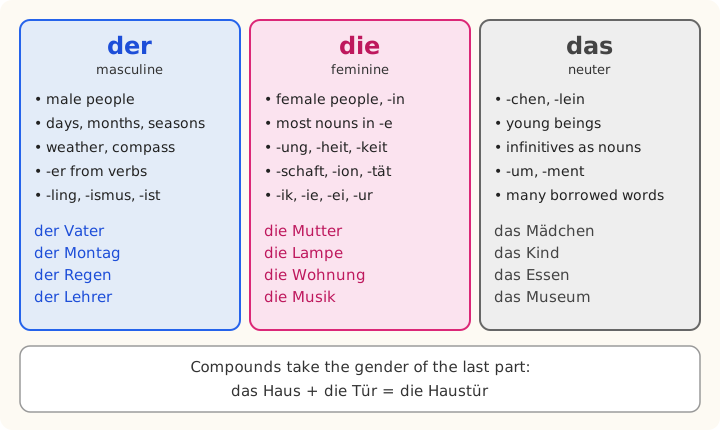
For people, the grammatical gender usually follows the person: der Mann, der Vater, die Frau, die Mutter. For things and ideas there is no logic in the meaning: der Löffel (spoon), die Gabel (fork) and das Messer (knife) are one of each. But the form of a noun, and especially its ending, often shows the gender. The rules below cover a large part of everyday vocabulary.
Masculine: der
- Male people and animals: der Mann, der Vater, der Sohn, der Onkel.
- Days, months, seasons: der Montag, der Mai, der Sommer (Lesson 3).
- Weather and points of the compass: der Regen, der Schnee, der Wind, der Norden, der Süden.
- Nouns in -er made from verbs, for people and machines: der Lehrer (from lehren, to teach), der Fernseher, der Computer.
- The endings -ling, -ismus, -ist: der Frühling, der Tourismus, der Tourist.
Feminine: die
- Female people and animals: die Frau, die Mutter, die Tochter, die Tante, and the feminine forms in -in: die Lehrerin, die Studentin, die Ärztin.
- Most nouns ending in -e: die Lampe, die Küche, die Tasche, die Straße, die Woche. This is a strong tendency, not a law (see the exceptions below), but it is right far more often than not.
- The endings -ung, -heit, -keit, -schaft: die Wohnung, die Zeitung, die Freiheit, die Möglichkeit, die Freundschaft. These are completely reliable.
- The endings -ion, -tät, -ik, -ie, -ei, -ur: die Information, die Universität, die Musik, die Familie, die Bäckerei, die Kultur. Most of them correspond to English words, which makes them easy to spot.
Neuter: das
- The endings -chen and -lein, which make "little" words, always neuter: das Mädchen (girl, originally "little maid"), das Brötchen (bread roll, "little bread"), das Häuschen (little house).
- Young people and animals: das Kind, das Baby.
- Infinitives used as nouns: das Essen (food, eating), das Leben (life), das Schwimmen (swimming).
- The endings -um and -ment, in words from Latin: das Museum, das Zentrum, das Datum, das Dokument, das Instrument.
- Many short words borrowed from other languages: das Hotel, das Kino, das Café, das Restaurant, das Auto, das Büro, das Handy, das Sofa.
- Colours and languages used as nouns: das Rot, das Deutsch.
The exceptions to learn now
| Word | Why it is surprising |
|---|---|
| das Mädchen | a girl, but -chen is always neuter |
| der Junge | ends in -e, but a male person |
| der Name | ends in -e, but masculine |
| der Käse | ends in -e, but masculine |
| das Ende | ends in -e, but neuter |
| das Auge | ends in -e, but neuter (the eye) |
| das Bier | most alcoholic drinks are masculine (der Wein), but beer is neuter |
Table 4.5. Common exceptions.
Das Mädchen: es or sie?
Strictly, a pronoun follows the grammatical gender, so das Mädchen is es: Das Mädchen heißt Lea. Es ist sieben. In everyday speech, though, people often switch to sie when they go on talking about the girl, especially in a longer text. Both are heard; at this stage, use es straight after the noun.
The pronouns er, sie, es for things
Because every noun has a gender, "it" has three forms in German. A thing is referred to with the pronoun of its gender:
- Wo ist der Schlüssel? – Er ist hier. — Where is the key? – It is here.
- Wie ist die Küche? – Sie ist groß. — What is the kitchen like? – It is big.
- Ist das Zimmer klein? – Ja, es ist klein. — Is the room small? – Yes, it is small.
- Wo sind die Bücher? – Sie sind im Regal. — Where are the books? – They are on the shelf.
The trick is that er looks like der, sie like die, and es like das: the last letter of the article is the pronoun's clue (der → er, das → es).
Common mistake: es for everything
English speakers tend to say es for every thing, because English says it. Der Tisch ist neu. Es ist schön. is wrong: the table is masculine, so Er ist schön. Always look back at the article.
4.4 Grammar: plurals and compound nouns
The plural article
In the plural there is only one article for all three genders, die, and one pronoun, sie (they). The plural is easy to recognise but harder to form, because the noun itself changes in one of several ways.
The plural patterns
| Pattern | Singular | Plural | Typical for |
|---|---|---|---|
| -e | der Tisch, das Heft | die Tische, die Hefte | many short masculine and neuter nouns |
| umlaut + -e | der Stuhl, die Stadt | die Stühle, die Städte | many short masculine nouns, some feminine |
| (umlaut +) -er | das Kind, das Buch | die Kinder, die Bücher | many short neuter nouns; umlaut where possible |
| -n / -en | die Lampe, die Frau | die Lampen, die Frauen | almost all feminine nouns |
| -nen | die Lehrerin | die Lehrerinnen | feminine nouns in -in |
| no ending | der Lehrer, das Zimmer | die Lehrer, die Zimmer | masculine and neuter nouns in -er, -el, -en, -chen, -lein |
| umlaut only | der Vater, die Mutter | die Väter, die Mütter | a few common nouns, many of them family words |
| -s | das Auto, das Handy | die Autos, die Handys | words ending in a vowel other than -e; many borrowed words |
Table 4.6. The plural patterns. The bold letters show what changes.
The column "Typical for" gives you rules of thumb that work most of the time:
- Feminine nouns almost all add -n or -en: die Lampen, die Wohnungen, die Türen, die Zeitungen. Learn the few exceptions as you meet them: die Städte, die Hände, die Nächte, die Mütter, die Töchter.
- Masculine and neuter nouns ending in -er, -el, -en, -chen, -lein add nothing, though some take an umlaut: die Fenster, die Schlüssel, die Mädchen; die Väter, die Äpfel, die Gärten.
- Short masculine nouns usually add -e, often with an umlaut: die Tage, die Freunde, die Stühle, die Schränke.
- Short neuter nouns add -e or -er: die Hefte, die Jahre; die Kinder, die Bilder, die Bücher, die Häuser.
- Words ending in -a, -i, -o, -u, -y and many recent borrowings add -s: die Sofas, die Kulis, die Kinos, die Handys, die Hotels.
Even native speakers learnt the plurals one by one, as children. Take the same path: learn the plural with the noun, and these rules will make most of them feel natural.
Common mistake: adding -s to everything
English makes almost every plural with -s, so English speakers are tempted to do the same in German. Only a minority of German nouns take -s. die Tischs and die Lampes are wrong: die Tische, die Lampen.
Nouns with no singular or no plural
Some nouns are plural in German where English uses a singular, and the other way round:
- die Brille is one pair of glasses, singular: Die Brille ist neu. So is die Hose, a pair of trousers.
- die Eltern (the parents) and die Leute (the people) exist only in the plural.
- die Information has a plural, die Informationen, used where English says information without a plural.
Compound nouns
German freely joins nouns together into one long word, the compound noun (das Kompositum). English does the same with bedroom or toothbrush, but usually writes the parts apart (front door, washing machine). Two rules make compounds easy:
- The last part says what the thing is, and gives the gender and the plural of the whole word. The parts before it describe it.
- The main stress falls on the first part.
| Parts | Compound | English |
|---|---|---|
| das Haus + die Tür | die Haustür | the front door |
| kühl + der Schrank | der Kühlschrank | the fridge |
| schlafen + das Zimmer | das Schlafzimmer | the bedroom |
| das Telefon + die Nummer | die Telefonnummer | the phone number |
| die Wohnung + die Tür | die Wohnungstür | the door of the flat |
| der Geburtstag + die Party | die Geburtstagsparty | the birthday party |
Table 4.7. Compound nouns. The article of the compound is the article of its last part.
Sometimes a linking -s- or -n- joins the parts: Wohnung-s-tür, Geburtstag-s-party, Straße-n-bahn (tram). After -ung, -heit, -keit, -schaft and -ion there is always an -s-.
Worked example: an unknown compound
You see the word Kinderzimmerlampe. What is it, and what is its article and plural?
- Split it from the end: Kinder + Zimmer + Lampe.
- The last part says what it is: a lamp. Kinderzimmer (children's room) describes which lamp.
- The gender and plural come from die Lampe, plural die Lampen.
So: die Kinderzimmerlampe, the lamp in the children's room; plural die Kinderzimmerlampen. The stress is on the first part: KIN-der-tsim-muh-lahm-puh.
4.5 Practice
Der, die or das?
Use the rules of section 4.3, then check.
| Noun | With its article | Clue |
|---|---|---|
| Zeitung (newspaper) | die Zeitung | -ung |
| Brötchen (roll) | das Brötchen | -chen |
| Winter | der Winter | season |
| Universität | die Universität | -tät |
| Museum | das Museum | -um |
| Straße (street) | die Straße | -e |
| Tourismus | der Tourismus | -ismus |
| Kino (cinema) | das Kino | borrowed, -o |
| Freiheit (freedom) | die Freiheit | -heit |
| Name | der Name | exception |
Table 4.8. Practice: der, die or das?
Plurals
| Singular | Plural |
|---|---|
| der Stuhl | die Stühle |
| die Tür | die Türen |
| das Buch | die Bücher |
| das Fenster | die Fenster |
| das Handy | die Handys |
| die Freundin | die Freundinnen |
| der Vater | die Väter |
| das Haus | die Häuser |
Table 4.9. Practice: plurals.
Where is it?
Answer each question with the right pronoun, as in the model.
- Wo ist der Kuli? – Er ist hier. — Where is the pen? – It's here.
- Wo ist die Brille? – Sie ist hier. — Where are the glasses? – They're here.
- Wo ist das Handy? – Es ist hier. — Where is the phone? – It's here.
- Wo sind die Schlüssel? – Sie sind hier. — Where are the keys? – They're here.
Say it
Look around the room you are in and name ten things with their articles, then their plurals: der Tisch, die Tische; die Lampe, die Lampen; das Fenster, die Fenster … Then describe three of them with a pronoun: Der Tisch ist alt. Er ist groß.
4.6 Culture: living in Germany, Austria and Switzerland
Renting is normal. In the German-speaking countries, and in Switzerland and Germany above all, far more people rent their homes than in Britain or the United States. Renting a flat for many years, even for life, is common, and tenants are well protected by law. Flats are described by the number of rooms, not bedrooms: a Dreizimmerwohnung (three-room flat) has three rooms plus kitchen and bathroom, and its size is always given in square metres. The rent is quoted as Kaltmiete ("cold rent", the flat alone) or Warmmiete ("warm rent", including heating and other running costs).
The kitchen may not be included. A surprise for many newcomers to Germany is that an unfurnished flat may come without a fitted kitchen: no cupboards, no cooker, sometimes not even a sink. Tenants often buy a kitchen and take it with them, or sell it to the next tenant, when they move.
The WG. Students and young people often share a flat in a Wohngemeinschaft, usually shortened to WG [vay-GAY]. Each person has a room of their own and shares the kitchen and bathroom, as Emma and Jonas do. Advertisements for rooms ask for a Mitbewohner or Mitbewohnerin (flatmate), and new flatmates are often chosen at a casual interview over coffee, the WG-Casting.
Rules of the house. Blocks of flats usually have a set of house rules (die Hausordnung), which may set quiet hours at night and on Sundays and say who cleans the stairs. Rubbish is sorted carefully into several bins: paper, packaging, glass by colour, organic waste and the rest. The colours of the bins and the exact rules vary from town to town, so newcomers ask their neighbours or read the local guide.
4.7 Summary
Summary
- Three genders: der (masculine), die (feminine), das (neuter); plural die for all. Pronouns: er, sie, es; plural sie.
- Masculine: male people, days, months, seasons, weather, -er from verbs, -ling, -ismus.
- Feminine: female people, -in, most nouns in -e, -ung, -heit, -keit, -schaft, -ion, -tät, -ik, -ie.
- Neuter: -chen, -lein, young beings, infinitives as nouns, -um, -ment, many borrowed words.
- Exceptions: das Mädchen, der Junge, der Name, der Käse, das Auge, das Ende, das Bier.
- Plurals: -e (Tische), ¨-e (Stühle), ¨-er (Bücher), -(e)n (Lampen, almost all feminines), -nen (Lehrerinnen), no ending (Zimmer), umlaut (Väter), -s (Autos).
- Compounds: the last part gives the gender and plural; the first part takes the stress: die Haustür.
- Learn every noun as article + noun + plural.
4.8 Exercises
Exercise 1
Give the definite article: ___ Wohnung.
Answer
die. die Wohnung. Nouns in -ung are always feminine.
Exercise 2
Give the definite article: ___ Mädchen.
Answer
das. das Mädchen. Nouns in -chen are always neuter, even for a girl.
Exercise 3
Give the definite article: ___ Montag.
Answer
der. der Montag. Days of the week are masculine.
Exercise 4
Give the plural: das Kind.
Answer
die Kinder. die Kinder.
Exercise 5
Give the plural: die Lampe.
Answer
die Lampen. die Lampen. Almost all feminine nouns add -n or -en.
Exercise 6
Give the plural: der Schlüssel.
Answer
die Schlüssel. die Schlüssel. Masculine nouns in -el add nothing.
Exercise 7
Complete with a pronoun: Wo ist der Computer? – ___ ist im Büro.
Answer
Er. Er ist im Büro. Der Computer is masculine.
Exercise 8
Give the article of the compound Bahnhofsuhr (station clock), and its plural.
Answer
die Bahnhofsuhr, die Bahnhofsuhren. The last part is die Uhr, plural die Uhren.
Exercise 9
Correct the mistakes: Das Tisch ist neu. Es ist groß. Die Stuhls sind alt.
Answer
Der Tisch ist neu. Er ist groß. Die Stühle sind alt. Tisch is masculine, so der and er; the plural of Stuhl is Stühle.
Exercise 10
Translate: "The bedroom is small, but the windows are big. The books are on the shelf." (on the shelf: im Regal)
Answer
Das Schlafzimmer ist klein, aber die Fenster sind groß. Die Bücher sind im Regal.
4.9 Quiz
Quiz: nouns, gender and plurals
Exercise 11
___ Zeitung
- der
- die
- das
Answer
die
-ung is always feminine.
Exercise 12
Which noun is neuter?
- Lampe
- Brötchen
- Montag
- Universität
Answer
Brötchen
-chen is always neuter. Lampe and Universität are feminine, Montag masculine.
Exercise 13
das Buch → die ___
Answer
Bücher / Buecher
Exercise 14
Die Lampe ist alt, aber ___ funktioniert.
Answer
sie
die Lampe is feminine, so the pronoun is sie.
Exercise 15
Match each singular to its plural.
| A | B |
|---|---|
| der Stuhl | die Zimmer |
| die Frau | die Autos |
| das Zimmer | die Stühle |
| das Auto | die Frauen |
Answer
der Stuhl — die Stühle; die Frau — die Frauen; das Zimmer — die Zimmer; das Auto — die Autos
Exercise 16
Give the article of the compound Haustür.
Answer
die
The last part, die Tür, gives the gender.
Exercise 17
Tap the wrong word.
Der Kühlschrank ist neu. Es ist groß.
Answer
Wrong word: Es.
Corrected: Der Kühlschrank ist neu. Er ist groß.
der Kühlschrank is masculine, so the pronoun is er.
Exercise 18
Put the words in order: "Where are the keys?"
Words: sind / Schlüssel? / die / Wo
Answer
Wo sind die Schlüssel?
Exercise 19
Write what you hear.
Dictation. Have someone read the sentence aloud, then write it down.
Das Zimmer ist klein, aber das Fenster ist groß.
Answer
Das Zimmer ist klein, aber das Fenster ist groß.