Lesson 2: Greetings and Introductions
Begrüßung und Vorstellung
The first things you say in a new language are always the same: hello, my name is, where are you from, how are you, goodbye. German has two ways of saying all of them, a polite way for strangers and people you meet at work, and a familiar way for friends, family, children and other young people. Choosing between them, du or Sie, is one of the first decisions every learner makes, and this lesson shows you how. You also meet your first verbs, the personal pronouns, and the two kinds of question.
Learning outcomes
By the end of this lesson you will be able to:
- greet people and say goodbye at any time of day, in Germany, Austria and Switzerland;
- introduce yourself and others, and say where you come from, where you live and which languages you speak;
- ask and answer Wie geht's?;
- choose between du, ihr and Sie;
- use the personal pronouns and the present of heißen, kommen, wohnen and sprechen;
- ask questions with a question word (wie, wo, woher, was, wer) and yes-no questions.
2.1 Dialogue: the first day of the course
In class
Frau Wagner, the teacher, meets her new students.
- Frau Wagner: Guten Morgen! Ich bin Frau Wagner, Ihre Lehrerin. Wie heißen Sie? — Good morning! I'm Frau Wagner, your teacher. What's your name?
- Emma: Guten Morgen, Frau Wagner. Ich heiße Emma Clarke. — Good morning, Frau Wagner. My name is Emma Clarke.
- Frau Wagner: Woher kommen Sie, Frau Clarke? — Where do you come from, Ms Clarke?
- Emma: Ich komme aus England, aus Manchester. — I come from England, from Manchester.
- Frau Wagner: Und wo wohnen Sie jetzt? — And where do you live now?
- Emma: Jetzt wohne ich hier in Leipzig. — Now I live here in Leipzig.
- Frau Wagner: Sehr schön. Herzlich willkommen! — Very nice. A warm welcome!
In the break
Emma talks to another student, Ravi. Then her flatmate Jonas, who studies at the university next door, comes past.
- Ravi: Hallo! Ich bin Ravi. Wie heißt du? — Hello! I'm Ravi. What's your name?
- Emma: Hallo, Ravi! Ich heiße Emma. Woher kommst du? — Hello, Ravi! I'm Emma. Where are you from?
- Ravi: Ich komme aus Indien, aus Pune. Und du? Kommst du aus Amerika? — I'm from India, from Pune. And you? Are you from America?
- Emma: Nein, ich komme aus England. Sprichst du Hindi? — No, I'm from England. Do you speak Hindi?
- Ravi: Ja, ich spreche Hindi, Marathi und Englisch. Und ein bisschen Deutsch! — Yes, I speak Hindi, Marathi and English. And a little German!
- Jonas: Hallo, Emma! Wie geht's? — Hi, Emma! How are you?
- Emma: Gut, danke. Und dir? — Fine, thanks. And you?
- Jonas: Super, danke. — Great, thanks.
- Emma: Jonas, das ist Ravi. Ravi, das ist Jonas. — Jonas, this is Ravi. Ravi, this is Jonas.
- Jonas: Hallo, Ravi! Freut mich. — Hi, Ravi! Nice to meet you.
- Ravi: Freut mich auch. Tschüss, bis morgen! — Nice to meet you too. Bye, see you tomorrow!
Notice:
- Frau Wagner and Emma say Sie to each other and use surnames: Frau Wagner, Frau Clarke. The students say du and use first names at once.
- The verb changes with the person: ich heiße, du heißt, Sie heißen; ich komme, du kommst.
- In a question with a question word, the verb comes second: Woher kommst du? In a yes-no question, the verb comes first: Kommst du aus Amerika?
- In Jetzt wohne ich hier, the verb comes second as well, so ich moves after it. Lesson 7 explains this important rule.
2.2 Vocabulary: hello, goodbye, and where you are from
Greetings and goodbyes
| German | Sounds like | English | When |
|---|---|---|---|
| Hallo! | [HAH-loh] | Hello! Hi! | informal, all day |
| Guten Morgen! | [GOO-ten MOR-gen] | Good morning! | until about 10 or 11 o'clock |
| Guten Tag! | [GOO-ten TAHK] | Hello! Good day! | from late morning to early evening |
| Guten Abend! | [GOO-ten AH-bent] | Good evening! | from about 6 p.m. |
| Gute Nacht! | [GOO-tuh NAHKHT] | Good night! | going to bed, never as a greeting |
| Auf Wiedersehen! | [owf VEE-duh-zay-en] | Goodbye! | polite |
| Tschüss! | [chüss] | Bye! | informal, very common |
| Bis später! | [bis SHPAY-tuh] | See you later! | |
| Bis morgen! | [bis MOR-gen] | See you tomorrow! | |
| Bis bald! | [bis BAHLT] | See you soon! | |
| Schönen Tag noch! | [SHÖ-nen TAHK nokh] | Have a nice day! | in shops, on leaving |
| Grüß Gott! | [grüss GOT] | Hello! | southern Germany and Austria |
| Servus! | [ZER-vus] | Hi! / Bye! | informal, Bavaria and Austria |
| Grüezi! | [GRÜ-ets-ee] | Hello! | Switzerland, polite |
| Moin! | [moyn] | Hi! | northern Germany, all day |
Table 2.1. Greetings and goodbyes. The regional greetings are explained in section 2.6.
On the telephone, Germans say Auf Wiederhören! ("until we hear each other again") instead of Auf Wiedersehen! ("until we see each other again").
How are you?
| German | English |
|---|---|
| Wie geht es Ihnen? | How are you? (polite) |
| Wie geht's? / Wie geht es dir? | How are you? How's it going? (informal) |
| Sehr gut, danke. | Very well, thank you. |
| Gut, danke. | Fine, thanks. |
| Es geht. | So-so. All right. |
| Nicht so gut. | Not so good. |
| Schlecht. | Bad. |
| Und Ihnen? / Und dir? | And you? (polite / informal) |
Table 2.2. Asking how someone is.
Introductions
| German | English |
|---|---|
| Wie heißen Sie? / Wie heißt du? | What is your name? (how are you called?) |
| Ich heiße Emma. | My name is Emma. |
| Mein Name ist Clarke. | My name is Clarke. (a little formal) |
| Ich bin Ravi. | I'm Ravi. |
| Das ist Jonas. | This is Jonas. |
| Freut mich. | Nice to meet you. (it pleases me) |
| Angenehm. | Pleased to meet you. (formal) |
| Woher kommen Sie? / Woher kommst du? | Where are you from? |
| Ich komme aus Irland. | I'm from Ireland. |
| Wo wohnen Sie? / Wo wohnst du? | Where do you live? |
| Ich wohne in Leipzig. | I live in Leipzig. |
| Was sprechen Sie? / Was sprichst du? | What languages do you speak? |
| Ich spreche Englisch und ein bisschen Deutsch. | I speak English and a little German. |
| Herzlich willkommen! | Welcome! |
Table 2.3. Introducing yourself.
Countries and languages
| Country | Language | Country | Language |
|---|---|---|---|
| Deutschland | Deutsch | Frankreich | Französisch |
| Österreich | Deutsch | Spanien | Spanisch |
| die Schweiz | Deutsch, Französisch, Italienisch | Italien | Italienisch |
| England | Englisch | Polen | Polnisch |
| Irland | Englisch, Irisch | Russland | Russisch |
| Amerika, die USA | Englisch | die Türkei | Türkisch |
| Kanada | Englisch, Französisch | China | Chinesisch |
| Australien | Englisch | Japan | Japanisch |
| Indien | Hindi, Englisch … | Brasilien | Portugiesisch |
Table 2.4. Countries and languages. Names of languages are nouns, so they have capitals.
Most countries are used without an article: Ich komme aus Deutschland. Ich wohne in Österreich. A few always have one, and the article changes after aus and in. Learn these as fixed phrases for now; Lesson 11 explains them.
- die Schweiz: Ich komme aus der Schweiz. Ich wohne in der Schweiz.
- die Türkei: Ich komme aus der Türkei.
- die USA (plural): Ich komme aus den USA. Ich wohne in den USA.
Small words
| German | English |
|---|---|
| und | and |
| auch | also, too |
| aber | but |
| hier / jetzt | here / now |
| sehr | very |
| ein bisschen | a little, a bit |
| nicht | not |
| Herr / Frau | Mr / Mrs, Ms; also "man" and "woman, wife" |
Table 2.5. Small words of this lesson.
2.3 Grammar: personal pronouns, and du or Sie
The personal pronouns
The personal pronouns are the words for I, you, he and so on. German has three words for you.
| Singular | Plural | |||
|---|---|---|---|---|
| 1st person | ich | I | wir | we |
| 2nd person, familiar | du | you (one friend) | ihr | you (several friends) |
| 3rd person | er, sie, es | he, she, it | sie | they |
| polite you | Sie | you (one person) | Sie | you (several people) |
Table 2.6. The personal pronouns.
Two things to notice:
- sie appears three times: sie (she), sie (they) and Sie (polite you, always with a capital). The verb and the context tell them apart: sie heißt is "she is called", sie heißen is "they are called", Sie heißen is "you are called". Lesson 5 has a figure of the three.
- er and sie are used not only for people but for things, according to the gender of the noun (Lesson 4): a table, der Tisch, is er, "he".
Du, ihr or Sie?
German divides the people you talk to into two groups. With one group you use du (to one person) and ihr (to two or more); with the other you use Sie (to one or more). English lost a similar distinction when thou disappeared.
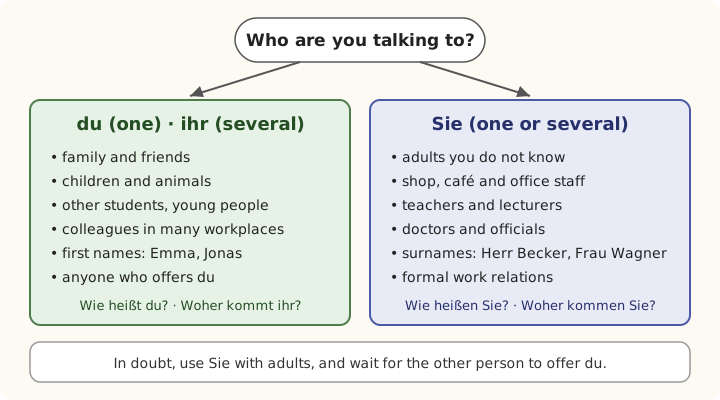
- Use du and ihr with family, friends, children and animals, with other students and young people of your own age, in many workplaces among colleagues, and in many online and sports settings.
- Use Sie with adults you do not know, with people serving you in shops, offices and restaurants, with teachers, lecturers, doctors and officials, and with most people in a formal working relationship. With Sie, use the surname: Herr Becker, Frau Wagner.
Moving from Sie to du is a small step of friendship. It is usually offered by the older person or the person of higher status, with a phrase such as Wollen wir uns duzen? ("Shall we say du?") or simply Ich bin Jonas. (giving the first name). The verb duzen means "to say du", siezen "to say Sie".
When in doubt
If you are not sure, use Sie with adults and wait for the other person to offer du. Saying Sie to someone who expects du sounds a little stiff; saying du to a stranger who expects Sie can sound rude. Among young people, students and on most social media, though, du is the normal form from the start.
2.4 Grammar: the first verbs, and two kinds of question
The present of heißen, kommen and wohnen
A German verb is listed in the dictionary in the infinitive, which ends in -en: kommen (to come), wohnen (to live), heißen (to be called). Take off -en and you have the stem: komm-, wohn-, heiß-. To use the verb, add an ending for each person.
| Person | kommen | wohnen | heißen |
|---|---|---|---|
| ich | komme | wohne | heiße |
| du | kommst | wohnst | heißt |
| er, sie, es | kommt | wohnt | heißt |
| wir | kommen | wohnen | heißen |
| ihr | kommt | wohnt | heißt |
| sie, Sie | kommen | wohnen | heißen |
Table 2.7. The present of three verbs. The endings are -e, -st, -t, -en, -t, -en.
The endings are the same for almost every verb in the language, so learning them now is a great investment. Three tips:
- The wir form, the sie (they) form and the Sie form are always the same as the infinitive.
- With heißen, the du form is du heißt, not heißst: when the stem already ends in an s sound (s, ß, z), the -st ending is reduced to -t.
- The er form and the ihr form are the same for regular verbs: er kommt, ihr kommt.
Sprechen: a verb that changes its vowel
sprechen (to speak) has the regular endings, but the e of its stem becomes i in the du and er forms. Lesson 6 explains this group of verbs; for now, learn its forms.
| Person | sprechen |
|---|---|
| ich | spreche |
| du | sprichst |
| er, sie, es | spricht |
| wir | sprechen |
| ihr | sprecht |
| sie, Sie | sprechen |
Table 2.8. The present of sprechen.
A first look at sein, to be
You have already met Ich bin Ravi and Das ist Jonas. These are forms of sein, "to be", the most irregular verb in German, as to be is in English. For now, learn ich bin (I am), du bist (you are), er ist (he is), Sie sind (you are, polite). Lesson 5 gives the whole verb.
Questions with a question word
A question that asks for information starts with a question word. All German question words start with w, as most English ones start with wh:
| Question word | English | Example |
|---|---|---|
| wie | how | Wie heißt du? |
| wo | where | Wo wohnen Sie? |
| woher | where from | Woher kommst du? |
| was | what | Was sprechen Sie? |
| wer | who | Wer ist das? |
Table 2.9. The first question words. Careful: German wer is "who" and wo is "where".
The order is: question word – verb – subject. The verb is always the second element:
- Woher kommen Sie? — Where do you come from?
- Wo wohnt Ravi? — Where does Ravi live?
German has no word like English do in questions: you do not say where do you come from, but simply where come you from.
Common mistake: wer and wo
The German question words look like the wrong English ones. wer means "who", not "where"; wo means "where", not "who". In fact the words are related to English the other way round: wer is the German relative of who, and wo of where; only the sounds have moved apart. Drill Wer ist das? Wo ist das? until the pair is automatic.
Yes-no questions
A question that can be answered with ja or nein starts with the verb:
- Kommst du aus England? — Do you come from England? Ja, ich komme aus England.
- Sprechen Sie Englisch? — Do you speak English? Ja, ein bisschen.
- Wohnt Jonas in Berlin? — Does Jonas live in Berlin? Nein, er wohnt in Leipzig.
To answer no and give the right information, use nein and a new sentence. To say that something is not so, put nicht after the verb or at the end: Ich wohne nicht in Berlin. Ich verstehe nicht.
Worked example: from information to questions
Ravi's details: name Ravi Kulkarni; from India; lives in Leipzig; speaks Hindi, Marathi, English. Ask about each, first with du, then with Sie.
- Name: Wie heißt du? / Wie heißen Sie?
- Country: Woher kommst du? / Woher kommen Sie?
- Town, as a yes-no question: Wohnst du in Leipzig? / Wohnen Sie in Leipzig?
- Languages: Was sprichst du? / Was sprechen Sie?
Now describe Ravi to someone else, with er: Das ist Ravi. Er kommt aus Indien und wohnt jetzt in Leipzig. Er spricht Hindi, Marathi und Englisch.
2.5 Practice
Endings
| Sentence | Verb |
|---|---|
| Ich komme aus Kanada. | kommen |
| Du wohnst in Wien. | wohnen |
| Er heißt Jonas. | heißen |
| Wir wohnen in Leipzig. | wohnen |
| Ihr kommt aus Irland. | kommen |
| Sie sprechen Deutsch. | sprechen |
| Sie spricht Französisch. | sprechen |
| Du heißt Emma. | heißen |
Table 2.10. Practice: fill in the verb with its ending.
Du or Sie?
Decide whether you would say du or Sie, then check.
| Person | du or Sie? |
|---|---|
| your new classmate, aged 20 | du |
| the woman at the ticket office | Sie |
| a five-year-old child | du |
| your teacher, Frau Wagner | Sie |
| your cousin | du |
| a police officer | Sie |
| your neighbour's dog | du |
Table 2.11. Practice: du or Sie?
A conversation
Read the conversation aloud with a partner, or take both parts yourself. Then do it again with your own details.
- Guten Tag! Ich heiße Sophie Huber. Und wie heißen Sie? — Hello! My name is Sophie Huber. And what's your name?
- Guten Tag, Frau Huber. Ich heiße Daniel Murphy. — Hello, Ms Huber. My name is Daniel Murphy.
- Kommen Sie aus England, Herr Murphy? — Do you come from England, Mr Murphy?
- Nein, ich komme aus Irland, aus Dublin. Und Sie? — No, I come from Ireland, from Dublin. And you?
- Ich komme aus Österreich. Ich wohne in Wien. — I come from Austria. I live in Vienna.
- Ah, Wien! Sehr schön. — Ah, Vienna! Very nice.
Say it
Introduce yourself in five sentences: your name, where you come from, where you live, which languages you speak, and a goodbye. For example:
Hallo! Ich heiße Ravi. Ich komme aus Indien. Jetzt wohne ich in Leipzig. Ich spreche Hindi, Englisch und ein bisschen Deutsch. Tschüss!
2.6 Culture: greetings in Germany, Austria and Switzerland
Shaking hands. In formal and business situations, people in all three countries greet and say goodbye with a firm handshake, looking the other person in the eye. Friends and family often hug, and in Austria and Switzerland a kiss on the cheek between friends is common (two in Austria, usually three in Switzerland). Among young people a simple Hallo! or Hi! with a wave is normal.
Regional greetings. The standard Guten Tag is understood everywhere, but regional greetings are what you will actually hear:
- Grüß Gott ("God greet you") is the normal polite greeting in Bavaria, in much of southern Germany and in Austria. It is used by everyone, religious or not, and you can use it too.
- Servus, from a Latin word meaning "servant", is a friendly hello and goodbye in Bavaria and Austria.
- In Switzerland you say Grüezi to one person you say Sie to, Grüezi mitenand to a group, and Hoi or Sali to friends. Goodbye is often Uf Wiederluege or Tschüss, and Merci, borrowed from French, is the usual thank you.
- In northern Germany, Moin or Moin moin means hello at any time of day, not only in the morning.
Herr and Frau. With Sie, people use Herr or Frau and the surname: Guten Tag, Herr Becker! Frau is used for every adult woman, married or not; the old word Fräulein ("Miss") is no longer used for adults and can sound condescending. Academic titles are taken seriously, especially in Austria: a doctor of any subject is addressed as Herr Doktor or Frau Doktor, and in Austria professional titles such as Frau Magister appear on letters and doorbells.
Knocking and greeting. Germans often greet a room when they walk in: in a waiting room or a small shop, a general Guten Tag! or Hallo! on arrival and Auf Wiedersehen! or Tschüss! on leaving is polite and expected.
2.7 Summary
Summary
- Greetings: Hallo, Guten Morgen, Guten Tag, Guten Abend; regional Grüß Gott, Servus, Grüezi, Moin. Goodbyes: Auf Wiedersehen, Tschüss, Bis morgen, Gute Nacht.
- How are you? Wie geht es Ihnen? (polite), Wie geht's? (informal). Gut, danke. Und Ihnen? / Und dir?
- Introductions: Ich heiße … Ich komme aus … Ich wohne in … Ich spreche … Das ist … Freut mich.
- Pronouns: ich, du, er, sie, es, wir, ihr, sie, Sie. sie = she / they; Sie = polite you.
- du / ihr for friends, family, children, young people; Sie for adults you do not know and formal relations. In doubt, Sie.
- Verb endings: -e, -st, -t, -en, -t, -en (komme, kommst, kommt, kommen, kommt, kommen). du heißt; du sprichst, er spricht.
- Questions: W-word + verb + subject (Woher kommst du?); yes-no: verb first (Kommst du aus England?).
2.8 Exercises
Exercise 1
Give the right greeting for 8 o'clock in the morning, to your teacher.
Answer
Guten Morgen! Guten Morgen, Frau Wagner!
Exercise 2
Complete with the right form of wohnen: Wo ___ du?
Answer
wohnst. Wo wohnst du?
Exercise 3
Complete with the right form of heißen: Wie ___ Sie?
Answer
heißen. Wie heißen Sie? The Sie form is the same as the infinitive.
Exercise 4
Complete with the right form of sprechen: Ravi ___ Hindi.
Answer
spricht. Ravi spricht Hindi. The e of the stem becomes i in the er form.
Exercise 5
Which question word? ___ kommen Sie? – Aus Kanada.
Answer
Woher. Woher kommen Sie? "Where from?"
Exercise 6
Which question word? ___ ist das? – Das ist Frau Wagner.
Answer
Wer. Wer ist das? "Who is that?"
Exercise 7
Make a yes-no question: Du sprichst Englisch.
Answer
Sprichst du Englisch? Sprichst du Englisch? The verb comes first.
Exercise 8
Rewrite in the polite form: Wie geht's? Woher kommst du? Wohnst du in Wien?
Answer
Wie geht es Ihnen? Woher kommen Sie? Wohnen Sie in Wien?
Exercise 9
Translate: "I come from Switzerland, but I live in Germany."
Answer
Ich komme aus der Schweiz, aber ich wohne in Deutschland. Die Schweiz takes an article: aus der Schweiz.
Exercise 10
Introduce Sophie: her name is Sophie Huber, she comes from Austria, she lives in Vienna, she speaks German and English. Write three sentences with sie.
Answer
Das ist Sophie Huber. Sie kommt aus Österreich und wohnt in Wien. Sie spricht Deutsch und Englisch.
2.9 Quiz
Quiz: greetings and introductions
Exercise 11
It is 9 p.m. You arrive at a friend's party. What do you say?
- Guten Morgen!
- Guten Abend!
- Gute Nacht!
- Auf Wiederhören!
Answer
Guten Abend!
Gute Nacht is said only when going to bed; Auf Wiederhören is goodbye on the phone.
Exercise 12
Which greeting would you expect in Zurich?
- Moin!
- Grüezi!
- Servus!
- Grüß Gott!
Answer
Grüezi!
Exercise 13
Woher ___ du? (kommen)
Answer
kommst
Exercise 14
Er ___ Englisch und Deutsch. (sprechen)
Answer
spricht
sprechen changes e to i in the du and er forms.
Exercise 15
Match the question to the answer.
| A | B |
|---|---|
| Wie heißen Sie? | In Leipzig. |
| Woher kommst du? | Gut, danke. |
| Wo wohnt ihr? | Ich heiße Clarke. |
| Wie geht's? | Aus Indien. |
Answer
Wie heißen Sie? — Ich heiße Clarke.; Woher kommst du? — Aus Indien.; Wo wohnt ihr? — In Leipzig.; Wie geht's? — Gut, danke.
Exercise 16
Put the words in order: "Do you live in Vienna?" (polite)
Words: Sie / in / Wien? / Wohnen
Answer
Wohnen Sie in Wien?
Exercise 17
Tap the wrong word.
Wie heißst du?
Answer
Wrong word: heißst.
Corrected: Wie heißt du?
After a stem ending in ß, the du ending is only -t.
Exercise 18
Say it aloud.
Freut mich. Ich komme aus England.
Answer
Say: Freut mich. Ich komme aus England.
Exercise 19
Write what you hear.
Dictation. Have someone read the sentence aloud, then write it down.
Ich wohne jetzt in Leipzig.
Answer
Ich wohne jetzt in Leipzig.