Lesson 16: Review: Putting It All Together
Wiederholung: alles zusammen
You have reached the last lesson of the course. In fifteen lessons you have learnt the sounds of German, its genders and plurals, three cases, the present, the perfect and the future, modal and separable verbs, and the word order that holds it all together, and you have used them to talk about yourself, your family, your town, your food, your day and your travels. This lesson brings everything together. It reviews the verb system and the case system at a glance, collects the mistakes English speakers make most often, warns you about false friends, gives you a first look at the next big step, the subordinate clause, and suggests where to go from here.
Learning outcomes
By the end of this lesson you will be able to:
- use the twenty most important verbs in the present and the perfect;
- see the whole verb system of the course in one table;
- choose the right case after any verb or preposition of the course, with the help of one overview;
- avoid the ten classic mistakes of English speakers and the common false friends;
- recognise subordinate clauses with weil, dass and wenn, where the verb goes to the end;
- write and speak about yourself for a minute or more, combining present, past and future.
masculinefeminineneuterplural
16.1 Dialogue: a farewell
The last day of the course
- Frau Wagner: Liebe Kursteilnehmer, heute ist unser letzter Tag. Sie haben in vier Monaten sehr viel gelernt! — Dear course members, today is our last day. You've learnt a great deal in four months!
- Ravi: Wir danken Ihnen für alles, Frau Wagner. — We thank you for everything, Frau Wagner.
- Frau Wagner: Gern geschehen. Frau Clarke, was machen Sie jetzt? Fahren Sie nach England zurück? — You're welcome. Ms Clarke, what are you doing now? Are you going back to England?
- Emma: Ja, nächste Woche fliege ich nach Manchester. Aber im Sommer komme ich wieder, weil ich einen Kurs in Wien machen will. — Yes, next week I'm flying to Manchester. But I'm coming back in the summer, because I want to do a course in Vienna.
- Frau Wagner: Wunderbar! Und Sie, Herr Kulkarni? — Wonderful! And you, Mr Kulkarni?
- Ravi: Ich bleibe in Leipzig. Ich habe eine Stelle bei einer Firma gefunden. Im März fange ich an. — I'm staying in Leipzig. I've found a job with a company. I start in March.
- Frau Wagner: Herzlichen Glückwunsch! — Congratulations!
In the flat, that evening
- Jonas: Emma, ich kann es nicht glauben. Du fährst wirklich weg! — Emma, I can't believe it. You're really leaving!
- Emma: Ja, leider. Aber ich habe hier so viel erlebt. Weißt du noch, mein erster Tag? Ich habe nur „Wie bitte?“ gesagt! — Yes, unfortunately. But I've experienced so much here. Do you remember my first day? All I said was "Sorry?"
- Jonas: Und jetzt sprichst du fast perfekt Deutsch. — And now you speak almost perfect German.
- Emma: Na ja, fast. Die Artikel sind immer noch schwer. — Well, almost. The articles are still hard.
- Sophie, on a video call: Hallo, ihr zwei! Emma, kommst du im Sommer wirklich nach Wien? — Hi, you two! Emma, are you really coming to Vienna in the summer?
- Emma: Ja, ganz sicher! Ich freue mich schon darauf. — Yes, definitely! I'm already looking forward to it.
- Sophie: Super, dann kannst du bei mir wohnen. Und Jonas, du kommst auch! — Great, then you can stay with me. And Jonas, you're coming too!
- Jonas: Natürlich. Also, Prost! Auf Emma! — Of course. So, cheers! To Emma!
- Alle: Auf Emma! Prost! — To Emma! Cheers!
Notice how much of the course is in these two short scenes:
- Tenses: the present for the present and the future (nächste Woche fliege ich), the perfect for the past (Sie haben … gelernt, ich habe … gefunden).
- Verb types: modal verbs (ich kann es nicht glauben, du kannst … wohnen), separable verbs (fange … an, fährst … weg, fahren … zurück), a reflexive verb (ich freue mich).
- Cases: accusative (einen Kurs, eine Stelle), dative (bei einer Firma, bei mir, Ihnen).
- Something new: weil ich einen Kurs in Wien machen will: after weil, the verb goes to the end. Section 16.4 explains.
16.2 Vocabulary: the words you use most
Twenty verbs to know perfectly
| Infinitive | er form | Perfect | English |
|---|---|---|---|
| sein | ist | ist gewesen (war) | to be |
| haben | hat | hat gehabt (hatte) | to have |
| werden | wird | ist geworden | to become |
| können | kann | (konnte) | can |
| müssen | muss | (musste) | must |
| gehen | geht | ist gegangen | to go |
| kommen | kommt | ist gekommen | to come |
| fahren | fährt | ist gefahren | to drive, travel |
| machen | macht | hat gemacht | to do, make |
| sagen | sagt | hat gesagt | to say |
| geben | gibt | hat gegeben | to give |
| nehmen | nimmt | hat genommen | to take |
| sehen | sieht | hat gesehen | to see |
| wissen | weiß | hat gewusst | to know (a fact) |
| finden | findet | hat gefunden | to find |
| sprechen | spricht | hat gesprochen | to speak |
| essen | isst | hat gegessen | to eat |
| bleiben | bleibt | ist geblieben | to stay |
| anfangen | fängt an | hat angefangen | to begin |
| verstehen | versteht | hat verstanden | to understand |
Table 16.1. Twenty essential verbs. Switch on Practice and test yourself on the forms.
Words that hold sentences together
| German | English | Word order |
|---|---|---|
| und, aber, oder, denn, sondern | and, but, or, because, but rather | no change (position zero) |
| dann, danach, deshalb, trotzdem | then, after that, so / therefore, nevertheless | take position 1: verb next |
| weil | because | verb to the end |
| dass | that | verb to the end |
| wenn | if, when (whenever) | verb to the end |
| als | when (one time in the past) | verb to the end |
| ob | whether, if | verb to the end |
Table 16.2. Linking words and their effect on word order. The last five are explained in section 16.4.
Phrases that save a conversation
| German | English |
|---|---|
| Wie bitte? | Sorry? |
| Können Sie das bitte wiederholen? | Could you repeat that, please? |
| Können Sie bitte langsamer sprechen? | Could you speak more slowly, please? |
| Was heißt … auf Deutsch? | What is … in German? |
| Wie sagt man …? | How do you say …? |
| Ich habe das nicht verstanden. | I didn't understand that. |
| Meinen Sie …? | Do you mean …? |
| Ich weiß das Wort nicht. | I don't know the word. |
| Einen Moment, bitte. | One moment, please. |
| Das ist eine gute Frage. | That's a good question. |
| Ich glaube, … / Ich finde, … | I think … / In my opinion … |
| Genau! / Stimmt! | Exactly! / That's right! |
Table 16.3. Phrases that keep a conversation going.
16.3 Grammar review: the verb system at a glance
Five verb forms
The course has taught five ways of using a verb. Here they are with one verb, fahren, and one separable verb, aufstehen:
| Form | Pattern | fahren | aufstehen |
|---|---|---|---|
| present | verb in position 2 | Ich fahre nach Wien. | Ich stehe früh auf. |
| imperative | verb first | Fahr langsam! | Steh auf! |
| with a modal | modal + infinitive at the end | Ich muss nach Wien fahren. | Ich muss früh aufstehen. |
| perfect | haben / sein + participle at the end | Ich bin nach Wien gefahren. | Ich bin früh aufgestanden. |
| future | werden + infinitive at the end | Ich werde nach Wien fahren. | Ich werde früh aufstehen. |
Table 16.4. The verb system of the course. Three of the five forms build a sentence bracket.
The present in four families
| Person | regular: wohnen | vowel change: sprechen | modal: können | irregular: sein |
|---|---|---|---|---|
| ich | wohne | spreche | kann | bin |
| du | wohnst | sprichst | kannst | bist |
| er, sie, es | wohnt | spricht | kann | ist |
| wir | wohnen | sprechen | können | sind |
| ihr | wohnt | sprecht | könnt | seid |
| sie, Sie | wohnen | sprechen | können | sind |
Table 16.5. The present in four families.
The perfect: two decisions
To form the perfect of any verb, make two decisions:
- haben or sein? sein for movement from A to B and change of state (gehen, fahren, kommen, aufstehen, werden), and for sein, bleiben, passieren; haben for everything else.
- Which participle? Regular: ge-…-t (gemacht); irregular: ge-…-en (gesehen); separable: -ge- inside (eingekauft); be-, ver-, er- … and -ieren: no ge- (besucht, verstanden, studiert).
16.4 Grammar review: cases, word order, mistakes and false friends
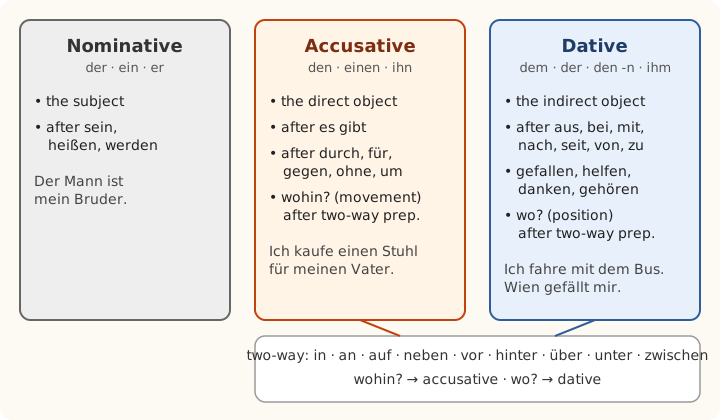
The cases on one page
| Case | Masculine | Feminine | Neuter | Plural | Pronouns |
|---|---|---|---|---|---|
| nominative | der, ein, mein | die, eine, meine | das, ein, mein | die, keine, meine | ich, du, er, sie, es, wir, ihr, sie |
| accusative | den, einen, meinen | die, eine, meine | das, ein, mein | die, keine, meine | mich, dich, ihn, sie, es, uns, euch, sie |
| dative | dem, einem, meinem | der, einer, meiner | dem, einem, meinem | den, keinen, meinen + -n | mir, dir, ihm, ihr, ihm, uns, euch, ihnen |
Table 16.6. The three cases of the course. The bold forms are those that differ from the nominative.
Word order on one page
- Statement: verb second. Morgen fahre ich nach Wien.
- Question with a question word: verb second. Wann fährst du nach Wien?
- Yes-no question and imperative: verb first. Fährst du nach Wien? Fahr nach Wien!
- The sentence bracket: the second verb (infinitive, participle, separable prefix) goes to the end. Ich muss morgen nach Wien fahren. Ich bin gestern nach Wien gefahren. Ich stehe morgen früh auf.
- Inside the bracket: pronouns early; then time – manner – place; nicht near the end. Ich fahre morgen mit dem Zug nach Wien.
- und, aber, oder, denn, sondern change nothing.
A look ahead: weil, dass and wenn
The next big step after this course is the subordinate clause: a part of a sentence that cannot stand alone, introduced by a word such as weil ("because"), dass ("that") or wenn ("if, when"). In a subordinate clause the conjugated verb goes to the very end, and the clause is separated by a comma:
- Ich komme im Sommer wieder, weil ich einen Kurs in Wien machen will.
- Ich glaube, dass Ravi recht hat.
- Wenn das Wetter gut ist, gehen wir wandern.
Compare denn, which you already know, and weil: they mean the same, but only weil moves the verb: … denn ich bin müde, … weil ich müde bin. Notice also the last example: when the subordinate clause comes first, it takes position 1, so the main verb follows straight after the comma: Wenn das Wetter gut ist, gehen wir wandern. For now, recognise these clauses when you hear them; using them freely is the work of level A2.
Ten classic mistakes of English speakers
| Wrong | Right | Why (lesson) |
|---|---|---|
| Morgen ich fahre nach Wien. | Morgen fahre ich nach Wien. | verb second (7) |
| Ich kann kommen morgen. | Ich kann morgen kommen. | infinitive at the end (12) |
| Ich habe gegangen. | Ich bin gegangen. | movement takes sein (14) |
| Ich habe ein Bruder. | Ich habe einen Bruder. | masculine accusative (8) |
| Der Tisch ist neu. Es ist schön. | Der Tisch ist neu. Er ist schön. | pronoun follows gender (4) |
| Ich habe nicht ein Auto. | Ich habe kein Auto. | kein, not nicht ein (5) |
| Ich bin ein Lehrer. | Ich bin Lehrer. | no article with jobs (5) |
| Ich habe zwanzig Jahre. Ich bin kalt. | Ich bin zwanzig. Mir ist kalt. | age with sein; feeling cold (5) |
| Ich lerne Deutsch für zwei Jahre. | Ich lerne seit zwei Jahren Deutsch. | seit + present (6) |
| Ich gehe zu Hause. | Ich gehe nach Hause. | nach Hause / zu Hause (11) |
Table 16.7. Ten classic mistakes. Read the right column aloud until it sounds natural.
False friends
| German | Means | Not |
|---|---|---|
| bekommen | to get, receive | to become (werden) |
| will | want(s) | will (werde) |
| also | so, therefore | also (auch) |
| bald | soon | bald (glatzköpfig) |
| der Chef | the boss | a chef (der Koch) |
| das Gift | poison | a gift (das Geschenk) |
| das Handy | mobile phone | handy (praktisch) |
| aktuell | current, up to date | actual (tatsächlich) |
| eventuell | possibly, perhaps | eventually (schließlich) |
| sympathisch | likeable | sympathetic (mitfühlend) |
| sensibel | sensitive | sensible (vernünftig) |
| der Rock | the skirt | rock (der Felsen) |
| fast | almost | fast (schnell) |
| das Kind | the child | kind (nett) |
Table 16.8. False friends. Many of them have a related English word with an older or rarer meaning: German bald, for instance, is related to English bold.
16.5 Practice: writing and speaking about yourself
A model text
Read Emma's text aloud. It uses the present, the perfect, modal verbs and the future, and the three cases.
- Ich heiße Emma Clarke und komme aus Manchester. — My name is Emma Clarke and I come from Manchester.
- Ich bin Lehrerin, aber dieses Jahr habe ich frei. — I'm a teacher, but this year I'm off work.
- Seit September lerne ich in Leipzig Deutsch. — Since September I've been learning German in Leipzig.
- Ich wohne mit Jonas in einer WG. Er studiert Maschinenbau und ist sehr nett. — I live with Jonas in a shared flat. He studies engineering and is very nice.
- Am Anfang war Deutsch sehr schwer für mich. Ich habe oft „Wie bitte?“ gesagt. — At first German was very hard for me. I often said "Sorry?"
- Im Dezember sind wir nach Wien gefahren und haben Jonas' Cousine besucht. — In December we went to Vienna and visited Jonas's cousin.
- Wien hat mir sehr gut gefallen. — I liked Vienna very much.
- Nächste Woche fliege ich nach England zurück, aber im Sommer komme ich wieder. — Next week I'm flying back to England, but I'll come back in the summer.
- Ich will dann in Wien einen Kurs machen. Ich freue mich schon! — Then I want to do a course in Vienna. I'm already looking forward to it!
Your own text
Write ten sentences about yourself, using Emma's text as a model. Include:
- your name, where you come from and where you live (present);
- your job or studies, and your family (present, possessives);
- your hobbies (gern, lieber, am liebsten);
- why and how long you have been learning German (seit, denn);
- two things you did recently (perfect, with haben and sein);
- something you have to do and something you want to do (modal verbs);
- a plan for the future (present with a time word, or werden).
Then read your text aloud, record it if you can, and compare it with the text you could have written after Lesson 2.
Role-plays
Act out these situations, alone or with a partner. Each brings together several lessons.
- At the station (Lessons 3, 11, 15): buy a return ticket to Salzburg for Saturday morning, ask about the platform and whether you have to change.
- In a café (Lesson 10): order for two people, ask whether a dish is vegetarian, pay separately with a tip.
- Asking the way (Lesson 11): ask a stranger the way to the town hall, and repeat the directions to check.
- An invitation (Lessons 12, 13): invite a friend to a party on Friday; your friend can't, explains why, and suggests another day.
- After the weekend (Lesson 14): ask a colleague what they did at the weekend, and tell them about yours.
Say it
Talk about yourself for one minute without stopping: who you are, what you do, what you did last weekend, and what you are going to do next summer. Don't worry about mistakes; aim to keep going, and use also, na ja and Moment to gain time, as German speakers do.
16.6 Culture: where to go from here
Keep listening and reading. The fastest way to improve now is to meet a lot of German you can almost understand. Listen to the news in slow, simple German, which several public broadcasters offer; watch films and series with German subtitles; read children's books, graded readers and simple magazines, then move on to the fairy tales of the Brothers Grimm, which are short, famous and written in a clear simple past. Your knowledge of the perfect and of war and hatte will let you follow the story; the other simple past forms soon become familiar.
Speak. Look for a conversation partner: many towns and universities run tandem programmes in which you practise German with a German speaker who wants to practise English. Online, there are many such exchanges. Use what you know, ask Wie sagt man …?, and accept corrections gratefully.
Courses and exams. The Goethe-Institut, Germany's cultural institute, has centres in many countries and offers courses and exams at every level; the Austrian Language Diploma (ÖSD) and the telc exams are other widely recognised certificates. All of them follow the levels of the Common European Framework. After this course you are ready to take an A1 exam and to start working towards A2, where you will learn the subordinate clauses of section 16.4, the adjective endings, the simple past and much more vocabulary.
Go there. Nothing replaces time in a German-speaking country: a language course in Leipzig, Vienna or Zurich, a summer job, a holiday in the Alps or on the Baltic coast. You will hear Saxon, Viennese and Swiss accents, eat Semmeln, Schrippen and Weggli, and discover how far the German of this book can take you. Viel Erfolg und viel Spaß! Good luck, and have fun!
16.7 Summary
Summary
- Verbs: present (verb second); imperative (verb first); modal + infinitive at the end; perfect: haben / sein + participle at the end; future: werden + infinitive at the end.
- Perfect: sein for movement and change; participles gemacht, gesehen, eingekauft, besucht, studiert.
- Cases: only the masculine changes in the accusative (den, einen); the dative changes everything (dem, der, dem, den + -n).
- Prepositions: accusative durch, für, gegen, ohne, um; dative aus, bei, mit, nach, seit, von, zu, gegenüber; two-way in, an, auf, neben, vor, hinter, über, unter, zwischen (wohin? accusative, wo? dative).
- Word order: verb second; bracket; time – manner – place; weil, dass, wenn send the verb to the end.
- Watch out for: the ten classic mistakes and the false friends (bekommen, will, also, Chef, Gift, Handy, eventuell).
16.8 Exercises
Exercise 1
Give the perfect, er form, of bleiben.
Answer
er ist geblieben. Er ist geblieben.
Exercise 2
Give the er form of nehmen in the present.
Answer
nimmt. er nimmt.
Exercise 3
Complete: Ich fahre mit ___ Bus zur Arbeit.
Answer
dem. mit dem Bus: mit takes the dative.
Exercise 4
Complete: Das Geschenk ist für ___ Vater. (my)
Answer
meinen. für meinen Vater: für takes the accusative.
Exercise 5
Complete: Wir gehen heute Abend ___ Theater. (into the theatre)
Answer
ins. ins Theater: movement, accusative.
Exercise 6
What does Ich bekomme ein Geschenk mean?
Answer
I get a present. bekommen means to get or receive, not to become.
Exercise 7
Join with weil: Ich lerne Deutsch. Ich will in Wien studieren.
Answer
Ich lerne Deutsch, weil ich in Wien studieren will. After weil, the conjugated verb (will) goes to the very end.
Exercise 8
Put into the perfect: Am Samstag kaufe ich ein, und dann fahre ich zu meiner Oma.
Answer
Am Samstag habe ich eingekauft, und dann bin ich zu meiner Oma gefahren.
Exercise 9
Correct the mistakes: Gestern ich habe gegangen in die Stadt. Ich habe ein neuer Rock gekauft für meine Schwester. Sie ist ein Studentin.
Answer
Gestern bin ich in die Stadt gegangen. Ich habe einen neuen Rock für meine Schwester gekauft. Sie ist Studentin. Verb second after gestern; gehen takes sein; the participle goes to the end; Rock is masculine, so einen neuen (the adjective takes -en here); no article with a job.
Exercise 10
Answer in full sentences: Was hast du letztes Wochenende gemacht, und was machst du nächstes Wochenende?
Answer
A model answer: Letztes Wochenende habe ich Freunde besucht, und wir sind zusammen ins Kino gegangen. Nächstes Wochenende fahre ich mit meiner Familie an den See.
16.9 Quiz
Quiz: review of the course
Exercise 11
Gestern ___ ich lange geschlafen.
- bin
- habe
- war
- hatte
Answer
habe
schlafen is not a verb of movement or change: perfect with haben.
Exercise 12
Wohin fährst du? – ___
- In der Schweiz.
- In die Schweiz.
- Nach die Schweiz.
- Bei der Schweiz.
Answer
In die Schweiz.
A country with an article, movement: in + accusative.
Exercise 13
Ich kann heute nicht kommen, weil ich krank ___.
Answer
bin
After weil, the conjugated verb goes to the end.
Exercise 14
Kannst du ___ helfen? (me)
Answer
mir
helfen takes the dative.
Exercise 15
Match each false friend to its meaning.
| A | B |
|---|---|
| bekommen | boss |
| Gift | so |
| Chef | to get |
| also | poison |
Answer
bekommen — to get; Gift — poison; Chef — boss; also — so
Exercise 16
Put the words in order: "Tomorrow I have to get up early."
Words: früh / Morgen / ich / muss / aufstehen.
Answer
Morgen muss ich früh aufstehen.
Exercise 17
Tap the wrong word.
Ich lerne seit zwei Jahre Deutsch.
Answer
Wrong word: Jahre.
Corrected: Ich lerne seit zwei Jahren Deutsch.
seit takes the dative; the dative plural adds -n: Jahren.
Exercise 18
Translate: I have a brother.
Answer
Ich habe einen Bruder
Exercise 19
Say it aloud.
Nächste Woche fliege ich nach England zurück.
Answer
Say: Nächste Woche fliege ich nach England zurück.
Exercise 20
Write what you hear.
Dictation. Have someone read the sentence aloud, then write it down.
Im Sommer komme ich wieder, weil ich einen Kurs machen will.
Answer
Im Sommer komme ich wieder, weil ich einen Kurs machen will.