Lesson 12: Modal Verbs: können, müssen, wollen
Die Modalverben
Much of what we say is not about what we do but about what we can do, must do, want to do, may do or should do. These meanings are carried by the modal verbs: können, müssen, wollen, dürfen, sollen and mögen with its form möchten. They make it possible to invite, accept and refuse, ask for permission, give advice and state rules. They also introduce a feature that runs through the whole of German grammar: the sentence bracket, in which one verb stands in second place and another goes to the very end of the sentence: Ich kann am Freitag leider nicht kommen.
Learning outcomes
By the end of this lesson you will be able to:
- conjugate the modal verbs können, müssen, wollen, dürfen, sollen and möchten in the present;
- build sentences with a modal verb and an infinitive at the end: the sentence bracket;
- choose the right modal verb, and avoid the traps müssen nicht (don't have to), nicht dürfen (must not) and wollen (want, not "will");
- invite someone, and accept or refuse politely;
- ask for permission with Darf ich …? and offer help with Soll ich …?;
- state rules with man and understand signs;
- say what is wrong when you are ill, and understand a doctor's advice.
12.1 Dialogue: an invitation
Jonas comes into the kitchen, where Emma is studying.
- Jonas: Emma, hast du am Freitag Zeit? Ich habe zwei Karten für ein Konzert. Willst du mitkommen? — Emma, are you free on Friday? I've got two tickets for a concert. Do you want to come?
- Emma: Am Freitag? Oh, schade, da kann ich nicht. Ich muss für meine Prüfung lernen. — On Friday? Oh, what a pity, I can't then. I have to study for my exam.
- Jonas: Musst du den ganzen Abend lernen? — Do you have to study all evening?
- Emma: Ja, leider. Die Prüfung ist am Montag. Aber am Samstag kann ich. — Yes, unfortunately. The exam is on Monday. But on Saturday I can.
- Jonas: Am Samstag gibt es kein Konzert, aber wir können ins Kino gehen. Möchtest du? — There's no concert on Saturday, but we can go to the cinema. Would you like to?
- Emma: Ja, gern! Soll ich die Karten kaufen? — Yes, I'd love to! Shall I buy the tickets?
- Jonas: Nein, das mache ich. Um wie viel Uhr wollen wir uns treffen? — No, I'll do that. What time shall we meet?
- Emma: Um sieben vor dem Kino? Kann Ravi auch kommen? — At seven outside the cinema? Can Ravi come too?
- Jonas: Nein, Ravi ist krank. Er hat Fieber und muss im Bett bleiben. Der Arzt sagt, er soll viel trinken und schlafen. — No, Ravi is ill. He has a temperature and has to stay in bed. The doctor says he should drink a lot and sleep.
- Emma: Der Arme! Darf er Besuch haben? Ich will ihm Suppe bringen. — Poor thing! Is he allowed visitors? I want to take him some soup.
- Jonas: Ich glaube, ja. Aber du musst nicht lange bleiben. Er ist sehr müde. — I think so. But you don't have to stay long. He's very tired.
Notice:
- The modal verb stands in second place, and the verb that says what is done goes to the end, in the infinitive: Ich muss für meine Prüfung lernen. Wir können ins Kino gehen.
- In a question, the modal verb comes first, and the infinitive still goes to the end: Willst du mitkommen? Soll ich die Karten kaufen?
- When the meaning is clear, the infinitive can be left out: Da kann ich nicht. Möchtest du?
- du musst nicht means "you don't have to", not "you mustn't".
12.2 Vocabulary: invitations and health
Inviting, accepting and refusing
| German | English |
|---|---|
| Hast du am Freitag Zeit? | Are you free on Friday? |
| Willst du mitkommen? / Kommst du mit? | Do you want to come along? |
| Hast du Lust auf Kino? | Do you fancy the cinema? |
| Wollen wir … ? | Shall we … ? |
| Ja, gern! / Gute Idee! | Yes, I'd love to! / Good idea! |
| Super, ich komme gern. | Great, I'd love to come. |
| Leider kann ich nicht. | Unfortunately I can't. |
| Schade! | What a pity! |
| Ich habe leider keine Zeit. | I'm afraid I'm busy. |
| Vielleicht ein anderes Mal. | Maybe another time. |
| Wann und wo treffen wir uns? | When and where shall we meet? |
| Abgemacht! | Agreed! It's a deal! |
| Bis dann! | See you then! |
| die Einladung | the invitation |
| die Karte, die Karten | the ticket; card; map |
| der Termin, die Termine | the appointment |
| die Prüfung, die Prüfungen | the exam |
Table 12.1. Invitations. Lust haben auf + accusative: to feel like something.
The body and health
| German | English | German | English |
|---|---|---|---|
| der Kopf | the head | der Bauch | the stomach, belly |
| der Hals | the throat, neck | der Rücken | the back |
| das Auge | the eye | der Arm | the arm |
| das Ohr | the ear | das Bein | the leg |
| die Nase | the nose | der Fuß | the foot |
| der Mund | the mouth | der Zahn | the tooth |
Table 12.2. The body.
| German | English |
|---|---|
| Ich bin krank. | I'm ill. |
| Ich bin erkältet. | I have a cold. |
| Ich habe Kopfschmerzen / Halsschmerzen / Bauchschmerzen. | I have a headache / sore throat / stomach ache. |
| Ich habe Fieber / Husten / Schnupfen. | I have a temperature / a cough / a runny nose. |
| Mein Bein tut weh. | My leg hurts. |
| Mir ist schlecht. | I feel sick. |
| die Praxis | the doctor's surgery, practice |
| das Medikament / die Tablette | the medicine / the tablet |
| das Rezept | the prescription; the recipe |
| Gute Besserung! | Get well soon! |
Table 12.3. Feeling ill. Schmerzen (pains) is plural: Kopfschmerzen, a headache.
12.3 Grammar: the modal verbs and the sentence bracket
The forms
The six modal verbs share a pattern that sets them apart from other verbs:
- In the singular, most of them change their vowel (only sollen does not), and the ich and er forms are the same and have no ending: ich kann, er kann.
- In the plural, they are regular, with the vowel of the infinitive: wir können, ihr könnt, sie können.
| Person | können | müssen | wollen | dürfen | sollen | möchten |
|---|---|---|---|---|---|---|
| ich | kann | muss | will | darf | soll | möchte |
| du | kannst | musst | willst | darfst | sollst | möchtest |
| er, sie, es | kann | muss | will | darf | soll | möchte |
| wir | können | müssen | wollen | dürfen | sollen | möchten |
| ihr | könnt | müsst | wollt | dürft | sollt | möchtet |
| sie, Sie | können | müssen | wollen | dürfen | sollen | möchten |
Table 12.4. The modal verbs in the present. Mögen (ich mag) is in Lesson 8; möchten (ich möchte) is its polite form.
The sentence bracket
When a modal verb is used with another verb, the two verbs split the sentence between them:
- The modal verb, with its person ending, takes the usual verb position: second in a statement or W-question, first in a yes-no question.
- The other verb, in the infinitive, goes to the very end of the sentence.
Everything else goes between them, like the contents of a bracket. German grammarians call this the sentence bracket (die Satzklammer).
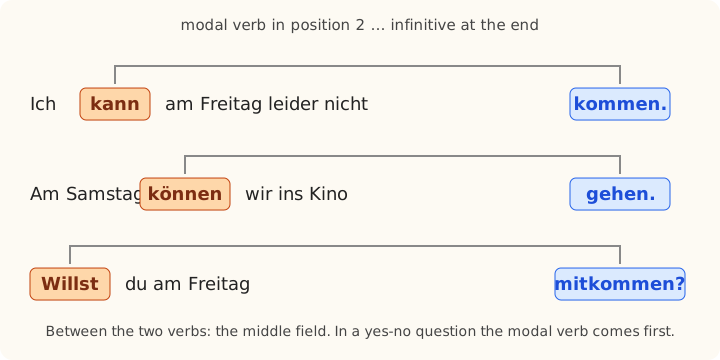
| Position 1 | Modal verb | Middle | Infinitive at the end |
|---|---|---|---|
| Ich | kann | am Freitag leider nicht | kommen. |
| Am Samstag | können | wir ins Kino | gehen. |
| Ravi | muss | im Bett | bleiben. |
| Wann | musst | du morgen | arbeiten? |
| — | Darf | ich das Fenster | öffnen? |
Table 12.5. The sentence bracket. Practice: hide the infinitives and put them back.
Common mistake: Ich kann kommen am Freitag
English puts the main verb right after the modal: I can come on Friday. German sends it to the end, after everything else: Ich kann am Freitag kommen. And the infinitive has no "zu" and no ending: Ich muss arbeiten, not Ich muss zu arbeiten or Ich muss arbeite.
Nicht in the bracket
To negate a sentence with a modal verb, nicht usually goes just before the infinitive: Ich kann heute nicht kommen. Du musst nicht lange bleiben. Hier darf man nicht rauchen. With a noun, use kein as usual: Er darf keinen Kaffee trinken.
The modal verb on its own
When the infinitive is obvious, it is often left out, especially with verbs of movement and with tun or machen:
- Ich muss jetzt nach Hause. (gehen) — I have to go home now.
- Kannst du Deutsch? (sprechen) — Can you speak German?
- Das darf man nicht. (machen) — You're not allowed to do that.
- Ich will nicht! — I don't want to!
12.4 Grammar: what each modal verb means
können: can, be able to
können expresses ability, possibility and, in everyday speech, permission:
- Ravi kann gut kochen. — Ravi can cook well. (ability)
- Wir können ins Kino gehen. — We can go to the cinema. (possibility)
- Kann ich mit Karte zahlen? — Can I pay by card?
- Können Sie mir helfen? — Can you help me? (a polite request)
müssen: must, have to
müssen expresses necessity and obligation:
- Ich muss für meine Prüfung lernen. — I have to study for my exam.
- Ravi muss im Bett bleiben. — Ravi has to stay in bed.
dürfen: may, be allowed to
dürfen expresses permission. Darf ich …? is the polite way to ask whether you may do something:
- Darf ich das Fenster öffnen? — May I open the window?
- Darf er Besuch haben? — Is he allowed visitors?
- Darf ich vorstellen? Das ist Ravi. — May I introduce Ravi?
Müssen nicht and nicht dürfen
Here German and English part company, and the difference matters:
| German | Meaning | English |
|---|---|---|
| Du musst nicht kommen. | it is not necessary | You don't have to come. |
| Du darfst nicht kommen. | it is forbidden | You mustn't come. You're not allowed to come. |
Table 12.6. Two kinds of "not". English mustn't is German nicht dürfen.
So Du musst nicht lange bleiben is kind ("You needn't stay long"), while Du darfst nicht lange bleiben is a ban. nicht brauchen zu also means "not need to": Du brauchst nicht zu kommen.
wollen and möchten: want, would like
wollen expresses a firm wish or intention; möchten is the softer, more polite "would like":
- Ich will Ärztin werden. — I want to become a doctor.
- Ich will ihm Suppe bringen. — I want to take him some soup.
- Ich möchte ein Glas Wasser. — I'd like a glass of water.
Wollen wir …? makes a suggestion: Wollen wir ins Kino gehen? ("Shall we go to the cinema?").
False friend: ich will
Ich will looks like English I will, but it means I want. Ich will nach Berlin fahren is "I want to go to Berlin", not "I will go". To talk about the future, use the present tense (Lesson 6) or werden (Lesson 15).
sollen: should, be supposed to
sollen expresses an obligation that comes from someone else: an instruction, advice, a rule, or what people say:
- Der Arzt sagt, ich soll viel trinken. — The doctor says I should drink a lot.
- Du sollst deine Mutter anrufen. — You're to call your mother. (she asked for it)
- Soll ich die Karten kaufen? — Shall I buy the tickets? (an offer: do you want me to?)
- Was soll ich machen? — What am I supposed to do?
The difference from müssen: Ich muss lernen is a necessity (the exam is on Monday); Ich soll lernen means someone has told me to.
Man: rules and signs
The pronoun man means "one, you, people in general". It takes the er form of the verb, and it is often used with modal verbs to state rules:
- Hier darf man nicht rauchen. — You can't smoke here.
- In der Bibliothek muss man leise sein. — You have to be quiet in the library.
- Kann man hier mit Karte zahlen? — Can you pay by card here?
- Wie sagt man das auf Deutsch? — How do you say that in German?
Notices and signs use short forms with the infinitive or a past participle: Rauchen verboten ("No smoking"), Bitte nicht stören ("Please do not disturb"), Betreten verboten ("No entry", literally "entering forbidden").
Worked example: choosing the modal
Say each idea in German with the right modal verb.
- It's possible to swim in the lake. → possibility: Man kann im See schwimmen.
- Swimming is forbidden here. → nicht dürfen: Hier darf man nicht schwimmen.
- You don't need to bring anything. → nicht müssen: Du musst nichts mitbringen.
- Jonas intends to study in Vienna. → wollen: Jonas will in Wien studieren.
- The doctor told Ravi to stay at home. → sollen: Ravi soll zu Hause bleiben.
- Offering to open the window. → Soll ich das Fenster öffnen?
12.5 Practice
The forms
| Sentence | Modal |
|---|---|
| Kannst du mir helfen? | können |
| Wir müssen um acht Uhr da sein. | müssen |
| Emma will Ärztin werden. | wollen |
| Darf ich hier sitzen? | dürfen |
| Was soll ich mitbringen? | sollen |
| Ihr könnt gern mitkommen. | können |
| Er muss heute nicht arbeiten. | müssen |
| Möchtest du etwas trinken? | möchten |
Table 12.7. Practice: the modal verbs.
Build the bracket
| Words | Sentence |
|---|---|
| ich / heute / kann / nicht / kommen | Ich kann heute nicht kommen. |
| du / morgen / musst / arbeiten / ? | Musst du morgen arbeiten? |
| wir / ins Kino / wollen / gehen | Wir wollen ins Kino gehen. |
| man / hier / darf / nicht / parken | Hier darf man nicht parken. |
| ich / das Fenster / soll / öffnen / ? | Soll ich das Fenster öffnen? |
Table 12.8. Practice: the sentence bracket.
At the doctor's
Read the dialogue aloud.
- Guten Tag, Herr Kulkarni. Was fehlt Ihnen? — Hello, Mr Kulkarni. What's the matter?
- Ich habe Fieber und Halsschmerzen, und mein Kopf tut weh. — I have a temperature and a sore throat, and my head hurts.
- Sie haben eine Grippe. Sie müssen drei Tage zu Hause bleiben. — You have flu. You must stay at home for three days.
- Darf ich zum Deutschkurs gehen? — Am I allowed to go to my German course?
- Nein, das dürfen Sie nicht. Sie sollen viel schlafen und viel Tee trinken. — No, you mustn't. You should sleep a lot and drink plenty of tea.
- Muss ich Tabletten nehmen? — Do I have to take tablets?
- Nein, das müssen Sie nicht. Gute Besserung! — No, you don't have to. Get well soon!
Say it
Invite a friend to do something at the weekend. Your friend refuses the first suggestion with a reason (Ich muss …), and accepts the second. Agree on a time and a place. For example:
Hast du am Samstag Zeit? Wollen wir schwimmen gehen? – Leider kann ich nicht, ich muss arbeiten. – Schade! Und am Sonntag? Wir können wandern. – Ja, gern! Wann treffen wir uns? – Um zehn am Bahnhof. – Abgemacht!
12.6 Culture: appointments, punctuality and quiet hours
Punctuality. Being on time matters in the German-speaking countries, and Switzerland and Germany in particular have a reputation for it. Arriving five minutes early for a business meeting or a doctor's appointment is normal; if you are going to be more than a few minutes late, you are expected to phone or send a message. For a private invitation to someone's home, arriving exactly on time or a few minutes late is polite; arriving very early is not.
Appointments. Much of life runs on appointments (der Termin): at the doctor's, at the hairdresser's, at the town hall to register your address. Spontaneous visits are less common than in some cultures, and even friends often arrange to meet a few days ahead. You will hear Haben Sie einen Termin? ("Do you have an appointment?") at many reception desks.
Quiet hours. House rules and local regulations often set quiet hours (die Ruhezeit): at night, and in many places at midday and on Sundays and public holidays. During these times you should not drill, mow the lawn, play loud music or, in some buildings, even put bottles into the glass recycling container. Sunday is a traditional day of rest, and many people value its calm.
Visiting the doctor. In Germany and Austria, people usually have a family doctor (der Hausarzt or die Hausärztin) whom they see first. Employees who are ill and cannot work need a doctor's certificate (die Krankschreibung) if they are off for more than a few days. Medicines are sold in pharmacies, recognisable by a large red Gothic A for Apotheke; even mild painkillers are generally bought there rather than in supermarkets.
Bringing a gift. When you are invited to someone's home, it is customary to bring a small present: flowers (unwrapped before you hand them over, and traditionally in an odd number), a bottle of wine or some chocolates.
12.7 Summary
Summary
- Forms: kann, muss, will, darf, soll, möchte (ich and er, no ending); plural regular: können, müssen, wollen, dürfen, sollen, möchten.
- Sentence bracket: modal in position 2 (or 1 in a yes-no question), infinitive at the end: Ich kann am Freitag nicht kommen. No zu.
- können: can, ability, possibility. müssen: must, have to. dürfen: may, be allowed to. wollen: want to. möchten: would like to. sollen: be supposed to, should (someone else's wish); Soll ich …? offers.
- Traps: nicht müssen = don't have to; nicht dürfen = mustn't; ich will = I want.
- nicht goes before the infinitive: Ich kann heute nicht kommen.
- man + modal for rules: Hier darf man nicht rauchen.
- Invitations: Hast du Zeit? Willst du mitkommen? Ja, gern! Leider kann ich nicht. Abgemacht!
- Health: Ich habe Kopfschmerzen / Fieber. Mein Bein tut weh. Gute Besserung!
12.8 Exercises
Exercise 1
Complete with the right form of können: ___ du Gitarre spielen?
Answer
Kannst. Kannst du Gitarre spielen?
Exercise 2
Complete with the right form of müssen: Er ___ heute arbeiten.
Answer
muss. Er muss heute arbeiten. No ending in the er form.
Exercise 3
Complete with the right form of dürfen: Hier ___ man nicht parken.
Answer
darf. Hier darf man nicht parken. man takes the er form.
Exercise 4
Complete with the right form of wollen: Was ___ ihr am Wochenende machen?
Answer
wollt. Was wollt ihr am Wochenende machen?
Exercise 5
Put in order: ich / morgen / muss / früh / aufstehen.
Answer
Ich muss morgen früh aufstehen. Ich muss morgen früh aufstehen. The infinitive goes to the end.
Exercise 6
Translate: "You don't have to come."
Answer
Du musst nicht kommen. Du musst nicht kommen. (Or Sie müssen nicht kommen.)
Exercise 7
Translate: "You mustn't smoke here."
Answer
Hier darfst du nicht rauchen. Hier darfst du nicht rauchen. Or, as a general rule: Hier darf man nicht rauchen.
Exercise 8
Offer to help a friend carry a bag (die Tasche tragen), with sollen.
Answer
Soll ich die Tasche tragen? Soll ich die Tasche tragen?
Exercise 9
Correct the mistakes: Ich will gehen morgen ins Kino. Kannst du kommen mit?
Answer
Ich will morgen ins Kino gehen. Kannst du mitkommen? The infinitive goes to the end; mitkommen is one word in the infinitive.
Exercise 10
Write a text message refusing an invitation: say it's a pity, you can't on Saturday because you have to visit your grandmother, and suggest Sunday instead.
Answer
Schade! Am Samstag kann ich leider nicht, ich muss meine Oma besuchen. Können wir am Sonntag gehen? (Other versions are possible, for example Hast du am Sonntag Zeit?)
12.9 Quiz
Quiz: modal verbs
Exercise 11
Ich ___ heute nicht kommen. Ich bin krank.
- kann
- kannst
- können
- könnt
Answer
kann
Exercise 12
Which sentence means "You don't have to pay"?
- Du darfst nicht zahlen.
- Du musst nicht zahlen.
- Du willst nicht zahlen.
- Du sollst zahlen.
Answer
Du musst nicht zahlen.
nicht müssen = not necessary; nicht dürfen = forbidden.
Exercise 13
___ ich das Fenster öffnen? (dürfen)
Answer
Darf
Exercise 14
Der Arzt sagt, Ravi ___ viel schlafen. (sollen)
Answer
soll
Exercise 15
Put the words in order: "We want to go to the cinema."
Words: ins / Kino / gehen. / wollen / Wir
Answer
Wir wollen ins Kino gehen.
Exercise 16
Match the modal verb to its meaning.
| A | B |
|---|---|
| können | may |
| müssen | want |
| dürfen | can |
| wollen | must |
Answer
können — can; müssen — must; dürfen — may; wollen — want
Exercise 17
Tap the word in the wrong place.
Ich muss lernen heute Abend.
Answer
Wrong word: lernen.
Corrected: Ich muss heute Abend lernen.
With a modal verb, the infinitive goes to the end.
Exercise 18
Say it aloud.
Leider kann ich am Freitag nicht kommen.
Answer
Say: Leider kann ich am Freitag nicht kommen.
Exercise 19
Write what you hear.
Dictation. Have someone read the sentence aloud, then write it down.
Kannst du mir bitte helfen?
Answer
Kannst du mir bitte helfen?