Lesson 3: Numbers, Days, Dates and Time
Zahlen, Tage, Daten und Uhrzeit
Numbers are everywhere in daily life: prices, phone numbers, addresses, ages, the time of the next train. German numbers are logical, but they have one feature that surprises every English speaker: from 21 to 99 the units come first, so 25 is "five-and-twenty", fünfundzwanzig, as in the old English nursery rhyme four-and-twenty blackbirds. German also says "half three" when it means half past two. In this lesson you learn to count, to give prices and phone numbers, to name the days and months, to say dates and birthdays, and to tell the time in the two ways Germans use: the 24-hour clock of timetables and the informal clock of conversation.
Learning outcomes
By the end of this lesson you will be able to:
- count from 0 to a million, and read prices, phone numbers and years aloud;
- name the days of the week, the months and the seasons, with am and im;
- say the date and your birthday with ordinal numbers: am dritten Mai;
- ask and tell the time, both officially (vierzehn Uhr dreißig) and informally (halb drei);
- say when something happens with um, am, im and the parts of the day;
- give your age with Ich bin … Jahre alt.
3.1 Dialogue: a birthday party
Emma and Jonas are having breakfast in the kitchen of their flat.
- Jonas: Emma, wann hast du Geburtstag? — Emma, when is your birthday?
- Emma: Am vierzehnten März. Und du? — On the fourteenth of March. And you?
- Jonas: Am Samstag! Am achtzehnten Oktober. Ich mache eine Party. — On Saturday! On the eighteenth of October. I'm having a party.
- Emma: Toll! Wie alt bist du dann? — Great! How old will you be then?
- Jonas: Dreiundzwanzig. Die Party beginnt um acht Uhr abends. Kommst du? — Twenty-three. The party starts at eight in the evening. Are you coming?
- Emma: Natürlich! Und Ravi? Er kommt sicher auch. — Of course! And Ravi? He's sure to come too.
- Jonas: Hast du seine Nummer? — Have you got his number?
- Emma: Ja: null eins sieben sechs, achtunddreißig, zweiundzwanzig, vierhundertneunundfünfzig. — Yes: 0176 38 22 459.
- Jonas: Langsam, bitte! Null eins sieben sechs … — Slowly, please! 0176 …
- Emma: … drei acht, zwo zwo, vier fünf neun. — … 3 8, 2 2, 4 5 9.
- Jonas: Danke. Oh, wie spät ist es? — Thanks. Oh, what time is it?
- Emma: Halb zehn. — Half past nine.
- Jonas: Halb zehn? Mein Seminar beginnt um Viertel vor zehn! Tschüss! — Half past nine? My seminar starts at a quarter to ten! Bye!
Notice:
- Dates use ordinal numbers ("fourteenth"), and "on" a date or a day is am: am vierzehnten März, am Samstag.
- "At" a time is um: um acht Uhr, um Viertel vor zehn.
- halb zehn, literally "half ten", means 9.30: half of the way to ten.
- On the phone, zwo is often said instead of zwei, so that it cannot be confused with drei.
3.2 Vocabulary: numbers, days, months and seasons
Numbers from 0 to 20
| German | German | German | |||
|---|---|---|---|---|---|
| 0 | null | 7 | sieben | 14 | vierzehn |
| 1 | eins | 8 | acht | 15 | fünfzehn |
| 2 | zwei | 9 | neun | 16 | sechzehn |
| 3 | drei | 10 | zehn | 17 | siebzehn |
| 4 | vier | 11 | elf | 18 | achtzehn |
| 5 | fünf | 12 | zwölf | 19 | neunzehn |
| 6 | sechs | 13 | dreizehn | 20 | zwanzig |
Table 3.1. The numbers from 0 to 20. Switch on Practice and write them from memory.
Look closely at three of them. In sechzehn (16) the s of sechs is dropped; in siebzehn (17) the -en of sieben is dropped. And elf and zwölf are relatives of English eleven and twelve.
The tens, and the big numbers
| German | German | ||
|---|---|---|---|
| 10 | zehn | 60 | sechzig |
| 20 | zwanzig | 70 | siebzig |
| 30 | dreißig | 80 | achtzig |
| 40 | vierzig | 90 | neunzig |
| 50 | fünfzig | 100 | hundert |
Table 3.2. The tens. Only dreißig is written with ß; sechzig and siebzig shorten their first part, as in 16 and 17.
| German | |
|---|---|
| 1 000 | tausend, eintausend |
| 10 000 | zehntausend |
| 100 000 | hunderttausend |
| 1 000 000 | eine Million |
| 2 000 000 | zwei Millionen |
| 1 000 000 000 | eine Milliarde (an English billion) |
Table 3.3. Big numbers. Careful: German eine Billion is a million million, an English trillion.
Days of the week
| German | English |
|---|---|
| der Montag | Monday |
| der Dienstag | Tuesday |
| der Mittwoch | Wednesday (mid-week) |
| der Donnerstag | Thursday (thunder's day) |
| der Freitag | Friday |
| der Samstag | Saturday (also der Sonnabend in the north and east) |
| der Sonntag | Sunday |
| das Wochenende | the weekend |
| die Woche | the week |
| der Tag | the day |
Table 3.4. The days of the week. All of them are masculine, because der Tag is.
Months and seasons
| German | German | German |
|---|---|---|
| der Januar (Austria: Jänner) | der Mai | der September |
| der Februar | der Juni | der Oktober |
| der März | der Juli | der November |
| der April | der August | der Dezember |
Table 3.5. The months. All are masculine. On the phone, Juni and Juli are often said Juno and Julei so that they are not confused.
| German | English |
|---|---|
| der Frühling | spring |
| der Sommer | summer |
| der Herbst | autumn, fall |
| der Winter | winter |
| der Monat | the month |
| das Jahr | the year |
Table 3.6. The seasons, also all masculine.
Words for time
| German | English |
|---|---|
| heute | today |
| morgen | tomorrow |
| übermorgen | the day after tomorrow |
| gestern | yesterday |
| der Morgen, morgens | the morning, in the morning(s) |
| der Vormittag, vormittags | the late morning, before noon |
| der Mittag, mittags | midday, at midday |
| der Nachmittag, nachmittags | the afternoon, in the afternoon(s) |
| der Abend, abends | the evening, in the evening(s) |
| die Nacht, nachts | the night, at night |
| die Uhr | the clock, watch; o'clock |
| die Stunde | the hour |
| die Minute | the minute |
| der Geburtstag | the birthday |
Table 3.7. Words for time.
Common mistake: morgen and der Morgen
morgen with a small m means "tomorrow"; der Morgen with a capital is "the morning". "Tomorrow morning" is morgen früh, never morgen Morgen. And Uhr is the time on the clock, while Stunde is a length of time: Es ist drei Uhr ("It is three o'clock"), but drei Stunden ("three hours").
3.3 Grammar: how German numbers work
From 21 to 99: the units first
From 21 to 99, German says the units, then und, then the tens, all in one word:
| Number | Built as | German |
|---|---|---|
| 21 | one-and-twenty | einundzwanzig |
| 22 | two-and-twenty | zweiundzwanzig |
| 34 | four-and-thirty | vierunddreißig |
| 47 | seven-and-forty | siebenundvierzig |
| 58 | eight-and-fifty | achtundfünfzig |
| 66 | six-and-sixty | sechsundsechzig |
| 79 | nine-and-seventy | neunundsiebzig |
| 85 | five-and-eighty | fünfundachtzig |
| 93 | three-and-ninety | dreiundneunzig |
Table 3.8. Numbers from 21 to 99.
Note that 21, 31, 41 … begin with ein-, not eins-: einundzwanzig. When you write a number down from dictation, write the second digit first: when you hear vierundsechzig, write the 4 in the units place, then the 6 in front of it. It takes practice; ten minutes a day with prices and phone numbers is the cure.
Hundreds and thousands
Above 100 the order is the same as in English, and the whole number is still one word: hundertzwanzig (120), zweihundertfünfundvierzig (245), tausendeinhundert (1 100), dreitausendsiebenhundertachtzig (3 780). hundert and tausend have no and: 101 is hunderteins. Only Million and Milliarde are separate nouns with a plural: drei Millionen.
Eins and ein
When you count, 1 is eins. Before a noun it becomes the article ein or eine ("one" and "a" are the same word in German): ein Kaffee, eine Stunde. In the time, 1 o'clock is ein Uhr or simply eins.
Writing numbers: the comma and the point
German uses a comma where English uses a decimal point, and a point or a space to separate thousands:
- 1,5 is "one point five", read eins Komma fünf;
- 10.000 or 10 000 is ten thousand.
Prices
The euro (der Euro) is the currency of Germany and Austria; one euro is 100 cents (der Cent). Prices are written with a comma and read without it:
- 2,50 € is read zwei Euro fünfzig;
- 0,99 € is read neunundneunzig Cent;
- 12,00 € is read zwölf Euro.
The plural of Euro after a number is Euro: zehn Euro, not zehn Euros. Switzerland and Liechtenstein use the Swiss franc, der Franken (CHF), divided into 100 Rappen: vier Franken zwanzig.
Phone numbers
Phone numbers are read digit by digit or in pairs, and both are common: 38 22 can be drei acht, zwo zwo or achtunddreißig, zweiundzwanzig. If you are not sure, ask for digits: Einzeln, bitte! ("One by one, please!").
Years and ages
Years up to 1999 are read in hundreds: 1989 is neunzehnhundertneunundachtzig ("nineteen hundred nine-and-eighty"). From 2000 they are read in thousands: 2026 is zweitausendsechsundzwanzig. A year stands alone, or with im Jahr, but never with in alone:
- Ich bin 2004 geboren. or Ich bin im Jahr 2004 geboren. — I was born in 2004.
Age is given with sein ("to be"), as in English:
- Wie alt bist du? — Ich bin zweiundzwanzig (Jahre alt). — How old are you? I'm twenty-two (years old).
3.4 Grammar: dates and the time
Days, months and seasons: am, im
- am + day or part of the day: am Montag, am Wochenende, am Abend, am Morgen (but in der Nacht).
- im + month or season: im Mai, im Sommer, im Winter.
- -s for a habit: montags ("on Mondays, every Monday"), abends ("in the evenings"), with a small letter.
am and im are short for an dem and in dem; Lesson 11 explains why.
Ordinal numbers and the date
The ordinal numbers (first, second, third …) are made by adding -te to the numbers from 2 to 19 and -ste from 20 upwards. Four are irregular: erste, dritte, siebte, achte.
| Ordinal | Ordinal | ||
|---|---|---|---|
| 1. | der erste | 10. | der zehnte |
| 2. | der zweite | 19. | der neunzehnte |
| 3. | der dritte | 20. | der zwanzigste |
| 4. | der vierte | 21. | der einundzwanzigste |
| 5. | der fünfte | 30. | der dreißigste |
| 7. | der siebte | 31. | der einunddreißigste |
| 8. | der achte | 100. | der hundertste |
Table 3.9. Ordinal numbers. In writing, an ordinal is a number with a point: 3. = dritte.
There are two patterns for the date, and the ending changes:
- What is the date? Der Wievielte ist heute? or Welches Datum ist heute? — Heute ist der dritte Mai. (written der 3. Mai): ending -e.
- On what date? Wann hast du Geburtstag? — Am dritten Mai. (written am 3. Mai): ending -en after am.
The day comes before the month, and in figures a date is written day, month, year, with points: 14.3.2026 or 14.03.2026, read vierzehnter dritter zweitausendsechsundzwanzig or, more often, vierzehnter März. A letter is dated Leipzig, 14. März 2026.
Telling the time: the official clock
To ask the time, say Wie spät ist es? (how late is it?) or Wie viel Uhr ist es?. The answer begins Es ist …
The official time uses the 24-hour clock: the hour, then Uhr, then the minutes. It is used for timetables, opening hours, the radio and anything formal, and in speech whenever precision matters.
- 8:00 acht Uhr
- 9:15 neun Uhr fünfzehn
- 14:30 vierzehn Uhr dreißig
- 20:45 zwanzig Uhr fünfundvierzig
- 0:10 null Uhr zehn
Telling the time: the informal clock
In conversation, people use a 12-hour clock with nach ("past"), vor ("to"), Viertel ("quarter") and halb ("half"). The key point is halb: it always looks forward to the next hour. halb drei is "half (of the way) to three", that is 2.30.
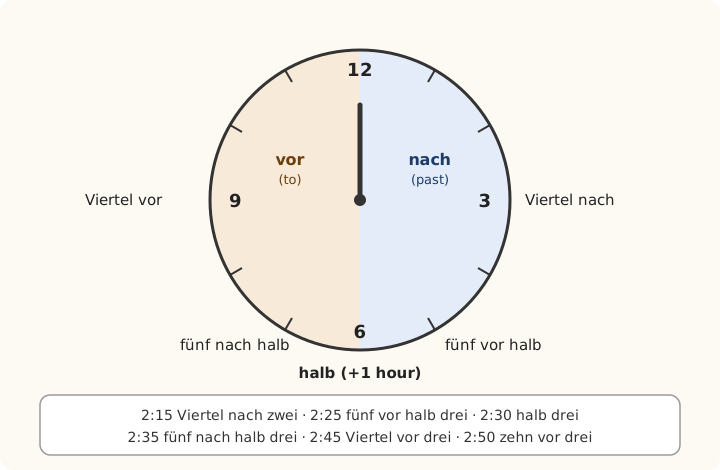
| Time | Informal | Literally |
|---|---|---|
| 3:00 | drei Uhr or drei | three o'clock |
| 3:05 | fünf nach drei | five past three |
| 3:10 | zehn nach drei | ten past three |
| 3:15 | Viertel nach drei | quarter past three |
| 3:20 | zwanzig nach drei | twenty past three |
| 3:25 | fünf vor halb vier | five to half-four |
| 3:30 | halb vier | half-four (half way to four) |
| 3:35 | fünf nach halb vier | five past half-four |
| 3:40 | zwanzig vor vier | twenty to four |
| 3:45 | Viertel vor vier | quarter to four |
| 3:50 | zehn vor vier | ten to four |
| 3:55 | fünf vor vier | five to four |
Table 3.10. The informal clock. 3:20 and 3:40 can also be said zehn vor halb vier and zehn nach halb vier.
The informal clock does not say a.m. or p.m. Add a part of the day when it is needed: um acht Uhr morgens (8 a.m.), um acht Uhr abends (8 p.m.), um drei Uhr nachmittags. Midday is zwölf Uhr or Mittag; midnight is Mitternacht.
Common mistake: halb
English half three (British, for 3.30) and German halb drei (2.30) are an hour apart. Many travellers have arrived an hour late, or an hour early, because of this. Think of halb drei as "half (of the hour) before three".
At what time? Um
To say when something happens, use um:
- Um wie viel Uhr beginnt der Film? — Um zwanzig Uhr. / Um acht. — What time does the film start? At eight.
- Der Kurs ist von neun bis zwölf Uhr. — The course is from nine to twelve.
- Wann kommst du? – Gegen sieben. — When are you coming? – Around seven.
Worked example: an appointment
Ravi has a doctor's appointment on Thursday 12 November at 10.45 a.m. Say it in German in two ways.
- Day: am Donnerstag; date: the 12th after am takes -en: am zwölften November.
- Time, official: um zehn Uhr fünfundvierzig. Informal: 10.45 is a quarter to eleven: um Viertel vor elf.
All together: Ravi hat am Donnerstag, am zwölften November, um Viertel vor elf einen Termin beim Arzt.
3.5 Practice
Prices and numbers
Read each price or number aloud, then check.
| Written | Said |
|---|---|
| 1,20 € | ein Euro zwanzig |
| 4,75 € | vier Euro fünfundsiebzig |
| 0,60 € | sechzig Cent |
| 16,99 € | sechzehn Euro neunundneunzig |
| 37 | siebenunddreißig |
| 71 | einundsiebzig |
| 365 | dreihundertfünfundsechzig |
| 1990 (a year) | neunzehnhundertneunzig |
Table 3.11. Practice: read prices and numbers.
What time is it?
| Clock | Informal |
|---|---|
| 7:30 | Es ist halb acht. |
| 10:15 | Es ist Viertel nach zehn. |
| 12:45 | Es ist Viertel vor eins. |
| 6:20 | Es ist zwanzig nach sechs. |
| 1:30 | Es ist halb zwei. |
| 9:55 | Es ist fünf vor zehn. |
Table 3.12. Practice: the informal clock.
Your week
Read Jonas's week aloud.
- Am Montag habe ich um neun Uhr ein Seminar. — On Monday I have a seminar at nine.
- Dienstags spiele ich Fußball. — On Tuesdays I play football.
- Am Mittwoch arbeite ich von zwei bis sechs. — On Wednesday I work from two to six.
- Am Samstag, am achtzehnten Oktober, ist meine Party. — On Saturday, the eighteenth of October, is my party.
- Im Dezember fahre ich nach Wien. — In December I'm going to Vienna.
Say it
Answer aloud: Wann hast du Geburtstag? Wie alt bist du? Wie spät ist es jetzt? Wie ist deine Telefonnummer? ("What is your phone number?"). Give your phone number twice, once in single digits and once in pairs.
3.6 Culture: clocks, calendars and fingers
The 24-hour clock. Timetables, shop signs, invitations and official letters all use the 24-hour clock, and people use it in speech too when they want to be precise: Der Zug fährt um siebzehn Uhr zwölf. In friendly conversation the informal clock is more usual. In parts of eastern and southern Germany and in Austria you will also hear viertel vier for 3.15 ("a quarter of the way to four") and dreiviertel vier for 3.45, following the same logic as halb vier. In Leipzig, where Emma studies, these forms are common.
Dates and weeks. Dates are written day, month, year: 3.10.2026 is the 3rd of October, never the 10th of March. The week starts on Monday, and calendars, diaries and many offices number the weeks of the year: in der Kalenderwoche 42 ("in week 42") is a normal way to arrange a delivery or a meeting.
National days. Each country has its own national day: in Germany, the Day of German Unity (der Tag der Deutschen Einheit) on 3 October, which marks the reunification of 1990; in Austria, the National Day (der Nationalfeiertag) on 26 October; in Switzerland, the Swiss National Day (der Bundesfeiertag) on 1 August, celebrated with bonfires and fireworks.
Birthdays. It is traditionally thought to bring bad luck to congratulate someone before their birthday, so Germans wait until the day itself: Alles Gute zum Geburtstag! ("All the best for your birthday!") or Herzlichen Glückwunsch! ("Congratulations!"). Often the person whose birthday it is brings a cake to work or invites the friends, rather than being treated.
Counting on your fingers. Germans count on their fingers starting with the thumb: the thumb alone is one, thumb and index finger two. If you hold up your index finger to order one beer, you may be understood, but holding up the thumb is clearer. Handwritten numbers differ a little too: the 1 is written with a long upstroke, like an upside-down V, and the 7 has a short line across it so that the two are not confused.
3.7 Summary
Summary
- 0 to 20: null, eins, zwei, drei … sechzehn, siebzehn … zwanzig. Tens: dreißig with ß, sechzig, siebzig shortened.
- 21 to 99: units + und + tens, one word: fünfundzwanzig (25). 21 = einundzwanzig.
- Writing: decimal comma (1,5), thousands point or space (10.000). Prices: 2,50 € = zwei Euro fünfzig; plural Euro.
- Years: neunzehnhundertneunzig, zweitausendsechsundzwanzig; no in: 2004 or im Jahr 2004. Age: Ich bin 22 Jahre alt.
- When: am Montag, am Wochenende, am Abend; im Mai, im Sommer; um acht Uhr; habits: montags, abends.
- Dates: ordinal -te (2 to 19), -ste (20+); erste, dritte, siebte, achte. Heute ist der dritte Mai. Am dritten Mai. Day before month: 3.5.
- Time: Wie spät ist es? Official: vierzehn Uhr dreißig. Informal: Viertel nach, halb, Viertel vor; halb drei = 2.30.
3.8 Exercises
Exercise 1
Write in figures: siebenundsechzig.
Answer
67. The units come first: seven-and-sixty.
Exercise 2
Write in words: 16.
Answer
sechzehn. sechzehn, without the s of sechs.
Exercise 3
Write in words: 30.
Answer
dreißig. dreißig, the only ten with ß.
Exercise 4
Say the price in words: 3,80 €.
Answer
drei Euro achtzig. drei Euro achtzig.
Exercise 5
Complete with am, im or um: Der Kurs beginnt ___ September.
Answer
im. im September: im with months.
Exercise 6
Complete with am, im or um: Wir essen ___ halb eins.
Answer
um. um halb eins (at 12.30): um with clock times.
Exercise 7
What time is halb sechs?
Answer
5.30. Half of the way to six. (17.30 in the afternoon.)
Exercise 8
Say 8.45 in the informal way.
Answer
Viertel vor neun. Es ist Viertel vor neun. In parts of the east and south also dreiviertel neun.
Exercise 9
Answer in a full sentence: Wann hast du Geburtstag? (on 7 July)
Answer
Ich habe am siebten Juli Geburtstag. Or simply Am siebten Juli. Siebte is irregular: no -en- in the middle.
Exercise 10
Translate: "Today is Monday, the first of June. The train leaves at 13.20." (leaves: fährt)
Answer
Heute ist Montag, der erste Juni. Der Zug fährt um dreizehn Uhr zwanzig. For a train, the official clock is natural; informally, um zwanzig nach eins.
3.9 Quiz
Quiz: numbers, days, dates and time
Exercise 11
How do you say 54?
- fünfzigvier
- vierundfünfzig
- fünfundvierzig
- vierfünfzig
Answer
vierundfünfzig
Units, und, tens: four-and-fifty.
Exercise 12
Es ist halb zehn. What time is it?
- 10.30
- 9.30
- 10.50
- 9.50
Answer
9.30
halb looks forward: half of the way to ten.
Exercise 13
Ich habe ___ zwölften Mai Geburtstag.
Answer
am
Exercise 14
Der Film beginnt ___ acht Uhr.
Answer
um
Exercise 15
Match the ordinal to the number.
| A | B |
|---|---|
| erste | 7. |
| dritte | 20. |
| siebte | 1. |
| zwanzigste | 3. |
Answer
erste — 1.; dritte — 3.; siebte — 7.; zwanzigste — 20.
Exercise 16
Write 17 in words.
Answer
siebzehn
Exercise 17
Tap the wrong word.
Ich bin in 2004 geboren.
Answer
Wrong word: in.
Corrected: Ich bin 2004 geboren.
A year stands alone or with im Jahr, never with in alone.
Exercise 18
Listen. What time is the train?
Read this aloud or have someone read it to you:
Der Zug nach Berlin fährt um Viertel nach drei.
- 2.45
- 3.15
- 3.45
- 2.15
Answer
3.15
Transcript: “Der Zug nach Berlin fährt um Viertel nach drei.”
Exercise 19
Write what you hear.
Dictation. Have someone read the sentence aloud, then write it down.
Heute ist der dritte Oktober.
Answer
Heute ist der dritte Oktober.