Lesson 10: Food and Shopping
Essen, Trinken und Einkaufen
Buying food is where a new language meets daily life: at the bakery counter, at the market, in the café. The good news is that the language of these situations is short and predictable. The seller asks Was darf es sein? ("What would you like?"), you ask for what you want politely, they ask Sonst noch etwas? ("Anything else?"), and you pay. In this lesson you learn the words for food and drink, quantities and prices, the polite ways of asking for things with ich möchte and ich hätte gern, and the imperative, the form of the verb for instructions, invitations and requests.
Learning outcomes
By the end of this lesson you will be able to:
- name common foods and drinks, with their genders and plurals;
- buy food in a shop or market: ask for quantities, ask the price, and pay;
- order and pay in a café or restaurant, separately or together, with a tip;
- ask politely with ich möchte, ich hätte gern and ich nehme;
- use noch ein ("another") and kein … mehr ("no more");
- give instructions and make requests with the imperative for Sie, du and ihr.
masculinefeminineneuterplural
10.1 Dialogue: at the bakery and in the café
At the bakery
On Saturday morning, Emma buys breakfast.
- Verkäuferin: Guten Morgen! Was darf es sein? — Good morning! What would you like?
- Emma: Guten Morgen! Ich hätte gern vier Brötchen und ein Vollkornbrot, bitte. — Good morning! I'd like four rolls and a wholemeal loaf, please.
- Verkäuferin: Gern. Sonst noch etwas? — Certainly. Anything else?
- Emma: Ja, zwei Stück Apfelkuchen, bitte. — Yes, two pieces of apple cake, please.
- Verkäuferin: Mit Sahne? — With cream?
- Emma: Nein, danke, ohne Sahne. Was macht das? — No, thanks, without cream. How much is that?
- Verkäuferin: Das macht neun Euro vierzig. — That's nine euros forty.
- Emma: Hier sind zehn Euro. — Here's ten euros.
- Verkäuferin: Und sechzig Cent zurück. Schönes Wochenende! — And sixty cents change. Have a nice weekend!
In the café
At lunchtime, Emma and Ravi go to a café.
- Kellner: Guten Tag! Was möchten Sie trinken? — Hello! What would you like to drink?
- Ravi: Ich nehme einen Cappuccino, bitte. — I'll have a cappuccino, please.
- Emma: Und für mich einen Tee mit Milch, bitte. — And a tea with milk for me, please.
- Kellner: Möchten Sie auch etwas essen? — Would you like something to eat as well?
- Ravi: Ja. Ist Fleisch in der Kartoffelsuppe? Ich esse kein Fleisch. — Yes. Is there meat in the potato soup? I don't eat meat.
- Kellner: Nein, die Suppe ist vegetarisch. — No, the soup is vegetarian.
- Ravi: Gut, dann nehme ich die Suppe. — Good, then I'll have the soup.
- Emma: Und ich hätte gern die Käsespätzle. — And I'd like the cheese noodles.
- (Later)
- Emma: Entschuldigung, wir möchten zahlen, bitte! — Excuse me, we'd like to pay, please!
- Kellner: Zusammen oder getrennt? — Together or separately?
- Ravi: Getrennt, bitte. — Separately, please.
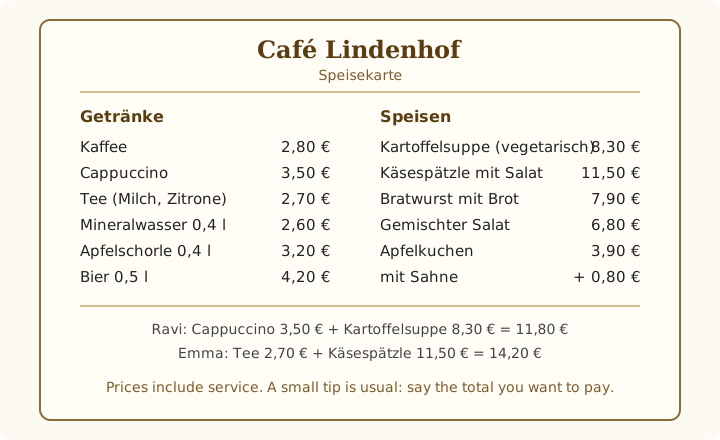
- Kellner: Der Cappuccino und die Suppe: elf Euro achtzig. — The cappuccino and the soup: eleven euros eighty.
- Ravi: Machen Sie dreizehn. — Make it thirteen.
- Kellner: Danke schön! Und für Sie? — Thank you! And for you?
- Emma: Der Tee und die Käsespätzle. — The tea and the cheese noodles.
- Kellner: Das macht vierzehn Euro zwanzig. — That's fourteen euros twenty.
- Emma: Fünfzehn, bitte. Stimmt so. — Fifteen, please. Keep the change.
Notice:
- To ask for something politely, say Ich hätte gern …, Ich möchte … or Ich nehme …. What you ask for is an object in the accusative: einen Cappuccino, einen Tee.
- Quantities need no word for "of": zwei Stück Apfelkuchen, "two pieces (of) apple cake".
- When you pay, you can include the tip by saying the total you want to pay: Machen Sie dreizehn, or say Stimmt so ("that's right as it is") when you hand over the money.
- Machen Sie dreizehn is an imperative: an instruction or request.
10.2 Vocabulary: food, drink and quantities
Food
| Singular | Plural | English |
|---|---|---|
| das Brot | die Brote | the bread, loaf |
| das Brötchen | die Brötchen | the bread roll |
| der Kuchen | die Kuchen | the cake |
| die Butter | — | butter |
| der Käse | — | cheese |
| die Wurst | die Würste | the sausage; cold meats |
| der Schinken | — | ham |
| das Ei | die Eier | the egg |
| die Milch | — | milk |
| der Joghurt | die Joghurts | the yoghurt |
| das Fleisch | — | meat |
| das Hähnchen | die Hähnchen | the chicken |
| der Fisch | die Fische | the fish |
| das Gemüse | — | vegetables |
| die Kartoffel | die Kartoffeln | the potato |
| die Tomate | die Tomaten | the tomato |
| die Zwiebel | die Zwiebeln | the onion |
| der Salat | die Salate | the salad; lettuce |
| das Obst | — | fruit |
| der Apfel | die Äpfel | the apple |
| die Banane | die Bananen | the banana |
| die Erdbeere | die Erdbeeren | the strawberry |
| der Reis | — | rice |
| — | die Nudeln | pasta, noodles |
| die Suppe | die Suppen | the soup |
| die Sahne | — | cream |
| der Zucker | — | sugar |
| das Salz / der Pfeffer | — | salt / pepper |
Table 10.1. Food. Words with a dash in the plural column are normally used in the singular.
Drinks
| German | English |
|---|---|
| der Kaffee | coffee |
| der Tee | tea |
| das Wasser, das Mineralwasser | water, mineral water |
| mit / ohne Kohlensäure | sparkling / still (with / without carbonic acid) |
| der Saft: der Orangensaft, der Apfelsaft | juice: orange juice, apple juice |
| die Apfelschorle | apple juice mixed with sparkling water |
| die Cola | cola |
| das Bier | beer |
| der Wein: der Rotwein, der Weißwein | wine: red wine, white wine |
Table 10.2. Drinks.
Quantities and containers
| German | English |
|---|---|
| das Kilo | kilo |
| das Pfund | half a kilo, 500 grams |
| das Gramm | gram |
| der Liter | litre |
| das Stück | piece |
| die Scheibe, die Scheiben | slice |
| die Flasche, die Flaschen | bottle |
| die Dose, die Dosen | tin, can |
| die Packung, die Packungen | packet |
| das Glas, die Gläser | glass; jar |
| die Tasse, die Tassen | cup |
Table 10.3. Quantities. A German Pfund is exactly half a kilo, a little more than an English pound.
In the shop and the café
Käsespätzle are a speciality of southern Germany and western Austria: small, soft egg noodles baked with cheese and topped with fried onions.
| German | English |
|---|---|
| Was darf es sein? | What would you like? (seller) |
| Sie wünschen? | Can I help you? (seller) |
| Ich hätte gern … / Ich möchte … | I'd like … |
| Sonst noch etwas? / Noch etwas? | Anything else? |
| Das ist alles. | That's all. |
| Was macht das? / Was kostet das? | How much is that? |
| Das macht … | That comes to … |
| Die Speisekarte, bitte. | The menu, please. |
| Zahlen, bitte! / Die Rechnung, bitte! | The bill, please! |
| Zusammen oder getrennt? | Together or separately? |
| Stimmt so. | Keep the change. |
| Kann ich mit Karte zahlen? | Can I pay by card? |
| Guten Appetit! | Enjoy your meal! |
| Prost! / Zum Wohl! | Cheers! |
| lecker | delicious, tasty |
| vegetarisch / vegan | vegetarian / vegan |
Table 10.4. Phrases for shops, cafés and restaurants.
10.3 Grammar: asking politely, quantities, noch and mehr
Ich möchte and ich hätte gern
The two politest ways to ask for something are ich möchte ("I would like") and ich hätte gern ("I would have gladly"). Both are followed by an object in the accusative.
| Person | möchten | hätte gern |
|---|---|---|
| ich | möchte | hätte gern |
| du | möchtest | hättest gern |
| er, sie, es | möchte | hätte gern |
| wir | möchten | hätten gern |
| ihr | möchtet | hättet gern |
| sie, Sie | möchten | hätten gern |
Table 10.5. möchten and hätte gern. Notice that the ich and er forms have no -t: ich möchte, er möchte.
- Ich möchte einen Kaffee, bitte. — I'd like a coffee, please.
- Was möchtest du? — What would you like?
- Wir hätten gern zwei Stück Kuchen. — We'd like two pieces of cake.
- Möchten Sie noch etwas? — Would you like anything else?
möchte comes from mögen (Lesson 8) and hätte from haben; both are forms of the subjunctive, the mood of wishes and politeness, like English would. With another verb, möchte sends the infinitive to the end of the sentence: Ich möchte zahlen. Wir möchten heute Abend Pizza essen. Lesson 12 explains this pattern with the other modal verbs.
In shops and restaurants, the simple Ich nehme … ("I'll take …") is just as normal: Ich nehme die Suppe. And among friends, Ich krieg(e) … ("I'll get …") is common colloquially.
Common mistake: Ich will einen Kaffee
Ich will means "I want", and in a café it sounds as demanding as I want a coffee does in English. It does not mean "I will". Use ich möchte or ich hätte gern.
Quantities without "of"
German puts the quantity straight before the food, with no word for "of":
- eine Flasche Wasser — a bottle of water
- ein Kilo Tomaten — a kilo of tomatoes
- zweihundert Gramm Käse — two hundred grams of cheese
- eine Tasse Tee — a cup of tea
- ein Stück Kuchen — a piece of cake
Measures of weight and volume (Kilo, Pfund, Gramm, Liter) and Stück stay in the singular after a number: zwei Kilo, drei Stück, fünfhundert Gramm. Containers, which are ordinary feminine nouns, take their plural: zwei Flaschen, drei Tassen, vier Scheiben.
Noch ein, kein … mehr
- noch ein means "another, one more": Ich möchte noch einen Kaffee. Noch ein Bier, bitte! noch etwas means "something else, some more".
- kein … mehr means "no more, not any more": Es gibt keine Milch mehr. ("There's no milk left.") Ich möchte keinen Kuchen mehr. ("I don't want any more cake.") nicht mehr means "no longer": Ich habe nicht mehr viel Zeit.
Worked example: a shopping list
Emma's list: 1 kg potatoes, 2 bottles of sparkling water, 200 g cheese, 6 eggs, 1 packet of rice. Ask for them at a market stall.
- Ich hätte gern ein Kilo Kartoffeln. (Kilo stays singular; Kartoffeln plural.)
- Und zwei Flaschen Wasser mit Kohlensäure. (Flasche takes its plural.)
- Zweihundert Gramm Käse, bitte. (Gramm stays singular.)
- Sechs Eier.
- Und eine Packung Reis. Das ist alles. Was macht das?
10.4 Grammar: the imperative
The imperative is the form of the verb for instructions, requests, advice and invitations: Come in! Take a seat! Try this! German has three forms, for the three ways of saying "you". In all of them the verb comes first.
The Sie form
For people you say Sie to, use the infinitive + Sie. It looks like a question, but the voice falls, and in writing it ends with an exclamation mark or a full stop:
- Kommen Sie herein! — Come in!
- Nehmen Sie Platz! — Take a seat!
- Probieren Sie den Käse! — Try the cheese!
- Machen Sie dreizehn. — Make it thirteen.
The du form
For one person you say du to, use the stem of the verb, without du and without an ending: Komm!, Trink!, Kauf Brot!
- Verbs with a stem in -t or -d add -e: Warte!, Arbeite!, Finde …! An -e is also possible with other verbs, especially in careful speech: Komme!, but Komm! is usual.
- Verbs that change e → i or e → ie keep the change, without the -st: nimm! (du nimmst), iss! (du isst), gib! (du gibst), sprich!, lies!, sieh!
- Verbs that change a → ä do not keep the umlaut: Fahr! (du fährst), Schlaf gut! (du schläfst).
The ihr form
For several people you say ihr to, use the ihr form of the present without ihr: Kommt!, Nehmt!, Esst!, Wartet!
| Infinitive | Sie | du | ihr |
|---|---|---|---|
| kommen | Kommen Sie! | Komm! | Kommt! |
| warten | Warten Sie! | Warte! | Wartet! |
| nehmen | Nehmen Sie! | Nimm! | Nehmt! |
| essen | Essen Sie! | Iss! | Esst! |
| lesen | Lesen Sie! | Lies! | Lest! |
| fahren | Fahren Sie! | Fahr! | Fahrt! |
| sein | Seien Sie! | Sei! | Seid! |
Table 10.6. The imperative. Sein is irregular: Sei ruhig! (Be quiet!), Seien Sie so nett! (Would you be so kind!)
Let's: the wir form
To suggest doing something together, use the wir form with the verb first: Gehen wir! ("Let's go!"), Essen wir zusammen! ("Let's eat together!"). With rising intonation it is a suggestion: Gehen wir ins Café? ("Shall we go to the café?").
Making the imperative friendly
A bare imperative can sound abrupt. German softens it with bitte and the little words mal and doch:
- Gib mir bitte das Salz. — Pass me the salt, please.
- Probier mal den Kuchen! — Do try the cake!
- Komm doch mit! — Why don't you come along!
- Nehmen Sie doch noch ein Stück! — Do have another piece!
mir ("to me") is a dative pronoun, which Lesson 11 explains; learn Gib mir … and Geben Sie mir … as phrases.
10.5 Practice
At the market
| You want | You say |
|---|---|
| 1 kg apples | Ich hätte gern ein Kilo Äpfel. |
| 500 g tomatoes | Ich hätte gern ein Pfund Tomaten. |
| 3 bottles of water | Ich hätte gern drei Flaschen Wasser. |
| 200 g ham | Ich hätte gern zweihundert Gramm Schinken. |
| 2 pieces of cake | Ich hätte gern zwei Stück Kuchen. |
| another coffee | Ich hätte gern noch einen Kaffee. |
Table 10.7. Practice: quantities.
Imperatives
| Situation | Imperative |
|---|---|
| Tell a friend to come in. | Komm herein! |
| Tell a guest (Sie) to take a seat. | Nehmen Sie Platz! |
| Tell a child to eat the vegetables. | Iss das Gemüse! |
| Tell two friends to wait. | Wartet mal! |
| Tell a friend to read the menu. | Lies die Speisekarte! |
| Suggest that you all go. | Gehen wir! |
Table 10.8. Practice: the imperative.
A recipe
A recipe uses the Sie imperative or the infinitive. Read this simple recipe for a potato salad aloud.
- Kochen Sie ein Kilo Kartoffeln. — Boil a kilo of potatoes.
- Schneiden Sie die Kartoffeln in Scheiben. — Cut the potatoes into slices.
- Nehmen Sie eine Zwiebel und schneiden Sie sie klein. — Take an onion and chop it finely.
- Geben Sie Salz, Pfeffer, Essig und Öl dazu. — Add salt, pepper, vinegar and oil.
- Guten Appetit! — Enjoy your meal!
Say it
Act out a visit to a café. Ask for the menu, order a drink and something to eat with ich möchte or ich hätte gern, ask whether something is vegetarian, ask for the bill and pay with a tip. For example:
Die Speisekarte, bitte. Ich hätte gern eine Apfelschorle und eine Kartoffelsuppe. Ist die Suppe vegetarisch? Zahlen, bitte! Machen Sie zehn Euro.
10.6 Culture: bread, coffee and paying the bill
Bread. The German-speaking countries are famous for their bread: hundreds of kinds of loaves and rolls, many of them made with rye or wholemeal flour, are sold in every bakery (die Bäckerei), and German bread culture is listed on Germany's national inventory of intangible cultural heritage. Breakfast is often fresh rolls with butter, jam, cheese and cold meats. The word for a bread roll is a famous regional variable: das Brötchen in the north and centre of Germany, die Semmel in Bavaria and Austria, die Schrippe in Berlin, der Weck or das Weckle in the south-west, and das Brötli in Switzerland. Everyone understands Brötchen.
Austrian coffee and food words. In a Viennese coffee house you do not order "a coffee" but a particular kind: a Melange (similar to a cappuccino), a Kleiner Brauner (a small black coffee with a little milk) or a Verlängerter (an espresso lengthened with hot water). It always comes with a glass of water, and you may sit for hours over one cup reading the newspapers. Austria also has many food words of its own: Schlagobers for whipped cream, Erdäpfel for potatoes, Paradeiser for tomatoes, Marille for apricot.
Shopping hours and deposits. In Germany and Austria, most shops are closed on Sundays and public holidays; bakeries may open for a few hours on Sunday morning, and shops in large stations and airports stay open. On weekdays supermarkets often open until 8 or later in towns. Drinks bottles and cans in Germany carry a deposit (das Pfand), which you get back by returning them to a machine in any supermarket; this is why you see people collecting empty bottles. Austria has introduced a similar deposit system.
Paying in a restaurant. You ask for the bill (Zahlen, bitte!); it is not brought until you do, because rushing a guest is considered impolite. The waiter often asks Zusammen oder getrennt?, and paying separately is normal, even for couples. Service is included in the price, but it is usual to round up or add a tip of roughly five to ten per cent. You do not leave the tip on the table: you tell the waiter the total you want to pay (Machen Sie dreizehn), or say Stimmt so as you hand over the money.
10.7 Summary
Summary
- Asking politely: Ich hätte gern … / Ich möchte … / Ich nehme … + accusative. Not ich will.
- möchten: möchte, möchtest, möchte, möchten, möchtet, möchten; with a verb, the infinitive goes to the end.
- Quantities: no "of": eine Flasche Wasser, ein Kilo Äpfel. Kilo, Gramm, Liter, Pfund, Stück stay singular after numbers.
- noch ein = another; kein … mehr = no more.
- Shop and café: Was darf es sein? Sonst noch etwas? Das macht … Zahlen, bitte! Zusammen oder getrennt? Stimmt so.
- Imperative: Sie: Kommen Sie!; du: stem, Komm! Warte! Nimm! Lies! (no umlaut: Fahr!); ihr: Kommt!; wir: Gehen wir!; sein: Seien Sie! Sei! Seid!
- Soften with bitte, mal, doch.
10.8 Exercises
Exercise 1
Complete with the right form of möchten: Was ___ du trinken?
Answer
möchtest. Was möchtest du trinken?
Exercise 2
Complete with the right form of möchten: Er ___ einen Tee.
Answer
möchte. Er möchte einen Tee. No -t in the er form.
Exercise 3
Ask for "a bottle of red wine".
Answer
eine Flasche Rotwein. Ich hätte gern eine Flasche Rotwein.
Exercise 4
How do you say "500 grams" with one word?
Answer
ein Pfund. ein Pfund, half a kilo.
Exercise 5
Give the du imperative of nehmen.
Answer
nimm. Nimm! The e → i change is kept.
Exercise 6
Give the du imperative of fahren.
Answer
fahr. Fahr! The a → ä change is not kept.
Exercise 7
Tell your two friends (ihr) to eat.
Answer
Esst! Esst! The ihr form without ihr.
Exercise 8
Translate: "There's no more milk."
Answer
Es gibt keine Milch mehr.
Exercise 9
Correct the mistakes: Ich will ein Kaffee. Und zwei Kilos Tomaten von Italien.
Answer
Ich möchte einen Kaffee. Und zwei Kilo Tomaten aus Italien. Polite möchte; Kaffee is masculine (einen); Kilo stays singular; origin is aus.
Exercise 10
Write a short dialogue at a bakery: the assistant greets you, you ask for three rolls and a piece of cheesecake (der Käsekuchen), you ask the price (4,60 €), and you pay with 5 € and say goodbye.
Answer
Guten Tag! Was darf es sein? – Ich hätte gern drei Brötchen und ein Stück Käsekuchen. – Sonst noch etwas? – Nein, das ist alles. Was macht das? – Das macht vier Euro sechzig. – Hier sind fünf Euro. – Und vierzig Cent zurück. – Danke. Auf Wiedersehen!
10.9 Quiz
Quiz: food and shopping
Exercise 11
Which is the most polite in a café?
- Ich will einen Tee.
- Ich hätte gern einen Tee.
- Gib mir einen Tee!
- Einen Tee jetzt!
Answer
Ich hätte gern einen Tee.
Exercise 12
Ich möchte zwei ___ Wasser.
- Flasche
- Flaschen
- Flaschens
- Flaschener
Answer
Flaschen
Containers take their plural; Kilo, Gramm and Stück do not.
Exercise 13
Ich hätte gern zwei ___ Kartoffeln. (kilos)
Answer
Kilo
Kilo stays singular after a number.
Exercise 14
___ die Speisekarte, bitte! (du, lesen)
Answer
Lies
Exercise 15
Match the German to the English.
| A | B |
|---|---|
| Stimmt so. | Together or separately? |
| Sonst noch etwas? | Enjoy your meal! |
| Zusammen oder getrennt? | Keep the change. |
| Guten Appetit! | Anything else? |
Answer
Stimmt so. — Keep the change.; Sonst noch etwas? — Anything else?; Zusammen oder getrennt? — Together or separately?; Guten Appetit! — Enjoy your meal!
Exercise 16
Give the Sie imperative of kommen (Come!).
Answer
Kommen Sie
Exercise 17
Tap the wrong word.
Fährst langsam, bitte!
Answer
Wrong word: Fährst.
Corrected: Fahr langsam, bitte!
The du imperative is the stem without -st, and a → ä verbs lose the umlaut: Fahr!
Exercise 18
Listen. How much does it cost?
Read this aloud or have someone read it to you:
Zwei Brötchen und ein Kaffee, das macht vier Euro siebzig.
- 4,17 €
- 4,70 €
- 7,40 €
- 14,70 €
Answer
4,70 €
Transcript: “Zwei Brötchen und ein Kaffee, das macht vier Euro siebzig.”
Exercise 19
Write what you hear.
Dictation. Have someone read the sentence aloud, then write it down.
Ich hätte gern ein Kilo Äpfel, bitte.
Answer
Ich hätte gern ein Kilo Äpfel, bitte.