Lesson 7: Word Order: Verb Second and Questions
Die Wortstellung: das Verb an zweiter Stelle
In English, the subject almost always comes before the verb: Tomorrow we are going to Dresden. German has a different rule, and it is one of the most important rules in the language: in a statement, the verb is always the second element. If you start a sentence with something other than the subject, such as a time, a place or an object, the subject moves to the other side of the verb: Morgen fahren wir nach Dresden, literally "Tomorrow go we to Dresden". In this lesson you learn this verb-second rule, the order of the other parts of a sentence, the joining words that do not disturb it, and how to ask and answer every kind of question, including the useful German answer doch.
Learning outcomes
By the end of this lesson you will be able to:
- put the verb in second position in any statement, and start a sentence with a time, a place or another element;
- order the middle of a sentence: time – manner – place;
- join sentences with und, aber, oder, denn, sondern without changing the word order;
- ask questions with all the question words, including wohin, warum, welcher, wie viele;
- ask yes-no questions, and answer them with ja, nein and doch;
- place nicht correctly in a sentence.
7.1 Dialogue: a day trip to Dresden
On Friday evening, Emma and Jonas plan their trip.
- Jonas: Morgen fahren wir nach Dresden. Kommt Ravi auch? — Tomorrow we're going to Dresden. Is Ravi coming too?
- Emma: Ja, er kommt auch. Wann fährt der Zug? — Yes, he's coming too. When does the train leave?
- Jonas: Um neun Uhr zwölf. Wir treffen Ravi um neun am Bahnhof. — At 9.12. We're meeting Ravi at the station at nine.
- Emma: Wie lange dauert die Fahrt? — How long does the journey take?
- Jonas: Ungefähr eine Stunde und zwanzig Minuten. — About an hour and twenty minutes.
- Emma: Und was machen wir in Dresden? — And what are we doing in Dresden?
- Jonas: Zuerst besuchen wir die Frauenkirche, dann gehen wir in die Altstadt. Mittags essen wir im Restaurant, denn ich habe immer Hunger! — First we visit the Frauenkirche, then we go into the old town. At midday we eat in a restaurant, because I'm always hungry!
- Emma: Gehst du nicht gern ins Museum? — Don't you like going to museums?
- Jonas: Doch, sehr gern! Aber nicht den ganzen Tag. — Yes, I do, very much! But not all day.
- Emma: Warum fährst du eigentlich so gern nach Dresden? — Why do you actually like going to Dresden so much?
- Jonas: Meine Oma wohnt dort, und die Stadt ist wunderschön. — My grandma lives there, and the city is beautiful.
- Emma: Besuchen wir sie auch? — Are we visiting her too?
- Jonas: Nein, nicht morgen, sondern im Dezember. Morgen ist sie in Berlin. — No, not tomorrow, but in December. Tomorrow she's in Berlin.
Notice:
- Morgen fahren wir, Zuerst besuchen wir, Mittags essen wir: when the sentence starts with a time, the verb still comes second, and the subject wir follows it.
- After denn ("because"), und and aber, the word order is normal: denn ich habe immer Hunger.
- To a negative question, "yes" is doch: Gehst du nicht gern ins Museum? – Doch!
- nicht …, sondern … means "not …, but (rather) …".
7.2 Vocabulary: question words and linking words
Question words
| German | English | Example |
|---|---|---|
| wer? | who? | Wer kommt mit? |
| was? | what? | Was machst du? |
| wo? | where? (position) | Wo wohnt deine Oma? |
| wohin? | where to? | Wohin fahrt ihr? |
| woher? | where from? | Woher kommt Ravi? |
| wann? | when? | Wann fährt der Zug? |
| um wie viel Uhr? | at what time? | Um wie viel Uhr treffen wir uns? |
| wie? | how? | Wie ist das Wetter? |
| wie lange? | how long? | Wie lange dauert die Fahrt? |
| wie oft? | how often? | Wie oft trainierst du? |
| wie viel? | how much? | Wie viel kostet das? |
| wie viele? | how many? | Wie viele Leute kommen? |
| warum? | why? | Warum lernst du Deutsch? |
| welcher? welche? welches? | which? | Welcher Zug fährt nach Dresden? |
Table 7.1. Question words. All begin with w.
Linking words
| German | English |
|---|---|
| und | and |
| aber | but |
| oder | or |
| denn | because, for |
| sondern | but (rather), after a negative |
| zuerst | first |
| dann | then |
| danach | after that |
| später | later |
| zum Schluss | finally, at the end |
| vielleicht | maybe, perhaps |
| eigentlich | actually |
| ungefähr | about, approximately |
| dort, da | there |
Table 7.2. Linking words and adverbs.
Going out
| German | English |
|---|---|
| die Fahrt | the journey, trip |
| der Ausflug | the outing, day trip |
| der Zug, die Züge | the train |
| der Bahnhof | the station |
| die Altstadt | the old town |
| die Kirche | the church |
| das Museum, die Museen | the museum |
| das Restaurant | the restaurant |
| die Oma / der Opa | grandma / grandpa |
| dauern | to last, to take (time) |
| treffen | to meet |
| wunderschön | beautiful, wonderful |
Table 7.3. Words for a day out.
7.3 Grammar: the verb in second place
The rule
In a German statement, the conjugated verb (the verb with the person ending) is always the second element. The first element can be the subject, but it can just as well be a time, a place, an object or a whole phrase. Whatever comes first, the verb stays in second place, and if the subject is not first, it comes straight after the verb.
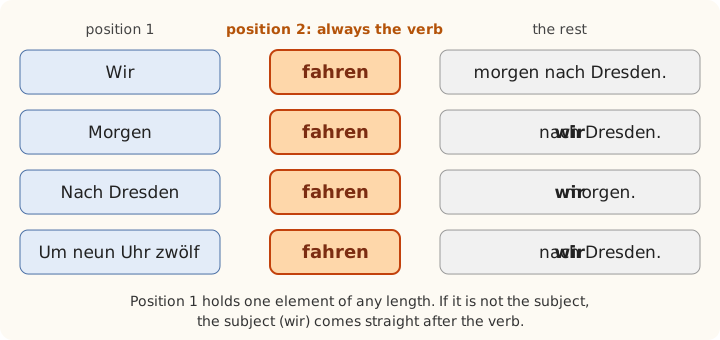
| Position 1 | Position 2: verb | The rest |
|---|---|---|
| Wir | fahren | morgen nach Dresden. |
| Morgen | fahren | wir nach Dresden. |
| Nach Dresden | fahren | wir morgen. |
| Um neun Uhr zwölf | fahren | wir nach Dresden. |
| Meine Oma | wohnt | in Dresden. |
| In Dresden | wohnt | meine Oma. |
Table 7.4. The verb-second rule. "Second" means the second element, not the second word: um neun Uhr zwölf is one element.
The first position is often used for what links the sentence to the previous one, or for what you want to stress. Starting with the subject is neutral; starting with a time is very common and natural (Heute arbeite ich.); starting with an object or a place gives it emphasis (Den Film kenne ich schon. — That film I know already.).
Common mistake: Morgen ich fahre
English speakers naturally say Morgen ich fahre nach Dresden, with the subject before the verb, as in "Tomorrow I'm going". This is wrong in German: only one element can stand before the verb. Say Morgen fahre ich nach Dresden. If it helps, think of the verb as a hinge in second place, around which the sentence turns.
What goes in the rest of the sentence
After the verb come the subject (if it was not first), then the other elements. Pronouns come early, right after the verb. For the adverbs and phrases that say when, how and where, the usual order is time – manner – place: when? – how? – where (to)?
| Subject | Verb | Time: when? | Manner: how? | Place: where? |
|---|---|---|---|---|
| Ich | fahre | morgen | mit dem Zug | nach Dresden. |
| Wir | essen | mittags | gern | im Restaurant. |
| Jonas | arbeitet | samstags | allein | im Café. |
Table 7.5. Time, manner, place. English usually puts the place before the time (I'm going to Dresden tomorrow); German does the opposite.
Any one of these can move to position 1, and the rest keep their order: Morgen fahre ich mit dem Zug nach Dresden.
Joining words in position zero: und, aber, oder, denn, sondern
Five short words join two main clauses without taking a position of their own. They stand in "position zero", before position 1, and the word order after them stays exactly as it was:
- Ich komme mit, und Ravi kommt auch. — I'm coming, and Ravi is coming too.
- Das Museum ist toll, aber es ist teuer. — The museum is great, but it's expensive.
- Fahren wir mit dem Zug, oder nehmen wir das Auto? — Are we going by train, or are we taking the car?
- Ich bleibe zu Hause, denn ich bin müde. — I'm staying at home, because I'm tired.
- Wir fahren nicht heute, sondern morgen. — We're not going today, but tomorrow.
denn gives a reason, like English for or because. Another word for "because", weil, sends the verb to the end of its clause (… weil ich müde bin); you meet it in Lesson 16. With denn you can give reasons now without worrying about word order.
sondern is used only after a negative, to correct it: Er ist nicht Lehrer, sondern Arzt. ("He's not a teacher, but a doctor.") Otherwise "but" is aber.
Worked example: building a sentence
Say "On Saturdays Jonas likes to go to the mountains by car with his friends", starting with the time.
- Position 1, the time: Samstags.
- Position 2, the verb: fährt (fahren, a → ä).
- Then the subject: Jonas.
- Then gern and the manner: mit Freunden, mit dem Auto.
- Last, the place: in die Berge.
Result: Samstags fährt Jonas gern mit Freunden mit dem Auto in die Berge.
7.4 Grammar: questions and answers
Questions with a question word
A question with a question word has the same shape as a statement: the question word takes position 1, and the verb comes second, followed by the subject.
- Wann fährt der Zug? — When does the train leave?
- Wohin fahrt ihr am Wochenende? — Where are you going at the weekend?
- Wie viele Museen gibt es in Dresden? — How many museums are there in Dresden?
- Warum lernst du Deutsch? — Why are you learning German?
The voice usually falls at the end of these questions, as in a statement.
Wo, wohin, woher
German distinguishes three questions about place, which English often covers with where:
- Wo bist du? — Where are you? (position: no movement)
- Wohin gehst du? — Where are you going (to)? (movement towards)
- Woher kommst du? — Where are you from? (movement away, origin)
In speech, wohin and woher are often split, with hin or her at the end: Wo gehst du hin? Wo kommst du her?
Welcher, welche, welches
"Which" takes the endings of der, die, das: welcher Zug (der Zug), welche Kirche (die Kirche), welches Museum (das Museum), welche Bücher (plural). Welcher Tag ist heute? — What day is it today?
Wie viel and wie viele
wie viel asks "how much" with things you cannot count (Wie viel Zeit hast du?) and for prices (Wie viel kostet das?); wie viele asks "how many" with a plural noun (Wie viele Geschwister hast du?).
Yes-no questions
A question that expects ja or nein begins with the verb, followed by the subject. The voice usually rises at the end.
- Kommt Ravi auch? — Is Ravi coming too?
- Fahrt ihr morgen nach Dresden? — Are you going to Dresden tomorrow?
- Ist der Eintritt frei? — Is admission free?
A statement with oder? or nicht? at the end also asks for confirmation, like an English question tag: Du kommst aus England, oder? ("You're from England, aren't you?")
Ja, nein and doch
German has three answers where English has two:
| Question | Answer that agrees | Answer that disagrees |
|---|---|---|
| positive: Kommst du mit? | Ja, ich komme mit. | Nein, ich komme nicht mit. |
| negative: Kommst du nicht mit? | Nein, ich komme nicht mit. | Doch, ich komme mit! |
Table 7.6. Answering questions. Doch says "yes" to a negative question or contradicts a negative statement.
doch removes the confusion that English answers can cause: to Don't you like museums?, does yes mean "yes, I like them" or "yes, I don't"? In German, Doch! clearly means "On the contrary, I do". It also contradicts a negative statement: Das ist nicht richtig. – Doch, das ist richtig!
Where nicht goes
nicht negates a whole sentence or one part of it. Its position follows a few rules:
- To negate the whole statement, put nicht at the end, after the objects and time expressions: Ich verstehe das nicht. Er kommt heute nicht. Ich kenne Frau Wagner nicht.
- Put it before an adjective or adverb: Das ist nicht teuer. Er spielt nicht gut.
- Put it before a phrase of place or manner, and before most phrases with a preposition: Ich fahre nicht nach Berlin. Wir fahren nicht mit dem Auto.
- To negate one particular element, put nicht directly before it, and usually add a correction with sondern: Nicht ich habe Geburtstag, sondern Jonas. Wir fahren nicht morgen, sondern übermorgen.
And remember from Lesson 5: nouns with ein or no article are negated with kein, not nicht ein: Ich habe keine Zeit.
7.5 Practice
Start with the time
Rewrite each sentence starting with the word in bold, then check.
| Sentence | Starting with the time |
|---|---|
| Ich arbeite heute. | Heute arbeite ich. |
| Wir essen um eins. | Um eins essen wir. |
| Jonas spielt dienstags Fußball. | Dienstags spielt Jonas Fußball. |
| Der Kurs beginnt im September. | Im September beginnt der Kurs. |
| Ich fahre morgen nach Wien. | Morgen fahre ich nach Wien. |
| Emma liest abends gern. | Abends liest Emma gern. |
Table 7.7. Practice: the verb stays second.
Ja, nein or doch?
| Question | True answer |
|---|---|
| Wohnt Emma in Leipzig? | Ja, sie wohnt in Leipzig. |
| Kommt Ravi nicht aus Indien? | Doch, er kommt aus Indien. |
| Ist Jonas Lehrer? | Nein, er ist Student. |
| Hat Jonas keine Oma in Dresden? | Doch, seine Oma wohnt in Dresden. |
| Spricht Emma nicht Deutsch? | Doch, sie spricht Deutsch. |
Table 7.8. Practice: ja, nein or doch?
Ask the questions
Here are Jonas's answers. What were the questions? Read the questions aloud.
- Wohin fährst du morgen? – Nach Dresden.
- Wann fährt der Zug? – Um neun Uhr zwölf.
- Wie lange dauert die Fahrt? – Ungefähr eine Stunde und zwanzig Minuten.
- Wer kommt mit? – Emma und Ravi.
- Warum fährst du nach Dresden? – Die Stadt ist schön.
Say it
Describe your plans for next weekend in five sentences, and start at least three of them with a time: Am Samstag …, Morgens …, Dann …, Abends …, Am Sonntag …. For example:
Am Samstag fahre ich nach Berlin. Morgens besuche ich ein Museum. Dann esse ich mit Freunden. Abends gehen wir ins Kino. Am Sonntag schlafe ich lange.
7.6 Culture: speaking directly
Direct, not rude. Speakers of English, and especially British English, often soften what they say: I was wondering if you might possibly …, That's an interesting idea, but …. German conversation, particularly in Germany, tends to be more direct. A colleague may simply say Das ist falsch. ("That's wrong.") or Das finde ich nicht gut. ("I don't think that's good."). This is not meant to be unfriendly: in German culture, being clear is a form of respect, because it takes the other person seriously and saves time. Austrians are often described as more indirect and diplomatic than Germans, and the Swiss as more reserved; like all such descriptions, these are generalisations, and individuals differ.
A question is a question. In Germany, Wie geht's? is a real question, usually asked by people who know each other, and the answer may be honest: Nicht so gut, ich habe Kopfschmerzen. Strangers do not normally ask it as a greeting. In the same spirit, an invitation is usually meant literally: if someone says Komm doch mal vorbei! ("Do drop by sometime!"), they may well expect you to.
Small talk and privacy. Small talk with strangers is less common than in English-speaking countries, and some topics, such as income, are generally considered private. But once you get to know people, conversations can be long and serious, and a good discussion, even a heated one, is enjoyed.
Doch, mal and other little words. Spoken German is full of small words called modal particles, such as doch, mal, ja and eigentlich, which do not change the facts of a sentence but colour its tone. Komm mal her! is a friendlier "Come here!"; Das ist ja toll! expresses surprise and pleasure. You will pick them up by listening; at this stage, simply notice them.
7.7 Summary
Summary
- Verb second: in a statement the conjugated verb is the second element. If something else comes first, the subject follows the verb: Morgen fahre ich nach Dresden.
- Position 1 holds one element of any length: subject, time, place, object.
- Order of the rest: time – manner – place: Ich fahre morgen mit dem Zug nach Dresden.
- Position zero: und, aber, oder, denn, sondern do not change the order. sondern only after a negative.
- W-questions: question word + verb + subject: Wann fährt der Zug? wo / wohin / woher; wie viel / wie viele; welcher, welche, welches.
- Yes-no questions: verb first: Kommt Ravi auch?
- Answers: ja, nein; doch = "yes" to a negative question.
- nicht: at the end for the whole sentence; before adjectives, adverbs and phrases of place; before the element it negates.
7.8 Exercises
Exercise 1
Put in order, starting with Heute: ich / heute / arbeite / nicht.
Answer
Heute arbeite ich nicht. Heute arbeite ich nicht.
Exercise 2
Which question word? ___ fahrt ihr im Sommer? – Nach Italien.
Answer
Wohin. Wohin fahrt ihr im Sommer? Movement towards a place.
Exercise 3
Which question word? ___ Geschwister hast du? – Zwei.
Answer
Wie viele. Wie viele Geschwister hast du?
Exercise 4
Answer truthfully with ja, nein or doch: Ist Berlin nicht in Deutschland?
Answer
Doch. Doch, Berlin ist in Deutschland. Yes to a negative question.
Exercise 5
Complete with aber or sondern: Das ist nicht mein Handy, ___ dein Handy.
Answer
sondern. After a negative, to correct it.
Exercise 6
Complete with aber or sondern: Die Wohnung ist klein, ___ sie ist schön.
Answer
aber. There is no negative to correct.
Exercise 7
Make a yes-no question: Sophie wohnt in Wien.
Answer
Wohnt Sophie in Wien? Wohnt Sophie in Wien?
Exercise 8
Correct the word order: Am Sonntag ich schlafe lange.
Answer
Am Sonntag schlafe ich lange. Am Sonntag schlafe ich lange. The verb must be second.
Exercise 9
Put nicht in the right place: Ich kenne den Mann.
Answer
Ich kenne den Mann nicht. Ich kenne den Mann nicht. The whole statement is negated, so nicht goes at the end.
Exercise 10
Translate, in the order time – manner – place: "I'm going to Vienna by train tomorrow, because my friend lives there." (by train: mit dem Zug)
Answer
Ich fahre morgen mit dem Zug nach Wien, denn meine Freundin wohnt dort. (or mein Freund). Also possible: Morgen fahre ich mit dem Zug nach Wien, denn …
7.9 Quiz
Quiz: word order and questions
Exercise 11
Put the words in order: "On Saturday I'm working."
Words: arbeite / ich. / Samstag / Am
Answer
Am Samstag arbeite ich.
Exercise 12
Which sentence is correct?
- Morgen ich fahre nach Wien.
- Morgen fahre ich nach Wien.
- Ich morgen fahre nach Wien.
- Morgen fahre nach Wien ich.
Answer
Morgen fahre ich nach Wien.
Exercise 13
Kommst du nicht mit? – ___, ich komme gern mit!
- Ja
- Nein
- Doch
- Nicht
Answer
Doch
doch says yes to a negative question.
Exercise 14
___ kommst du? – Aus Kanada.
Answer
Woher
Exercise 15
Er ist nicht Lehrer, ___ Arzt.
Answer
sondern
Exercise 16
Match the question word to its meaning.
| A | B |
|---|---|
| wohin | when |
| warum | how often |
| wann | where to |
| wie oft | why |
Answer
wohin — where to; warum — why; wann — when; wie oft — how often
Exercise 17
Tap the word in the wrong place.
Ich bleibe heute zu Hause, denn bin ich müde.
Answer
Wrong word: bin.
Corrected: Ich bleibe heute zu Hause, denn ich bin müde.
denn does not change the word order: denn ich bin müde.
Exercise 18
Put the words in order: "We're going to Dresden by train tomorrow."
Words: mit / nach / Dresden. / morgen / dem / Wir / Zug / fahren
Answer
Wir fahren morgen mit dem Zug nach Dresden.
Exercise 19
Write what you hear.
Dictation. Have someone read the sentence aloud, then write it down.
Wann fährt der Zug nach Dresden?
Answer
Wann fährt der Zug nach Dresden?