Lesson 11: The City and Directions: the Dative
Die Stadt, der Weg und der Dativ
To find your way around a town you need to ask where things are, understand the answer, and say how you are travelling: by tram, by bus, on foot. All of this needs the third German case, the dative. You have already met it in fixed phrases: mit dem Zug, aus der Schweiz, am Montag, im Café, seit einem Jahr. In this lesson you learn how it works. The dative is used after a group of very common prepositions, for the place where something is, and for the person to whom something is given or done. Its forms are regular, and with them you can understand and give directions anywhere.
Learning outcomes
By the end of this lesson you will be able to:
- name the places and buildings of a town, and the means of transport;
- ask the way, and understand and give directions with the imperative;
- use the dative forms of the articles: dem, der, dem, den; einem, einer, einem;
- use the prepositions aus, bei, mit, nach, seit, von, zu and gegenüber, and the contractions zum, zur, beim, vom;
- say where something is with in, an, auf, neben, vor, hinter, über, unter, zwischen and the dative;
- use the dative pronouns mir, dir, ihm, ihr, uns, euch, ihnen, Ihnen after prepositions.
masculinefeminineneuterplural
11.1 Dialogue: asking the way
In the street
Emma needs to send a parcel. She asks a passer-by the way to the post office.
- Emma: Entschuldigung, wie komme ich zur Post? — Excuse me, how do I get to the post office?
- Passant: Zur Post? Gehen Sie hier geradeaus bis zur Ampel. — To the post office? Go straight on here as far as the traffic lights.
- Passant: An der Ampel gehen Sie links. Dann nehmen Sie die zweite Straße rechts. — At the lights, turn left. Then take the second street on the right.
- Passant: Die Post ist neben der Bank, gegenüber dem Rathaus. — The post office is next to the bank, opposite the town hall.
- Emma: Ist das weit? — Is it far?
- Passant: Nein, nur fünf Minuten zu Fuß. — No, only five minutes on foot.
- Emma: Vielen Dank! — Thank you very much!
- Passant: Gern geschehen. — You're welcome.
On the phone
Later, Ravi calls Emma. He has just arrived at the main station.
- Ravi: Hallo, Emma! Ich bin am Hauptbahnhof. Wo ist das Café? — Hi, Emma! I'm at the main station. Where is the café?
- Emma: Nimm die Straßenbahn, Linie vier, bis zum Augustusplatz. Oder komm zu Fuß, das sind nur zehn Minuten. — Take the tram, line four, to Augustusplatz. Or walk, it's only ten minutes.
- Ravi: Zu Fuß ist gut. Wie gehe ich? — Walking is fine. Which way do I go?
- Emma: Geh aus dem Bahnhof und dann geradeaus durch den Park. Nach dem Park gehst du rechts. — Go out of the station and then straight on through the park. After the park, turn right.
- Emma: Das Café ist in der Schillerstraße, neben einem Buchladen. — The café is in Schillerstraße, next to a bookshop.
- Ravi: Neben einem Buchladen. Okay. Und wo sitzt ihr? — Next to a bookshop. Okay. And where are you sitting?
- Emma: Am Fenster. Jonas ist auch bei mir. Bis gleich! — By the window. Jonas is with me too. See you in a minute!
Notice:
- After zu, aus, nach, bei, gegenüber and mit, the article changes: die Post → zur Post (zu der), der Bahnhof → aus dem Bahnhof, das Rathaus → gegenüber dem Rathaus. This is the dative.
- To say where something is, neben, an and in are followed by the dative too: neben der Bank, an der Ampel, in der Schillerstraße, am Fenster (an dem).
- Directions are given with the imperative: Gehen Sie geradeaus! to a stranger, Nimm die Straßenbahn! to a friend.
- bei mir means "with me, at my place". mir is the dative of ich.
11.2 Vocabulary: the town, directions and transport
Places in town
| Singular | English | Singular | English |
|---|---|---|---|
| die Stadt | the town, city | der Bahnhof | the station |
| die Straße | the street, road | der Hauptbahnhof | the main station |
| der Platz | the square; the seat | die Haltestelle | the stop (bus, tram) |
| das Zentrum | the centre | der Flughafen | the airport |
| das Rathaus | the town hall | die Post | the post office |
| die Kirche | the church | die Bank | the bank; the bench |
| das Museum | the museum | die Apotheke | the chemist's, pharmacy |
| das Kino | the cinema | das Krankenhaus | the hospital |
| das Theater | the theatre | die Bibliothek | the library |
| der Park | the park | der Supermarkt | the supermarket |
| der Markt | the market | das Geschäft | the shop; business |
| die Brücke | the bridge | der Buchladen | the bookshop |
| die Ampel | the traffic lights | die Kreuzung | the crossroads |
| die Ecke | the corner | die Schule | the school |
| die Universität | the university | das Hotel | the hotel |
Table 11.1. Places in town. Die Ampel is singular: one set of traffic lights.
Directions
| German | English |
|---|---|
| Wie komme ich zum Bahnhof / zur Post? | How do I get to the station / the post office? |
| Wo ist hier eine Apotheke? | Where is there a chemist's around here? |
| Gibt es hier in der Nähe eine Bank? | Is there a bank near here? |
| geradeaus | straight on |
| links / rechts | (on the) left / (on the) right |
| nach links / nach rechts | to the left / to the right |
| die erste / zweite / dritte Straße links | the first / second / third street on the left |
| an der Ampel / an der Kreuzung / an der Ecke | at the lights / at the crossroads / at the corner |
| bis zur Ampel / bis zum Platz | as far as the lights / the square |
| über die Straße / über die Brücke | across the street / over the bridge |
| um die Ecke | round the corner |
| gegenüber | opposite |
| in der Nähe | nearby |
| weit / nah | far / near |
| zu Fuß | on foot |
Table 11.2. Asking and giving directions.
Transport
| German | English |
|---|---|
| der Bus: mit dem Bus | the bus: by bus |
| die Straßenbahn: mit der Straßenbahn | the tram: by tram |
| die U-Bahn: mit der U-Bahn | the underground, subway |
| die S-Bahn: mit der S-Bahn | the suburban train |
| der Zug: mit dem Zug | the train: by train |
| das Auto: mit dem Auto | the car: by car |
| das Fahrrad: mit dem Fahrrad | the bicycle: by bike |
| das Taxi: mit dem Taxi | the taxi: by taxi |
| die Linie | the line, route (bus, tram) |
| die Fahrkarte, das Ticket | the ticket |
Table 11.3. Means of transport. "By" is mit + dative.
11.3 Grammar: the dative and its prepositions
The forms of the dative
The dative is the third case. Unlike the accusative, it changes the articles of every gender, but its forms are very regular.
| Masculine | Feminine | Neuter | Plural | |
|---|---|---|---|---|
| nominative | der Park | die Post | das Kino | die Freunde |
| dative: the | dem Park | der Post | dem Kino | den Freunden |
| dative: a | einem Park | einer Post | einem Kino | Freunden |
| dative: no | keinem Park | keiner Post | keinem Kino | keinen Freunden |
| dative: my | meinem Park | meiner Post | meinem Kino | meinen Freunden |
Table 11.4. The dative. Masculine and neuter: -em; feminine: -er; plural: -en, and the noun adds -n.
Three rules sum it up:
- Masculine and neuter take -m: dem, einem, keinem, meinem.
- Feminine takes -r: der, einer, keiner, meiner. (Yes, der is also the masculine nominative; the context tells them apart.)
- Plural takes -n: den, keinen, meinen, and the noun itself adds -n if it does not already end in -n or -s: mit den Kindern, mit meinen Freunden; but mit den Frauen, mit den Autos.
The question word for the dative is wem? ("to whom?", "whom?"): Mit wem fährst du? ("Who are you going with?").
Prepositions that always take the dative
Eight common prepositions are always followed by the dative. German learners often sing the first seven to the tune of the Blue Danube waltz: aus, bei, mit, nach, seit, von, zu.
| Preposition | Meaning | Examples |
|---|---|---|
| aus | out of; from (origin, material) | aus dem Bahnhof; Ich komme aus der Schweiz. |
| bei | at (someone's home or workplace); near | bei meiner Oma; beim Arzt; Er arbeitet bei Siemens. |
| mit | with; by (transport) | mit meinem Bruder; mit dem Bus |
| nach | after; to (towns, countries without article) | nach dem Park; nach Berlin; nach Hause |
| seit | since; for (a period up to now) | seit einem Jahr; seit Montag |
| von | from; of; by | von der Arbeit; ein Freund von mir |
| zu | to (people, buildings, places, events) | zum Bahnhof; zu meiner Freundin; zu Hause (at home) |
| gegenüber | opposite | gegenüber dem Rathaus |
Table 11.5. The dative prepositions.
Contractions
Some prepositions merge with dem and der. These short forms are normal, both in speech and in writing:
| Long form | Short form | Example |
|---|---|---|
| zu dem | zum | zum Bahnhof, zum Arzt |
| zu der | zur | zur Post, zur Arbeit |
| bei dem | beim | beim Bäcker, beim Arzt |
| von dem | vom | vom Bahnhof |
| in dem | im | im Café, im Park |
| an dem | am | am Fenster, am Bahnhof |
Table 11.6. Contractions with the dative. Now you know why it is am Montag and im Mai (Lesson 3).
Nach, zu or in? Going places
English to has several German equivalents:
- nach for towns and for countries without an article, and in the fixed phrase nach Hause (home, homewards): Ich fahre nach Wien. Wir fliegen nach Spanien. Ich gehe nach Hause.
- zu for people, and for buildings and places that you go to as a destination: Ich gehe zu Jonas. Ich gehe zum Arzt. Wie komme ich zum Bahnhof?
- in + accusative for going into a building, and for countries with an article: Ich gehe ins Kino. Wir fahren in die Schweiz. Lesson 15 explains this.
And to say where you are: zu Hause (at home), in Wien, beim Arzt, im Kino.
Common mistake: nach Hause and zu Hause
nach Hause means "(going) home"; zu Hause means "at home". Ich gehe nach Hause. Ich bin zu Hause. Never Ich gehe zu Hause. (In Austria and Switzerland you will also see nachhause and zuhause written as one word.)
The dative pronouns
After a dative preposition, a pronoun is in the dative too:
| Nominative | Accusative | Dative | Example |
|---|---|---|---|
| ich | mich | mir | Komm mit mir! |
| du | dich | dir | Ich komme zu dir. |
| er | ihn | ihm | Ich wohne bei ihm. |
| sie | sie | ihr | ein Brief von ihr |
| es | es | ihm | mit ihm |
| wir | uns | uns | Kommt zu uns! |
| ihr | euch | euch | Wir fahren mit euch. |
| sie | sie | ihnen | Ich wohne bei ihnen. |
| Sie | Sie | Ihnen | Wie geht es Ihnen? |
Table 11.7. The pronouns in three cases. Now you can see why "How are you?" is Wie geht es Ihnen? and Wie geht es dir?: literally "How goes it to you?"
11.4 Grammar: saying where things are, and giving directions
Wo? Location with the dative
To say where something is, German uses nine prepositions with the dative. They are the "two-way prepositions": with the dative they describe a position (where?); with the accusative they describe a movement to a place (where to?), which you will learn in Lesson 15.
| Preposition | Meaning | Example: wo? + dative |
|---|---|---|
| in | in, inside | Das Café ist in der Schillerstraße. |
| an | at, by, on (a vertical surface, an edge) | Wir sitzen am Fenster. Das Bild hängt an der Wand. |
| auf | on (a horizontal surface) | Das Handy liegt auf dem Tisch. |
| neben | next to | Die Post ist neben der Bank. |
| vor | in front of; before | Ich warte vor dem Kino. |
| hinter | behind | Der Park ist hinter dem Rathaus. |
| über | above, over | Die Lampe hängt über dem Tisch. |
| unter | under, below | Die Katze schläft unter dem Bett. |
| zwischen | between | Die Apotheke ist zwischen der Post und dem Kino. |
Table 11.8. The two-way prepositions with the dative, for position.
an or auf?
Both mean "on", but auf is for a horizontal surface you put things on (auf dem Tisch, auf dem Boden, "on the floor") and an for a vertical surface or an edge (an der Wand, "on the wall"; am Fenster, "by the window"; an der Ampel; am See, "by the lake"). With places, auf is also used for some public places: auf dem Markt, auf der Post, auf der Bank (in the post office, at the bank), though in der Post and bei der Bank are also heard.
Giving directions
Directions are given with the imperative (Lesson 10) or with the present tense, which sounds a little softer: Gehen Sie geradeaus! or Sie gehen geradeaus.
- Gehen Sie geradeaus bis zur Kreuzung. — Go straight on as far as the crossroads.
- Gehen Sie an der Ampel nach rechts. — Turn right at the traffic lights.
- Nehmen Sie die erste Straße links. — Take the first street on the left.
- Gehen Sie über die Brücke. — Go over the bridge. (über + accusative for movement)
- Fahren Sie mit der Linie vier bis zum Rathaus. — Take line four to the town hall.
- Das Kino ist auf der linken Seite. — The cinema is on the left-hand side.
Notice that German has no single verb for "turn": you simply "go left" (nach links gehen) or "drive right" (nach rechts fahren). And gehen is only on foot; in a vehicle, use fahren.
Worked example: from the station to the café
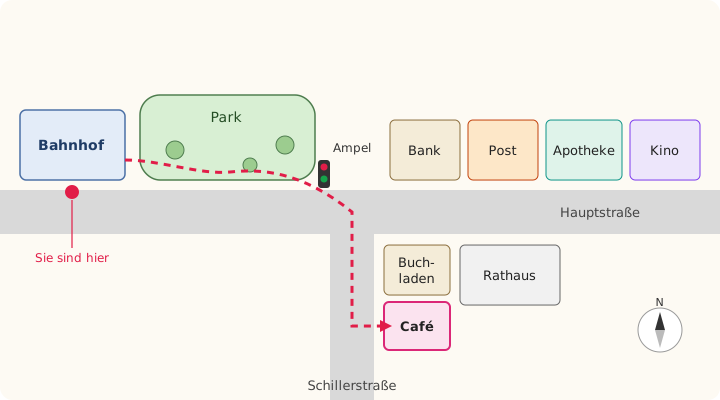
Use Figure 11.1 to direct a stranger from the station to the café.
- Start: Gehen Sie aus dem Bahnhof (aus + dative: der Bahnhof → dem Bahnhof).
- … und dann geradeaus durch den Park (durch + accusative: der Park → den Park).
- Gehen Sie bis zur Ampel (bis zu + dative: die Ampel → der Ampel → zur).
- An der Ampel gehen Sie nach rechts in die Schillerstraße.
- Position: Das Café ist auf der linken Seite, neben dem Buchladen (neben + dative: der Buchladen → dem Buchladen).
11.5 Practice
Dative after prepositions
| Phrase | Dative |
|---|---|
| mit + der Bus | mit dem Bus |
| zu + die Apotheke | zur Apotheke |
| aus + das Kino | aus dem Kino |
| bei + der Arzt | beim Arzt |
| von + die Arbeit | von der Arbeit |
| mit + meine Freunde | mit meinen Freunden |
| seit + ein Monat | seit einem Monat |
| gegenüber + die Kirche | gegenüber der Kirche |
| zu + das Rathaus | zum Rathaus |
Table 11.9. Practice: the dative after prepositions.
Where is it?
Look at Figure 11.1 and answer.
| Question | Answer |
|---|---|
| Wo ist die Post? | Neben der Bank. |
| Wo ist das Rathaus? | Gegenüber der Post. |
| Wo ist die Apotheke? | Zwischen der Post und dem Kino. |
| Wo ist das Café? | In der Schillerstraße, neben dem Buchladen. |
| Wo ist die Ampel? | An der Kreuzung. |
Table 11.10. Practice: saying where things are.
How do you get to work?
Read aloud, then say how you get to work, school or the shops.
- Ich fahre mit dem Fahrrad zur Uni. — I cycle to university.
- Jonas fährt mit der Straßenbahn zur Arbeit. — Jonas takes the tram to work.
- Frau Wagner kommt mit dem Auto. — Frau Wagner comes by car.
- Ravi geht zu Fuß, denn er wohnt in der Nähe. — Ravi walks, because he lives nearby.
Say it
Choose two places in Figure 11.1 and give a stranger directions from one to the other, using the Sie imperative, bis zur / bis zum, an der Ampel, and a sentence saying where the place is. Then explain to a friend, with du, how to get from your home to the nearest supermarket.
11.6 Culture: getting around
Public transport. Towns and cities in the German-speaking countries have dense networks of buses, trams (die Straßenbahn, called die Bim in Vienna and das Tram in Switzerland), underground trains (die U-Bahn) and suburban trains (die S-Bahn). One ticket is usually valid on all of them within a fare zone. In many cities there are no barriers: you buy a ticket from a machine or an app, and if it is a paper ticket you may have to stamp it in a small machine (entwerten, "to validate") before the journey. Inspectors check tickets at random, and travelling without a valid ticket (schwarzfahren) costs a fine.
Cycling. Bicycles are everywhere, and many towns have cycle lanes (der Radweg), sometimes marked in red on the pavement. Pedestrians should not walk on them, and cyclists ring their bells firmly at anyone who does.
Waiting at the red light. Many Germans, Austrians and Swiss wait at a red pedestrian light even when the street is empty, especially when children are watching: it is seen as setting a good example, and crossing on red can be fined. In eastern Germany, including Leipzig, the pedestrian lights show the Ampelmännchen, a little man with a hat designed in the German Democratic Republic. After reunification in 1990 many towns began replacing it with the western figure, but it became so popular that it was kept and has even spread to some western towns.
Addresses. In a German address the house number comes after the street name: Goethestraße 12, and the postcode comes before the town: 04109 Leipzig. Street names are often joined to their last part: Schillerstraße, Bahnhofstraße, Marktplatz. Most towns have a Bahnhofstraße leading to the station and a Hauptstraße (main street).
11.7 Summary
Summary
- Dative articles: dem (m), der (f), dem (n), den + -n (pl); einem, einer, einem; meinem, meiner, meinem, meinen.
- Dative prepositions: aus, bei, mit, nach, seit, von, zu, gegenüber.
- Contractions: zum, zur, beim, vom, im, am.
- Going: nach Berlin, nach Hause; zum Arzt, zu Jonas; at home: zu Hause.
- Pronouns: mir, dir, ihm, ihr, ihm, uns, euch, ihnen, Ihnen.
- Wo? + dative: in, an, auf, neben, vor, hinter, über, unter, zwischen: neben der Bank, auf dem Tisch, am Fenster.
- Directions: Gehen Sie geradeaus bis zur Ampel. Nehmen Sie die erste Straße links. Transport: mit dem Bus, mit der Straßenbahn, zu Fuß.
11.8 Exercises
Exercise 1
Complete: Ich fahre mit ___ Zug.
Answer
dem. mit dem Zug. Der Zug is masculine: dative dem.
Exercise 2
Complete: Wie komme ich ___ Apotheke?
Answer
zur. zur Apotheke: zu der → zur.
Exercise 3
Complete: Er wohnt bei ___ Eltern. (his)
Answer
seinen. bei seinen Eltern. Plural dative: -en.
Exercise 4
Complete: Ich lerne seit ___ Woche Deutsch. (eine)
Answer
einer. seit einer Woche. Feminine dative: -er.
Exercise 5
nach, zu or zu Hause? Am Wochenende fahre ich ___ Hamburg.
Answer
nach. nach Hamburg: a town.
Exercise 6
Give the dative plural with the noun: mit den ___ (die Kinder).
Answer
Kindern. mit den Kindern. The noun adds -n.
Exercise 7
Complete with a pronoun: Kommst du mit ___? (us)
Answer
uns. Kommst du mit uns?
Exercise 8
Translate: "The keys are on the table, next to the lamp."
Answer
Die Schlüssel sind auf dem Tisch, neben der Lampe. (Or liegen instead of sind.)
Exercise 9
Correct the mistakes: Ich gehe zu Hause mit mein Freund. Er wohnt neben die Post.
Answer
Ich gehe mit meinem Freund nach Hause. Er wohnt neben der Post. Going home is nach Hause; mit and neben (position) take the dative.
Exercise 10
Give directions to a stranger: go straight on to the crossroads, turn left at the crossroads, the museum is opposite the church.
Answer
Gehen Sie geradeaus bis zur Kreuzung. An der Kreuzung gehen Sie nach links. Das Museum ist gegenüber der Kirche.
11.9 Quiz
Quiz: the city, directions and the dative
Exercise 11
Wir fahren mit ___ Straßenbahn.
- die
- der
- dem
- den
Answer
der
die Straßenbahn is feminine; the dative is der.
Exercise 12
Wie komme ich ___ Bahnhof?
- zur
- zum
- nach
- in
Answer
zum
zu dem Bahnhof → zum Bahnhof.
Exercise 13
Die Lampe hängt über ___ Tisch.
Answer
dem
Exercise 14
Ich gehe jetzt nach ___. (home)
Answer
Hause
Exercise 15
Match the preposition to its meaning.
| A | B |
|---|---|
| neben | behind |
| gegenüber | between |
| hinter | next to |
| zwischen | opposite |
Answer
neben — next to; gegenüber — opposite; hinter — behind; zwischen — between
Exercise 16
Contract: zu der → ?
Answer
zur
Exercise 17
Tap the wrong word.
Ich wohne bei meine Tante.
Answer
Wrong word: meine.
Corrected: Ich wohne bei meiner Tante.
bei takes the dative; feminine meine → meiner.
Exercise 18
Listen. Where is the chemist's?
Read this aloud or have someone read it to you:
Die Apotheke ist neben dem Kino, gegenüber der Kirche.
- next to the church
- next to the cinema
- behind the cinema
- opposite the cinema
Answer
next to the cinema
Transcript: “Die Apotheke ist neben dem Kino, gegenüber der Kirche.”
Exercise 19
Write what you hear.
Dictation. Have someone read the sentence aloud, then write it down.
Gehen Sie geradeaus bis zur Ampel.
Answer
Gehen Sie geradeaus bis zur Ampel.