Chapter 58: 50 sabse aam galtiyan
50 sabse aam galtiyan — ek hi jagah
Ye chapter padhne ke liye nahi, dhoondhne ke liye hai. Chhe groups hain — articles, tenses, prepositions, word choice, word order aur plurals. Har galti teen hisson me hai: galat → sahi → kyun. Jab likhte waqt shaq ho, is page par aao, apne group me jaao, aur aage badho. Mobile par bookmark kar lo.
- 1Kahan sabse zyada galtiyan hoti hain
- 2Group 1 — Articles (galti 1 se 7)
- 3Group 2 — Tenses (8 se 16)
- 4Group 3 — Prepositions (17 se 25)
- 5Group 4 — Word choice (26 se 35)
- 6Group 5 — Word order (36 se 42)
- 7Group 6 — Plurals aur countables (43 se 50)
- 8Teen rules jo 50 me se 30 bacha dete hain
- 9Pakki jodiyan — inhe rata hi lena behtar hai
- 10Chhe sahi vaakya — zor se bolo
Ek line me
In 50 me se lagbhag saari galtiyan ek hi wajah se hoti hain — Hindi ka dhaancha English ke shabdon me. Isliye "kyun" wala hissa sabse zaroori hai. Wajah samajh gaye to poora group theek ho jaata hai.
58.1 Kahan sabse zyada galtiyan hoti hain
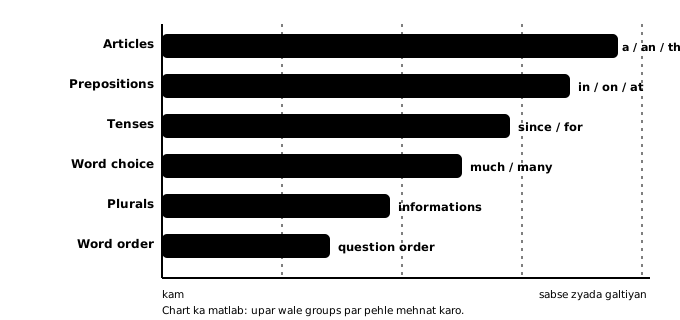
Neeche ka chart batata hai ki Indian speakers ki likhai aur bol-chaal me kaunsa hissa sabse zyada pakda jaata hai. Agar time kam hai, to upar wale do groups se shuru karo — wahi sabse zyada farq laayenge.
58.2 Group 1 — Articles (galti 1 se 7)
Hindi me a, an, the jaisa kuch nahi hota. Isliye ye shabd dimaag me "bekaar" lagte hain aur chhoot jaate hain. Pakka rule: har singular countable noun ke aage kuch hona chahiye — a, an, the, my, this, one… kuch bhi, par khaali nahi.
1–7 · a / an / the
- Galat: 1. I am going to market.
- Sahi: I'm going to the market.
-
Kyun: Jo jagah dono jaante hain (mohalle ka bazaar) — wahan "the". Singular countable noun khaali nahi reh sakta.
-
Galat: 2. She is doctor.
- Sahi: She's a doctor.
-
Kyun: Pesha batate waqt hamesha a/an lagta hai: a teacher, an engineer, a driver.
-
Galat: 3. He is a honest man.
- Sahi: He's an honest man.
-
Kyun: a/an spelling se nahi, aawaz se tay hota hai. "Honest" ka H chup hai, isliye aawaz "o" se shuru — an. Isi tarah: an hour, par a university (aawaz "yoo").
-
Galat: 4. I like the music.
- Sahi: I like music.
-
Kyun: Aam baat (general) me "the" nahi lagta. "The music" matlab wo khaas music jo abhi baj raha hai.
-
Galat: 5. He went to the Mumbai.
- Sahi: He went to Mumbai.
-
Kyun: Shehron aur desho ke naam ke aage "the" nahi. Apwaad: the US, the UK, the Netherlands, the Philippines.
-
Galat: 6. I have an university degree.
- Sahi: I have a university degree.
-
Kyun: "University" ki aawaz "yoo-" se shuru hoti hai — ye consonant jaisi aawaz hai, isliye "a".
-
Galat: 7. Please pass me salt.
- Sahi: Please pass me the salt.
- Kyun: Mez par rakha wahi namak — khaas cheez, isliye "the". Uncountable nouns ke saath bhi "the" lagta hai jab cheez khaas ho.
58.3 Group 2 — Tenses (8 se 16)
Hindi aur English ke tense ka dhaancha kaafi milta hai, par present perfect (have/has + done) Hindi me nahi hai. Isliye sabse zyada galtiyan wahi karwata hai.
8–16 · tenses
- Galat: 8. I am working here since three years.
- Sahi: I have been working here for three years.
-
Kyun: Do galtiyan ek saath: kaam jo pehle shuru hua aur abhi chal raha hai = have been + -ing. Aur duration ke saath "for", point ke saath "since".
-
Galat: 9. I didn't went to office.
- Sahi: I didn't go to the office.
-
Kyun: "Did" pehle se past bata deta hai, isliye verb apne pehle roop me aata hai. Did + go, never did + went.
-
Galat: 10. He have finished the work.
- Sahi: He has finished the work.
-
Kyun: He, she, it ke saath "has". I, we, you, they ke saath "have".
-
Galat: 11. I am having a car.
- Sahi: I have a car.
-
Kyun: Maalikana haq batane wala "have" continuous nahi hota. Par khaana-peena ke matlab me chalta hai: "I'm having lunch."
-
Galat: 12. Yesterday I have gone to Delhi.
- Sahi: Yesterday I went to Delhi.
-
Kyun: Jab past ka samay bataya ho (yesterday, last week, in 2019), to simple past aata hai — present perfect kabhi nahi.
-
Galat: 13. I will tell you when he will come.
- Sahi: I'll tell you when he comes.
-
Kyun: "When", "if", "after", "before" ke baad future me bhi present tense aata hai. Ek vaakya me do "will" nahi.
-
Galat: 14. She is knowing the answer.
- Sahi: She knows the answer.
-
Kyun: Soch aur ehsaas wale verbs continuous me nahi jaate: know, understand, believe, like, want, need, mean.
-
Galat: 15. I have my breakfast at eight every day.
- Sahi: I have breakfast at eight every day.
-
Kyun: Roz ki aadat ke khaane ke saath "my" nahi lagta: have breakfast, have lunch, have dinner.
-
Galat: 16. By the time I reached, the train left.
- Sahi: By the time I reached, the train had left.
- Kyun: Past me do kaam hon, to jo pehle hua uske saath "had" lagta hai. Isi ko past perfect kehte hain.
58.4 Group 3 — Prepositions (17 se 25)
Hindi ka ek shabd English me teen prepositions ban jaata hai (me → in/on/at), aur kai English verbs ke baad koi preposition lagta hi nahi. Dono wajahon se galti hoti hai.
17–25 · prepositions
- Galat: 17. Let's discuss about the plan.
- Sahi: Let's discuss the plan.
-
Kyun: Discuss ke andar hi "about" ka matlab hai. Isi family me: enter the room, reach Delhi, order two teas, request a copy, consider my application.
-
Galat: 18. He is good in maths.
- Sahi: He's good at maths.
-
Kyun: Kisi kaam me mahir hona = good at. Good with = cheezein sambhalne me achha (good with kids, good with numbers).
-
Galat: 19. I am afraid from dogs.
- Sahi: I'm afraid of dogs.
-
Kyun: Dar hamesha "of". Isi tarah: tired of, proud of, ashamed of, capable of.
-
Galat: 20. She is married with an engineer.
- Sahi: She's married to an engineer.
-
Kyun: Shaadi hamesha "married to". "Married with" ka matlab ban jaata hai "bachchon ke saath shaadi-shuda".
-
Galat: 21. Please explain me the process.
- Sahi: Please explain the process to me.
-
Kyun: Explain, describe, suggest aur mention ke baad pehle cheez, phir "to" + insaan.
-
Galat: 22. I will reach at the station by six.
- Sahi: I'll reach the station by six. / I'll arrive at the station by six.
-
Kyun: Reach ke baad seedha jagah. Arrive ke saath preposition lagta hai: arrive at (chhoti jagah), arrive in (shehar, desh).
-
Galat: 23. He died from cancer.
- Sahi: He died of cancer.
-
Kyun: Bimari se maut = died of. Haadse ya chot se = died from injuries.
-
Galat: 24. I have been waiting since two hours.
- Sahi: I've been waiting for two hours.
-
Kyun: For = kitni der (duration). Since = kab se (point). "Since 4 o'clock" sahi, "since two hours" galat.
-
Galat: 25. He is angry on me.
- Sahi: He's angry with me.
- Kyun: Insaan par gussa = angry with. Cheez ya haalat par = angry about the delay.
58.5 Group 4 — Word choice (26 se 35)
Yahan galti grammar ki nahi, shabd chunne ki hai. Aksar do shabd ek jaise lagte hain par kaam alag karte hain.
26–35 · shabd ka chunaav
- Galat: 26. I will give the exam next month.
- Sahi: I'll take the exam next month.
-
Kyun: Student exam take karta hai; teacher exam gives/sets karta hai. Hindi "dena" seedha ulta baith jaata hai.
-
Galat: 27. There is too much traffic — it's very bad.
- Sahi: There's a lot of traffic.
-
Kyun: "Too much" ka matlab hai "zaroorat se zyada", sirf "bahut" nahi. Bahut ke liye "a lot of" ya "a great deal of".
-
Galat: 28. How much peoples came?
- Sahi: How many people came?
-
Kyun: Do galtiyan: gin sakte ho to "many" (not much), aur "people" khud plural hai.
-
Galat: 29. I am boring in this class.
- Sahi: I'm bored in this class.
-
Kyun: -ing = cheez kaisi hai (the class is boring). -ed = aap kaisa mehsoos kar rahe ho (I am bored). Isi tarah: interesting/interested, confusing/confused, tiring/tired.
-
Galat: 30. Myself Ravi.
- Sahi: I'm Ravi.
-
Kyun: "Myself" reflexive pronoun hai (I hurt myself) — subject nahi ban sakta.
-
Galat: 31. Please revert back at the earliest.
- Sahi: Please get back to me by Thursday.
-
Kyun: Revert me "waapas" pehle se hai, isliye "back" bekaar. Aur "at the earliest" ki jagah asli taarikh likho.
-
Galat: 32. He has less friends than me.
- Sahi: He has fewer friends than me.
-
Kyun: Gin sakte ho to "fewer" (fewer friends, fewer errors). Gin nahi sakte to "less" (less water, less time).
-
Galat: 33. Its raining outside.
- Sahi: It's raining outside.
-
Kyun: It's = it is. Its = uska (The dog wagged its tail). Apostrophe yahan possession nahi, shortcut batata hai.
-
Galat: 34. I can able to finish it today.
- Sahi: I can finish it today. / I'm able to finish it today.
-
Kyun: Dono ek hi kaam karte hain — ek hi chuno. "Can able to" dono ko jod deta hai, jo galat hai.
-
Galat: 35. Open the light.
- Sahi: Turn on the light. / Switch on the light.
- Kyun: Hindi "kholna" English me do kaam karta hai. Darwaza open hota hai; light, fan aur TV turn on/off hote hain.
58.6 Group 5 — Word order (36 se 42)
Hindi ka kram hai Subject – Object – Verb (main khaana khaata hoon). English ka hai Subject – Verb – Object (I eat food). Sawaal me aur adjectives me ye farq sabse zyada dikhta hai.
36–42 · shabdon ka kram
- Galat: 36. What you are doing?
- Sahi: What are you doing?
-
Kyun: Sawaal me helping verb subject se pehle aata hai: What are you… / Where did he… / Why has she…
-
Galat: 37. Tell me where is the station.
- Sahi: Tell me where the station is.
-
Kyun: Jab sawaal kisi bade vaakya ke andar aa jaaye, to kram seedha ho jaata hai — verb peechhe chala jaata hai.
-
Galat: 38. I yesterday went to the bank.
- Sahi: I went to the bank yesterday.
-
Kyun: Samay ka shabd aakhir me (ya shuru me) aata hai — subject aur verb ke beech me nahi.
-
Galat: 39. She speaks very well English.
- Sahi: She speaks English very well.
-
Kyun: Pehle object (English), phir adverb (very well). Verb aur uske object ke beech kuch nahi aata.
-
Galat: 40. He gave to me the keys.
- Sahi: He gave me the keys. / He gave the keys to me.
-
Kyun: Do hi kram sahi hain: verb + insaan + cheez, ya verb + cheez + to + insaan. Beech wala roop galat hai.
-
Galat: 41. A red big plastic box.
- Sahi: A big red plastic box.
-
Kyun: Adjectives ka kram tay hai: raay → aakaar → umar → rang → kahan ka → kis cheez ka. "Big" (aakaar) "red" (rang) se pehle.
-
Galat: 42. Only I have one question.
- Sahi: I have only one question.
- Kyun: "Only" jis shabd par zor dena hai, uske bilkul pehle aata hai. Jagah badlo, matlab badal jaata hai.
58.7 Group 6 — Plurals aur countables (43 se 50)
English me kuch cheezein gini nahi jaa sakti, aur Hindi me wahi cheezein aaraam se gini jaati hain. Yahi tak-raar in aath galtiyon ki jad hai.
43–50 · plural aur ginti
- Galat: 43. I need some informations.
- Sahi: I need some information. / I need a few details.
-
Kyun: Information uncountable hai — "s" kabhi nahi lagta. Ginti karni ho to: two pieces of information.
-
Galat: 44. He gave me good advices.
- Sahi: He gave me good advice. / He gave me a piece of advice.
-
Kyun: Advice uncountable hai. Isi list me: furniture, luggage, equipment, machinery, traffic, homework, research, feedback, knowledge.
-
Galat: 45. My hairs are wet.
- Sahi: My hair is wet.
-
Kyun: Sir ke saare baal milkar "hair" (uncountable) hote hain. "Hairs" ka matlab ek-ek baal — jo khaane me milte hain!
-
Galat: 46. There are many equipments in the lab.
- Sahi: There's a lot of equipment in the lab.
-
Kyun: Equipment uncountable hai, isliye "many" bhi badal kar "a lot of" karna padta hai aur verb singular ho jaata hai.
-
Galat: 47. Peoples are waiting outside.
- Sahi: People are waiting outside.
-
Kyun: "People" khud plural hai (person ka plural). "Peoples" ka matlab hai "kai qaumein" — bilkul alag baat.
-
Galat: 48. I bought two pant and three shirt.
- Sahi: I bought two pairs of trousers and three shirts.
-
Kyun: Shirt countable hai, isliye "shirts". Trousers/pants hamesha plural hote hain, aur ginti "pairs" se hoti hai — jaise scissors aur glasses.
-
Galat: 49. Each of the students have a laptop.
- Sahi: Each of the students has a laptop.
-
Kyun: Each, every, everyone, nobody — ye sab singular hain, chahe baad me plural dikhe. Isi tarah: "Everyone is here."
-
Galat: 50. The news are not good.
- Sahi: The news is not good.
- Kyun: "News" ke aakhir me "s" hai par wo singular hai. Isi tarah: mathematics, physics, economics, politics — sab singular verb lete hain.
58.8 Teen rules jo 50 me se 30 bacha dete hain
Ratne layak teen cheezein
1. Har singular countable noun ke aage kuch hona chahiye — a, an, the, my, this. Khaali kabhi nahi.
2. Ek vaakya me tense ek hi baar batao — did + go, will + come, has + finished. Do jagah past mat lagao.
3. English me verb seedha object ko pakadta hai — beech me samay, adverb ya "to me" nahi ghusta.
58.9 Pakki jodiyan — inhe rata hi lena behtar hai
Kuch adjectives aur verbs ke saath preposition fix hota hai. Inme logic dhoondhne ka faayda nahi — ye jodiyan hain, inhe jodi ki tarah yaad karo. Group 3 aur 4 ki aadhi galtiyan yahi table rok deti hai.
| Jodi | Example | Jo log galti se bolte hain |
|---|---|---|
| good at | good at cricket | good in |
| afraid of | afraid of heights | afraid from |
| married to | married to a teacher | married with |
| angry with (insaan) | angry with me | angry on me |
| angry about (cheez) | angry about the delay | angry for the delay |
| die of (bimari) | died of a heart attack | died from a heart attack |
| depend on | it depends on you | depends from you |
| listen to | listen to me | listen me |
| explain to | explain it to me | explain me |
| agree with (insaan) | I agree with you | I am agree with you |
| interested in | interested in design | interested for design |
| responsible for | responsible for payroll | responsible of payroll |
| congratulate on | congratulate her on the win | congratulate her for the win |
| apologise for | apologise for the delay | apologise of the delay |
| no preposition | discuss · enter · reach · order · request · consider · marry | discuss about, enter into, reach at… |
58.10 Chhe sahi vaakya — zor se bolo
Har group se ek sudhra hua vaakya. Inhe sunne aur bolne se rule ratne se zyada jaldi baithta hai — kyunki kaan galti pakadna seekh jaata hai.
- She's a doctor at the hospital near the market. Articles — pesha ke saath "a", jaani-pehchaani jagah ke saath "the".
- I've been working here for three years. Tenses — kaam pehle shuru hua, abhi chal raha hai; duration ke saath "for".
- He's good at maths but he's afraid of exams. Prepositions — good at, afraid of. Ye jodiyan fix hain.
- I'll take the exam next month, so please get back to me by Friday. Word choice — exam "take" karte hain, aur "revert back" ki jagah "get back to me".
- Could you tell me where the station is? Word order — sawaal bade vaakya ke andar aaya, to verb peechhe chala gaya.
- The news is good, and each of the teams has its own budget. Plurals — "news" aur "each" dono singular verb lete hain.
Is page ko kaise use karein
Ek baar poora padho — sirf ek baar. Phir ise sirf zaroorat par kholo. Jab ek galti teen baar pakdo, to wo apne aap theek ho jaati hai. Poori list ratne ki koshish karne se kuch nahi hota.
58.11 Practice — 50 galtiyan
Exercise 1
Kaunsa vaakya sahi hai?
- He is an honest man with a university degree.
- He is a honest man with an university degree.
- He is an honest man with an university degree.
- He is a honest man with a university degree.
Hint: a/an aawaz se tay hota hai, spelling se nahi.
Jawaab
He is an honest man with a university degree.
Honest ka H chup hai, aawaz 'o' se shuru — an. University ki aawaz 'yoo' se shuru hoti hai, jo consonant jaisi hai — a.
Exercise 2
'Main teen saal se yahan kaam kar raha hoon' ka sahi roop?
- I have been working here for three years.
- I am working here since three years.
- I work here since three years.
- I am working here for three years only.
Jawaab
I have been working here for three years.
Jo kaam pehle shuru hua aur abhi chal raha hai = have been + -ing. Aur duration ke saath 'for', point ke saath 'since'.
Exercise 3
Kaunsa vaakya galat hai?
- She is married with an engineer.
- She is married to an engineer.
- He is afraid of dogs.
- He is angry with me.
Jawaab
She is married with an engineer.
Shaadi hamesha 'married to'. 'Married with' ka matlab ban jaata hai bachchon ke saath shaadi-shuda.
Exercise 4
Student exam ke saath kaunsa verb lagta hai?
- take the exam
- give the exam
- do the exam paper only
- put the exam
Jawaab
take the exam
Student exam take karta hai; teacher exam gives ya sets karta hai. Hindi 'dena' seedha ulta baith jaata hai.
Exercise 5
Adjectives ka sahi kram kaunsa hai?
- a big red plastic box
- a red big plastic box
- a plastic big red box
- a red plastic big box
Hint: Aakaar pehle, rang baad me.
Jawaab
a big red plastic box
Kram tay hai: raay → aakaar → umar → rang → kahan ka → kis cheez ka. Isliye big (aakaar) red (rang) se pehle.
Exercise 6
I have been waiting ___ two hours.
Hint: Duration hai ya point?
Jawaab
for
For = kitni der. Since = kab se. 'Since 4 o'clock' sahi hai, 'since two hours' galat.
Exercise 7
He has ___ friends than me, but they are good ones.
Hint: Dost gine jaa sakte hain.
Jawaab
fewer
Gin sakte ho to fewer (fewer friends, fewer errors). Gin nahi sakte to less (less water, less time).
Exercise 8
Each of the students ___ a laptop.
Hint: Each singular hai ya plural?
Jawaab
has
Each, every, everyone, nobody — sab singular hain, chahe baad me plural dikhe.
Exercise 9
Please ___ on the light, it's getting dark.
Hint: Light 'open' nahi hoti.
Jawaab
turn / switch
Hindi 'kholna' do kaam karta hai. Darwaza open hota hai; light, fan aur TV turn on/off hote hain.
Exercise 10
Galat shabd dhoondo.
I didn't went to the office yesterday.
Jawaab
Galat shabd: went.
Sahi roop: I didn't go to the office yesterday.
'Did' pehle se past bata deta hai, isliye verb apne pehle roop me aata hai — did + go.
Exercise 11
Ek shabd me 's' bekaar hai — us par tap karo.
He gave me some very useful advices.
Jawaab
Galat shabd: advices.
Sahi roop: He gave me some very useful advice.
Advice uncountable hai. Isi list me: information, furniture, luggage, equipment, feedback, homework.
Exercise 12
Kram galat hai — galat jagah wale shabd par tap karo.
Tell me where is the station please.
Jawaab
Galat shabd: is.
Sahi roop: Tell me where the station is, please.
Jab sawaal bade vaakya ke andar aa jaaye, to kram seedha ho jaata hai — verb peechhe chala jaata hai.
Exercise 13
Ek shabd galat hai — use dhoondo.
My hairs are wet because of the rain.
Jawaab
Galat shabd: hairs.
Sahi roop: My hair is wet because of the rain.
Sir ke saare baal milkar 'hair' (uncountable) hote hain, isliye verb bhi 'is' ho jaata hai.
Exercise 14
Galat roop ko uske sahi roop se jodo.
| A | B |
|---|---|
| discuss about the plan | good at maths |
| explain me this | afraid of dogs |
| good in maths | discuss the plan |
| afraid from dogs | explain this to me |
Jawaab
discuss about the plan — discuss the plan; explain me this — explain this to me; good in maths — good at maths; afraid from dogs — afraid of dogs
Kuch verbs ke baad preposition nahi lagta, aur kuch adjectives ki apni fix jodi hoti hai.
Exercise 15
Shabd ko uski kism se jodo.
| A | B |
|---|---|
| information | 's' hai par singular |
| people | hamesha plural, pairs me gine |
| news | uncountable — 's' nahi |
| trousers | khud plural hai |
Jawaab
information — uncountable — 's' nahi; people — khud plural hai; news — 's' hai par singular; trousers — hamesha plural, pairs me gine
Ginti wale rules yaad rakhne se Group 6 ki lagbhag saari galtiyan apne aap khatam ho jaati hain.
Exercise 16
Sahi kram banao.
Shabd: very / She / English / speaks / well
Jawaab
She speaks English very well
Pehle object (English), phir adverb (very well). Verb aur object ke beech kuch nahi aata.
Exercise 17
Sawaal sahi kram me banao.
Shabd: What / this / are / evening / you / doing
Jawaab
What are you doing this evening
Sawaal me helping verb (are) subject (you) se pehle aata hai.
Exercise 18
Ye line bolo — isme teen group ke sudhaar ek saath hain.
I have been working here for three years and I am good at my job
Jawaab
Bolo: I have been working here for three years and I am good at my job
Tense (have been working), preposition (for, good at), aur word order — teeno ek hi line me theek baithe hain.