Chapter 17: Subject-verb agreement
Subject-verb agreement — "He go" ya "He goes"?
Agreement ka matlab hai mel — subject aur verb ka mel. Hindi me ye mel hota hai lekin alag tareeke se (ladka jaata hai / ladke jaate hain), isliye hum ye cheez jaante hain. Dikkat sirf do jagah hoti hai: pehla, English me -s singular ke saath lagta hai (ulta lagta hai!), aur doosra, kabhi-kabhi asli subject chhup jaata hai beech ke shabdon ke peeche. Dono cheezein is chapter me hamesha ke liye saaf.
- 1Buniyaadi naksha
- 2Asli subject dhoondo — beech ke shabd gin-tee me nahi
- 3Hamesha singular — ye yaad rakhna hai
- 4"A number of" vs "The number of"
- 5Do subject jude hain — tab kya?
- 6Collective nouns — ek ya kai?
- 7Dikhne me plural, par singular
- 8There is / There are
- 9Wo galtiyan jo hum sach me karte hain
Ek line me
A singular subject takes a singular verb; a plural subject takes a plural verb. Ek subject → ek wala verb. Kai subject → kai wala verb. Aur yaad rakho — verb me -s matlab singular.
17.1 Buniyaadi naksha
| Subject | Present Simple | be (present) | be (past) | have |
|---|---|---|---|---|
| I | go | am | was | have |
| You | go | are | were | have |
| He / She / It | goes | is | was | has |
| We | go | are | were | have |
| They | go | are | were | have |
-s ki dohri gadbad
Noun me -s lagne se wo plural banta hai: boy → boys.
Verb me -s lagne se wo singular banta hai: go → goes.
Yani ek vaakya me -s ya noun par hoga ya verb par — dono par nahi. The boy runs ✓ The boys run ✓ The boys runs ✗
17.2 Asli subject dhoondo — beech ke shabd gin-tee me nahi
Sabse zyada galti yahan hoti hai. Subject aur verb ke beech koi lamba phrase aa jaata hai, aur dimaag us phrase ke aakhri shabd ko subject samajh leta hai. Trick ye hai: us beech wale hisse par kaalpanik kaanch laga do aur bhool jao.
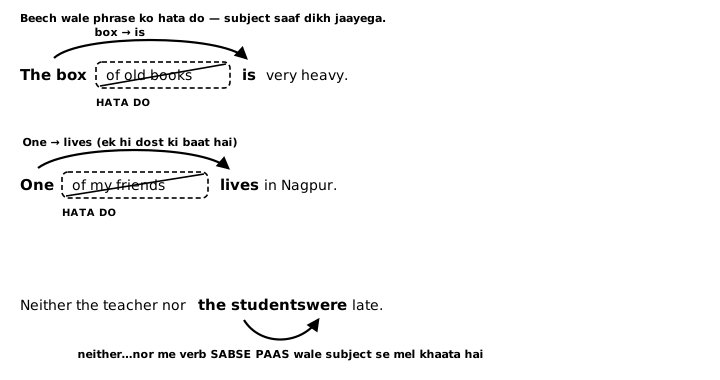
Ye sab beech wale shabd verb nahi badalte
of, with, along with, together with, as well as, including, besides, in addition to, accompanied by
The minister, along with his officers, has arrived. Subject "the minister" hai — ek insaan. "Officers" se koi farq nahi padta.
17.3 Hamesha singular — ye yaad rakhna hai
| Subject | Sahi | Galat |
|---|---|---|
| each | Each boy has a book. | Each boy have… |
| every | Every student was present. | Every student were… |
| everyone / everybody | Everyone knows it. | Everyone know it. |
| someone / somebody | Somebody is at the door. | Somebody are… |
| nobody / no one | Nobody came. | — |
| anyone / anybody | Does anybody know him? | Do anybody know… |
| either / neither (akele) | Neither is correct. | Neither are correct. |
| one of + plural | One of my friends is a doctor. | One of my friend is… |
| the number of | The number of cases is rising. | The number of cases are… |
| each of / every one of | Each of the girls sings well. | Each of the girls sing… |
'one of my friend' — do galtiyan ek saath
- Galat: One of my friend are coming today.
- Sahi: One of my friends is coming today.
- Kyun: Socho: "mere doston me se ek". "Doston" plural hai (friends), par baat ek ki ho rahi hai — isliye verb singular (is). Yahi rule "one of the best players", "one of my sisters" sab par chalta hai.
17.4 "A number of" vs "The number of"
| Phrase | Matlab | Verb | Example |
|---|---|---|---|
| a number of | kai, bahut se | plural | A number of students are absent. |
| the number of | ginti, sankhya | singular | The number of students is falling. |
| a lot of / plenty of | noun par depend | noun dekho | A lot of water is wasted. · A lot of people are waiting. |
| 50% of / half of | noun par depend | noun dekho | Half of the cake is gone. · Half of the boys are here. |
17.5 Do subject jude hain — tab kya?
| Jodne wala shabd | Rule | Example |
|---|---|---|
| and | plural | Ravi and Sita are friends. |
| and (ek hi cheez) | singular | Bread and butter is my breakfast. |
| or / nor | paas wale se mel | Ravi or his brothers are coming. |
| either… or | paas wale se mel | Either the boys or the teacher is wrong. |
| neither… nor | paas wale se mel | Neither the teacher nor the boys are wrong. |
| not only… but also | paas wale se mel | Not only the players but also the coach was blamed. |
Chalaaki ki salaah
either/or aur neither/nor wale vaakya me, agar ho sake to plural subject ko aakhir me rakho. Tab verb plural ho jaata hai aur vaakya kaan ko zyada natural lagta hai.
Neither the manager nor the workers were happy.
17.6 Collective nouns — ek ya kai?
Team, family, class, committee, government, jury, staff — ye ek group hain. Jab group ek ikaai ki tarah kaam kar raha ho to singular; jab group ke log alag-alag kaam kar rahe hon to plural.
- The team is playing well today. Poori team ek ikaai ki tarah — singular.
- The team are arguing among themselves. Team ke log aapas me — alag-alag log, isliye plural.
Teen shabd jo hamesha plural hain
police, people, cattle — inke saath verb hamesha plural.
The police have arrested him. ✓ The police has arrested him. ✗
Many people were waiting. ✓
17.7 Dikhne me plural, par singular
| Kism | Shabd | Example |
|---|---|---|
| Vishay ke naam | mathematics, physics, economics, politics, statistics | Mathematics is my favourite subject. |
| Bimaari | measles, mumps, diabetes | Measles is contagious. |
| Khabar | news | The news is good. |
| Uncountable | information, advice, furniture, luggage, work, money | This information is useful. |
| Doori, paisa, samay — ek ikaai | — | Ten kilometres is a long walk. · Five hundred rupees is too much. |
| Kitaab / film ka naam | — | "Three Idiots" is a great film. |
Aur inka ulta — dikhne me ek, par plural
scissors, trousers, jeans, spectacles, pliers, scales — do hisson wali cheezein plural hoti hain: My spectacles are broken.
Par "a pair of" lagate ho to singular ho jaata hai: A pair of scissors is missing.
17.8 There is / There are
"There" subject nahi hota — subject uske baad aata hai. Isliye verb baad wale noun se mel khaata hai.
- There is a problem with the laptop. Ek problem — singular.
- There are three problems in this file. Teen problems — plural.
17.9 Wo galtiyan jo hum sach me karte hain
Agreement ki top galtiyan
- Galat: He don't know my name.
- Sahi: He doesn't know my name.
-
Kyun: He/she/it ke saath "does" aata hai. "don't" sirf I, you, we, they ke saath.
-
Galat: My parents is very supportive.
- Sahi: My parents are very supportive.
-
Kyun: "Parents" plural hai — are. Ek ki baat ho to "My father is".
-
Galat: Everyone have their own problems.
- Sahi: Everyone has their own problems.
-
Kyun: "Everyone" dikhne me sab lagta hai, par grammar me singular hai — has. (Aage "their" chalta hai, ye aaj normal English hai.)
-
Galat: The police is looking for him.
- Sahi: The police are looking for him.
-
Kyun: "Police" hamesha plural. Ek pulisvaale ki baat ho to "a policeman is".
-
Galat: Mathematics are difficult for me.
- Sahi: Mathematics is difficult for me.
-
Kyun: -s se khatam hone wale vishay (mathematics, physics, economics) singular hain.
-
Galat: One of my cousin works in Dubai.
- Sahi: One of my cousins works in Dubai.
-
Kyun: "One of" ke baad noun plural hota hai, par verb singular. Dono ek saath yaad rakho.
-
Galat: The list of items are on the table.
- Sahi: The list of items is on the table.
-
Kyun: Subject "the list" hai — ek list. "of items" beech ka phrase hai, use hata do.
-
Galat: My brother and I is going to Goa.
- Sahi: My brother and I are going to Goa.
- Kyun: "and" se jude do subject = plural. Aur kram bhi dhyaan rakho — "My brother and I", not "I and my brother".
Chaar kadam, har baar
1. Verb dhoondo.
2. Poochho "kaun/kya?" — jawaab hi subject hai.
3. Subject aur verb ke beech ka sab kuch hata do.
4. Ab dekho subject ek hai ya kai — aur usi hisaab se verb chuno.
17.10 Practice — Subject-verb agreement
Exercise 1
One of my cousins ___ in Canada.
- live
- lives
- are living
- have lived
Hint: Baat kitne logon ki ho rahi hai?
Jawaab
lives
'One of my cousins' ka matlab hai 'mere cousins me se EK'. Baat ek ki hai, isliye verb singular — lives.
Exercise 2
The box of chocolates ___ on the fridge.
- are
- is
- were
- have
Hint: Asli subject kaun hai — box ya chocolates?
Jawaab
is
Subject 'the box' hai — ek dabba. 'of chocolates' beech ka phrase hai, use hata do, to 'The box is' bachta hai.
Exercise 3
Neither the principal nor the teachers ___ present.
- was
- were
- is
- has
Hint: Verb ke sabse paas kaun hai?
Jawaab
were
neither…nor me verb sabse paas wale subject se mel khaata hai. Paas me 'the teachers' hai — plural, isliye 'were'.
Exercise 4
The police ___ already caught the thief.
- has
- have
- is
- was
Hint: 'Police' singular hai ya plural?
Jawaab
have
'Police' English me hamesha plural hai — have. Ek pulisvaale ke liye 'a policeman has' bolte hain.
Exercise 5
Every student ___ (have) a separate roll number.
Hint: 'Every' ke baad kaunsa roop?
Jawaab
has
'Every' aur 'each' hamesha singular hote hain, chahe baad me kitne bhi log hon — isliye 'has'.
Exercise 6
There ___ two pens and a pencil in my bag.
Hint: 'There' ke baad kya aa raha hai?
Jawaab
are
'There' subject nahi hota — baad wala noun subject hai. 'Two pens' plural hai, isliye 'are'.
Exercise 7
Mathematics ___ my favourite subject.
Hint: -s dikhne se plural nahi ho jaata.
Jawaab
is
Mathematics, physics, economics, politics — ye -s par khatam hote hain par singular hain, isliye 'is'.
Exercise 8
Is vaakya me ek galti hai — galat shabd par tap karo.
My younger brother don't like sweets.
Jawaab
Galat shabd: don't.
Sahi roop: My younger brother doesn't like sweets.
Subject 'my younger brother' = he. He/she/it ke saath 'doesn't' aata hai, 'don't' nahi.
Exercise 9
Galat shabd dhoondo.
One of my friend works in a bank.
Jawaab
Galat shabd: friend.
Sahi roop: One of my friends works in a bank.
'One of' ke baad noun hamesha plural hota hai — friends. Verb phir bhi singular rehta hai — works.
Exercise 10
Ek shabd galat hai — pakdo.
The quality of these mangoes are very poor.
Jawaab
Galat shabd: are.
Sahi roop: The quality of these mangoes is very poor.
Subject 'the quality' hai, ek cheez. 'of these mangoes' hata do to 'The quality is' bachta hai.
Exercise 11
Subject ko sahi verb se jodo.
| A | B |
|---|---|
| Everyone | is |
| My parents | are |
| The news | were |
| My spectacles | knows |
| A number of boys | know |
Jawaab
Everyone — knows; My parents — know; The news — is; My spectacles — are; A number of boys — were
Everyone singular → knows. Parents plural → know. News singular → is. Spectacles plural → are. 'A number of' plural → were.
Exercise 12
Sahi kram me vaakya banao.
Shabd: this / thirty / number / class / is / of / in / The / students
Jawaab
The number of students in this class is thirty
'The number of' hamesha singular leta hai — is. Agar 'A number of students' hota to 'are' aata.
Exercise 13
Ab ye line bol ke dekho — teen jagah agreement sambhaalni hai.
One of my friends has a shop and his brothers work there
Jawaab
Bolo: One of my friends has a shop and his brothers work there
'One of my friends' singular → has. 'His brothers' plural → work. Ek hi vaakya me dono tarah ka mel — bolkar practice karne se ye aadat ban jaata hai.
Aage kya karein
Jab likho, ek baar sirf verbs par ungli rakh kar poora padho — har verb par ruk kar poochho "iska subject kaun hai?". Ye ek minute ka check aapki 90% agreement galtiyan khud pakad lega.