Chapter 43: Basic se Native
Basic se Native — wahi baat, naya andaaz
Aapki English galat nahi hai. I am very tired poora sahi vaakya hai — grammar perfect, matlab saaf. Phir bhi ek native speaker shayad ye nahi bolega. Wo bolega I'm running on fumes. Is chapter me hum wahi farq seekhenge: sahi English se natural English tak ka chhota safar. Aur sabse zaroori baat — kaunsa phrase kahan bolna hai, kyunki galat jagah par bola gaya natural phrase basic phrase se zyada kharab lagta hai.
- 1Chaar jodi jo aaj se kaam aayengi
- 2Roz kaam aane wali upgrade table
- 3Jazbaat wale upgrades — gussa, dar, khushi, thakaan
- 4Kaam aur roz ki baat — 12 aur upgrades
- 5Register — phrase ki jagah ka naksha
- 6Chhoti aadatein jo turant farq laati hain
- 7Jo galtiyan native phrases ke saath hoti hain
- 8Ek chhota script — yahi roz bolna hai
Ek line me
Native lagna mushkil shabd se nahi aata — sahi phrase sahi maahaul me rakhne se aata hai. Bade shabd ratne ki zaroorat nahi; thode phrases, par unka sahi istemaal.
43.1 Chaar jodi jo aaj se kaam aayengi
Pehle in chaar ko theek se samajh lo. Har ek ke saath tasveer banao dimaag me — phrase ka asli matlab tabhi baithta hai.
I'm very tired → I'm running on fumes
"Fumes" matlab petrol ki bhaap — gaadi me petrol khatam, bas dhuaan bacha hai, aur wo phir bhi chal rahi hai. Yahi tasveer hai: energy khatam ho chuki hai par kaam jaari hai. Isliye ye phrase sirf "neend aa rahi hai" ke liye nahi hai; ye tab hai jab aap teen din ki deadline ke baad bhi laptop khole baithe ho.
- Honestly, I'm running on fumes — can we finish this tomorrow morning? Sach kahun to meri energy bilkul khatam hai — kal subah nipta lein?
Aur bhi options, halke se bhaari ki taraf: I'm beat (casual, dosti me), I'm wiped out (thoda zyada thaka), I'm exhausted (har jagah safe — office, interview, doctor).
I don't understand → I'm not following
I don't understand sunne wale ko lagta hai "mujhe samajh nahi aata, main kamzor hoon". I'm not following ka matlab hai "aapki baat ka dhaaga mere haath se chhoot gaya" — ilzaam na aap par, na saamne wale par. Office aur meeting ke liye yahi best hai.
- Sorry, I'm not following — could you walk me through that part again? Maaf kijiye, main samajh nahi paaya — wo hissa dobara samjha denge?
- You've lost me. What happens after the payment fails? Main peechhe chhoot gaya. Payment fail hone ke baad kya hota hai?
I need to leave → I should get going
I need to leave me majboori hai, jaise koi emergency ho. I should get going narm hai, polite hai, aur jaana apni marzi lagta hai. Kisi ke ghar se nikalte waqt, call khatam karte waqt — yahi line hai.
- This was lovely, but I should get going — it's a long drive back. Bahut achha laga, par ab mujhe nikalna chahiye — waapsi ka raasta lamba hai.
- I'd better head out before the traffic starts. Traffic shuru hone se pehle nikal jaata hoon.
I made a mistake → I dropped the ball
Yahan dhyan do, kyunki ye jodi barabar nahi hai. I dropped the ball har galti ke liye nahi hai — ye tab hai jab kaam aapke zimme tha aur aapse chhoot gaya. Typo ke liye ye phrase bolna over-dramatic lagega. Client ko follow-up email bhejna bhool gaye — ab theek hai.
- I dropped the ball on the vendor follow-up. I'm fixing it today. Vendor ka follow-up mere haath se chhoot gaya. Aaj theek kar deta hoon.
- That one's on me — I misread the deadline. Wo galti meri hai — maine deadline galat padh li.
Galti maanne ka native formula
Maano + theek karne ka plan, safai nahi. "I dropped the ball on this. Here's what I'm doing about it." Native English me galti ke baad "sorry sorry" nahi, aage ka plan aata hai. Yahi professional lagta hai.
43.2 Roz kaam aane wali upgrade table
Baayein taraf wo jo hum bolte hain, daayein taraf wo jo kaan ko natural lagta hai. Teesra column sabse zaroori hai — kab.
| Plain | Native | Kab bolna theek hai |
|---|---|---|
| I am very busy | I'm swamped | Office, colleagues, WhatsApp. Boss ko bhi theek hai. Client ke pehle email me nahi. |
| I will think about it | Let me sleep on it | Jab faisla kal tak tal sakta ho. Meeting aur dosti dono me chalta hai. |
| Tell me about it later | Fill me in later | Casual aur office. "Fill me in" = chhooti hui baat bata dena. |
| I agree completely | Couldn't agree more | Har jagah safe — meeting, interview, dost. |
| It is not a problem | No worries | Casual aur normal office. Formal email me "That's absolutely fine" likho. |
| I am confused | I'm a bit lost here | Meeting aur class — honest lagta hai, kamzor nahi. |
| Please wait a little | Bear with me | Jab aap screen share kar rahe ho ya kuch dhoond rahe ho. Bahut natural. |
| I did it very fast, so it is rough | It's a first pass | Office. Kaam bhejte waqt expectation set karne ke liye. |
| We have very little time | We're cutting it close | Team ke saath. Client ko "the timeline is tight" kehna behtar. |
| I understood | Got it / Makes sense | Har roz, har jagah. "Noted with thanks" se bahut behtar. |
| Let us start | Let's dive in | Presentation aur meeting ki shuruaat. |
| I will do it later | I'll circle back on this | Sirf office. Doston me ye corporate lagta hai aur hasi aati hai. |
43.3 Jazbaat wale upgrades — gussa, dar, khushi, thakaan
Feelings batate waqt I'm very ___ sabse aam aadat hai. Native speaker "very" ki jagah ek tasveer wala phrase uthata hai. Har line par 🔊 dabao aur rhythm suno — ye phrases ek saans me bole jaate hain.
| Basic | Native | Matlab | Kab use karein |
|---|---|---|---|
| I'm very angry | I'm seeing red right now | Gusse se aankhon ke aage laal-laal dikh raha hai. | Casual, dost aur family. Bahut tez gussa hai — office me bologe to log ghabra jaayenge. Wahan I'm really frustrated. |
| I'm very scared | I'm freaking out right now | Dar ya ghabrahat se haalat kharab hai. | Sirf casual. Dar ke saath-saath "panic" bhi isi me aata hai. Formal me I'm really worried. |
| I'm very confused | I'm totally thrown off | Kuch achaanak badla aur main patri se utar gaya. | Casual aur office dono. Khaas kar jab plan ya jawaab achaanak badal jaaye. |
| I'm very nervous | I'm a little worked up | Andar se bechaini aur tension chal rahi hai. | Casual. Dhyan do — worked up me thoda gussa ya bhadkaav bhi ho sakta hai. Sirf ghabrahat ke liye I've got butterflies bhi bolte hain. |
| I'm very surprised | I'm completely caught off guard | Bilkul taiyaar nahi tha, baat ne chaunka diya. | Har jagah safe — meeting me bhi. Achhi ya buri, dono tarah ki surprise ke liye. |
| I'm very happy | I'm feeling great about it | Is baat ko lekar man bahut khush aur bharosemand hai. | Har jagah safe. Kisi faisle, result ya plan ke baare me khushi — sirf mood ke liye I'm in a great mood. |
| I'm very tired | I'm running on fumes | Energy khatam, phir bhi kaam chal raha hai. | Casual aur team. Poori kahani upar Section 1 me — doctor ke saamne nahi. |
Teen phrases jo galat jagah ajeeb lagte hain
seeing red = bahut tez gussa, chhoti chidh ke liye nahi · freaking out = slang, interview ya client ke saamne nahi · worked up = ghabrahat ya bhadkaav — context se saaf karo. Jazbaat wale idioms dost ke saath sabse natural hain; office me neutral roop uthao.
43.4 Kaam aur roz ki baat — 12 aur upgrades
Ye wo lines hain jo din me das baar aati hain — paise, kaam, plan aur mana karna. Inme se zyadatar neutral zone ke hain, yaani office aur dosti dono me chalte hain.
| Basic | Native | Matlab | Kab use karein |
|---|---|---|---|
| I need to leave | I need to get going | Ab mujhe nikalna hai. | Har jagah safe. I should get going (Section 1) aur narm hai; need to me thodi jaldi hai. |
| I don't understand | I'm not catching your drift | Aap kehna kya chahte ho, wo pakad nahi paa raha. | Casual, thoda purana andaaz. Ishaare wali baat ke liye. Meeting me I'm not following behtar. |
| That's expensive | That's gonna cost me big time | Isme meri jeb ka bada nuksaan hoga. | Sirf bolchaal. Gonna kabhi likhna nahi. Client ko: That's above our budget. |
| I'm very busy | I've got a lot on my plate | Meri thaali me pehle se bahut kaam pada hai. | Har jagah safe — boss ko bhi. I'm swamped se thoda narm. |
| I don't want it | I think I'll pass on that | Shukriya, par is baar rehne dijiye. | Polite mana — khaana, offer, invitation. I don't want it rukha lagta hai. |
| That's very difficult | That's a tough nut to crack | Sakht akhrot — todna mushkil. | Office aur casual. Problem, sawaal ya mushkil insaan ke liye. Idiom fix hai — crack hi aayega. |
| I don't know yet | I haven't figured it out yet | Abhi tak samajh ya tay nahi kar paaya. | Har jagah safe. Isme "koshish jaari hai" ka bhaav hai. |
| I made a mistake | I dropped the ball on that | Wo kaam mere zimme tha aur chhoot gaya. | Team aur manager. Chhoti typo ke liye nahi — Section 1 dekho. |
| Let's talk later | Let's touch base later | Baad me thodi der ke liye baat kar lete hain. | Office ki bhasha. Doston me corporate lagega — wahan Let's catch up later. |
| I'm ready to start | I'm ready to get started | Main shuru karne ke liye taiyaar hoon. | Har jagah safe — meeting, class, interview. |
| That's very annoying | That's getting on my nerves | Ye cheez dimaag kharab kar rahi hai. | Casual. Nerves hamesha plural. Kisi insaan ke muh par bolna rude lagega. |
| I'll handle it | I'll take care of it | Aap chinta mat karo, main sambhal lunga. | Har jagah safe — client ko bhi. I'll handle it bhi sahi hai, bas thoda rukha. |
Teen jo har jagah chal jaate hain
Agar is table me se sirf teen uthane hain to ye uthao: I've got a lot on my plate, I'll take care of it, I think I'll pass on that. Teeno neutral hain — dost, manager aur client, sabke saath bina dar ke bolo.
43.5 Register — phrase ki jagah ka naksha
English ke phrases ek line par baithe hote hain: ek sire par bilkul casual, doosre sire par bilkul formal. Beech wala hissa sabse kaam ka hai — wahan ke phrases dost ke saath bhi chalte hain aur manager ke saath bhi. Agar confusion ho, beech se uthao.
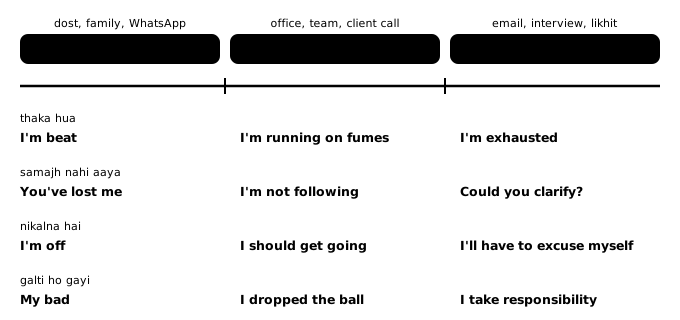
Over-correction — asli khatra
Naya phrase seekh kar use har jagah thoos dena sabse aam galti hai. Doctor ke saamne "I'm running on fumes" bolne se wo samajh hi nahi payega ki aapko kitni neend aa rahi hai. Wahan seedha "I've been sleeping badly for a week" bolo. Natural phrase galat jagah = basic phrase se bura. Pehle maahaul dekho, phir shabd chuno.
43.6 Chhoti aadatein jo turant farq laati hain
Phrases ke alawa teen aadatein hain jo aapki English ko ek hi hafte me natural bana deti hain.
a) Contractions bolo
Native log I am, do not, it is pura nahi bolte — I'm, don't, it's bolte hain. Pura roop sirf zor dene ke liye: "I am listening!" Bina contraction wali English kitaabi lagti hai, galat nahi — bas thodi akdi hui.
b) Softener lagao
Native English direct hone se bachti hai. Ek chhota shabd jod do: a bit, kind of, maybe, I think, actually.
"This is wrong" → "I think there's a small issue here." Softener se baat kam hamlawar lagti hai — office me ye bahut kaam aata hai.
c) Jawaab lamba karo, do lafz nahi
"How was your weekend?" ka jawaab "Fine" nahi. "Pretty quiet, actually — I just caught up on sleep. You?" Ek chhoti detail + waapis sawaal. Yahi conversation chalti rakhta hai.
43.7 Jo galtiyan native phrases ke saath hoti hain
Phrase theek, istemaal galat
- Galat: I am running in fumes.
- Sahi: I'm running on fumes.
-
Kyun: Idiom ke chhote shabd badalne se wo toot jaata hai. Phrase poora, jaisa hai waisa yaad karo — on fumes, kyunki gaadi "petrol par" chalti hai.
-
Galat: I dropped the ball — I made one spelling mistake.
- Sahi: Sorry, typo. Fixed it.
-
Kyun: Chhoti galti ke liye bada idiom bolna drama lagta hai. "Dropped the ball" tab jab zimmedari ka kaam chhoot gaya ho.
-
Galat: I am not following your.
- Sahi: I'm not following.
-
Kyun: Ye phrase apne aap me poora hai — object ki zaroorat nahi. Agar jodna hai to: I'm not following your point.
-
Galat: I should get going now itself.
- Sahi: I should get going right now.
-
Kyun: "Now itself" Indian English ki aadat hai — bahar samajh nahi aati. Sahi roop: right now ya right away.
-
Galat: Let me sleep over it.
- Sahi: Let me sleep on it.
- Kyun: "Sleep over" bachchon ka raat ruk jaana hai. Faisla talne ke liye sleep on it.
43.8 Ek chhota script — yahi roz bolna hai
Neeche ek standard office exchange hai, dono roop me. Zor se do baar padho — pehle baayein, phir daayein. Farq kaan se samajh aayega.
| Textbook English | Jo log asal me bolte hain |
|---|---|
| Good morning. How are you? | Morning! How's it going? |
| I have completed the report. | I've wrapped up the report. |
| I did not understand the second point. | I'm not following the second point. |
| Please give me some time. | Bear with me for a minute. |
| I will inform you afterwards. | I'll let you know. |
| I am very tired today. | I'm running on fumes today. |
| I have to go now. | I should get going. |
43.9 Practice — Basic se native
Exercise 1
Office meeting me kisi ki baat samajh nahi aayi. Sabse natural line kaunsi hai?
- Sorry, I'm not following.
- I am not understanding.
- I have a doubt in your talk.
- Please repeat it again.
Hint: Ilzaam kisi par na aaye.
Jawaab
Sorry, I'm not following.
'I'm not following' neutral hai — na aap kamzor lagte ho, na saamne wala galat. 'I am not understanding' grammar se bhi galat hai, aur 'repeat it again' me 'again' bekaar hai.
Exercise 2
Aapne ek bade client ka follow-up email bhejna bhool gaye. Manager ko kya bologe?
- I dropped the ball on the client follow-up.
- I am running on fumes.
- Let me sleep on it.
- I'm swamped so it is not my fault.
Jawaab
I dropped the ball on the client follow-up.
Zimmedari ka kaam chhoot gaya = dropped the ball. Baaki phrases ka matlab yahan fit nahi baithta, aur aakhri line safai de rahi hai — jo kabhi achha nahi lagta.
Exercise 3
Doctor ke saamne apni thakaan batani hai. Kya bolna chahiye?
- I've been exhausted for two weeks and sleeping badly.
- I'm running on fumes, doc.
- I'm beat.
- I'm totally wiped.
Hint: Yahan saaf jaankari chahiye, style nahi.
Jawaab
I've been exhausted for two weeks and sleeping badly.
Doctor ko detail chahiye, idiom nahi. Yahi over-correction ka khatra hai — natural phrase galat jagah par ulta nuksaan karta hai.
Exercise 4
This was fun, but I should get ___ — it's getting late.
Hint: Nikalne ka narm tareeka.
Jawaab
going
'I should get going' = mujhe ab nikalna chahiye. 'I need to leave' se zyada polite aur zyada natural hai.
Exercise 5
Give me a minute to find the file — please ___ with me.
Hint: Jaanwar nahi, phrase hai: ___ with me.
Jawaab
bear
'Bear with me' = thoda sabr kijiye. Screen share karte waqt ya kuch dhoondte waqt native log yahi bolte hain.
Exercise 6
Is vaakya me idiom toot gaya hai — galat shabd par tap karo.
After three night shifts I am running in fumes.
Jawaab
Galat shabd: in.
Sahi roop: After three night shifts I'm running on fumes.
Idiom ke chhote shabd fix hote hain — 'on fumes', 'in' nahi. Idiom ke andar ka ek shabd badla to poora phrase ajnabi lagta hai.
Exercise 7
Ek shabd Indian English ki aadat hai aur bahar samajh nahi aata — use dhoondo.
I should get going now itself.
Jawaab
Galat shabd: itself.
Sahi roop: I should get going right now.
'Now itself' sirf India me chalta hai. International call me 'right now' ya 'right away' bolo.
Exercise 8
Plain line ko uske natural roop se jodo.
| A | B |
|---|---|
| I am very busy | Got it |
| I will think about it | Couldn't agree more |
| I understood | I'm swamped |
| I agree completely | Let me sleep on it |
Jawaab
I am very busy — I'm swamped; I will think about it — Let me sleep on it; I understood — Got it; I agree completely — Couldn't agree more
Chaaron daayein wale roop neutral zone ke hain — office aur dosti, dono me chalte hain.
Exercise 9
Phrase ko uski sahi jagah se jodo.
| A | B |
|---|---|
| My bad | likhit, formal email |
| I dropped the ball | sirf office ki bhasha |
| I take full responsibility | dost ke saath, bilkul casual |
| I'll circle back on this | team ya manager ke saath |
Jawaab
My bad — dost ke saath, bilkul casual; I dropped the ball — team ya manager ke saath; I take full responsibility — likhit, formal email; I'll circle back on this — sirf office ki bhasha
Register ka naksha yaad rakho: ek hi baat ke teen roop, aur unki jagah alag.
Exercise 10
Sahi kram me lagao — manager ko galti batane wali line.
Shabd: the / today / it / am / this / and / on / I / I / ball / fixing / dropped
Jawaab
I dropped the ball on this and I am fixing it today
Native formula: pehle galti maano, phir aage ka plan batao. Safai beech me nahi aati.
Exercise 11
Kaunsi aadat aapki English ko turant natural banati hai?
- Contractions bolna — I'm, don't, it's
- Har vaakya me ek bada shabd daalna
- Hamesha pura roop bolna — I am, do not
- Har jawaab do shabd me dena
Jawaab
Contractions bolna — I'm, don't, it's
Contractions rhythm theek karte hain. Pura roop kitaabi lagta hai, aur do-shabd ke jawaab conversation maar dete hain.
Exercise 12
Manager ne naya kaam diya, par aapke paas pehle se bahut kaam hai. Sabse natural aur polite line?
- I've got a lot on my plate right now.
- I am having many works today.
- I'm seeing red right now.
- That's gonna cost me big time.
Jawaab
I've got a lot on my plate right now.
'A lot on my plate' = thaali me pehle se bahut kaam. Ye manager ke saath bhi safe hai. 'Seeing red' gussa hai aur 'cost me big time' paison ki baat.
Exercise 13
Client ko formal email likh rahe ho. Kaunsi line yahan NAHI likhni chahiye?
- That's gonna cost me big time.
- I'll take care of it.
- I'm ready to get started.
- I haven't figured it out yet.
Hint: Ek line sirf bolchaal ki hai.
Jawaab
That's gonna cost me big time.
'Gonna' aur 'big time' sirf bolne ki bhasha hai. Client ko 'That's above our budget' likho. Baaki teeno lines har jagah safe hain.
Exercise 14
This bug has taken three days — it's a tough nut to ___.
Hint: Akhrot ke saath kaunsa verb aata hai?
Jawaab
crack
'A tough nut to crack' = mushkil masla. Idiom fix hai — 'break' ya 'open' lagane se toot jaata hai.
Exercise 15
Idiom me ek shabd galat roop me hai — use dhoondo.
The drilling next door is getting on my nerve.
Jawaab
Galat shabd: nerve.
Sahi roop: The drilling next door is getting on my nerves.
'Getting on my nerves' me 'nerves' hamesha plural hai. 'Nerve' akela matlab badal deta hai (himmat).
Exercise 16
Basic feeling ko uske native roop se jodo.
| A | B |
|---|---|
| I'm very angry | I'm caught off guard |
| I'm very scared | I'm totally thrown off |
| I'm very surprised | I'm seeing red |
| I'm very confused | I'm freaking out |
Jawaab
I'm very angry — I'm seeing red; I'm very scared — I'm freaking out; I'm very surprised — I'm caught off guard; I'm very confused — I'm totally thrown off
Chaaron phrases tasveer wale hain — laal rang, ghabrahat, bina taiyaari, patri se utarna. Pehle teen zyada tar casual hain.
Exercise 17
Ab ye line bol kar dekho. 'I'm' ek hi aawaz me, aur 'not following' me zor 'foll' par.
Sorry I'm not following could you walk me through that again
Jawaab
Bolo: Sorry I'm not following could you walk me through that again
Bolte waqt 'I'm not following' me pause nahi aata — ek saath beh jaata hai. Yahi rhythm native lagta hai.
Aage kya karein
Poori table ratne ki koshish mat karo. Is hafte sirf teen phrases chuno — I'm not following, I should get going, bear with me — aur unhe roz bolo. Teen phrases jo aapke muh me baith gaye, tees ratte phrases se zyada kaam ke hain.