Chapter 22: Kisi ki baat aage batana
Kisi ki baat aage batana — reported speech
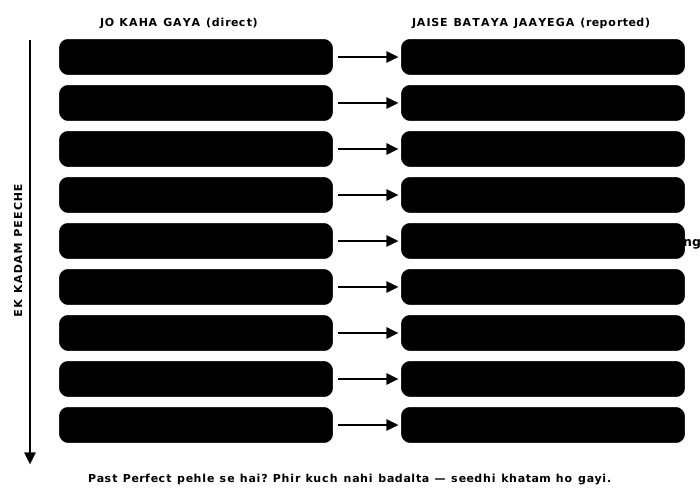
Din bhar hum yahi karte hain: "Mummy ne kaha ki khaana khaa lo", "Boss bola ki kal aa jana". English me ise reported speech kehte hain, aur isme ek hi bada rule hai — tense ek kadam peeche chala jaata hai. Jaise kisi ne jo kaha, wo ab purani baat ban gayi, to uski tense bhi ek seedhi peeche ki seedhi utar jaati hai. Is chapter me wo seedhi (ladder) aapko tasveer me dikhegi.
- 1Paanch cheezein badalti hain
- 2Tense ki seedhi — ek kadam peeche
- 3Pronoun kaise badalte hain
- 4Samay aur jagah ke shabd
- 5Jab tense nahi badalti
- 6Sawaal ko report karna
- 7Hukm, request aur salaah
- 8say, tell, ask — teen shabd, teen aadat
- 9Wo galtiyan jo hum sach me karte hain
Ek line me
If the reporting verb is in the past (said, told, asked), move the tense inside one step back. Bahar wala verb past me hai, to andar wala tense ek kadam peeche — present → past, past → past perfect.
22.1 Paanch cheezein badalti hain
| # | Kya badalta hai | Direct | Reported |
|---|---|---|---|
| 1 | Quotes aur comma hat jaate hain, "that" aa jaata hai | He said, "I am tired." | He said that he was tired. |
| 2 | Pronoun badalte hain | "I am tired." | … he was tired. |
| 3 | Tense ek kadam peeche | "I am tired." | … he was tired. |
| 4 | Samay ke shabd badalte hain | "I will come tomorrow." | … he would come the next day. |
| 5 | Jagah ke shabd badalte hain | "Sit here." | … to sit there. |
22.2 Tense ki seedhi — ek kadam peeche
Yahi is poore chapter ka dil hai. Bayein taraf wo tense hai jo bolne wale ne use kiya, aur dayein taraf wo tense jo report karte waqt aata hai. Dhyaan do — sab kuch ek kadam neeche utar raha hai.
22.3 Pronoun kaise badalte hain
Rule aasaan hai: pronoun report karne wale ke nazariye se badalta hai. "Main" bolne wale ka tha — ab wo "wo" ban jaata hai.
| Direct | Reported | Example |
|---|---|---|
| I, me, my | he/she, him/her, his/her | He said, "I lost my pen." → He said he had lost his pen. |
| we, us, our | they, them, their | They said, "We are busy." → They said they were busy. |
| you, your | me/him/her (kisse kaha, uske hisaab se) | She told me, "You are late." → She told me I was late. |
| he, she, it, they | wahi rehte hain | She said, "He is away." → She said he was away. |
22.4 Samay aur jagah ke shabd
| Direct | Reported |
|---|---|
| now | then |
| today | that day |
| tonight | that night |
| tomorrow | the next day / the following day |
| yesterday | the previous day / the day before |
| last night | the previous night |
| next week | the following week |
| two days ago | two days before |
| here | there |
| this / these | that / those |
| come | go |
- Direct: She said, "I am going to Delhi tomorrow."
- Reported: She said that she was going to Delhi the next day. Teen badlaav: I → she, am → was, tomorrow → the next day.
22.5 Jab tense nahi badalti
Har baar tense peeche nahi jaati. Chaar mauke aise hain jahan tense waisi hi rehti hai — aur ye jaanna bahut zaroori hai, warna English banaawati lagti hai.
| Mauka | Example |
|---|---|
| Reporting verb present me hai | He says that he is busy. |
| Hamesha sach rehne wali baat | The teacher said that the sun rises in the east. |
| Baat abhi bhi sach hai | She said she works in a bank. (aaj bhi karti hai) |
| Pehle se Past Perfect hai | He said, "I had finished." → He said he had finished. |
22.6 Sawaal ko report karna
Yahan do cheezein hoti hain: "that" nahi aata, aur kram seedha ho jaata hai — helping verb wapas subject ke peeche chala jaata hai. Question mark bhi hat jaata hai.
WH wale sawaal — WH-word hi joint banta hai
| Direct | Reported |
|---|---|
| He asked, "Where do you live?" | He asked where I lived. |
| She asked, "What is your name?" | She asked what my name was. |
| They asked, "Why did he leave?" | They asked why he had left. |
Yes/No sawaal — "if" ya "whether" lagao
| Direct | Reported |
|---|---|
| He asked, "Are you ready?" | He asked if I was ready. |
| She asked, "Did you call him?" | She asked whether I had called him. |
| Mother asked, "Have you eaten?" | Mother asked if I had eaten. |
Sawaal reported hone ke baad sawaal nahi rehta
- Galat: He asked me where was I going?
- Sahi: He asked me where I was going.
- Kyun: Reported sawaal ab ek bayaan (statement) hai. Isliye kram seedha, aur aakhir me full stop — question mark nahi.
22.7 Hukm, request aur salaah
In sab me ek hi trick hai: "to" + V1. Negative ho to "not to" + V1. Aur reporting verb baat ke suroor ke hisaab se badalta hai.
| Kism | Reporting verb | Direct | Reported |
|---|---|---|---|
| Hukm | ordered / told | "Stand up!" | He ordered me to stand up. |
| Request | requested / asked | "Please help me." | She requested me to help her. |
| Salaah | advised | "You should rest." | He advised me to rest. |
| Mana karna | forbade / told… not to | "Don't touch it." | She told me not to touch it. |
| Sujhaav | suggested | "Let's go out." | He suggested going out. |
| Prarthna / dua | prayed / wished | "May you succeed!" | He wished that I might succeed. |
22.8 say, tell, ask — teen shabd, teen aadat
Ye teen shabd Indian English ki sabse badi reported-speech galti banate hain. Farq sirf itna hai ki kaun kisko leta hai.
| Verb | Kaise aata hai | Sahi |
|---|---|---|
| say | insaan seedha nahi aata — "to" lagta hai | He said to me… / He said that… |
| tell | insaan seedha aata hai — "to" nahi | He told me that… |
| ask | insaan seedha aata hai | He asked me if… |
'She said me' — sabse aam galti
- Galat: She said me that the shop was closed.
- Sahi: She told me that the shop was closed.
-
Kyun: "Say" ke baad insaan seedha nahi aata. Do raaste hain: She told me… ya She said to me…. Aasaan tareeka — insaan ka naam lena ho to hamesha tell use karo.
-
Galat: He told that he would come.
- Sahi: He said that he would come. / He told me that he would come.
- Kyun: "Tell" ke baad kisko bataya — ye batana padta hai. Akela "told that" adhoora hai.
22.9 Wo galtiyan jo hum sach me karte hain
Reported speech ki top galtiyan
- Galat: She said that she is coming tomorrow.
- Sahi: She said that she was coming the next day.
-
Kyun: "said" past me hai, to andar ka tense ek kadam peeche — is → was, aur tomorrow → the next day.
-
Galat: He asked me that where I live.
- Sahi: He asked me where I lived.
-
Kyun: Sawaal me "that" nahi aata. WH-word khud jodne ka kaam karta hai.
-
Galat: My father told me that study hard.
- Sahi: My father told me to study hard.
-
Kyun: Hukm aur salaah ke liye "to + V1" — "that" nahi.
-
Galat: She asked me do I know the way.
- Sahi: She asked me if I knew the way.
-
Kyun: Yes/no sawaal ke liye "if" ya "whether", aur kram seedha. "do/does/did" gayab ho jaate hain.
-
Galat: He said that he will help me.
- Sahi: He said that he would help me.
-
Kyun: will → would. Isi tarah can → could, may → might, must → had to.
-
Galat: The teacher said that water boiled at 100 degrees.
- Sahi: The teacher said that water boils at 100 degrees.
-
Kyun: Hamesha sach rehne wali baat me tense peeche nahi jaati.
-
Galat: He told me that don't go there.
- Sahi: He told me not to go there.
- Kyun: Mana karne ke liye "not to + V1" — chhota aur seedha roop.
Chaar kadam, har baar
1. Kism pehchaano — bayaan, sawaal, ya hukm?
2. Sahi joint lagao — that / if-whether / WH-word / to.
3. Pronoun badlo.
4. Tense ek kadam peeche, aur samay-jagah ke shabd badlo.
22.10 Practice — Reported speech
Exercise 1
Report karo: She said, "I am very tired."
- She said that she is very tired.
- She said that she was very tired.
- She said that I was very tired.
- She told that she was very tired.
Hint: said past me hai, to andar kya hoga?
Jawaab
She said that she was very tired.
Do badlaav hue: pronoun I → she, aur tense am → was. 'said' past me hai isliye tense ek kadam peeche jaati hai.
Exercise 2
Report karo: He asked, "Where is the bank?"
- He asked where is the bank.
- He asked that where was the bank.
- He asked where the bank was.
- He asked where was the bank?
Hint: Sawaal reported hone par kram seedha ho jaata hai.
Jawaab
He asked where the bank was.
Reported sawaal ab bayaan hai — isliye 'the bank was', aur aakhir me full stop. 'That' bhi nahi aata.
Exercise 3
Report karo: Mother said, "Don't play in the sun."
- Mother said that don't play in the sun.
- Mother told not to play in the sun.
- Mother told me not to play in the sun.
- Mother said me not to play in the sun.
Hint: Mana karna hai.
Jawaab
Mother told me not to play in the sun.
Mana karne ke liye 'not to + V1'. Aur 'tell' ke baad kisko kaha — ye batana zaroori hai, isliye 'told me'.
Exercise 4
Kis vaakya me tense peeche NAHI jaayegi?
- He said, "I am ill."
- She said, "The earth moves round the sun."
- They said, "We are leaving."
- He said, "I will call you."
Hint: Kaunsi baat hamesha sach hai?
Jawaab
She said, "The earth moves round the sun."
Hamesha sach rehne wali baat (universal truth) me tense waisi hi rehti hai — 'She said that the earth moves round the sun.'
Exercise 5
He said, "I will come tomorrow." → He said that he ___ come the next day.
Hint: will ka reported roop?
Jawaab
would
will → would. Isi tarah can → could, may → might, shall → should.
Exercise 6
She asked, "Are you coming?" → She asked ___ I was coming.
Hint: Yes/no sawaal ka joint.
Jawaab
if / whether
Yes/no sawaal report karte waqt 'if' ya 'whether' lagta hai. Dono sahi hain — 'whether' thoda zyada formal hai.
Exercise 7
Ravi ___ me that the train was late.
Hint: Insaan ('me') seedha aa raha hai — to kaunsa verb?
Jawaab
told
'Tell' ke baad insaan seedha aata hai — told me. 'Said me' galat hai; 'said to me' chalta hai.
Exercise 8
Is vaakya me ek galti hai — galat shabd par tap karo.
My sister said me that she would help.
Jawaab
Galat shabd: said.
Sahi roop: My sister told me that she would help.
'Say' ke baad insaan seedha nahi aata. 'Told me' bolna hai, ya 'said to me'.
Exercise 9
Galat shabd dhoondo.
He asked me that where I was going.
Jawaab
Galat shabd: that.
Sahi roop: He asked me where I was going.
Sawaal report karte waqt 'that' nahi lagta. WH-word khud dono hisson ko jod deta hai.
Exercise 10
Ek shabd galat hai — pakdo.
The doctor advised him that rest for a week.
Jawaab
Galat shabd: that.
Sahi roop: The doctor advised him to rest for a week.
Salaah aur hukm ke liye 'to + V1' aata hai — 'to rest'. 'That' yahan nahi chalta.
Exercise 11
Sahi kram me reported vaakya banao.
Shabd: she / work / finished / me / that / her / told / She / had
Jawaab
She told me that she had finished her work
'Tell' ke baad insaan (me), phir 'that', phir tense ek kadam peeche — 'has finished' ban gaya 'had finished'.
Exercise 12
Direct roop ko uske reported roop se jodo.
| A | B |
|---|---|
| I write | he would write |
| I wrote | he could write |
| I will write | he had to write |
| I can write | he wrote |
| I must write | he had written |
Jawaab
I write — he wrote; I wrote — he had written; I will write — he would write; I can write — he could write; I must write — he had to write
Present → past, past → past perfect, will → would, can → could, must → had to. Seedhi ka har kadam ek hi disha me utarta hai.
Exercise 13
Ab ye line bol ke dekho — roz kaam aane wali reported speech.
He told me that he would call me the next day
Jawaab
Bolo: He told me that he would call me the next day
Teen cheezein ek saath sahi karni hain: 'told me' (said me nahi), 'would' (will nahi), aur 'the next day' (tomorrow nahi). Bolkar practice karne se ye teeno saath aane lagte hain.
Aage kya karein
Aaj raat sone se pehle, din bhar ki teen baatein kisi ko report karke bolo — "My boss told me that…", "My friend asked me if…", "Mummy told me to…". Teen vaakya, roz. Ek hafte me ye seedhi apne-aap dimaag me baith jaayegi.