Chapter 8: Pronoun — naam ki jagah
Pronoun — naam ki jagah lene wale shabd
Pronoun wo shabd hai jo noun ki jagah le leta hai, taaki wahi naam baar-baar na bolna pade. Chhote shabd hain — I, me, my, he, him, who, this — par inme hui galti sabse zyada sunai deti hai. "Myself Ravi", "Me and my friend went", "Between you and I" — teeno pronoun ki galtiyan hain, aur teeno is chapter me theek ho jaayengi.
- 1Personal pronouns — poori table ek jagah
- 2I ya me? — ek second ka test
- 3Possessive — my, mine aur ka farq
- 4Reflexive pronouns — jab kaam khud par palat aaye
- 5Demonstrative pronouns — this, that, these, those
- 6Relative pronouns — who, whom, which, that, whose
- 7Baaki prakaar — ek-ek line me
- 8Pronoun kiska hai — ye saaf hona chahiye
- 9Wo galtiyan jo hum sach me karte hain
Ek line me
A pronoun is a word used in place of a noun. Jo noun ke badle me aaye — wo pronoun. Jis noun ki jagah leta hai use antecedent kehte hain.
- Priya lost her keys, so she called me. "she" = Priya. Ek baar naam lene ke baad pronoun — yahi natural English hai.
- This is mine, and that is yours. Ye mera hai, wo tumhara. Bina kisi noun ke poori baat ho gayi.
8.1 Personal pronouns — poori table ek jagah
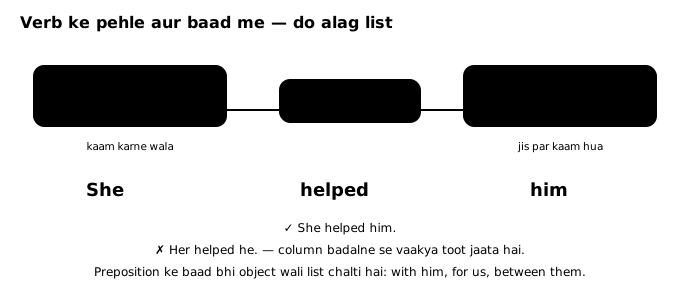
Yahi sabse zaroori table hai. Ek baar iska column samajh gaye to I/me, he/him, we/us ki gadbad khatam. Column ka matlab hai — pronoun vaakya me kahan baith raha hai.
| Kaun | Subject (kaam karne wala) |
Object (jis par kaam hua) |
Possessive adj. (noun ke saath) |
Possessive pron. (akela) |
Reflexive (khud) |
|---|---|---|---|---|---|
| Main | I | me | my | mine | myself |
| Tum / aap | you | you | your | yours | yourself / yourselves |
| Wo (ladka) | he | him | his | his | himself |
| Wo (ladki) | she | her | her | hers | herself |
| Wo (cheez) | it | it | its | — | itself |
| Hum | we | us | our | ours | ourselves |
| Wo (bahut log) | they | them | their | theirs | themselves |
8.2 I ya me? — ek second ka test
Sabse bada confusion yahan aata hai jab do log ho jaate hain: "Ravi and I" ya "Ravi and me"? Rule yaad karne ki zaroorat nahi — doosre insaan ko hata do aur padh ke dekho.
Hatao-aur-sunlo test
Ravi and __ went to the market. → "Ravi and" hatao → "I went to the market." ✓ ("Me went" galat lagta hai) → isliye Ravi and I.
She invited Ravi and __. → hatao → "She invited me." ✓ ("She invited I" galat lagta hai) → isliye Ravi and me. Kaan khud bata deta hai, bas doosra naam beech se hata do.
Teen galtiyan jo roz sunai deti hain
- Galat: Me and my friend went to the mall.
- Sahi: My friend and I went to the mall.
-
Kyun: Do baatein: subject hai isliye "I", aur politeness me doosre ka naam pehle aata hai. Test: "Me went" — galat lagta hai.
-
Galat: Between you and I…
- Sahi: Between you and me…
-
Kyun: "Between" ek preposition hai, aur preposition ke baad hamesha object wali list aati hai — me, him, her, us, them. Log "I" ko zyada shuddh samajh kar galti karte hain.
-
Galat: He is taller than me. (bolchaal me chalta hai)
- Sahi: He is taller than I am. (likhne me behtar)
- Kyun: Poora vaakya hai "than I am tall" — isliye formal English me "than I". Bolchaal me "than me" aam hai, par exam ya email me "than I am" likho.
8.3 Possessive — my, mine aur ka farq
Do list hain: ek jo noun ke saath aati hai, aur ek jo akeli khadi hoti hai.
| Noun ke saath | Example | Akela | Example |
|---|---|---|---|
| my | This is my pen. | mine | This pen is mine. |
| your | your seat | yours | The seat is yours. |
| his | his bike | his | The bike is his. |
| her | her bag | hers | The bag is hers. |
| our | our house | ours | The house is ours. |
| their | their car | theirs | The car is theirs. |
Inme apostrophe kabhi nahi lagta
its, hers, ours, yours, theirs — in paanch me apostrophe lagana hamesha galat hai. Kyunki ye khud possessive hain, inhe apostrophe ki madad ki zaroorat nahi.
✗ her's, ✗ our's, ✗ their's, ✗ it's (possessive ke liye)
8.4 Reflexive pronouns — jab kaam khud par palat aaye
-self / -selves wale pronouns tab aate hain jab kaam karne wala aur jis par kaam hua — wahi ek insaan ho.
- She hurt herself while cooking. Chot usi ko lagi jo kaam kar rahi thi — isliye herself.
- I made this cake myself. Yahan "myself" zor dene ke liye hai — kisi aur ne nahi, maine khud. Is kaam ko emphatic kehte hain (neeche dekho).
- The children behaved themselves at the wedding. Bahut log hain, isliye -selves.
Emphatic pronouns — wahi shabd, alag kaam
myself, yourself, himself, herself, itself, ourselves, yourselves, themselves — yahi shabd jab sirf zor dene ke liye aayein, to unhe emphatic pronoun kehte hain. Ye aksar noun/pronoun ke turant baad, ya vaakya ke aakhir me aate hain. Hindi ka "khud", "swayam", "apne aap".
- I myself saw the accident. Maine khud dekha — kisi se suna nahi.
- She herself cooked the whole dinner. Usne swayam banaya — kisi cook ne nahi.
- The Principal himself gave us the prizes. Principal ne khud diye — baat ki ahmiyat badh gayi.
| Reflexive | Emphatic | |
|---|---|---|
| Kaam | kaam karne wale par hi palat kar aata hai (object) | sirf zor deta hai — "khud, kisi aur ne nahi" |
| Hata do to? | vaakya adhoora / galat ho jaata hai | vaakya poora rehta hai, sirf zor chala jaata hai |
| Jagah | verb ya preposition ke baad | subject ke turant baad, ya aakhir me |
| Example | She hurt herself. | She herself called me. |
Hatao-test — reflexive ya emphatic?
He cut himself. → "He cut." adhoora hai → reflexive.
He himself cut the cake. → "He cut the cake." poora hai → emphatic. Dono me emphatic bhi subject ki jagah akela nahi aata — "Himself cut the cake" galat hai. Pehle subject, phir zor.
'Myself Ravi' — Indian English ki sabse pehchaani galti
- Galat: Myself Ravi Kumar, from Lucknow.
- Sahi: I am Ravi Kumar, from Lucknow.
-
Kyun: Reflexive pronoun kabhi subject nahi ban sakta — uske aage hone ke liye pehle ek normal subject (I) chahiye. Hindi ka "main Ravi" seedha utaarne se "myself" aa jaata hai. Interview me ye pehle teen second me pakad liya jaata hai.
-
Galat: My friend and myself attended the class.
- Sahi: My friend and I attended the class.
-
Kyun: Yahan subject chahiye — I. "Myself" tab aata jab maine khud par kuch kiya hota.
-
Galat: Please send the file to myself.
- Sahi: Please send the file to me.
- Kyun: Preposition ke baad object pronoun aata hai — to me. Office email me "to myself" formal lagta hai par galat hai.
8.5 Demonstrative pronouns — this, that, these, those
Ye chaar shabd ungli uthane ka kaam karte hain — ye wala, wo wala.
| Paas (near) | Door (far) | |
|---|---|---|
| Ek | this | that |
| Bahut | these | those |
- This is my seat, and those are theirs. Ye meri seat hai, aur wo unki.
Pronoun ya adjective?
Agar iske baad noun aa raha hai to ye adjective hai — this book. Agar akela khada hai to pronoun — This is good. Kaam se pehchaan, shabd se nahi.
8.6 Relative pronouns — who, whom, which, that, whose
Ye do vaakyon ko jod kar ek bana dete hain, aur beech me ek chhoti si jaankari ghusa dete hain. Inke bina English bahut katee-katee lagti hai.
| Shabd | Kiske liye | Example |
|---|---|---|
| who | insaan — subject | The man who called is my uncle. |
| whom | insaan — object (formal) | The man whom I met is a doctor. |
| whose | kiska (possession) | The boy whose bag was lost is crying. |
| which | cheez / jaanwar | The phone which I bought is heavy. |
| that | dono — zaroori jaankari me | The book that you lent me is great. |
who ya whom — ek choti trick
Jawaab me he aata hai to who, aur him aata hai to whom. Dono me "m" hai — yahi jodi yaad rakho.
__ called? → He called. → Who called?
You met __? → I met him. → Whom did you meet?
8.7 Baaki prakaar — ek-ek line me
| Prakaar | Shabd | Example |
|---|---|---|
| Interrogative (sawaal) | who, whom, whose, which, what | What is your name? |
| Indefinite (anishchit) | someone, anyone, everyone, nobody, something, all, few, many | Someone is knocking. |
| Reciprocal (ek doosre ko) | each other, one another | They love each other. |
| Emphatic (zor) | myself, herself, themselves… (subject ke baad) | I myself checked it. |
| Distributive (alag-alag) | each, either, neither | Each of the boys has a bat. |
Indefinite pronouns aur verb
everyone, everybody, someone, nobody, each, either, neither — ye sab dikhne me "bahut" lagte hain par grammar me singular hain.
✓ Everyone is ready. ✗ Everyone are ready.
✓ Neither of them knows the answer.
8.8 Pronoun kiska hai — ye saaf hona chahiye
Pronoun ka kaam tabhi poora hota hai jab sunne wale ko pata ho ki wo kiski jagah le raha hai. Agar do log ho to pronoun confuse kar deta hai:
✗
Ravi told Mohan that he had failed. (kaun fail hua — Ravi ya Mohan?)
✓
Ravi told Mohan, "You have failed." (ya) Ravi admitted to Mohan that he himself had failed.
8.9 Wo galtiyan jo hum sach me karte hain
Pronoun ki aam Indian-English galtiyan
- Galat: Myself Ravi, and myself working in an IT company.
- Sahi: I am Ravi, and I work in an IT company.
-
Kyun: Reflexive pronoun subject nahi ban sakta, aur verb bhi chhoot gaya tha. Intro ka safe formula: "My name is ___ . I am from ___ . I work as ___ ."
-
Galat: She is my cousin sister, and she don't speak Hindi.
- Sahi: She is my cousin, and she doesn't speak Hindi.
-
Kyun: "Cousin" apne aap me poora shabd hai. Aur "she" third person singular hai, isliye helping verb "does" — she doesn't.
-
Galat: I am having a car, and it's colour is red.
- Sahi: I have a car, and its colour is red.
-
Kyun: Do galtiyan: "have" ko continuous me nahi daalte jab possession ki baat ho, aur possessive "its" me apostrophe nahi lagta. "it's" sirf "it is" ka chhota roop hai.
-
Galat: Me and my brother are going to Goa.
- Sahi: My brother and I are going to Goa.
-
Kyun: Subject hai to "I" chahiye — "Me am going" galat lagta hai, na? Doosra naam pehle rakhna politeness hai.
-
Galat: Everyone have submitted their forms.
- Sahi: Everyone has submitted their forms.
-
Kyun: "Everyone" dikhta bahut logon jaisa hai, par grammar me singular hai — isliye "has". Aage "their" aana aaj ki English me bilkul theek hai.
-
Galat: One of my friend gave I a gift.
- Sahi: One of my friends gave me a gift.
-
Kyun: "One of" ke baad plural noun, aur verb ke baad object pronoun — me, na ki I.
-
Galat: The two brothers help themself.
- Sahi: The two brothers help each other.
- Kyun: "themself" shabd hi nahi hai. Aur matlab bhi badal gaya — ek doosre ki madad ke liye "each other" chahiye; "themselves" ka matlab hota apni-apni madad.
Teen pakke rule, bas
1. Verb se pehle → I, he, she, we, they. Verb ya preposition ke baad → me, him, her, us, them.
2. -self wala shabd kabhi subject nahi banta.
3. its, hers, ours, yours, theirs me apostrophe kabhi nahi.
8.10 Practice — Pronouns
Exercise 1
___ and I went to the station together.
- My sister
- Me
- Myself
- Mine
Hint: Hatao-aur-sunlo test lagao.
Jawaab
My sister
Subject do log hain, aur 'I' pehle se sahi roop me hai. Politeness me doosre ka naam pehle aata hai — 'My sister and I'.
Exercise 2
This is a secret between you and ___.
- me
- I
- myself
- mine
Hint: 'Between' kaunsa part of speech hai?
Jawaab
me
'Between' preposition hai, aur preposition ke baad hamesha object pronoun aata hai — me, him, her, us, them. 'I' zyada shuddh lagta hai par galat hai.
Exercise 3
Introduction ka sahi tareeka kaunsa hai?
- I am Ravi from Patna.
- Myself Ravi from Patna.
- Myself is Ravi from Patna.
- Me Ravi from Patna.
Jawaab
I am Ravi from Patna.
Reflexive pronoun 'myself' subject nahi ban sakta, aur vaakya me verb bhi chahiye. 'I am ___' me dono cheezein hain.
Exercise 4
The girl ___ bag was stolen is in my class.
- whose
- who
- whom
- which
Hint: Kiska bag? — possession.
Jawaab
whose
'Whose' possession batata hai — kiska. 'Who' subject ke liye hai aur 'whom' object ke liye, par yahan bag ka maalik batana hai.
Exercise 5
She cut ___ while chopping onions. (wo khud)
Hint: Kaam karne wala aur jis par kaam hua — wahi insaan.
Jawaab
herself
Chot usi ko lagi jo kaam kar rahi thi, isliye reflexive pronoun chahiye — herself. 'her' hota to koi doosri ladki hoti.
Exercise 6
The dog hurt ___ paw. (possessive)
Hint: Apostrophe lagta hai ya nahi?
Jawaab
its
Possessive 'its' me apostrophe nahi lagta. 'it's' ka matlab 'it is' hai, aur 'the dog hurt it is paw' bemaani hai.
Exercise 7
Is vaakya me galat shabd par tap karo.
Please send the report to myself by evening.
Jawaab
Galat shabd: myself.
Sahi roop: Please send the report to me by evening.
Preposition 'to' ke baad object pronoun aata hai — me. 'Myself' tab aata jab main khud ko kuch bhejta, jo yahan ho hi nahi raha.
Exercise 8
Galat shabd dhoondo.
Everyone have finished their homework.
Jawaab
Galat shabd: have.
Sahi roop: Everyone has finished their homework.
'Everyone' dikhne me bahut log lagta hai par grammar me singular hai, isliye 'has'. Aage 'their' aana aaj ki English me theek hai.
Exercise 9
Ek shabd galat hai.
Me and Rohit watched the match yesterday.
Jawaab
Galat shabd: Me.
Sahi roop: Rohit and I watched the match yesterday.
Subject ke liye 'I' chahiye — 'Me watched' galat lagta hai. Rohit ko hata ke padho, kaan khud bata dega.
Exercise 10
Kis vaakya me 'herself' EMPHATIC pronoun hai?
- She herself solved the puzzle.
- She hurt herself.
- She looked at herself in the mirror.
- She introduced herself.
Hint: Hata ke dekho — vaakya poora rehta hai ya nahi?
Jawaab
She herself solved the puzzle.
'She solved the puzzle' hataane ke baad bhi poora hai — 'herself' sirf zor de raha tha, isliye emphatic. Baaki teeno me kaam usi par palat raha hai — reflexive.
Exercise 11
The Prime Minister ___ opened the new bridge. (khud, zor ke liye)
Hint: Prime Minister — he.
Jawaab
himself
Zor dene ke liye subject ke turant baad emphatic pronoun — himself. Hata do to bhi vaakya poora hai.
Exercise 12
Pronoun ko uske prakaar se jodo.
| A | B |
|---|---|
| himself | relative |
| those | indefinite |
| which | possessive |
| somebody | reflexive |
| theirs | demonstrative |
Jawaab
himself — reflexive; those — demonstrative; which — relative; somebody — indefinite; theirs — possessive
Reflexive me -self/-selves hota hai, demonstrative ungli uthata hai, relative do vaakye jodta hai, indefinite kisi anjaan ki baat karta hai, aur possessive maalikana dikhata hai.
Exercise 13
Sahi kram me vaakya banao — subject aur object pronoun dono hain.
Shabd: notebook / She / me / gave / old / her
Jawaab
She gave me her old notebook
Kram hai: subject pronoun (She) + verb (gave) + jise diya (me) + kya diya (her old notebook). Object pronoun verb ke baad hi aata hai.
Exercise 14
Ye introduction bol ke dekho — 'myself' ki jagah 'I am' ki aadat daalni hai.
I am Ravi and I work in Pune
Jawaab
Bolo: I am Ravi and I work in Pune
Interview me pehli line hi pehchaan ban jaati hai. 'I am' se shuru karne ki aadat padi to 'Myself Ravi' kabhi muh se nahi niklega.
Aage kya karein
Aaj se ek kaam: jab bhi "myself" bolne ka man kare, ruk kar socho — "yahan I chahiye ya me?" Do din me aadat badal jaayegi. Agla chapter Verb hai — vaakya ka dil.