Chapter 25: Asar daar vaakya
Grammar sahi ho jaane ke baad agla kadam hai asar. "Maine car theek karwayi", "aisa maine kabhi nahi dekha", "mujhe bas chhutti chahiye" — inhe English me kehne ke khaas tareeke hain jo aapki baat ko vazan dete hain. Is chapter me paanch auzaar hain: causative, inversion, cleft sentences, emphatic do aur chhote jawaab (so do I, I hope not).
- 1Paanch auzaar — ek nazar me
- 2Causative — "karwana" English me
- 3have someone do, get someone to do, make, let, help
- 4Inversion — "Never have I…" wala zor
- 5if ke bina if — Should you…, Had I…, Were I…
- 6Cleft sentences — ek hisse par spotlight
- 7Emphatic do aur fronting — "sach me!"
- 8Chhote jawaab — so do I, neither do I, I hope not
- 9Asli zindagi me — ek interview jawaab
Ek line me
get it done = karwana · Never have I… = zor ke liye ulta kram · What I need is… = ek hisse par roshni · I do like it = sach me · So do I = main bhi. Matlab wahi, par vaakya ka dhaancha badal kar zor paida karna.
25.1 Paanch auzaar — ek nazar me
Pehle poora naksha dekh lo. Har auzaar ek saadharan vaakya leta hai aur use zyada saaf, zyada formal ya zyada bhaavuk bana deta hai.
| Auzaar | Saadharan | Asardaar |
|---|---|---|
| Causative | A mechanic repaired my car. | I got my car repaired. |
| Inversion | I have never seen this. | Never have I seen this. |
| Cleft | I need a holiday. | What I need is a holiday. |
| Emphatic do | I like it. | I do like it. |
| Ellipsis | I like tea too. | So do I. |
- Never have I seen such a crowd at Marine Drive. Marine Drive par itni bheed maine kabhi nahi dekhi.
- What I need is a long holiday. Mujhe to bas ek lambi chhutti chahiye.
25.2 Causative — "karwana" English me
Hindi me banana → banwana, kaatna → katwana, theek karna → theek karwana — ek chhota sa "-wa-" batata hai ki kaam kisi aur ne kiya. English me iske liye have / get + cheez + V3 lagta hai. Ye bahut zaroori hai, kyunki iske bina English bolne wala sochega ki kaam aapne khud kiya.
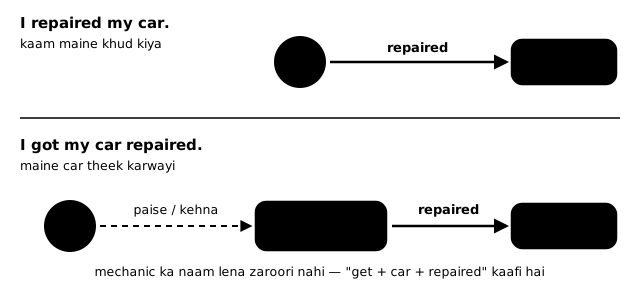
Causative ka formula
have / get + object + V3 = karwana. get bolchaal me zyada, have thoda formal. Kram pakka: pehle cheez, phir V3 — got my car repaired.
- I got my car repaired last week. Pichhle hafte maine car theek karwayi.
- She had her hair cut short. Usne baal chhote katwa liye.
- We're having the house painted before Diwali. Diwali se pehle hum ghar paint karwa rahe hain.
- Where do you get your kurtas stitched? Tum apne kurte kahan silwaate ho?
- You need to get your eyes tested. Tumhe aankhein check karwani chahiye.
- Don't worry, I'll get it done by Friday. Fikar mat karo, Friday tak ho jaayega (main karwa dunga / kar dunga).
✗
I cut my hair yesterday. (barber ne kaate)
✓
I got my hair cut yesterday.
✗
I got repaired my phone.
✓
I got my phone repaired.
object
Jab kuch bura "ho jaaye"
Yahi dhaancha tab bhi chalta hai jab aapke saath kuch bura hua ho — yahan "karwaya" ka matlab nahi, bas "mere saath hua":
- I had my phone stolen on the local train. Local train me mera phone chori ho gaya.
25.3 have someone do, get someone to do, make, let, help
Kabhi aap insaan ka naam lena chahte ho — "maine Ravi se file bhijwayi", "usne mujhe rukwaya". Yahan har verb ka apna pattern hai: kisi ke baad seedha V1, kisi ke baad to + V1. Yahi galti ka sabse bada adda hai.
| Verb | Pattern | Matlab / Example |
|---|---|---|
| have | have + person + V1 | kaam saunpna: I'll have Ravi send it. |
| get | get + person + to V1 | manana: I got him to sign. |
| make | make + person + V1 | majboor karna: She made me wait. |
| let | let + person + V1 | ijaazat dena: Let me go. |
| help | help + person + (to) V1 | madad: Help me (to) carry this. |
- I'll have my assistant email you the details. Main apne assistant se aapko details email karwa dunga.
- I finally got the landlord to fix the geyser. Aakhirkaar maine makaan-maalik ko geyser theek karne ke liye mana liya.
- The teacher made us rewrite the essay. Teacher ne hamse essay dobara likhwaya.
- My parents didn't let me go on the trip. Mummy-papa ne mujhe trip par jaane nahi diya.
- Can you help me move this almirah? Ye almari khiskane me meri madad karoge?
✗
He made me to wait for an hour.
✓
He made me wait for an hour.
I was made to wait.
✗
Please let me to explain.
✓
Please let me explain. / Please allow me to explain.
to
Teen chhote shabd, teen alag zor
make = zabardasti · let = chhoot · get … to = samjha-bujha kar. "My boss made me stay" (majboori) vs "My boss let me leave early" (meharbaani) vs "I got my boss to approve it" (meri koshish).
25.4 Inversion — "Never have I…" wala zor
Jab vaakya kisi negative ya seemit shabd se shuru ho (never, rarely, not only, hardly, only then…), to uske baad subject aur helping verb jagah badal lete hain — bilkul sawaal ki tarah. Ye formal, likhit ya speech wali English hai; isse baat me drama aur vazan aata hai.
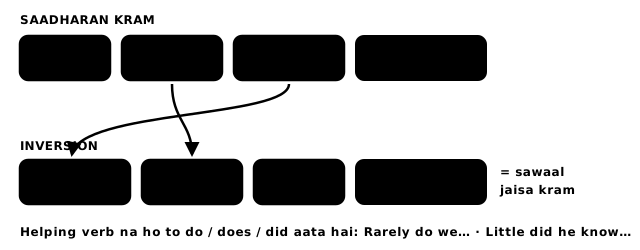
Inversion ka niyam
Negative/limiting shabd + helping verb + subject + baaki. Helping verb nahi hai to do / does / did lagao: Rarely do we eat out.
| Shuruaat | Example | Suno |
|---|---|---|
| Never / Rarely / Seldom | Rarely do we get such rain in April. | |
| Not only … but also | Not only did she top the class, but she also won the debate. | |
| Hardly / Scarcely … when | Hardly had I sat down when the phone rang. | |
| No sooner … than | No sooner had we reached than it started pouring. | |
| Only then / Only after | Only then did I realise my mistake. | |
| Under no circumstances | Under no circumstances should you share your OTP. | |
| Little | Little did he know what was coming. |
- Not only did she top the class, but she also won the debate. Usne na sirf class me top kiya, balki debate bhi jeeti.
- Hardly had I sat down when the phone rang. Main baitha hi tha ki phone baj utha.
- Only after the results came out did he start studying. Result aane ke baad hi usne padhna shuru kiya.
✗
Never I have seen such a crowd.
✓
Never have I seen such a crowd.
I have never seen such a crowd.
✗
No sooner had we reached when it started raining.
✓
No sooner had we reached than it started raining.
No sooner … than
Hardly / Scarcely … when
✗
Not only she sings, but she also dances.
✓
Not only does she sing, but she also dances.
Roz ki baat me kam
Dosto ke saath "Never have I eaten such good pani puri!" thoda natakiya lagega (mazaak me chalega). Inversion ki asli jagah: essay, speech, formal email, IELTS writing. Bolchaal me "I've never eaten such good pani puri!" hi kaafi hai.
25.5 if ke bina if — Should you…, Had I…, Were I…
Formal English me if hata kar helping verb ko aage la dete hain. Matlab bilkul wahi rehta hai jo conditional ka — bas zyada sophisticated (conditionals ki poori kahani If wale vaakya chapter me hai).
| if wala roop | Inversion |
|---|---|
| If you need any help, … | Should you need any help, … |
| If I had known, … | Had I known, … |
| If I were you, … | Were I in your place, … |
| If it had not rained, … | Had it not rained, … |
- Should you need any help, please call me. Agar kabhi madad chahiye ho to mujhe call kijiye. (email ki pasandida line)
- Had I known about the strike, I would have taken the metro. Agar mujhe hadtaal ka pata hota, to main metro le leta.
- Were I in your place, I would accept the offer. Aapki jagah main hota to offer maan leta.
- Had it not rained, we would have won. Agar baarish na hoti to hum jeet jaate.
✗
Hadn't I known, I would have gone.
✓
Had I not known, I would have gone.
25.6 Cleft sentences — ek hisse par spotlight
"Cleft" ka matlab hai "do tukde". Ek vaakya ko tod kar do hisson me likhte hain taaki ek khaas cheez par roshni pade — khaas kar jab aap kisi galatfehmi ko sudhaar rahe ho. Hindi me ye kaam "hi" karta hai: Ravi ne hi todi thi.
(a) It is / was … who / that …
- It was Ravi who broke the glass, not Amit. Gilaas Ravi ne hi toda tha, Amit ne nahi.
- It's the price that worries me, not the quality. Mujhe quality nahi, daam pareshaan kar raha hai.
- It was in Jaipur that they first met. Wo dono pehli baar Jaipur me hi mile the.
(b) What … is / All … is / The reason … is
- What I need is a good night's sleep. Mujhe to bas achhi neend chahiye.
- What she did was call the police immediately. Usne jo kiya wo ye tha — turant police ko phone.
- All I want is some peace and quiet. Mujhe bas thoda sukoon chahiye — aur kuch nahi.
- The reason I called is to ask about Saturday. Maine isliye call kiya ki Saturday ke baare me poochh sakoon.
Cleft = 'hi' wala zor
It was X who/that… = X hi. What I need is X = mujhe to X chahiye. All I want is X = bas X, aur kuch nahi.
✗
All what I want is a holiday.
✓
All I want is a holiday. / What I want is a holiday.
✗
It was my sister which found the keys.
✓
It was my sister who (ya that) found the keys.
Chhote se bade vaakya
25.7 Emphatic do aur fronting — "sach me!"
Positive vaakya me do / does / did + V1 daal kar (aur us par zor de kar) aap kehte ho "sach me", "waqai", "maine kiya tha!". Ye tab kaam aata hai jab koi aapki baat par shak kare, ya aap kisi baat ko garmjoshi se kehna chahte ho.
- I do like your new haircut — honestly! Tumhara naya haircut mujhe sach me pasand hai!
- I did call you — three times! Maine call kiya tha — teen baar!
- She does know a lot about cars. Use cars ke baare me waqai bahut pata hai.
- Do sit down, Uncle — make yourself at home. Baithiye na, Uncle — apna hi ghar samjhiye.
✗
I did called you yesterday!
✓
I did call you yesterday!
Zor aawaz me bhi
Emphatic do likhne se zyada bolne ki cheez hai — "do / did" ko lamba aur zor se bolo: "I DID call you." Is taal ke liye Rhythm aur stress chapter dekho.
Fronting — jo zaroori hai, wo pehle
Kabhi object ya koi hissa vaakya ke shuru me le aate hain, taaki contrast dikhe. Kram (subject + verb) waisa hi rehta hai — ye inversion nahi hai.
- Tea I can live without. Coffee, never. Chai ke bina reh lunga. Coffee ke bina — kabhi nahi.
- Strange as it may seem, I enjoy Monday mornings. Ajeeb lagega, par mujhe Monday ki subah achhi lagti hai.
25.8 Chhote jawaab — so do I, neither do I, I hope not
Native speaker poora vaakya dohraate nahi. Wo sirf helping verb se jawaab dete hain — isse ellipsis (chhod dena) kehte hain. Hindi me "main bhi", "main bhi nahi" — English me helping verb pichhle vaakya se match karna padta hai.
| Doosre ne kaha | Main bhi | Main bhi nahi |
|---|---|---|
| I love biryani. | So do I. | — |
| I can't swim. | — | Neither can I. |
| I'm tired. | So am I. | — |
| I didn't go. | — | Neither / Nor did I. |
| I've been there. | So have I. | — |
- "I love biryani." — "So do I!" "Mujhe biryani pasand hai." — "Mujhe bhi!"
- "I didn't sleep well." — "Neither did I." "Mujhe theek se neend nahi aayi." — "Mujhe bhi nahi."
- Informal: "Me too." / "Me neither." Dosto me chhota roop bilkul theek hai.
✗
"I don't eat meat." — "Me also not." / "I also don't."
✓
"Neither do I." / "Me neither."
so / not — poore vaakya ki jagah
think, hope, guess, be afraid ke baad so (haan wala) aur not (na wala) poore clause ki jagah le lete hain.
| Sawaal | Jawaab | Matlab |
|---|---|---|
| Will it rain? | I think so. | mujhe lagta hai haan |
| Is the shop open? | I don't think so. | shayad nahi |
| Will we miss the flight? | I hope not. | ummeed hai nahi |
| Is it serious, doctor? | I'm afraid so. | afsos, haan |
| Can you come? | I'd love to. | zaroor aana chahunga |
- "Will the match be cancelled?" — "I hope not." "Match cancel hoga kya?" — "Ummeed hai nahi hoga."
- "Are you coming to the wedding?" — "I'd love to, but I can't." "Shaadi me aa rahe ho?" — "Aana to chahta hoon, par nahi aa paunga."
✗
"Is he coming?" — "I think yes." / "I don't think."
✓
"I think so." / "I don't think so."
so
25.9 Asli zindagi me — ek interview jawaab
Interviewer ne poochha: "Tell me about a challenge you faced." Dekho kaise ek hi jawaab me kai auzaar milkar baat ko yaadgaar bana dete hain.
| Vaakya | Auzaar | Suno |
|---|---|---|
| Last year our biggest client threatened to leave. | — | |
| What they wanted was a working app in two weeks. | Cleft | |
| I got the whole team to work in two shifts. | get + person + to | |
| Not only did we deliver on time, but we also cut costs. | Inversion | |
| It was that project that taught me to plan backwards. | Cleft |
Kitna use karein?
Ek jawaab me ek-do auzaar kaafi hain. Har vaakya ulta ya cleft hoga to baat banawati lagegi. Masala ki tarah — thoda sa, sahi jagah.
25.10 Practice — Asar daar vaakya
Exercise 1
My scooter broke down, so I ___ at the garage near my office.
- got it repaired
- got repaired it
- repaired it
- made it repair
Hint: Mechanic ne theek kiya.
Jawaab
got it repaired
Causative: get + object + V3. Cheez (it) beech me, phir V3.
Exercise 2
You should get your blood pressure ___ (check) regularly.
Hint: get + object + V3
Jawaab
checked
get + your blood pressure + checked = check karwana.
Exercise 3
The teacher made us ___ the whole chapter again.
- read
- to read
- reading
- reads
Jawaab
read
make + person + V1, bina 'to'. (Passive me: We were made to read…)
Exercise 4
Tap the extra word.
My father did not let me to go on the school trip.
Jawaab
Galat shabd: to.
Sahi roop: My father did not let me go on the school trip.
let + person + V1. 'to' sirf allow ke saath: allow me to go.
Exercise 5
Never ___ such a beautiful sunset.
- have I seen
- I have seen
- I saw
- seen I have
Jawaab
have I seen
Negative shabd aage = helping verb + subject (sawaal jaisa kram).
Exercise 6
No sooner had we reached the platform ___ the train left.
Hint: 'sooner' ek comparative hai.
Jawaab
than
Pakki jodi: No sooner … than.
Exercise 7
Hardly had I opened the laptop ___ the power went off.
- when
- than
- then
- that
Jawaab
when
Pakki jodi: Hardly / Scarcely … when.
Exercise 8
Put the words in order.
Shabd: not / she / also / only / the / record / she / did / broke / but / win
Jawaab
not only did she win but she also broke the record
Not only + did + subject + V1, but + subject + also …
Exercise 9
___ I known about the metro strike, I would have left earlier.
Hint: if ke bina third conditional
Jawaab
Had
Had I known = If I had known (formal inversion).
Exercise 10
___ I need right now is a cup of strong chai.
- What
- That
- Which
- All what
Jawaab
What
Cleft: What I need is … = mujhe to … chahiye.
Exercise 11
Tap the wrong word.
It was my sister which found the lost keys.
Jawaab
Galat shabd: which.
Sahi roop: It was my sister who found the lost keys.
Insaan ke liye who / that, 'which' nahi.
Exercise 12
Match the reply to its meaning.
| A | B |
|---|---|
| So do I. | ummeed hai aisa na ho |
| Neither do I. | afsos, haan |
| I hope not. | main bhi (haan wali baat par) |
| I'm afraid so. | main bhi nahi |
Jawaab
So do I. — main bhi (haan wali baat par); Neither do I. — main bhi nahi; I hope not. — ummeed hai aisa na ho; I'm afraid so. — afsos, haan
Chhote jawaab me helping verb ya so/not poore vaakya ki jagah le leta hai.
Exercise 13
A: I can't drive. B: Neither ___ I.
Hint: Pehle vaakya ka helping verb.
Jawaab
can
can't → Neither can I. Helping verb match karna padta hai.
Exercise 14
"Will the flight be on time?" — "I think ___."
- so
- yes
- it
- that
Jawaab
so
think / hope / guess ke baad haan = so. 'I think yes' galat hai.
Exercise 15
Who fixed the AC?
Ise zor se padho, ya kisi se padhwao:
I didn't fix the AC myself. I had a technician come over on Sunday, and he got it working in ten minutes.
- a technician
- the speaker
- the speaker's father
- nobody
Jawaab
a technician
Transcript: “I didn't fix the AC myself. I had a technician come over on Sunday, and he got it working in ten minutes.”
'I had a technician come over' = have + person + V1. Kaam technician ne kiya.
Exercise 16
According to the speaker, what saved the project?
Ise zor se padho, ya kisi se padhwao:
Not only did Ananya finish the report early, but she also found two mistakes in the budget. It was her careful checking that saved the project.
- Ananya's careful checking
- the early deadline
- a bigger budget
- the manager's help
Jawaab
Ananya's careful checking
Transcript: “Not only did Ananya finish the report early, but she also found two mistakes in the budget. It was her careful checking that saved the project.”
Cleft 'It was her careful checking that…' isi par spotlight daalta hai.
Exercise 17
Write what you hear.
Dictation. Kisi se ye vaakya zor se padhwao, phir likh lo.
Had I known you were coming, I would have cooked something special.
Jawaab
Had I known you were coming, I would have cooked something special.
Had I known = If I had known.
Exercise 18
Write what you hear.
Dictation. Kisi se ye vaakya zor se padhwao, phir likh lo.
What I need is a long holiday.
Jawaab
What I need is a long holiday.
Cleft: What I need is …
Exercise 19
Say it with stress on 'do'.
I do like your new haircut
Jawaab
Bolo: I do like your new haircut
Emphatic do = 'sach me'. 'do' ko lamba aur zor se bolo.
Aage kya karein
Apne agle formal email me ek Should you need… aur agli baat-cheet me ek What I need is… zaroor daalo. Aur jab bhi salon ya darzi ke paas jao, man me bolo: I'm getting my hair cut. Bolne ki taraf badhna ho to Rhythm aur stress aur Native speed English dekho.