Chapter 20: Chhote se bade vaakya
Clauses — chhote vaakyon se bade vaakya
Agar aapki English me har vaakya chhota-chhota hai — "I have a friend. He lives in Delhi. He is a doctor." — to galat kuch nahi, par baat bachchon jaisi lagti hai. Clauses ko jodna seekh lo, to wahi baat ek saaf, pakke vaakya me aa jaati hai. Ye chapter wahi jodne ka hunar sikhata hai.
- 1Independent aur Dependent clause
- 2Chaar tarah ke vaakya
- 3Compound — barabar ke do clause jodna
- 4Complex — kaaran, samay, shart aur virodh
- 5Relative clauses — who, which, that, whose, where
- 6Defining vs Non-defining — comma ka khel
- 7Chhote vaakyon ko jodkar behtar vaakya
- 8Wo galtiyan jo hum sach me karte hain
Ek line me
A clause is a group of words with its own subject and verb. A sentence can have one clause or many. Sentence structure wala chapter yaad hai? Phrase me subject-verb jodi nahi hoti; clause me hoti hai.
- I have a friend who lives in Delhi. Do clause: "I have a friend" + "who lives in Delhi".
- She was tired, so she went to bed early. Do clause, "so" se jude hue.
20.1 Independent aur Dependent clause
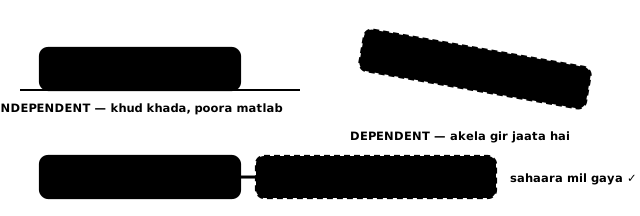
Har clause ek jaisa nahi hota. Kuch akele khade ho sakte hain, kuch nahi. Ye farq samajhna zaroori hai, kyunki adhoore clause ko poora vaakya maan lena likhne me sabse badi galti hai.
Independent vs dependent
Independent clause akela poora vaakya hai (I stayed at home.). Dependent clause because, when, if, although, who, which jaise shabd se shuru hota hai aur akela adhoora rehta hai — use independent clause se jodo.
| Dependent clause shuru karne wale | Kaam | Example |
|---|---|---|
| because, since, as | kaaran | because he was ill |
| when, while, after, before, until | samay | when the bell rang |
| if, unless | shart | if you call me |
| although, though, even though | virodh | although it was late |
| who, which, that, whose, where | noun ke baare me | who lives next door |
20.2 Chaar tarah ke vaakya
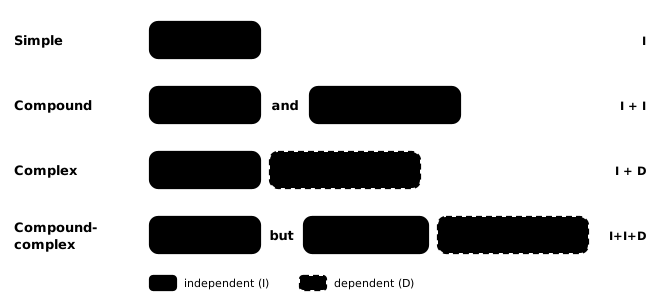
Clauses kitne hain aur kaise jude hain — isse vaakya ke chaar prakaar bante hain. Achhi English me chaaron ka mel hota hai; sirf ek tarah ke vaakya likhne se lekh neeras ho jaata hai.
Chaar prakaar
Simple = ek independent clause. Compound = do independent (and, but, so se). Complex = independent + dependent (because, when, who se). Compound-complex = do independent + kam se kam ek dependent.
20.3 Compound — barabar ke do clause jodna
Jab do baatein barabar zaroori hon, to unhe compound sentence me jodo. Iske liye saat chhote shabd hain jinhe yaad karne ki trick hai — FANBOYS.
| Shabd | Kaam | Example |
|---|---|---|
| For | kaaran (formal) | He left early, for he was ill. |
| And | jodna | I cooked, and she cleaned. |
| Nor | na ye, na wo | He didn't call, nor did he write. |
| But | virodh | It was cheap, but it was good. |
| Or | vikalp | Hurry up, or we'll miss the train. |
| Yet | phir bhi | She was tired, yet she kept working. |
| So | natija | It was raining, so we stayed in. |
Compound ka niyam
Do independent clause jodne ke liye comma + FANBOYS (for, and, nor, but, or, yet, so) lagao. Sirf comma se do poore vaakya nahi judte: I was tired, I slept. ✗ → I was tired, so I slept. ✓
Comma kab chhod sakte ho
Dono clause bahut chhote hon to comma zaroori nahi: I cooked and she cleaned.
Aur agar doosre hisse me subject hi na ho, to wo clause nahi — comma mat lagao: She opened the door and smiled.
20.4 Complex — kaaran, samay, shart aur virodh
Jab ek baat mukhya ho aur doosri usse kaaran, samay, shart ya virodh batati ho, to complex sentence banta hai. Ye wahi vaakya hain jo aapki English ko sochi-samjhi aur paripakv banate hain.
- I took an umbrella because it looked cloudy. Mukhya baat: chhaata liya. Kaaran: baadal the.
- When the guests arrived, we served lunch. Dependent clause pehle aaya, isliye beech me comma.
- Although the test was hard, she passed. Test mushkil tha, phir bhi wo paas ho gayi. — "but" ki zaroorat nahi.
Complex ka niyam
Dependent clause pehle aaye to beech me comma lagao (When it rained, we stayed in.); baad me aaye to comma nahi. Ek jod ke liye ek hi shabd: although ya but — dono nahi.
Hindi ka 'halaanki… lekin' English me nahi chalta
- Galat: Although he is rich, but he is not happy.
- Sahi: Although he is rich, he is not happy. / He is rich, but he is not happy.
- Kyun: Hindi me "halaanki… lekin" dono lagte hain, English me ek hi. Isi tarah "because… so" bhi saath nahi aate.
20.5 Relative clauses — who, which, that, whose, where
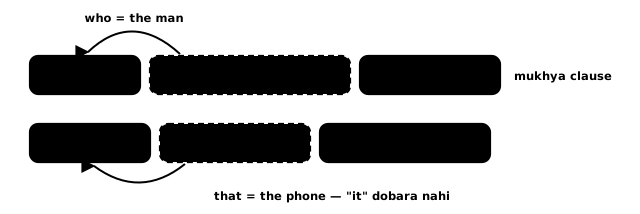
Relative clause kisi noun ke baare me aur jaankari deta hai, bilkul adjective ki tarah — bas ek shabd ki jagah poora clause. Isse do chhote vaakya ek ho jaate hain: I met a man. He speaks six languages. → I met a man who speaks six languages.
Relative clause ka niyam
who — log, which — cheezein, that — dono, whose — kiska, where — jagah. Relative shabd noun ki jagah leta hai, isliye wahi noun ya pronoun dobara mat lagao.
| Shabd | Kiske liye | Example |
|---|---|---|
| who | insaan | the girl who won the prize |
| which | cheez, jaanwar | the bus which goes to Agra |
| that | insaan ya cheez (bina comma) | the book that I lost |
| whose | maalikana — "jiska" | the boy whose bike was stolen |
| where | jagah | the village where I was born |
| when | samay | the day when we met |
Object wala relative chhod bhi sakte ho
Jab who/that clause ka object ho, to use hata sakte ho: the book (that) I lost, the man (who) I met. Bolchaal me ye bahut aam hai. Par subject ho to nahi: the man who called — "who" zaroori hai.
20.6 Defining vs Non-defining — comma ka khel
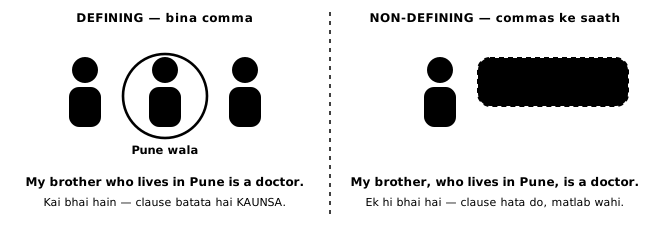
Do commas vaakya ka matlab badal sakte hain. Sawaal ye hai: kya clause batata hai ki kaunsa noun, ya sirf ek extra jaankari jodta hai jo hata bhi do to farq nahi padta?
Defining vs non-defining
Defining clause batata hai kaunsa noun — bina comma, who/which/that teeno chalte hain. Non-defining sirf extra jaankari deta hai — commas ke saath, aur isme "that" nahi lagta.
- The Taj Mahal, which is in Agra, attracts millions of visitors. Taj Mahal ek hi hai — "which is in Agra" extra jaankari hai, isliye commas.
- Students who finish early can leave. Sirf wo students jo jaldi khatam karein — clause zaroori hai, comma nahi.
20.7 Chhote vaakyon ko jodkar behtar vaakya
Ab sab saath laate hain. Likhte waqt pehle chhote vaakya likh lo, phir dekho kaunse jod sakte ho. Ye teen sawaal poochho: kya ye barabar hain (FANBOYS)? kya ek kaaran/samay hai (because, when)? kya ek noun ke baare me hai (who, which)?
| Pehle (chhote vaakya) | Baad me (jode hue) |
|---|---|
| I have a cousin. She lives in Canada. She is a nurse. | I have a cousin who lives in Canada and works as a nurse. |
| The train was late. We missed the meeting. | The train was late, so we missed the meeting. |
| It was raining. The match continued. | Although it was raining, the match continued. |
| This is the school. My father studied here. | This is the school where my father studied. |
| I met a writer. Her books are famous. | I met a writer whose books are famous. |
Sab kuch ek vaakya me mat thoso
Jodne ka matlab ye nahi ki poora paragraph ek vaakya ban jaaye. Ek vaakya me do-teen clause kaafi hain. Lamba ho jaaye to wapas tod do — saaf baat hamesha lambi baat se behtar hai.
20.8 Wo galtiyan jo hum sach me karte hain
Clauses ki sabse aam Indian-English galtiyan
- Galat: Although I studied hard, but I failed.
- Sahi: Although I studied hard, I failed.
-
Kyun: "halaanki… lekin" ka seedha anuvaad. English me ek jod ke liye ek hi shabd — although ya but.
-
Galat: This is the man who I told you about him.
- Sahi: This is the man (who) I told you about.
-
Kyun: "who" pehle hi "the man" ki jagah le chuka hai. "him" lagane se wahi aadmi do baar aa gaya. Isi tarah: the book which I bought it.
-
Galat: I was very tired, I went to bed early.
- Sahi: I was very tired, so I went to bed early.
-
Kyun: Do independent clause sirf comma se nahi judte. Beech me FANBOYS lagao, ya full stop.
-
Galat: My father, that is a teacher, loves reading.
- Sahi: My father, who is a teacher, loves reading.
-
Kyun: Commas wale (non-defining) clause me "that" nahi lagta. Insaan ke liye "who", cheez ke liye "which".
-
Galat: Because the shop was closed.
- Sahi: We came back because the shop was closed.
- Kyun: "Because" wala clause dependent hai — akela vaakya nahi ban sakta. Jawab me bolna theek hai, par likhte waqt use mukhya clause se jodo.
20.9 Practice — Clauses
Exercise 1
'I called her, but she didn't answer.' — ye kaunsa vaakya hai?
- Compound
- Simple
- Complex
- Compound-complex
Hint: Kitne independent clause hain?
Jawaab
Compound
Do independent clause hain — 'I called her' aur 'she didn't answer' — jo 'but' (FANBOYS) se jude hain. Dependent clause koi nahi, isliye compound.
Exercise 2
'When the power went off, we lit candles.' — ye kaunsa vaakya hai?
- Complex
- Compound
- Simple
- Compound-complex
Jawaab
Complex
'When the power went off' dependent clause hai, 'we lit candles' independent. Independent + dependent = complex.
Exercise 3
This is the girl ___ father is a pilot.
- whose
- who
- which
- where
Hint: 'jiske pita'
Jawaab
whose
Maalikana batana hai — 'jiske pita'. Iske liye 'whose'. 'who father' galat hai.
Exercise 4
Kaunsa vaakya sahi hai?
- Although it was late, we kept talking.
- Although it was late, but we kept talking.
- Although it was late, so we kept talking.
- It was late, although but we kept talking.
Jawaab
Although it was late, we kept talking.
Ek jod ke liye ek hi shabd. 'Although' lag gaya to 'but' ki zaroorat nahi — Hindi ka 'halaanki… lekin' English me nahi chalta.
Exercise 5
Mumbai, ___ is India's financial capital, is very crowded.
- which
- that
- who
- where
Hint: Commas ke beech — non-defining.
Jawaab
which
Commas wale clause me 'that' nahi lagta, aur Mumbai cheez/jagah hai (yahan subject), insaan nahi — isliye 'which'. 'where' tab aata jab clause me apna subject hota: where my uncle lives.
Exercise 6
This is the village ___ my grandmother was born.
Hint: Jagah ki baat.
Jawaab
where / in which
Jagah ke liye 'where' — the village where she was born. 'in which' bhi sahi hai, par thoda formal.
Exercise 7
Ek extra shabd hai — us par tap karo.
This is the laptop which I bought it last week.
Jawaab
Galat shabd: it.
Sahi roop: This is the laptop which I bought last week.
'which' pehle hi 'the laptop' ki jagah le chuka hai. 'it' lagaane se wahi cheez do baar aa jaati hai.
Exercise 8
Galat shabd dhoondo.
Although the hotel was expensive, but the food was terrible.
Jawaab
Galat shabd: but.
Sahi roop: Although the hotel was expensive, the food was terrible.
'Although' aur 'but' ek saath nahi aate. Ek hata do — yahan 'but'.
Exercise 9
Relative shabd ko uske kaam se jodo.
| A | B |
|---|---|
| who | jiska / maalikana |
| which | jagah |
| whose | insaan |
| where | cheez |
Jawaab
who — insaan; which — cheez; whose — jiska / maalikana; where — jagah
who log ke liye, which cheezon ke liye, whose maalikana ke liye, where jagah ke liye. 'that' defining clause me log aur cheez dono ke liye chalta hai.
Exercise 10
Do vaakya ek banao: 'I have a friend. He speaks Japanese.'
Shabd: friend / Japanese / I / who / speaks / a / have
Jawaab
I have a friend who speaks Japanese
'who' ne 'He' ki jagah le li aur clause seedha 'a friend' ke baad baith gaya. Do chhote vaakya ek saaf vaakya ban gaye.
Exercise 11
Complex sentence banao.
Shabd: inside / stayed / We / raining / because / was / heavily / it
Jawaab
We stayed inside because it was raining heavily
Mukhya baat pehle (we stayed inside), kaaran baad me (because…). Dependent clause baad me aaya, isliye comma ki zaroorat nahi.
Exercise 12
Ye vaakya bolo — commas par halka sa ruko.
My brother, who lives in Pune, is a doctor
Jawaab
Bolo: My brother, who lives in Pune, is a doctor
Bolte waqt commas ka matlab hai chhota sa thehraav. Is thehraav se sunne wala samajh jaata hai ki 'who lives in Pune' sirf extra jaankari hai.
Aage kya karein
Apna pichla koi email ya message kholo. Jahan teen chhote vaakya lagaatar hon, unme se do ko who, because ya so se jodo. Har roz ek paragraph — ek mahine me aapki likhai badal jaayegi.