Chapter 13: Conjunction — jodne wale shabd
Conjunction wo shabd hai jo do shabd, do phrase ya do poore vaakya ko jod deta hai. Inke bina English chhoti-chhoti tooti line bankar reh jaati hai — "I was tired. I went to work." Conjunction lagao, aur wahi baat badi lagti hai — "I was tired, but I went to work." Teen parivaar hain, aur teeno is chapter me.
- 1Teen parivaar — ek naksha
- 2Coordinating conjunctions — FANBOYS
- 3Subordinating conjunctions — tikaane wale
- 4Correlative conjunctions — jodi me aane wale
- 5Conjunctive adverbs — jo conjunction lagte hain par hain nahi
- 6Wo galtiyan jo hum sach me karte hain
- 7Chhota naksha
Ek line me
A conjunction joins words, phrases, or clauses together. Jo do hisson ko jode — wo conjunction. Hindi me "aur, par, kyunki, agar, jab" yahi kaam karte hain.
- Tea and biscuits. Do shabd jude.
- I called her, but she did not pick up. Do poore vaakya jude — barabari me.
- Because it was raining, we stayed home. Ek hissa doosre par tik gaya — ye alag parivaar hai.
13.1 Teen parivaar — ek naksha
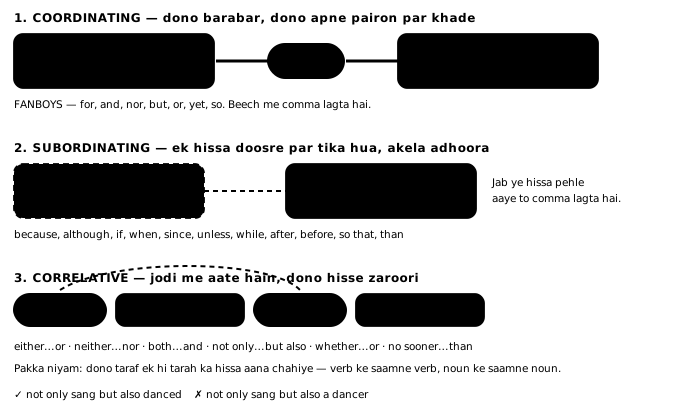
13.2 Coordinating conjunctions — FANBOYS
Ye saat shabd do barabar hisson ko jodte hain. Dono hisse apne aap me poore hote hain. Yaad rakhne ka tareeka: FANBOYS — pehle akshar se bana shabd.
| Shabd | Matlab | Example |
|---|---|---|
| F — for | kyunki (formal) | He stayed in, for it was raining. |
| A — and | aur (jodna) | She cooked and he cleaned. |
| N — nor | na hi | He did not call, nor did he write. |
| B — but | par (ulta) | It is small but comfortable. |
| O — or | ya (vikalp) | Tea or coffee? |
| Y — yet | phir bhi | She was tired, yet she kept working. |
| S — so | isliye (nateeja) | It was late, so we left. |
Comma kab lagega
Do poore vaakye jod rahe ho to conjunction se pehle comma — I called her, but she was busy.
Sirf do shabd ya chhote hisse jod rahe ho to comma nahi — I called her but got no reply. Test: conjunction ke baad naya subject aa raha hai? Haan to comma.
'nor' ke baad shabdon ka kram palat jaata hai
✓ He did not call, nor did he write.
✗ He did not call, nor he wrote. "nor" ke baad sawaal jaisa kram aata hai — helping verb pehle, subject baad me.
13.3 Subordinating conjunctions — tikaane wale
Ye wo shabd hain jo ek hisse ko doosre par nirbhar bana dete hain. Jis hisse ke aage ye lagta hai, wo akela khada nahi reh sakta — use poora karne ke liye doosra hissa chahiye.
- Although he was ill, he came to class. "Although he was ill" akela bolo to baat adhoori lagti hai — kuch aur sunne ka mann karta hai. Yahi nirbharta hai.
| Kya bata raha hai | Shabd | Example |
|---|---|---|
| Kaaran (kyunki) | because, since, as | I left early because I was tired. |
| Virodh (phir bhi) | although, though, even though, whereas, while | Though she is young, she is wise. |
| Shart (agar) | if, unless, provided that, in case | Unless you study, you will fail. |
| Samay (kab) | when, while, before, after, until, as soon as, since | Call me when you reach. |
| Maqsad (taaki) | so that, in order that, lest | He ran fast so that he could catch the bus. |
| Tulna | than, as…as | He is taller than his brother. |
| Jagah | where, wherever | Sit where you like. |
Jagah badli ja sakti hai — bas comma dhyan rakho
Because she was late, we started without her. (pehle aaya → comma lagta hai)
We started without her because she was late. (baad me aaya → comma nahi)
13.4 Correlative conjunctions — jodi me aane wale
Ye jodi me aate hain — ek hissa aage, doosra beech me. Inka ek pakka rule hai: dono taraf ek hi tarah ka hissa aana chahiye. Isse "parallel structure" kehte hain.
| Jodi | Matlab | Example |
|---|---|---|
| either … or | ya ye, ya wo | Either you come or I go. |
| neither … nor | na ye, na wo | Neither Ram nor Shyam came. |
| both … and | dono | She is both clever and kind. |
| not only … but also | sirf nahi, balki | He not only sang but also danced. |
| whether … or | chahe ye, chahe wo | I don't know whether he will come or not. |
| no sooner … than | jaise hi | No sooner did he arrive than it started raining. |
| as … as | jitna … utna | She is as tall as her mother. |
Verb kiske saath milega — paas wale ke saath
either…or aur neither…nor me verb us subject se milta hai jo verb ke sabse paas ho:
✓ Neither the boys nor the teacher was present. (teacher paas hai → was)
✓ Neither the teacher nor the boys were present. (boys paas hain → were)
Parallel structure tootne ki galti
- Galat: She not only plays the piano but also a good singer.
- Sahi: She not only plays the piano but also sings beautifully.
-
Kyun: "not only" ke baad verb aaya tha, to "but also" ke baad bhi verb aana chahiye. Ek taraf verb aur doosri taraf noun — ye vaakya ko langda kar deta hai.
-
Galat: He is interested in reading and to write.
- Sahi: He is interested in reading and writing.
- Kyun: "and" ke dono taraf ek hi roop — dono gerund, ya dono infinitive. Mila-jula nahi.
13.5 Conjunctive adverbs — jo conjunction lagte hain par hain nahi
however, therefore, moreover, nevertheless, otherwise, hence, besides, meanwhile — ye adverb hain, conjunction nahi. Isliye ye do vaakyon ko comma se nahi jod sakte. Inke saath semicolon ya full stop chahiye.
Comma splice — 'however' ke saath sabse aam galti
- Galat: I was tired, however I finished the work.
- Sahi: I was tired; however, I finished the work.
- Kyun: "however" conjunction nahi hai, isliye wo akela do vaakye nahi jod sakta. Do raaste hain: semicolon lagao, ya seedha "but" use karo. Doosra raasta aasaan bhi hai aur saaf bhi.
13.6 Wo galtiyan jo hum sach me karte hain
Conjunction ki aam Indian-English galtiyan
- Galat: Although he was ill, but he came to work.
- Sahi: Although he was ill, he came to work.
-
Kyun: Ek matlab ke liye ek hi conjunction. Hindi me "halaanki… lekin" dono aate hain, isliye English me bhi dono lag jaate hain. English me ek chuno: ya "although", ya "but". Isi tarah ✗ "Because he was late, so we left" bhi galat hai.
-
Galat: As she was busy, so she didn't attend.
- Sahi: As she was busy, she didn't attend.
-
Kyun: Wahi dohraav — "as" pehle se kaaran bata chuka hai, "so" ki zaroorat nahi. Hindi ke "kyunki… isliye" ka seedha asar.
-
Galat: Unless you don't study, you will fail.
- Sahi: Unless you study, you will fail.
-
Kyun: "Unless" ka matlab hi hai "agar nahi" — usme negative already hai. Doosra "don't" lagane se matlab ulta ho jaata hai.
-
Galat: Neither he or his brother came.
- Sahi: Neither he nor his brother came.
-
Kyun: Jodi tootti nahi — "neither" ke saath "nor", aur "either" ke saath "or". Partner badalna galat hai.
-
Galat: I don't know that she will come or not.
- Sahi: I don't know whether she will come or not.
-
Kyun: "or not" ke saath "whether" aata hai, "that" nahi. "if" bhi chalta hai par "whether…or not" zyada saaf hai.
-
Galat: She is more taller than her sister, but still she plays well.
- Sahi: She is taller than her sister, but she plays well.
-
Kyun: Do galtiyan: "more taller" me double comparison, aur "but still" me dohraav — "but" ya "still", dono nahi.
-
Galat: She is my cousin brother and also my neighbour.
- Sahi: He is my cousin and also my neighbour.
-
Kyun: "Cousin" apne aap me poora shabd hai — brother jodne ki zaroorat nahi. Baaki vaakya theek tha; "and also" chalta hai, halaanki sirf "and" se bhi kaam ho jaata.
-
Galat: He don't have money and time.
- Sahi: He doesn't have money or time.
- Kyun: Do galtiyan: "he" ke saath doesn't, aur negative vaakya me "and" ki jagah "or" aata hai. Negative me "and" dono cheezon ko ek saath jod deta hai, jo matlab badal deta hai.
13.7 Chhota naksha
| Parivaar | Dono hisse | Shabd | Comma |
|---|---|---|---|
| Coordinating | barabar | for, and, nor, but, or, yet, so | do poore vaakye ho to haan |
| Subordinating | ek doosre par tika | because, although, if, when, unless, since | nirbhar hissa pehle aaye to haan |
| Correlative | jodi me, parallel | either…or, neither…nor, both…and, not only…but also | aksar nahi |
Teen pakke rule
1. Ek matlab ke liye ek hi conjunction — although ya but, dono nahi.
2. Correlative jodi ke dono taraf ek hi tarah ka hissa.
3. however, therefore, moreover conjunction nahi hain — unse pehle semicolon ya full stop.
13.8 Practice — Conjunctions
Exercise 1
Kaunsa vaakya sahi hai?
- Although he was tired, he kept working.
- Although he was tired, but he kept working.
- Although he was tired, so he kept working.
- Although he was tired but so he kept working.
Hint: Ek matlab ke liye kitne conjunction?
Jawaab
Although he was tired, he kept working.
'Although' pehle hi virodh bata chuka hai, isliye 'but' lagana dohraav hai. Hindi me 'halaanki… lekin' dono aate hain, isliye English me bhi dono lag jaate hain.
Exercise 2
Neither Ravi ___ his friends were invited.
- nor
- or
- and
- but
Hint: Jodi todni nahi hai.
Jawaab
nor
'Neither' ka partner hamesha 'nor' hota hai, jaise 'either' ka 'or'. Jodi badalne se vaakya galat ho jaata hai.
Exercise 3
___ you apologise, she will not talk to you.
- Unless
- If
- Although
- Because
Hint: Is shabd me negative pehle se chhupa hai.
Jawaab
Unless
'Unless' ka matlab hai 'agar nahi' — usme negative already hai. Isi liye 'unless you don't apologise' likhna matlab ulta kar deta hai.
Exercise 4
FANBOYS me kaunsa shabd nahi aata?
- because
- but
- yet
- nor
Hint: FANBOYS coordinating conjunctions hain.
Jawaab
because
'because' subordinating hai — wo ek hisse ko doosre par tikaata hai. FANBOYS (for, and, nor, but, or, yet, so) barabar hisson ko jodte hain.
Exercise 5
I was very tired, ___ I finished the report. (ulta batane wala shabd)
Hint: Do barabar vaakya hain, aur baat ulti ja rahi hai.
Jawaab
but
Do poore vaakye barabari me jud rahe hain aur matlab ulta ja raha hai, isliye 'but'. 'however' bhi matlab wahi deta par uske pehle semicolon chahiye hota.
Exercise 6
She studied hard ___ she could clear the exam. (taaki)
Hint: Maqsad batana hai.
Jawaab
so that
Maqsad batane ke liye 'so that' aata hai. Sirf 'so' lagane se wo nateeja ban jaata hai, maqsad nahi — do alag baatein hain.
Exercise 7
Is vaakya me ek shabd extra hai — us par tap karo.
Because it was raining so we cancelled the match.
Jawaab
Galat shabd: so.
Sahi roop: Because it was raining, we cancelled the match.
'Because' pehle hi kaaran bata chuka hai, isliye 'so' extra ho gaya. Hindi ke 'kyunki… isliye' ka seedha asar hai ye.
Exercise 8
Galat shabd dhoondo.
Unless you don't hurry you will miss the train.
Jawaab
Galat shabd: don't.
Sahi roop: Unless you hurry, you will miss the train.
'Unless' me negative pehle se hai, isliye 'don't' lagane se do negative ho gaye aur matlab ulat gaya.
Exercise 9
Ek shabd galat hai.
I was tired, however I completed the task.
Jawaab
Galat shabd: however.
Sahi roop: I was tired; however, I completed the task.
'however' conjunction nahi, adverb hai — wo akele comma se do vaakye nahi jod sakta. Semicolon lagao, ya seedha 'but' use karo.
Exercise 10
Conjunction ko uske kaam se jodo.
| A | B |
|---|---|
| because | shart batata hai |
| although | maqsad batata hai |
| unless | samay batata hai |
| so that | kaaran batata hai |
| as soon as | virodh batata hai |
Jawaab
because — kaaran batata hai; although — virodh batata hai; unless — shart batata hai; so that — maqsad batata hai; as soon as — samay batata hai
Subordinating conjunction ka chunaav uske matlab se hota hai — kaaran, virodh, shart, maqsad ya samay. Galat chunne se poora matlab badal jaata hai.
Exercise 11
Sahi kram me vaakya banao — correlative jodi ka istemaal hai.
Shabd: but / guitar / plays / only / sings / the / not / She / also
Jawaab
She not only sings but also plays the guitar
'not only' ke baad verb aaya hai, to 'but also' ke baad bhi verb aana chahiye — yahi parallel structure hai. Ek taraf verb aur doosri taraf noun vaakya ko langda kar deta hai.
Exercise 12
Ye line bol ke dekho — 'although' ke baad 'but' nahi bolna hai.
Although it was raining we went out
Jawaab
Bolo: Although it was raining we went out
Bolte waqt Hindi ki aadat se 'but' nikal jaata hai. Jaan-boojh kar bina 'but' bolne ki practice se ye aadat tootti hai.
Aage kya karein
Aaj apne paanch chhote vaakye lo aur unhe conjunction se jodo. Phir padh kar dekho — kitna behtar lagta hai. Aakhri chapter is hisse ka: Interjection.