Chapter 35: Presentation dena
Presentation dena — shuruaat, beech, ant
College ka seminar ho, office ki Monday meeting ho ya client ka pitch — sabke saamne khade hokar English bolna sabse bada darr hai. Par achhe presenter ki English sabse fancy nahi hoti; uska dhaancha sabse saaf hota hai. Sunne wale ko har pal pata hota hai ki hum kahan hain aur kahan ja rahe hain. Is chapter me wahi dhaancha hai — taiyaar lines, ek kahani ka saancha, sawaal-jawaab ka tareeka, aur ghabraahat sambhaalne ke nuskhe.
- 1Presentation ka dhaancha — open, signpost, body, close
- 2Shuruaat — pehle tees second
- 3Signposting — sunne walon ko raasta dikhana
- 4Kahani sunana — ek chhota arc
- 5Ant — jo yaad reh jaaye
- 6Sawaal-jawaab — jab pata ho, aur jab na pata ho
- 7Ghabraahat, aawaaz aur raftaar
- 8Wo galtiyan jo hum sach me karte hain
35.1 Presentation ka dhaancha — open, signpost, body, close
Sunne wala page palat kar peeche nahi ja sakta — jo ek baar nikal gaya, wo gaya. Isliye bolne wali English me dhaancha likhne se bhi zyada zaroori hai. Purana niyam aaj bhi sabse kaam ka hai: batao kya bataoge, batao, phir batao kya bataya.
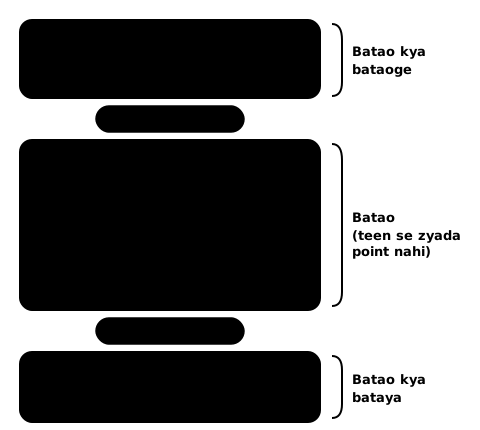
Dhaancha
Open → Signpost → Body → Close. Batao kya bataoge, batao, phir batao kya bataya. Body me teen point se zyada nahi, aur har point ke saath ek example. Teen point log yaad rakhte hain; saat point sab bhool jaate hain.
35.2 Shuruaat — pehle tees second
Pehle tees second me sunne wale tay kar lete hain ki phone dekhna hai ya aapko. "Mic check" aur "sorry" me wo waqt barbaad mat karo — seedha ek hook do, phir apna parichay.
- Good morning, everyone. Thanks for being here. Greeting + shukriya — saaf aur garam shuruaat.
- Let me start with a quick question. How many of you checked your phone in the last ten minutes? Hook: sawaal. Log haath uthate hain — aur jaag jaate hain.
- Here's a number that surprised me: we lose three customers every single day. Hook: chaunkaane wala number.
- I'm Neha, and I lead the design team at Brightline. Parichay — ek line, bas. Poora resume nahi.
- Today, I'm going to talk about how we can fix that. Aaj ka vishay — "talk about", "talk on the topic of" nahi.
- I'll take about fifteen minutes, and there'll be time for questions at the end. Kitna samay aur sawaal kab — sunne wale ko sukoon milta hai.
Hook pehle, parichay baad me
Shuruaat sawaal, number ya ek line ki kahani se karo. Kabhi "Sorry, I'm not a good speaker" ya "Am I audible?" se nahi. Maafi maangne se sunne wala aapko kamzor maan leta hai — aapke bolne se pehle hi.
35.3 Signposting — sunne walon ko raasta dikhana
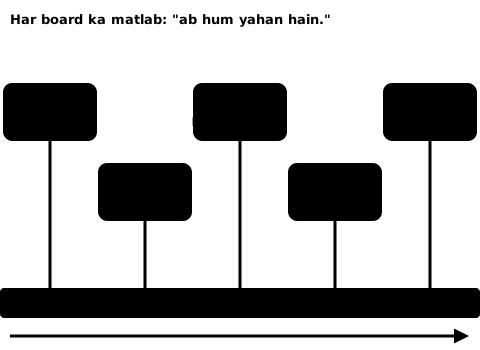
Sunne wale aapki slide nahi, aapki aawaaz follow kar rahe hain. Signpost wo chhote phrase hain jo sadak ke board ki tarah batate hain: ab hum yahan hain, ab yahan mud rahe hain.
| Kaam | Signpost | Suno |
|---|---|---|
| Naksha dena | I've divided this talk into three parts. | |
| Pehla point | Let's start with the problem. | |
| Aage badhna | That brings me to my second point. | |
| Misaal | Let me give you an example. | |
| Peeche jodna | As I mentioned earlier, cost is the big issue. | |
| Zor dena | The key point here is this. | |
| Sametna | So, to sum up, we need three things. |
Har mod par ek board
Har naye hisse se pehle ek signpost: "Moving on…", "That brings me to…", "Let me give you an example.", "To sum up…" Signpost ke baad ek pal ruko — sunne wala mud jaata hai, phir aap aage badho.
35.4 Kahani sunana — ek chhota arc
Number aur bullet points log shaam tak bhool jaate hain; kahani hafton yaad rehti hai. Har achhi chhoti kahani ek hi pahaad chadhti hai — shaant shuruaat, mushkil, koshish, mod, nateeja aur seekh.
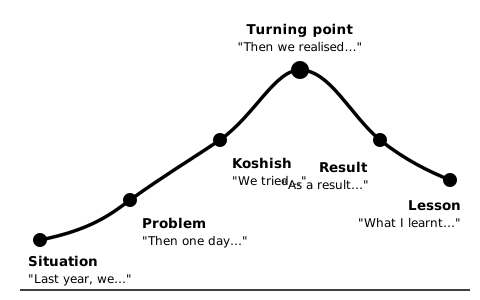
- Last year, our app had about ten thousand users. Situation — sab theek chal raha tha.
- Then, in March, half of them suddenly stopped using it. Problem — kahani me jaan yahin aati hai.
- We tried discounts, new features, even a new logo. Nothing worked. Koshish — "Nothing worked" ke baad ruko.
- Then we called twenty users, and we realised the login was too slow. Turning point — "we realised" = humein samajh aaya.
- We fixed the login in two weeks, and people started coming back. Result.
- What I learnt was simple: ask your users before you guess. Lesson — yahi line log ghar le jaate hain.
Kahani ka saancha
Situation → Problem → Koshish → Turning point → Result → Lesson. Ek minute se chhoti, past tense me, aur ant me hamesha ek seekh. Bina lesson ki kahani sirf qissa hai; lesson usse aapki baat ka saboot bana deta hai.
35.5 Ant — jo yaad reh jaaye
Hum aksar ant me sabse kamzor hote hain — thak jaate hain aur "that's all" bol kar bhaag lete hain. Par sunne wale ko aakhri line sabse zyada yaad rehti hai. Use pehle se likh kar rakho.
- So, to sum up, we covered three things: the problem, the plan, and the cost. Summary — teen point dobara, ek line me.
- If you remember just one thing from today, remember this: speed matters more than features. Ek takeaway — "remember this" ke baad ruko.
- So my request is simple: let's run a two-week trial. Agar kuch chahiye — saaf maango.
- Thank you. I'm happy to take any questions. "That's all from my side" ki jagah — ye line.
Ant ka formula
Summary + ek takeaway + shukriya. "That's all from my side" ki jagah: "Thank you. I'm happy to take questions." Aakhri line pehle se likh lo aur zubaani yaad rakho — ghabraahat me bhi nikal aayegi.
35.6 Sawaal-jawaab — jab pata ho, aur jab na pata ho
Q&A me log sabse zyada darte hain, kyonki wahan script nahi hoti. Par jawaab ka bhi ek saancha hai — aur sabse badi baat: jo pata nahi, use banana nahi hai.
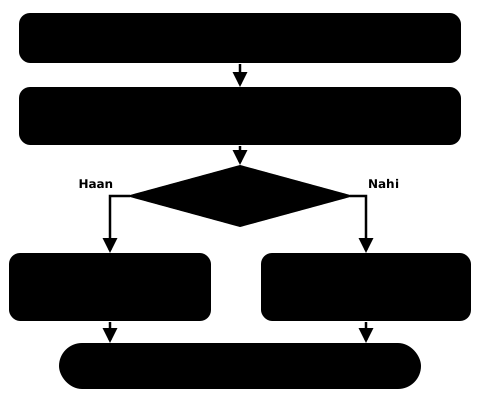
- That's a really good question. Kabhi-kabhi — har sawaal par bologe to khokhla lagega.
- If I understand correctly, you're asking about the timeline. Dohraana — "agar main sahi samjha…"
- I don't have that number with me, but I'll email it to you today. Na pata ho — imaandaari + vaada.
- Can I come back to that at the end? Beech me sawaal aaye aur abhi jawaab dene se flow toote.
- Does that answer your question? Jawaab ke baad check — darwaaza band karne ka sharif tareeka.
Pata na ho to banao mat
Akela "I don't know" kamzor lagta hai, banaya hua jawaab usse bhi bura. "I don't have that right now, but I'll get back to you by Friday" — imaandaar bhi, mazboot bhi. Aur vaada kiya hai to Friday tak email zaroor bhejo.
Mini-dialogue — presentation ke baad sawaal
Haalat: aapne naye software ka trial propose kiya. Manager ke do sawaal hain — ek ka jawaab aapko pata hai, ek ka nahi.
- Manager: How long will the trial take? Trial kitna lamba chalega?
- Aap: So you're asking about the timeline. It'll take about two weeks. Dohraao + chhota jawaab.
- Manager: And what will it cost us? Ab mushkil sawaal — aapke paas exact number nahi.
- Aap: I don't have the exact figure with me, but I'll email it to you this afternoon. Imaandaari + vaada, time ke saath.
- Manager: That's fine. Thanks, Neha. Banaaye hue number se kahin behtar asar.
- Aap: Thank you. Does anyone else have a question? Agle sawaal ke liye darwaaza kholo.
35.7 Ghabraahat, aawaaz aur raftaar
Ghabraahat sabko hoti hai — bade-bade speakers ko bhi. Fark sirf itna hai ki taiyaar log use sambhaal lete hain. Aur ghabraahat ka sabse pehla asar hota hai raftaar par: hum tez bolne lagte hain.
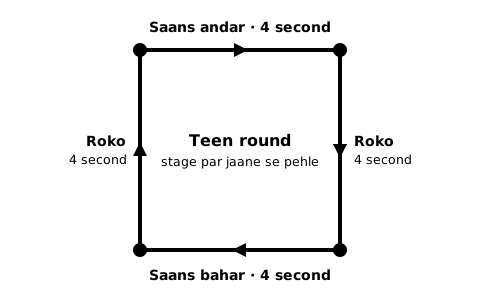
Ghabraahat ke liye paanch kaam
1. Pehli teen lines zubaani yaad karo — shuruaat nikal gayi to baaki nikal jaata hai.
2. Kam se kam teen baar khade hokar, zor se practice — mann me padhna practice nahi hai.
3. Jaane se pehle box breathing ke teen round.
4. Audience me do-teen muskuraate chehre dhoondho aur unse baat karo.
5. Shabd atke to "umm" mat bharo — ek pal chup raho. Chuppi aapko jitni lambi lagti hai, utni hoti nahi.
Raftaar aur zor: jitna aapko "dheere" lagta hai, sunne wale ke liye wo bilkul sahi hota hai. Har comma par chhota ruko, full stop par poori saans, aur zaroori shabd par zor. Suno:
- Last year / we lost / our biggest client. // Today / I'll show you / how we won them back. / = chhota ruko, // = poori saans. Mote shabdon par zor. Statement ke ant me aawaaz neeche.
35.8 Wo galtiyan jo hum sach me karte hain
Inme se zyaadatar galtiyan college ke seminar se chali aa rahi hain — sabne suna, sabne dohraya. Ek baar pakad lo, to aapki presentation turant zyada professional lagegi.
Presentation ki aam galtiyan
- Galat: Myself Neha and today I will be presenting on the topic of sales.
- Sahi: Hi, I'm Neha. Today I'll talk about our sales.
-
Kyun: "Myself…" se parichay nahi hota, aur "presenting on the topic of" bhaari hai. Chhota aur seedha.
-
Galat: I will explain about the new process.
- Sahi: I'll explain the new process.
-
Kyun: "Explain" aur "discuss" ke baad "about" nahi lagta. "Talk about" me lagta hai.
-
Galat: Any doubts?
- Sahi: Any questions?
-
Kyun: Indian English me "doubt" = sawaal. Baaki duniya me "doubt" = shak — "Any doubts?" ka matlab lagta hai "kisi ko mujh par shak hai?"
-
Galat: That's all from my side.
- Sahi: Thank you. I'm happy to take questions.
-
Kyun: "Meri taraf se itna hi" ka anuvaad — ant ko phika kar deta hai. Ant me summary aur garam shukriya.
-
Galat: As you can see in this slide…
- Sahi: As you can see on this slide…
- Kyun: Slide, screen aur page ek surface hain — on the slide, on the screen, on page 5.
35.9 Practice — Presentations
Exercise 1
Presentation ki sabse achhi shuruaat kaunsi hai?
- Let me start with a quick question.
- Sorry, I am not a good speaker.
- Am I audible to all?
- Myself Neha, I will present.
Jawaab
Let me start with a quick question.
Hook pehle — sawaal, number ya kahani. Maafi ya mic check se shuru karne par pehle tees second barbaad ho jaate hain.
Exercise 2
Pehla point khatam hua, ab doosre par jaana hai. Sahi signpost kaunsa hai?
- That brings me to my second point.
- Now second point is coming.
- Next is the next point.
- Please see second.
Jawaab
That brings me to my second point.
'That brings me to…' sunne wale ko saaf batata hai ki ek hissa khatam hua aur naya shuru.
Exercise 3
Q&A me aisa sawaal aaya jiska jawaab aapko nahi pata. Sabse achha jawaab?
- I don't have that figure now, but I'll email it to you today.
- (Andaaze se koi bhi number bata do)
- That question is not relevant.
- (Chup rehkar agli slide par chale jao)
Jawaab
I don't have that figure now, but I'll email it to you today.
Imaandaari + vaada. Banaya hua jawaab pakda gaya to poori presentation par se bharosa uth jaata hai.
Exercise 4
So, to sum ___, we need more time and a bigger team.
Hint: Ant ka signpost — 'sametna'.
Jawaab
up
'To sum up' = saar me kahun to. Ant ka sabse aam signpost.
Exercise 5
Let me give you an ___. Last month, two clients left.
Hint: Misaal.
Jawaab
example
'Let me give you an example' — point ke baad misaal, taaki baat zameen par utre.
Exercise 6
Is line me ek preposition galat hai — us par tap karo.
As you can see in this slide, sales went up.
Jawaab
Galat shabd: in.
Sahi roop: As you can see on this slide, sales went up.
Slide ek surface hai — on the slide, on the screen, on page 5.
Exercise 7
Sahi kram me lagao — audience ko naksha do.
Shabd: have / I / talk / parts / divided / three / into / this
Jawaab
I have divided this talk into three parts
Present perfect (have divided) + 'into three parts' — shuruaat me roadmap dene ki line.
Exercise 8
Kahani ki line ko arc ke hisse se jodo.
| A | B |
|---|---|
| Last year, we had ten thousand users. | Turning point |
| Then half of them suddenly left. | Lesson |
| Then we realised the login was slow. | Situation |
| What I learnt was simple: ask first. | Problem |
Jawaab
Last year, we had ten thousand users. — Situation; Then half of them suddenly left. — Problem; Then we realised the login was slow. — Turning point; What I learnt was simple: ask first. — Lesson
Situation se shuru, problem se tension, turning point par mod, aur lesson par ant — yahi arc hai.
Exercise 9
Presentation ki pehli line bolo — muskura kar.
Good morning, everyone. Thanks for being here
Jawaab
Bolo: Good morning, everyone. Thanks for being here
'everyone' ke baad chhota ruko. 'Thanks for' ko jodkar — 'thanks-fer'.
Exercise 10
Ab ek signpost bolo.
That brings me to my second point
Jawaab
Bolo: That brings me to my second point
'second' par zor do — sunne wale ko pata chale ki naya hissa shuru hua.
Exercise 11
Presentation ka ant — 'That's all from my side' ki jagah.
Thank you. I'm happy to take questions
Jawaab
Bolo: Thank you. I'm happy to take questions
'Thank you' ke baad poori saans. Ant me aawaaz neeche aur aankhein audience par.
Aage kya karein
Apne kaam ya padhai par do minute ki presentation banao — ek hook, teen point, ek chhoti kahani, ek ant. Phone par record karo, ek baar suno, aur sirf ek cheez sudhaaro: raftaar.