Chapter 40: Phrasal verbs
Phrasal verbs — do shabd, naya matlab
Phrasal verb matlab verb + ek chhota shabd (up, off, out, after…) jo milkar bilkul naya matlab bana dete hain. Give = dena. Up = upar. Par give up = haar maan lena. Yahi wajah hai ki shabdon ka matlab aata ho phir bhi English samajh nahi aati — aur yahi wajah hai ki phrasal verbs seekhna vocabulary ka sabse zyada faayde wala kaam hai. Native log inhe bade shabdon se zyada bolte hain.
- 1Chhote shabd ka apna mijaaj
- 2Separable vs inseparable — asli rule
- 3Group ke hisaab se — gyarah zaroori phrasal verbs
- 4Ek nazar me — poori list
- 5Galtiyan jo sabse zyada hoti hain
- 6Ek chhoti baat-cheet — saat phrasal verbs ek saath
Ek line me
Phrasal verb ko ek shabd ki tarah yaad karo — hisson ko jod kar matlab nikaalne ki koshish mat karo. "Look after" ko dekhna+baad me nahi, seedha "dekhbhaal karna" yaad karo.
40.1 Chhote shabd ka apna mijaaj
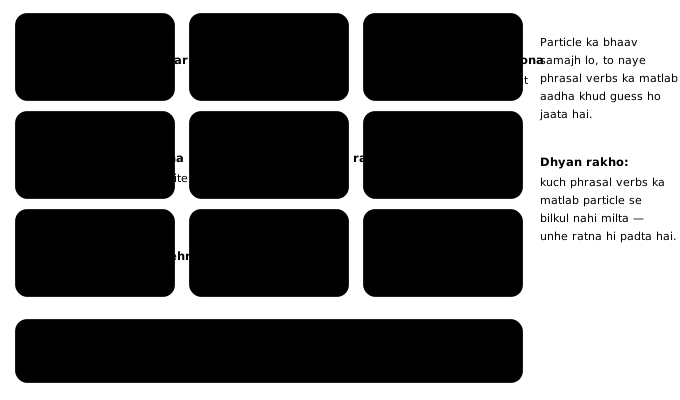
Har particle (up, off, out…) ka ek bhaav hota hai jo lagbhag har phrasal verb me jhalakta hai. Ye bhaav samajh lo to naye phrasal verbs ka andaza khud lagne lagega.
40.2 Separable vs inseparable — asli rule
Yahi hissa sabse zyada galtiyan karwata hai. Sawaal ye hai: object (jiske saath kaam ho raha hai) particle se pehle aayega ya baad me?
Teen kism ke phrasal verbs
A. Separable — object beech me bhi aa sakta hai, baad me bhi:
Turn down the offer ✓ · Turn the offer down ✓
B. Inseparable — object hamesha particle ke baad:
Look after the baby ✓ · Look the baby after ✗
C. Bina object — kuch lagta hi nahi:
Please carry on. · Don't give up.
Pronoun ka pakka niyam — ise mat bhoolo
Separable phrasal verb ke saath jab object it, him, her, them, us, me ho, to wo majboori se beech me aayega. Yahan choice khatam ho jaati hai.
✓ Turn it down. · ✗ Turn down it.
✓ Pick her up at six. · ✗ Pick up her at six.
✓ Put it off till Monday. · ✗ Put off it till Monday. Pronoun chhota aur halka hai — wo peechhe latak nahi sakta, beech me baith jaata hai.
Ek aur aasaan pehchaan: agar phrasal verb ke baad pehle se ek preposition lagta hai (get along with, run out of), wo hamesha inseparable hai.
40.3 Group ke hisaab se — gyarah zaroori phrasal verbs
A. Logon ke saath — rishte aur dekhbhaal
| Phrasal verb | Matlab | Kism |
|---|---|---|
| look after | dekhbhaal karna | Inseparable |
| get along (with) | nibhna, patri baithna | Inseparable |
| bring up | paalna-poshna; ya baat chhedna | Separable |
- Can you look after my bag for ten minutes? Dus minute mera bag dekh lenge?
- I get along with almost everyone on the team. Team me lagbhag sabke saath meri patri baithti hai.
- She brought up the budget issue at the end of the call. Usne call ke aakhir me budget ki baat chhedi.
- He was brought up by his grandparents in Nagpur. Uski parvarish Nagpur me uske dada-dadi ne ki.
Interview ki line
"I get along well with people from different teams." "I am a good team player" se zyada natural aur zyada sach lagta hai.
B. Shuru, jaari, aur khatam
| Phrasal verb | Matlab | Kism |
|---|---|---|
| give up | haar maan lena; chhod dena (aadat) | Separable / bina object |
| carry on | jaari rakhna | Bina object (ya "with") |
| run out of | khatam ho jaana (stock) | Inseparable |
- Don't give up now — you're two days from finishing. Abhi haar mat maano — khatam hone me do din bache hain.
- He gave up sugar in January and hasn't looked back. Usne January me cheeni chhod di aur phir palat kar nahi dekha.
- Sorry to interrupt — please carry on. Beech me bolne ke liye maaf kijiye — aap jaari rakhein.
- We've run out of milk again. Doodh phir khatam ho gaya.
run out of — do galtiyan
- Galat: The milk run out.
- Sahi: We've run out of milk. / The milk has run out.
-
Kyun: Jab aap bolo ki kiski kami hai, to "of" zaroori hai. Bina "of" ke sirf cheez subject ban sakti hai.
-
Galat: I am running out from time.
- Sahi: I'm running out of time.
- Kyun: Hamesha "out of" — "out from" kabhi nahi.
C. Faisle aur kaam — office ke phrasal verbs
| Phrasal verb | Matlab | Kism |
|---|---|---|
| put off | taalna, aage badhana | Separable |
| turn down | mana karna (offer, request); aawaz kam karna | Separable |
| sort out | suljhana, theek karna, chhaantna | Separable |
- Let's put the review off until Thursday. Review Thursday tak taal dein.
- She turned down the offer — the pay was good but the city wasn't. Usne offer thukra diya — tankhwah achhi thi par shehar nahi.
- Give me an hour and I'll sort it out. Ek ghanta do, main sab theek kar deta hoon.
'I'll sort it out' — sona hai
Office me koi gadbad ho jaaye, to ye teen shabd sabse zyada bharosa jagate hain. Isse aage kuch bolne ki zaroorat nahi.
D. Ittefaq aur seekhna
| Phrasal verb | Matlab | Kism |
|---|---|---|
| come across | achaanak mil jaana; ya kaisa lagna | Inseparable |
| pick up | uthana; lene jaana; seekh lena | Separable |
- I came across an old photo of us while clearing my desk. Desk saaf karte waqt humari ek purani photo achaanak mil gayi.
- He comes across as shy, but he isn't. Wo sharmila lagta hai, par hai nahi.
- Can you pick the kids up at four? Bachchon ko chaar baje le aaoge?
- She picked up Tamil just by living there. Wahan reh kar hi usne Tamil seekh li.
'comes across as' — bahut kaam ka
Kisi ke baare me narmi se raay dene ka tareeka: "The email comes across as a bit harsh." Aap ye nahi keh rahe ki wo kharab hai — bas ye ki aisa lag raha hai. Office me ye farq bada hai.
40.4 Ek nazar me — poori list
| Phrasal verb | Matlab | Separable? | Pronoun ke saath |
|---|---|---|---|
| give up | haar maanna / chhod dena | Haan | give it up |
| look after | dekhbhaal karna | Nahi | look after her |
| pick up | uthana / lene jaana / seekhna | Haan | pick it up |
| put off | taalna | Haan | put it off |
| turn down | mana karna / aawaz kam karna | Haan | turn it down |
| come across | achaanak milna / aisa lagna | Nahi | come across it |
| carry on | jaari rakhna | Object nahi | carry on |
| run out of | khatam ho jaana | Nahi | run out of it |
| sort out | suljhana | Haan | sort it out |
| get along (with) | nibhna | Nahi | get along with him |
| bring up | paalna / baat chhedna | Haan | bring it up |
40.5 Galtiyan jo sabse zyada hoti hain
Dhyan do
- Galat: Please turn down it, the music is too loud.
- Sahi: Please turn it down, the music is too loud.
-
Kyun: Pronoun (it, him, her, them) separable phrasal verb ke beech me majboori se aata hai.
-
Galat: She will look the baby after.
- Sahi: She will look after the baby.
-
Kyun: Look after inseparable hai — object kabhi beech me nahi aata, chahe wo pronoun ho: look after her.
-
Galat: I gave up from the exam.
- Sahi: I gave up on the exam.
-
Kyun: Kisi cheez ki ummeed chhodna = give up on. "Give up from" nahi hota.
-
Galat: We are running out from seats.
- Sahi: We are running out of seats.
-
Kyun: Hamesha "out of". Ye jodi ek hi shabd jaisi yaad karo.
-
Galat: Let's prepone the meeting to Monday.
- Sahi: Let's move the meeting up to Monday.
-
Kyun: "Prepone" sirf India me samajh aata hai. Aage karna = move up / bring forward. Peechhe karna = put off / push back.
-
Galat: I get along my manager very well.
- Sahi: I get along with my manager very well.
-
Kyun: Insaan ke saath "with" zaroori hai. Bina "with" ke matlab hota hai "guzaara ho raha hai".
-
Galat: He came across very rude.
- Sahi: He came across as very rude.
- Kyun: Jab matlab "aisa lagna" ho, to "as" lagta hai. Bina "as" ke matlab hota hai "takra gaya".
40.6 Ek chhoti baat-cheet — saat phrasal verbs ek saath
Zor se do baar padho
A: We've run out of chairs, and I've still got forty forms to sort out.
B: Don't give up — I'll pick some up from the store room. Should we put the briefing off by an hour?
A: Good idea. Can you bring that up with Meera? She gets along with the facilities team.
B: Done. You carry on with the forms.
40.7 Practice — Phrasal verbs
Exercise 1
Music bahut tez hai. Sahi vaakya kaunsa hai?
- Please turn it down.
- Please turn down it.
- Please turn down.
- Please it turn down.
Hint: Pronoun kahan jaata hai?
Jawaab
Please turn it down.
Turn down separable hai, aur pronoun (it) majboori se beech me aata hai. 'Turn down it' kabhi sahi nahi hota.
Exercise 2
Kaunsa phrasal verb inseparable hai — object kabhi beech me nahi aata?
- look after
- put off
- sort out
- bring up
Jawaab
look after
Look after inseparable hai: look after her ✓, look her after ✗. Baaki teeno separable hain.
Exercise 3
'He comes across as shy' ka matlab kya hai?
- Wo sharmila lagta hai
- Wo sharmile logon se milta hai
- Wo sharmila ban gaya
- Wo sharmila nahi hai
Jawaab
Wo sharmila lagta hai
'Come across as' = aisa lagna, aisa impression dena. Dhyan rakho: 'as' zaroori hai.
Exercise 4
Meeting ko pehle karna hai, baad me nahi. Kya bologe?
- Let's move the meeting up.
- Let's prepone the meeting.
- Let's put the meeting off.
- Let's turn the meeting down.
Hint: 'Prepone' bahar samajh nahi aata.
Jawaab
Let's move the meeting up.
Aage laana = move up / bring forward. Put off ka ulta matlab hai (taalna), aur turn down matlab mana karna.
Exercise 5
We've run ___ of printer paper again.
Hint: Ye jodi kabhi badalti nahi.
Jawaab
out
Hamesha 'run out of' — 'run out from' ya sirf 'run out' + cheez galat hai.
Exercise 6
I ___ along with everyone on my team.
Hint: Nibhna, patri baithna.
Jawaab
get
Get along with = nibhna. Insaan ke saath 'with' zaroori hai.
Exercise 7
She ___ up the budget problem right at the end of the call.
Hint: Baat chhedna.
Jawaab
brought
Bring up ke do matlab hain: paalna-poshna, aur baat chhedna. Yahan doosra matlab hai.
Exercise 8
Is vaakya me kram galat hai — galat shabd par tap karo.
She will look the baby after this evening.
Jawaab
Galat shabd: after.
Sahi roop: She will look after the baby this evening.
Look after inseparable hai — object particle ke baad hi aayega, beech me kabhi nahi.
Exercise 9
Ek shabd galat hai — use dhoondo.
I finally gave up from trying to fix the printer.
Jawaab
Galat shabd: from.
Sahi roop: I finally gave up on trying to fix the printer.
Ummeed chhodna = give up on. 'Give up from' angrezi me nahi hota.
Exercise 10
Phrasal verb ko uske matlab se jodo.
| A | B |
|---|---|
| put off | suljha dena |
| turn down | achaanak mil jaana |
| sort out | taal dena |
| come across | mana kar dena |
Jawaab
put off — taal dena; turn down — mana kar dena; sort out — suljha dena; come across — achaanak mil jaana
Chaaron office me roz kaam aate hain. Dhyan rakho: pehle teen separable hain, come across nahi.
Exercise 11
Particle ko uske asli bhaav se jodo.
| A | B |
|---|---|
| up | jaari rakhna |
| off | saath-saath chalna |
| on | poora ho jaana, khatam |
| along | alag hona, hat jaana |
Jawaab
up — poora ho jaana, khatam; off — alag hona, hat jaana; on — jaari rakhna; along — saath-saath chalna
Particle ka bhaav samajh aa jaaye to naye phrasal verbs ka matlab aadha khud guess ho jaata hai.
Exercise 12
Sahi kram banao — pronoun ka dhyan rakhna.
Shabd: hour / it / an / out / sort / Give / I / and / me / will
Jawaab
Give me an hour and I will sort it out
'Sort it out' — pronoun beech me. 'Sort out it' galat hota hai.
Exercise 13
Vaakya banao.
Shabd: four / you / Can / pick / kids / at / up / the
Jawaab
Can you pick the kids up at four
Separable phrasal verb ke saath noun beech me bhi chalta hai aur baad me bhi: 'pick up the kids' bhi sahi hai.
Exercise 14
Ye line bolo. 'Sort it out' teeno shabd jud kar ek saath bahte hain.
Don't worry I will sort it out
Jawaab
Bolo: Don't worry I will sort it out
Office me gadbad hone par ye sabse bharosemand line hai. Bolte waqt 'sort-it-out' ek lehar ki tarah nikalta hai.
Aage kya karein
Gyarah phrasal verbs ek saath mat rato. Aaj sirf teen chuno — sort out, get along with, put off — aur unhe apni asli zindagi ke vaakyon me daalo (apne kaam, apne log, apne naam). Jo vaakya aapka hai, wahi yaad rehta hai.