Chapter 42: Milte-julte shabd
Milte-julte shabd — jo roz dhokha dete hain
Kuch shabd judwa bhaiyon jaise hain — dikhte ek jaise, sunai ek jaise, par kaam bilkul alag. loose aur lose, then aur than, your aur you're — ye galtiyan padhe-likhe logon ki emails me bhi roz dikhti hain. Spell-check bhi nahi pakadta, kyonki dono shabd sahi hain — bas galat jagah par. Is chapter me solah jode hain, samajhdaari se guchhon me baante hue, aur har guchhe ke saath ek yaad rakhne ki trick.
- 1Teen tarah ke jode — pehle pehchaano
- 2Apostrophe wale — its/it's, your/you're, their/there/they're
- 3Ek aawaaz, do spelling — stationary/stationery, principal/principle
- 4Noun ya verb — affect/effect, advice/advise
- 5Ek akshar ka farq — lose/loose, quite/quiet, then/than, accept/except
- 6Disha wale jode — borrow/lend, bring/take, say/tell
- 7Ginti aur rakhna — fewer/less, lie/lay
- 8Wo galtiyan jo hum sach me karte hain
42.1 Teen tarah ke jode — pehle pehchaano
Har confusion ki jad alag hoti hai, isliye ilaaj bhi alag. Pehle ye pehchaano ki jodi kis tarah ki hai — aadha kaam wahin ho jaata hai.
Kaise padhein
Ek baar me ek guchha. Har jode ki trick zor se bolo, phir apna ek vaakya banao. Trick yaad rahi to jodi kabhi nahi ulajhegi.
42.2 Apostrophe wale — its/it's, your/you're, their/there/they're
Ye sabse aam likhit galti hai — WhatsApp se lekar office email tak. Bolte waqt koi fark nahi padta, kyonki aawaaz ek hai. Par likhte waqt ek chhota sa apostrophe poora matlab badal deta hai.
| Shabd | Matlab | Example |
|---|---|---|
| it's / its | it is / uska (cheez ka) | It's raining. · The phone lost its charge. |
| you're / your | you are / aapka | You're late. · Is this your seat? |
| they're | they are | They're coming at six. |
| their | unka | Their car is new. |
| there | wahan / "hai" (there is) | Put it over there. · There is a problem. |
Khol ke padho
Apostrophe = gayab akshar. "it's" ko "it is", "you're" ko "you are", "they're" ko "they are" bana ke padho — vaakya sahi baithe to apostrophe, na baithe to bina apostrophe wala (its / your / their). "Your welcome" → "You are welcome"? Haan! To "You're welcome".
42.3 Ek aawaaz, do spelling — stationary/stationery, principal/principle
Ye do jode bilkul ek jaise bole jaate hain — sirf ek akshar ka fark hai. Isliye inke liye aawaaz nahi, tasveer wali trick kaam karti hai.

- The bus was stationary, so I bought some stationery from the shop nearby. Bus ruki hui thi, to maine paas ki dukaan se pen-copy le li.
- Our principal never breaks her principles. Hamari principal madam apne usool kabhi nahi todti.
- The principal reason was cost. "principal" adjective bhi hai = sabse mukhya. Isme bhi -al.
Ek akshar, ek tasveer
stationAry = At rest (ruka hua) · stationEry = Envelope (pen-kaagaz). principAL = insaan / mukhya ("your PAL") · principLE = usool (ruLE).
42.4 Noun ya verb — affect/effect, advice/advise
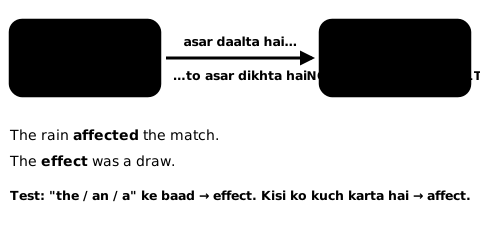
In do jodon me ek shabd kaam (verb) hai aur doosra cheez (noun). Vaakya me dekho ki wahan verb chahiye ya noun — jawaab khud mil jaayega.
| Shabd | Kya hai | Example | Suno |
|---|---|---|---|
| affect | verb — asar daalna | Stress can affect your sleep. | |
| effect | noun — asar, nateeja | The medicine had a quick effect. | |
| advice | noun — salaah (s ki aawaaz) | Can I give you some advice? | |
| advise | verb — salaah dena (z ki aawaaz) | I advise you to wait. |
A = Action, -ice = cheez
Affect = Action (verb), Effect = End result (noun). Advice ice jaisi ek cheez hai (noun, "s" ki aawaaz); advise ek kaam hai (verb, "z" ki aawaaz). Aur advice ginti nahi hoti: "some advice", "a piece of advice" — "an advice" ya "advices" nahi.
42.5 Ek akshar ka farq — lose/loose, quite/quiet, then/than, accept/except
In jodon me ek akshar idhar-udhar hota hai, aur padhte waqt aankh use chhod deti hai. Har jodi ki ek chhoti trick hai — trick ko shabd ke saath jodo, matlab apne aap aa jaayega.
| Jodi | Matlab | Trick |
|---|---|---|
| lose / loose | khona, haarna / dheela | lose ne ek "o" kho diya. loose me "oo" — dheela, jagah zyada. |
| quite / quiet | kaafi / shaant | quite = ek syllable (kwait). qui-et = do syllable (kwai-yet) — shaanti me dheere bolo. |
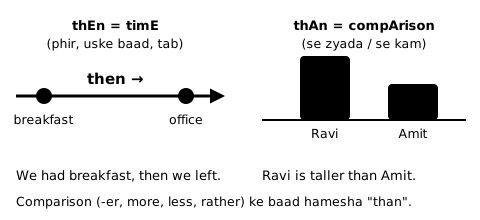
| then / than | phir / se (tulna) | thEn = timE, thAn = compArison. |
| accept / except | sweekar karna / ke alawa | accept = apnaana. except = exit — bahar rakhna. |
- These jeans are too loose. I must have lost weight! loose = "loos" (s ki aawaaz), lose = "looz" (z ki aawaaz). Bolne me bhi farq hai.
- The library is quite big, and it's always quiet. Kaafi bada, aur hamesha shaant.
- I accept all the changes except the last one. Saare badlaav manzoor, aakhri wale ko chhod kar.
Chaar tricks
lose ne ek "o" kho diya (khona) · loose = dheela · quiet = do syllable, shaant · quite = kaafi · thEn = timE · thAn = compArison · except = exit (bahar), accept = apnaana.
42.6 Disha wale jode — borrow/lend, bring/take, say/tell
Hindi me "lena-dena" aur "laana-le jaana" alag shabd hain — phir bhi English me ye ulajh jaate hain, kyonki hum "udhaar" ya "le aao" jaise ek shabd se sochte hain. Yahan sawaal hai: cheez kis taraf ja rahi hai?
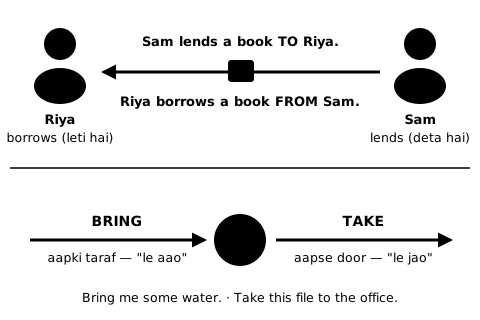
- Could you lend me your pen? / Could I borrow your pen? Dono sahi — par "Can you borrow me…" kabhi nahi. Saamne wala dega = lend.
- Please bring your ID card tomorrow, and take the old one home. Yahan (office) laao = bring. Ghar le jao = take.
- She told me the news and said it was a secret. tell + insaan (told me), say + baat (said it was…). "She said me" galat.
Cheez kis taraf ja rahi hai?
lend = dena, borrow = lena (lend to, borrow from). bring = bolne wale ki taraf, take = usse door. tell ke baad insaan (tell me), say ke baad baat (say something).
42.7 Ginti aur rakhna — fewer/less, lie/lay
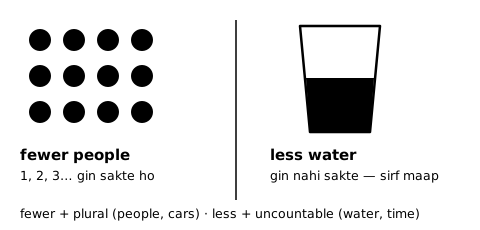
Ye do jode sabse "advanced" lagte hain, par niyam seedha hai. fewer/less me sawaal hai: gin sakte ho? Aur lie/lay me: koi cheez rakhi ja rahi hai, ya aap khud let rahe ho?
| Verb | Matlab | Aaj | Kal (past) | Kar chuka |
|---|---|---|---|---|
| lie | letna | lie · lying | lay | lain |
| lay | (kuch) rakhna, bichhaana | lay · laying | laid | laid |
| lie | jhooth bolna | lie · lying | lied | lied |
- I'm tired. I'm going to lie down for a bit. Khud letna = lie. Iske baad koi cheez nahi aati.
- Please lay the files on my desk. Kuch rakhna = lay + cheez (the files).
- There were fewer cars today, so it took less time. Cars gin sakte ho → fewer. Time nahi → less.
Gin sakte ho? Kuch rakh rahe ho?
fewer + jo gin sakte ho (fewer people), less + jo nahi gin sakte (less water). lay ke baad hamesha koi cheez (lay the table); lie ke baad nahi (lie down). Sabse bada jaal: lie ka past "lay" hai — "Yesterday I lay in bed all day."
42.8 Wo galtiyan jo hum sach me karte hain
Ye saari galtiyan asli emails, WhatsApp messages aur class ki copies se li gayi hain. Inme se ek bhi aapki aadat me hai, to aaj hi use pakdo.
Milte-julte shabdon ki aam galtiyan
- Galat: Can you borrow me your charger?
- Sahi: Can you lend me your charger? / Can I borrow your charger?
-
Kyun: Dene wala lend karta hai, lene wala borrow. "Borrow me" kabhi nahi.
-
Galat: I don't want to loose this chance.
- Sahi: I don't want to lose this chance.
-
Kyun: Khona = lose (ek o). Loose = dheela — "loose shirt".
-
Galat: The new rule will effect everyone.
- Sahi: The new rule will affect everyone.
-
Kyun: "will ___ everyone" me verb chahiye → Affect = Action.
-
Galat: My brother is taller then me.
- Sahi: My brother is taller than me.
-
Kyun: Tulna (taller) ke baad than. "then" sirf samay ke liye.
-
Galat: Your welcome!
- Sahi: You're welcome!
- Kyun: Khol ke padho: "You are welcome" — fit hai, to you're.
42.9 Practice — Milte-julte shabd
Exercise 1
Shabd ko uske kaam se jodo.
| A | B |
|---|---|
| affect | verb — salaah dena |
| effect | noun — salaah |
| advise | verb — asar daalna |
| advice | noun — asar, nateeja |
Jawaab
affect — verb — asar daalna; effect — noun — asar, nateeja; advise — verb — salaah dena; advice — noun — salaah
A = Action (affect, verb), E = End result (effect, noun). Advice ek cheez hai (noun), advise ek kaam (verb).
Exercise 2
Ek akshar ka farq — sahi matlab se jodo.
| A | B |
|---|---|
| stationery | pradhan, sabse mukhya |
| stationary | usool |
| principal | pen, paper, file |
| principle | ruka hua |
Jawaab
stationery — pen, paper, file; stationary — ruka hua; principal — pradhan, sabse mukhya; principle — usool
E = Envelope (stationery), A = At rest (stationary). The principal is your PAL; principLE = ruLE.
Exercise 3
Is vaakya me galat shabd par tap karo.
Can you borrow me your charger for an hour?
Jawaab
Galat shabd: borrow.
Sahi roop: Can you lend me your charger for an hour?
Saamne wala dega, to wo 'lend' karega. Aap lete ho to 'Can I borrow…?'
Exercise 4
Spelling ka dhokha dhoondo.
I don't want to loose my job.
Jawaab
Galat shabd: loose.
Sahi roop: I don't want to lose my job.
Khona = lose (ek o). Loose = dheela.
Exercise 5
Apostrophe galat jagah hai — us shabd par tap karo.
The dog wagged it's tail happily.
Jawaab
Galat shabd: it's.
Sahi roop: The dog wagged its tail happily.
Khol ke padho: 'wagged it is tail'? Fit nahi — to bina apostrophe: its = uska.
Exercise 6
I think ___ going to be late. The traffic is terrible.
- they're
- their
- there
- them
Jawaab
they're
Khol ke dekho: 'I think they are going to be late' — fit hai, to they're.
Exercise 7
Everyone came to the party ___ Rahul. He was ill.
- except
- accept
- expect
- excuse
Jawaab
except
except = ke alawa (ex = exit, bahar rakhna). accept = sweekar karna.
Exercise 8
Please ___ the baby gently on the bed.
- lay
- lie
- lied
- lain
Jawaab
lay
Kisi cheez ya insaan ko rakhna = lay + object (lay the baby). Khud letna = lie.
Exercise 9
There are ___ people here than yesterday.
Hint: People gine ja sakte hain.
Jawaab
fewer
Gin sakte ho → fewer. 'less people' bahut aam galti hai; less sirf uncountable ke liye (less water).
Exercise 10
Please be ___. The baby is sleeping.
Hint: Shaant — do syllable wala shabd.
Jawaab
quiet
quiet (kwai-yet) = shaant. quite (kwait) = kaafi.
Exercise 11
Sahi kram me lagao.
Shabd: our / rain / heavy / will / affect / The / plans
Jawaab
The heavy rain will affect our plans
'will ___ our plans' me verb chahiye — affect (A = Action).
Exercise 12
Ye polite request bolo.
Could I borrow your pen, please
Jawaab
Bolo: Could I borrow your pen, please
Aap le rahe ho → borrow. 'borrow' me zor pehle hisse par: BOR-row.
Aage kya karein
Apni pichhli das emails ya messages kholo aur sirf teen cheezein dhoondo: your/you're, its/it's, then/than. Jo galti mile, use is chapter ki trick ke saath ek baar dobara likho.