Chapter 23: If wale vaakya
If wale vaakya — shart aur nateeja
Conditional vaakya ka matlab hai: agar ye, to wo. Hindi me hum roz bolte hain — "agar baarish hogi to match nahi hoga". English me chaar tarah ke "if" vaakya hote hain, aur unme farq sirf ek cheez ka hai: baat kitni sambhav hai. Pakki baat, ho sakne waali baat, mushkil baat, aur wo baat jo ab kabhi nahi ho sakti. Chaar tarah ki sambhaavna, chaar formula. Aur ek sunehra rule jo sab se zyada toota jaata hai: "if" ke baad "will" kabhi nahi.
- 1Chaar shaakhayein — sambhaavna ke saath
- 2Zero conditional — jo hamesha hota hai
- 3First conditional — asli sambhaavna
- 4Second conditional — kalpana aur salaah
- 5Third conditional — jo ho hi nahi saka
- 6Mixed conditional — do waqt ek vaakya me
- 7"if" ke doosre roop
- 8Wo galtiyan jo hum sach me karte hain
Ek line me
A conditional sentence has two parts: the if-clause (shart) and the main clause (nateeja). Kram badla ja sakta hai. Agar "if" wala hissa pehle aaye to beech me comma lagta hai; baad me aaye to comma nahi.
- If it rains, we will stay home. If pehle aaya — comma laga.
- We will stay home if it rains. If baad me aaya — comma nahi. Matlab bilkul wahi hai.
23.1 Chaar shaakhayein — sambhaavna ke saath
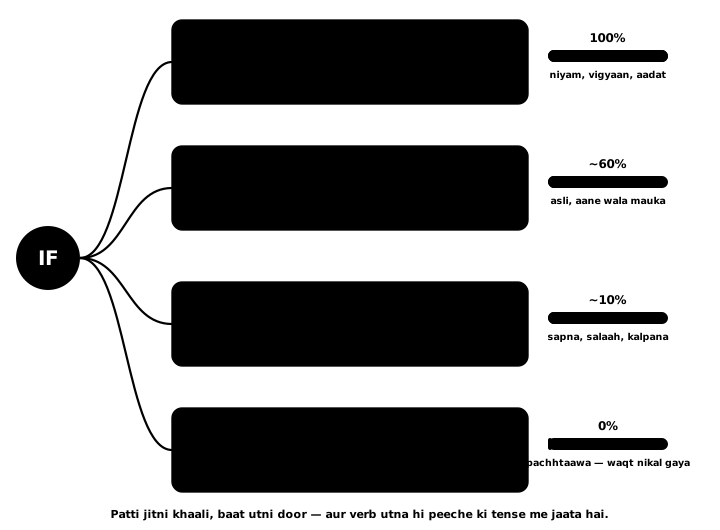
Neeche wali tasveer har tarah ke "if" vaakya ko uski sambhaavna ke saath dikhaati hai. Patti (bar) jitni bhari hui hai, utni hi baat ho sakne wali hai.
23.2 Zero conditional — jo hamesha hota hai
Yahan "if" ka matlab lagbhag "when" hota hai. Niyam, vigyaan, machine, aadat — in sab ke liye ye roop hai. Dono taraf present simple.
- If you heat water to 100 °C, it boils. Hamesha hota hai — koi shaq nahi.
- If the light turns red, the traffic stops. Niyam hai. Yahan "when" bhi chalega.
23.3 First conditional — asli sambhaavna
Aane wale waqt ki asli baat. Ho sakta hai, ho bhi sakta hai nahi. Ye sabse zyada bola jaane wala roop hai — plan, vaada, dhamki, chetawni, sab isme aate hain.
| Kaam | Example |
|---|---|
| Plan | If the train is on time, we will reach by eight. |
| Vaada | If you help me today, I will help you tomorrow. |
| Chetawni | If you touch that wire, you will get a shock. |
| Shart / sauda | If you finish the work, you can go early. |
Sunehra rule — 'if' ke baad 'will' nahi
- Galat: If it will rain, we will cancel the match.
- Sahi: If it rains, we will cancel the match.
- Kyun: "will" ek vaakya me ek hi baar, aur wo nateeje wale hisse me. Shart wala hissa present simple me rehta hai, chahe baat kal ki ho.
Yahi rule when, after, before, until, as soon as, unless ke saath bhi chalta hai.
will ki jagah doosre shabd bhi chalte hain
First conditional me nateeje wale hisse me can, may, should, must aur hukm bhi aa sakta hai:
If you are tired, you should rest.
If he calls, tell him I am busy.
23.4 Second conditional — kalpana aur salaah
Jab baat ab ki haalat me mushkil ya kaalpanik hai. Dekho kaise verb past me jaata hai, par baat past ki nahi hai — baat abhi ki hai. Isliye isko "unreal present" bhi kehte hain.
- If I won a lottery, I would buy a house for my parents. Lottery jeetne ka chance kam hai — isliye past roop, par baat aaj ki hai.
- If I were you, I would speak to the manager. Salaah dene ka sabse shisht aur natural tareeka.
'If I were' — yahan 'was' nahi
Second conditional me "be" ka roop were hota hai — har subject ke saath.
If I were rich… · If he were here… · If she were in charge… "If I was you" bol-chaal me sun lete hain, par sahi aur sunne me achha roop "If I were you" hi hai — aur ye poori duniya me salaah dene ka standard vaakya hai.
23.5 Third conditional — jo ho hi nahi saka
Guzra hua waqt, jo badal nahi sakta. Isme pachhtaawa, ilzaam, ya "kaash aisa hota" wali baat hoti hai. Dono taraf ek-ek kadam aur peeche: had + V3 aur would have + V3.
- If I had left earlier, I would not have missed the train. Main jaldi nahi nikla, aur train chhoot gayi. Ab kuch nahi ho sakta.
- If she had told me, I could have helped her. "would" ki jagah could / might bhi chalta hai — sambhaavna ka rang badal jaata hai.
23.6 Mixed conditional — do waqt ek vaakya me
Kabhi shart past ki hoti hai aur nateeja aaj ka, ya ulta. Tab dono taraf ke roop mila diye jaate hain. Ye advanced hai, par bahut kaam ka — kyunki zindagi me baatein aise hi hoti hain.
| Kism | Formula | Example | Matlab |
|---|---|---|---|
| Past shart → aaj ka nateeja | If + had + V3 , would + V1 | If I had studied engineering, I would be an engineer today. | Padha nahi tha, isliye aaj engineer nahi hoon. |
| Aaj ki haalat → past ka nateeja | If + past simple , would have + V3 | If I were braver, I would have told him the truth. | Main himmat wala nahi hoon, isliye us waqt sach nahi bola. |
23.7 "if" ke doosre roop
| Shabd | Matlab | Example |
|---|---|---|
| unless | agar nahi (= if not) | You will fail unless you work hard. |
| as long as | jab tak | You can stay as long as you keep quiet. |
| provided that | is shart par ki | I will sign it provided that you read it first. |
| in case | kahin aisa na ho ki | Take an umbrella in case it rains. |
| even if | chahe | Even if you apologise, he will not forgive you. |
| otherwise | warna | Hurry up, otherwise we will be late. |
'unless' me 'not' dobara nahi
- Galat: Unless you do not hurry, you will miss the bus.
- Sahi: Unless you hurry, you will miss the bus.
- Kyun: "Unless" ke andar hi "not" chhipa hua hai (= if you do not hurry). Dobara "not" lagane se matlab ulta ho jaata hai.
23.8 Wo galtiyan jo hum sach me karte hain
Conditional ki top galtiyan
- Galat: If I will go to Delhi, I will meet you.
- Sahi: If I go to Delhi, I will meet you.
-
Kyun: Shart wale hisse me will nahi — present simple. Ek vaakya me will ek hi baar.
-
Galat: If he would come, I would be happy.
- Sahi: If he came, I would be happy.
-
Kyun: Second conditional me "if" wale hisse me past simple aata hai, would nahi. Would sirf nateeje me.
-
Galat: If I was you, I would not accept that offer.
- Sahi: If I were you, I would not accept that offer.
-
Kyun: Kaalpanik baat me "were" aata hai, har subject ke saath. Ye salaah dene ka standard vaakya hai.
-
Galat: If she would have told me, I would have helped.
- Sahi: If she had told me, I would have helped.
-
Kyun: Third conditional me shart "had + V3" hoti hai. "would have" sirf nateeje wale hisse me.
-
Galat: If you would study hard, you will pass.
- Sahi: If you study hard, you will pass.
-
Kyun: Do modal mila dene se vaakya uljh jaata hai. Ek sadhe formula par tiko.
-
Galat: I will tell you if he will come.
- Sahi: I will tell you if he comes.
- Kyun: Chahe "if" baad me aaye, rule wahi — if ke baad present.
Chaar formula, ek line me
Zero: if + present, present
First: if + present, will + V1
Second: if + past, would + V1
Third: if + had + V3, would have + V3 Dekho — "if" wale hisse me kabhi will/would nahi aata. Yahi ek baat 90% galtiyan bacha leti hai.
23.9 Practice — Conditionals
Exercise 1
If it ___ tomorrow, we will cancel the picnic.
- will rain
- rains
- would rain
- rained
Hint: If ke baad kaunsa roop aata hai?
Jawaab
rains
First conditional hai — if wale hisse me present simple (rains) aur nateeje me will. 'If it will rain' sabse aam galti hai.
Exercise 2
If I ___ a bird, I would fly to the mountains.
- am
- was
- were
- will be
Hint: Kaalpanik baat hai — be ka kaunsa roop?
Jawaab
were
Second conditional me 'be' ka roop hamesha 'were' hota hai — chahe subject I, he ya she ho. 'If I were a bird' sahi hai.
Exercise 3
If you had called me, I ___ at the station.
- will come
- would come
- would have come
- came
Hint: Third conditional ka nateeja kaisa hota hai?
Jawaab
would have come
Third conditional — guzri baat. Shart 'had called' hai, isliye nateeja 'would have come'. Ab ye ho nahi sakta, sirf pachhtaawa hai.
Exercise 4
Kaunsa vaakya zero conditional hai?
- If I get time, I will call you.
- If you mix blue and yellow, you get green.
- If I were rich, I would travel.
- If he had tried, he would have won.
Hint: Kaunsi baat hamesha sach hai?
Jawaab
If you mix blue and yellow, you get green.
Zero conditional me dono taraf present simple hota hai aur baat hamesha sach hoti hai — rang milane ka nateeja kabhi nahi badalta.
Exercise 5
If I ___ (have) more time, I would learn the guitar.
Hint: Second conditional — abhi time nahi hai.
Jawaab
had
Second conditional me if ke baad past simple aata hai. 'Had' likhne ka matlab past ki baat nahi — matlab 'abhi time nahi hai'.
Exercise 6
You will not pass ___ you work hard.
Hint: 'agar nahi' ka ek hi shabd.
Jawaab
unless
'Unless' ka matlab hai 'if not'. Iske andar hi 'not' chhipa hai, isliye dobara 'not' nahi lagana.
Exercise 7
If water ___ (freeze), it becomes ice.
Hint: Hamesha sach — zero conditional.
Jawaab
freezes
Zero conditional me dono taraf present simple. 'Water' singular hai, isliye 'freezes' — -s lagega.
Exercise 8
Is vaakya me ek galti hai — galat shabd par tap karo.
If I will get the job, I shall shift to Pune.
Jawaab
Galat shabd: will.
Sahi roop: If I get the job, I shall shift to Pune.
If wale hisse me will/shall kabhi nahi aata. Wahan present simple rehta hai — 'If I get'.
Exercise 9
Galat shabd dhoondo.
If I was the captain, I would change the batting order.
Jawaab
Galat shabd: was.
Sahi roop: If I were the captain, I would change the batting order.
Kaalpanik baat (main captain nahi hoon) me 'were' aata hai, 'was' nahi.
Exercise 10
Ek shabd galat hai — pakdo.
If she would have asked me, I might have helped her.
Jawaab
Galat shabd: would.
Sahi roop: If she had asked me, I might have helped her.
Third conditional me shart 'had + V3' hoti hai. 'If she would have' galat hai — wahan 'If she had' aata hai. Would/might have sirf nateeje wale hisse me.
Exercise 11
Sahi kram me second conditional banao.
Shabd: I / job / take / were / you / that / I / If / would
Jawaab
If I were you I would take that job
Salaah dene ka standard roop — 'If I were you, I would…'. Yaad rakho: if wale hisse me 'were', nateeje me 'would + V1'.
Exercise 12
Conditional ki kism ko uske matlab se jodo.
| A | B |
|---|---|
| If you heat ice, it melts | abhi nahi hai — kalpana |
| If I get leave, I will come | ho hi nahi saka |
| If I had a car, I would drive | hamesha sach |
| If I had known, I would have come | ho sakta hai |
Jawaab
If you heat ice, it melts — hamesha sach; If I get leave, I will come — ho sakta hai; If I had a car, I would drive — abhi nahi hai — kalpana; If I had known, I would have come — ho hi nahi saka
Zero = niyam. First = asli sambhaavna. Second = aaj ki kalpana. Third = guzri baat, ab nahi badal sakti.
Exercise 13
Ab ye line bol ke dekho — salaah dene wala sabse kaam ka vaakya.
If I were you I would not worry about it
Jawaab
Bolo: If I were you I would not worry about it
Bolte waqt 'If I were you' ko ek hi saans me bolo — ye lagbhag ek phrase ki tarah sunai deta hai. Office aur dosti, dono me ye line roz kaam aati hai.
Aage kya karein
Ek kaam aaj hi karo: apne baare me chaar vaakya banao — ek zero ("If I skip breakfast, I get a headache"), ek first, ek second, ek third. Apne jeevan ki asli baatein likho. Jo vaakya aapka khud ka hota hai, wo formula se zyada tez yaad rehta hai.