अध्याय 17: Subject-verb agreement
Subject-verb agreement — "He go" या "He goes"?
Agreement का मतलब है मेल — subject और verb का मेल। हिंदी में भी यह मेल होता है, बस अलग तरीके से (लड़का जाता है / लड़के जाते हैं), इसलिए हम यह चीज़ जानते हैं। दिक़्क़त सिर्फ़ दो जगह होती है: पहली, English में -s singular के साथ लगता है (उल्टा लगता है!), और दूसरी, कभी-कभी असली subject बीच के शब्दों के पीछे छुप जाता है। दोनों चीज़ें इस chapter में हमेशा के लिए साफ़ हो जाएँगी।
- 1बुनियादी नक्शा
- 2असली subject ढूँढो — बीच के शब्द गिनती में नहीं
- 3हमेशा singular — यह याद रखना है
- 4"A number of" vs "The number of"
- 5दो subject जुड़े हैं — तब क्या?
- 6Collective nouns — एक या कई?
- 7दिखने में plural, पर singular
- 8There is / There are
- 9वो गलतियाँ जो हम सच में करते हैं
एक लाइन में
A singular subject takes a singular verb; a plural subject takes a plural verb. एक subject → एक वाला verb। कई subject → कई वाला verb। और याद रखो — verb में -s का मतलब singular।
17.1 बुनियादी नक्शा
| Subject | Present Simple | be (present) | be (past) | have |
|---|---|---|---|---|
| I | go | am | was | have |
| You | go | are | were | have |
| He / She / It | goes | is | was | has |
| We | go | are | were | have |
| They | go | are | were | have |
-s की दोहरी गड़बड़
Noun में -s लगने से वह plural बनता है: boy → boys।
Verb में -s लगने से वह singular बनता है: go → goes।
यानी एक वाक्य में -s या तो noun पर होगा या verb पर — दोनों पर नहीं। The boy runs ✓ The boys run ✓ The boys runs ✗
17.2 असली subject ढूँढो — बीच के शब्द गिनती में नहीं
सबसे ज़्यादा गलती यहीं होती है। Subject और verb के बीच कोई लंबा phrase आ जाता है, और दिमाग़ उस phrase के आख़िरी शब्द को subject समझ लेता है। Trick यह है: उस बीच वाले हिस्से पर काल्पनिक कैंची चला दो और उसे भूल जाओ।
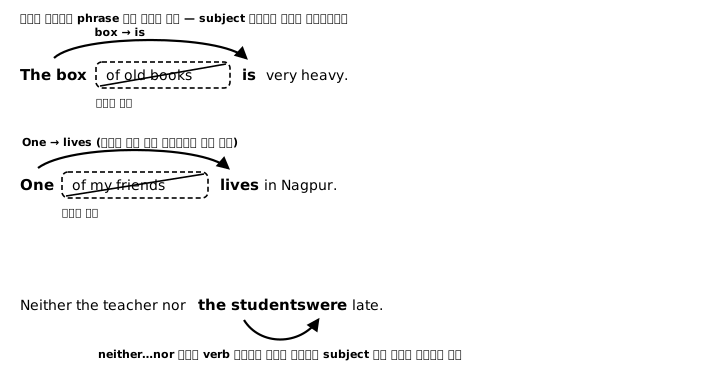
ये सब बीच वाले शब्द verb नहीं बदलते
of, with, along with, together with, as well as, including, besides, in addition to, accompanied by
The minister, along with his officers, has arrived. Subject "the minister" है — एक इंसान। "Officers" से कोई फ़र्क़ नहीं पड़ता।
17.3 हमेशा singular — यह याद रखना है
| Subject | सही | गलत |
|---|---|---|
| each | Each boy has a book. | Each boy have… |
| every | Every student was present. | Every student were… |
| everyone / everybody | Everyone knows it. | Everyone know it. |
| someone / somebody | Somebody is at the door. | Somebody are… |
| nobody / no one | Nobody came. | — |
| anyone / anybody | Does anybody know him? | Do anybody know… |
| either / neither (अकेले) | Neither is correct. | Neither are correct. |
| one of + plural | One of my friends is a doctor. | One of my friend is… |
| the number of | The number of cases is rising. | The number of cases are… |
| each of / every one of | Each of the girls sings well. | Each of the girls sing… |
'one of my friend' — दो गलतियाँ एक साथ
- गलत: One of my friend are coming today.
- सही: One of my friends is coming today.
- क्यों: सोचो: "मेरे दोस्तों में से एक"। "दोस्तों" plural है (friends), पर बात एक की हो रही है — इसलिए verb singular (is)। यही rule "one of the best players", "one of my sisters" सब पर चलता है।
17.4 "A number of" vs "The number of"
| Phrase | मतलब | Verb | Example |
|---|---|---|---|
| a number of | कई, बहुत से | plural | A number of students are absent. |
| the number of | गिनती, संख्या | singular | The number of students is falling. |
| a lot of / plenty of | noun पर depend | noun देखो | A lot of water is wasted. · A lot of people are waiting. |
| 50% of / half of | noun पर depend | noun देखो | Half of the cake is gone. · Half of the boys are here. |
17.5 दो subject जुड़े हैं — तब क्या?
| जोड़ने वाला शब्द | Rule | Example |
|---|---|---|
| and | plural | Ravi and Sita are friends. |
| and (एक ही चीज़) | singular | Bread and butter is my breakfast. |
| or / nor | पास वाले से मेल | Ravi or his brothers are coming. |
| either… or | पास वाले से मेल | Either the boys or the teacher is wrong. |
| neither… nor | पास वाले से मेल | Neither the teacher nor the boys are wrong. |
| not only… but also | पास वाले से मेल | Not only the players but also the coach was blamed. |
चालाकी की सलाह
either/or और neither/nor वाले वाक्य में, अगर हो सके तो plural subject को आख़िर में रखो। तब verb plural हो जाता है और वाक्य कान को ज़्यादा natural लगता है।
Neither the manager nor the workers were happy.
17.6 Collective nouns — एक या कई?
Team, family, class, committee, government, jury, staff — ये एक group हैं। जब group एक इकाई की तरह काम कर रहा हो तो singular; जब group के लोग अलग-अलग काम कर रहे हों तो plural।
- The team is playing well today. पूरी team एक इकाई की तरह — singular।
- The team are arguing among themselves. Team के लोग आपस में — अलग-अलग लोग, इसलिए plural।
तीन शब्द जो हमेशा plural हैं
police, people, cattle — इनके साथ verb हमेशा plural।
The police have arrested him. ✓ The police has arrested him. ✗
Many people were waiting. ✓
17.7 दिखने में plural, पर singular
| किस्म | शब्द | Example |
|---|---|---|
| विषय के नाम | mathematics, physics, economics, politics, statistics | Mathematics is my favourite subject. |
| बीमारी | measles, mumps, diabetes | Measles is contagious. |
| ख़बर | news | The news is good. |
| Uncountable | information, advice, furniture, luggage, work, money | This information is useful. |
| दूरी, पैसा, समय — एक इकाई | — | Ten kilometres is a long walk. · Five hundred rupees is too much. |
| किताब / फ़िल्म का नाम | — | "Three Idiots" is a great film. |
और इनका उल्टा — दिखने में एक, पर plural
scissors, trousers, jeans, spectacles, pliers, scales — दो हिस्सों वाली चीज़ें plural होती हैं: My spectacles are broken.
पर "a pair of" लगाते हो तो singular हो जाता है: A pair of scissors is missing.
17.8 There is / There are
"There" subject नहीं होता — subject उसके बाद आता है। इसलिए verb बाद वाले noun से मेल खाता है।
- There is a problem with the laptop. एक problem — singular।
- There are three problems in this file. तीन problems — plural।
17.9 वो गलतियाँ जो हम सच में करते हैं
Agreement की टॉप गलतियाँ
- गलत: He don't know my name.
- सही: He doesn't know my name.
-
क्यों: He/she/it के साथ "does" आता है। "don't" सिर्फ़ I, you, we, they के साथ।
-
गलत: My parents is very supportive.
- सही: My parents are very supportive.
-
क्यों: "Parents" plural है — are। एक की बात हो तो "My father is"।
-
गलत: Everyone have their own problems.
- सही: Everyone has their own problems.
-
क्यों: "Everyone" दिखने में सब लगता है, पर grammar में singular है — has। (आगे "their" चलता है, यह आज normal English है।)
-
गलत: The police is looking for him.
- सही: The police are looking for him.
-
क्यों: "Police" हमेशा plural। एक पुलिसवाले की बात हो तो "a policeman is"।
-
गलत: Mathematics are difficult for me.
- सही: Mathematics is difficult for me.
-
क्यों: -s से ख़त्म होने वाले विषय (mathematics, physics, economics) singular हैं।
-
गलत: One of my cousin works in Dubai.
- सही: One of my cousins works in Dubai.
-
क्यों: "One of" के बाद noun plural होता है, पर verb singular। दोनों एक साथ याद रखो।
-
गलत: The list of items are on the table.
- सही: The list of items is on the table.
-
क्यों: Subject "the list" है — एक list। "of items" बीच का phrase है, उसे हटा दो।
-
गलत: My brother and I is going to Goa.
- सही: My brother and I are going to Goa.
- क्यों: "and" से जुड़े दो subject = plural। और क्रम का भी ध्यान रखो — "My brother and I", not "I and my brother"।
चार कदम, हर बार
1. Verb ढूँढो।
2. पूछो "कौन/क्या?" — जवाब ही subject है।
3. Subject और verb के बीच का सब कुछ हटा दो।
4. अब देखो subject एक है या कई — और उसी हिसाब से verb चुनो।
17.10 Practice — Subject-verb agreement
अभ्यास 1
One of my cousins ___ in Canada.
- live
- lives
- are living
- have lived
संकेत: बात कितने लोगों की हो रही है?
उत्तर
lives
'One of my cousins' का मतलब है 'मेरे cousins में से एक'। बात एक की है, इसलिए verb singular — lives।
अभ्यास 2
The box of chocolates ___ on the fridge.
- are
- is
- were
- have
संकेत: असली subject कौन है — box या chocolates?
उत्तर
is
Subject 'the box' है — एक डिब्बा। 'of chocolates' बीच का phrase है, उसे हटा दो, तो 'The box is' बचता है।
अभ्यास 3
Neither the principal nor the teachers ___ present.
- was
- were
- is
- has
संकेत: Verb के सबसे पास कौन है?
उत्तर
were
neither…nor में verb सबसे पास वाले subject से मेल खाता है। पास में 'the teachers' है — plural, इसलिए 'were'।
अभ्यास 4
The police ___ already caught the thief.
- has
- have
- is
- was
संकेत: 'Police' singular है या plural?
उत्तर
have
'Police' English में हमेशा plural है — have। एक पुलिसवाले के लिए 'a policeman has' बोलते हैं।
अभ्यास 5
Every student ___ (have) a separate roll number.
संकेत: 'Every' के बाद कौन सा रूप?
उत्तर
has
'Every' और 'each' हमेशा singular होते हैं, चाहे बाद में कितने भी लोग हों — इसलिए 'has'।
अभ्यास 6
There ___ two pens and a pencil in my bag.
संकेत: 'There' के बाद क्या आ रहा है?
उत्तर
are
'There' subject नहीं होता — बाद वाला noun subject है। 'Two pens' plural है, इसलिए 'are'।
अभ्यास 7
Mathematics ___ my favourite subject.
संकेत: -s दिखने से plural नहीं हो जाता।
उत्तर
is
Mathematics, physics, economics, politics — ये -s पर ख़त्म होते हैं पर singular हैं, इसलिए 'is'।
अभ्यास 8
इस वाक्य में एक गलती है — गलत शब्द पर tap करो।
My younger brother don't like sweets.
उत्तर
गलत शब्द: don't.
सही रूप: My younger brother doesn't like sweets.
Subject 'my younger brother' = he। He/she/it के साथ 'doesn't' आता है, 'don't' नहीं।
अभ्यास 9
गलत शब्द ढूँढो।
One of my friend works in a bank.
उत्तर
गलत शब्द: friend.
सही रूप: One of my friends works in a bank.
'One of' के बाद noun हमेशा plural होता है — friends। Verb फिर भी singular रहता है — works।
अभ्यास 10
एक शब्द गलत है — पकड़ो।
The quality of these mangoes are very poor.
उत्तर
गलत शब्द: are.
सही रूप: The quality of these mangoes is very poor.
Subject 'the quality' है, एक चीज़। 'of these mangoes' हटा दो तो 'The quality is' बचता है।
अभ्यास 11
Subject को सही verb से जोड़ो।
| A | B |
|---|---|
| Everyone | is |
| My parents | are |
| The news | were |
| My spectacles | knows |
| A number of boys | know |
उत्तर
Everyone — knows; My parents — know; The news — is; My spectacles — are; A number of boys — were
Everyone singular → knows। Parents plural → know। News singular → is। Spectacles plural → are। 'A number of' plural → were।
अभ्यास 12
सही क्रम में वाक्य बनाओ।
शब्द: this / thirty / number / class / is / of / in / The / students
उत्तर
The number of students in this class is thirty
'The number of' हमेशा singular लेता है — is। अगर 'A number of students' होता तो 'are' आता।
अभ्यास 13
अब यह लाइन बोलकर देखो — तीन जगह agreement संभालनी है।
One of my friends has a shop and his brothers work there
उत्तर
बोलो: One of my friends has a shop and his brothers work there
'One of my friends' singular → has। 'His brothers' plural → work। एक ही वाक्य में दोनों तरह का मेल — बोलकर practice करने से यह आदत बन जाती है।
आगे क्या करो
जब लिखो, एक बार सिर्फ़ verbs पर उँगली रखकर पूरा पढ़ो — हर verb पर रुककर पूछो "इसका subject कौन है?"। यह एक मिनट का check आपकी 90% agreement गलतियाँ खुद पकड़ लेगा।