Chapter 58: 50 most common mistakes
The 50 most common mistakes — in one place
This chapter is not for reading through; it is for looking things up. There are six groups — articles, tenses, prepositions, word choice, word order and plurals. Each mistake has three parts: wrong → right → why. When you are unsure while writing, come to this page, go to your group, and move on. Bookmark it on your phone.
- 1Where the most mistakes happen
- 2Group 1 — Articles (mistakes 1 to 7)
- 3Group 2 — Tenses (8 to 16)
- 4Group 3 — Prepositions (17 to 25)
- 5Group 4 — Word choice (26 to 35)
- 6Group 5 — Word order (36 to 42)
- 7Group 6 — Plurals and countables (43 to 50)
- 8Three rules that save 30 of the 50
- 9Fixed pairs — better learned by heart
- 10Six correct sentences — say them aloud
In one line
Almost all of these 50 mistakes have the same cause — the Hindi pattern carried into English words. That is why the "why" part is the most important. Once you understand the cause, the whole group is fixed.
58.1 Where the most mistakes happen
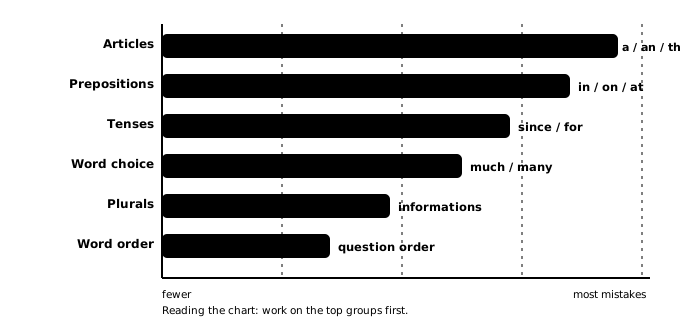
The chart below shows which areas of Indian speakers' writing and speaking are corrected most often. If you are short of time, start with the top two groups — they will make the biggest difference.
58.2 Group 1 — Articles (mistakes 1 to 7)
Hindi has nothing like a, an, the. So these words feel "useless" and get dropped. The firm rule: every singular countable noun needs something in front of it — a, an, the, my, this, one… anything, but never nothing.
1–7 · a / an / the
- Wrong: 1. I am going to market.
- Right: I'm going to the market.
-
Why: For a place both people know (the neighbourhood market), use "the". A singular countable noun cannot stand bare.
-
Wrong: 2. She is doctor.
- Right: She's a doctor.
-
Why: When you state a job, a/an is always used: a teacher, an engineer, a driver.
-
Wrong: 3. He is a honest man.
- Right: He's an honest man.
-
Why: a/an is decided by the sound, not the spelling. The H in "honest" is silent, so the sound starts with "o" — an. Likewise: an hour, but a university (the sound is "yoo").
-
Wrong: 4. I like the music.
- Right: I like music.
-
Why: "The" is not used for general statements. "The music" means that particular music that is playing right now.
-
Wrong: 5. He went to the Mumbai.
- Right: He went to Mumbai.
-
Why: No "the" before names of cities and countries. Exceptions: the US, the UK, the Netherlands, the Philippines.
-
Wrong: 6. I have an university degree.
- Right: I have a university degree.
-
Why: "University" begins with the sound "yoo-" — that is a consonant sound, so "a".
-
Wrong: 7. Please pass me salt.
- Right: Please pass me the salt.
- Why: The salt on the table — a specific thing, so "the". Even uncountable nouns take "the" when the thing is specific.
58.3 Group 2 — Tenses (8 to 16)
The tense structures of Hindi and English are quite similar, but the present perfect (have/has + done) does not exist in Hindi. That is why it causes the most mistakes.
8–16 · tenses
- Wrong: 8. I am working here since three years.
- Right: I have been working here for three years.
-
Why: Two mistakes together: work that started earlier and is still going on = have been + -ing. And "for" goes with a duration, "since" with a point in time.
-
Wrong: 9. I didn't went to office.
- Right: I didn't go to the office.
-
Why: "Did" already shows the past, so the verb stays in its base form. Did + go, never did + went.
-
Wrong: 10. He have finished the work.
- Right: He has finished the work.
-
Why: "Has" with he, she, it. "Have" with I, we, you, they.
-
Wrong: 11. I am having a car.
- Right: I have a car.
-
Why: "Have" meaning possession is not used in the continuous. But it works in the sense of eating or drinking: "I'm having lunch."
-
Wrong: 12. Yesterday I have gone to Delhi.
- Right: Yesterday I went to Delhi.
-
Why: When a time in the past is stated (yesterday, last week, in 2019), use the simple past — never the present perfect.
-
Wrong: 13. I will tell you when he will come.
- Right: I'll tell you when he comes.
-
Why: After "when", "if", "after", "before", the present tense is used even for the future. No two "will"s in one sentence.
-
Wrong: 14. She is knowing the answer.
- Right: She knows the answer.
-
Why: Verbs of thinking and feeling do not go into the continuous: know, understand, believe, like, want, need, mean.
-
Wrong: 15. I have my breakfast at eight every day.
- Right: I have breakfast at eight every day.
-
Why: No "my" with the meals of a daily habit: have breakfast, have lunch, have dinner.
-
Wrong: 16. By the time I reached, the train left.
- Right: By the time I reached, the train had left.
- Why: When two things happened in the past, the one that happened first takes "had". This is called the past perfect.
58.4 Group 3 — Prepositions (17 to 25)
One Hindi word becomes three English prepositions (me → in/on/at), and many English verbs take no preposition at all. Mistakes come from both causes.
17–25 · prepositions
- Wrong: 17. Let's discuss about the plan.
- Right: Let's discuss the plan.
-
Why: Discuss already contains the meaning of "about". Others in the same family: enter the room, reach Delhi, order two teas, request a copy, consider my application.
-
Wrong: 18. He is good in maths.
- Right: He's good at maths.
-
Why: Skilled at something = good at. Good with = good at handling things (good with kids, good with numbers).
-
Wrong: 19. I am afraid from dogs.
- Right: I'm afraid of dogs.
-
Why: Fear is always "of". Likewise: tired of, proud of, ashamed of, capable of.
-
Wrong: 20. She is married with an engineer.
- Right: She's married to an engineer.
-
Why: Marriage is always "married to". "Married with" ends up meaning "married with children".
-
Wrong: 21. Please explain me the process.
- Right: Please explain the process to me.
-
Why: After explain, describe, suggest and mention, the thing comes first, then "to" + the person.
-
Wrong: 22. I will reach at the station by six.
- Right: I'll reach the station by six. / I'll arrive at the station by six.
-
Why: After reach, the place follows directly. Arrive takes a preposition: arrive at (a small place), arrive in (a city, a country).
-
Wrong: 23. He died from cancer.
- Right: He died of cancer.
-
Why: Death from an illness = died of. From an accident or injury = died from injuries.
-
Wrong: 24. I have been waiting since two hours.
- Right: I've been waiting for two hours.
-
Why: For = how long (duration). Since = from when (a point). "Since 4 o'clock" is right, "since two hours" is wrong.
-
Wrong: 25. He is angry on me.
- Right: He's angry with me.
- Why: Angry at a person = angry with. At a thing or situation = angry about the delay.
58.5 Group 4 — Word choice (26 to 35)
Here the mistake is not grammar but choosing the word. Often two words seem alike but do different jobs.
26–35 · choosing the word
- Wrong: 26. I will give the exam next month.
- Right: I'll take the exam next month.
-
Why: A student takes an exam; a teacher gives/sets one. The Hindi "dena" lands exactly backwards.
-
Wrong: 27. There is too much traffic — it's very bad.
- Right: There's a lot of traffic.
-
Why: "Too much" means "more than is needed", not just "a lot". For "a lot", use "a lot of" or "a great deal of".
-
Wrong: 28. How much peoples came?
- Right: How many people came?
-
Why: Two mistakes: if you can count it, use "many" (not much), and "people" is already plural.
-
Wrong: 29. I am boring in this class.
- Right: I'm bored in this class.
-
Why: -ing = what the thing is like (the class is boring). -ed = how you feel (I am bored). Likewise: interesting/interested, confusing/confused, tiring/tired.
-
Wrong: 30. Myself Ravi.
- Right: I'm Ravi.
-
Why: "Myself" is a reflexive pronoun (I hurt myself) — it cannot be a subject.
-
Wrong: 31. Please revert back at the earliest.
- Right: Please get back to me by Thursday.
-
Why: Revert already contains "back", so "back" is redundant. And write a real date instead of "at the earliest".
-
Wrong: 32. He has less friends than me.
- Right: He has fewer friends than me.
-
Why: If you can count it, use "fewer" (fewer friends, fewer errors). If you can't, use "less" (less water, less time).
-
Wrong: 33. Its raining outside.
- Right: It's raining outside.
-
Why: It's = it is. Its = belonging to it (The dog wagged its tail). Here the apostrophe shows a shortcut, not possession.
-
Wrong: 34. I can able to finish it today.
- Right: I can finish it today. / I'm able to finish it today.
-
Why: Both do the same job — choose one. "Can able to" joins the two, which is wrong.
-
Wrong: 35. Open the light.
- Right: Turn on the light. / Switch on the light.
- Why: The Hindi "kholna" does two jobs in English. A door is opened; a light, fan or TV is turned on/off.
58.6 Group 5 — Word order (36 to 42)
The Hindi order is Subject – Object – Verb (main khaana khaata hoon). The English order is Subject – Verb – Object (I eat food). The difference shows most in questions and adjectives.
36–42 · word order
- Wrong: 36. What you are doing?
- Right: What are you doing?
-
Why: In a question the helping verb comes before the subject: What are you… / Where did he… / Why has she…
-
Wrong: 37. Tell me where is the station.
- Right: Tell me where the station is.
-
Why: When a question sits inside a larger sentence, the order becomes straight — the verb moves to the back.
-
Wrong: 38. I yesterday went to the bank.
- Right: I went to the bank yesterday.
-
Why: The time word goes at the end (or the beginning) — not between the subject and the verb.
-
Wrong: 39. She speaks very well English.
- Right: She speaks English very well.
-
Why: First the object (English), then the adverb (very well). Nothing comes between a verb and its object.
-
Wrong: 40. He gave to me the keys.
- Right: He gave me the keys. / He gave the keys to me.
-
Why: Only two orders are correct: verb + person + thing, or verb + thing + to + person. The one in the middle is wrong.
-
Wrong: 41. A red big plastic box.
- Right: A big red plastic box.
-
Why: The order of adjectives is fixed: opinion → size → age → colour → origin → material. "Big" (size) comes before "red" (colour).
-
Wrong: 42. Only I have one question.
- Right: I have only one question.
- Why: "Only" goes right before the word you want to stress. Change its place, and the meaning changes.
58.7 Group 6 — Plurals and countables (43 to 50)
Some things cannot be counted in English, while in Hindi the same things are counted without trouble. That is the root of these eight mistakes.
43–50 · plurals and counting
- Wrong: 43. I need some informations.
- Right: I need some information. / I need a few details.
-
Why: Information is uncountable — it never takes "s". To count it: two pieces of information.
-
Wrong: 44. He gave me good advices.
- Right: He gave me good advice. / He gave me a piece of advice.
-
Why: Advice is uncountable. In the same list: furniture, luggage, equipment, machinery, traffic, homework, research, feedback, knowledge.
-
Wrong: 45. My hairs are wet.
- Right: My hair is wet.
-
Why: All the hair on your head together is "hair" (uncountable). "Hairs" means single strands — the kind you find in food!
-
Wrong: 46. There are many equipments in the lab.
- Right: There's a lot of equipment in the lab.
-
Why: Equipment is uncountable, so "many" has to change to "a lot of" and the verb becomes singular.
-
Wrong: 47. Peoples are waiting outside.
- Right: People are waiting outside.
-
Why: "People" is already plural (the plural of person). "Peoples" means "several nations" — a completely different thing.
-
Wrong: 48. I bought two pant and three shirt.
- Right: I bought two pairs of trousers and three shirts.
-
Why: Shirt is countable, so "shirts". Trousers/pants are always plural, and they are counted in "pairs" — like scissors and glasses.
-
Wrong: 49. Each of the students have a laptop.
- Right: Each of the students has a laptop.
-
Why: Each, every, everyone, nobody — all are singular, even if a plural follows. Likewise: "Everyone is here."
-
Wrong: 50. The news are not good.
- Right: The news is not good.
- Why: "News" ends in "s" but is singular. Likewise: mathematics, physics, economics, politics — all take a singular verb.
58.8 Three rules that save 30 of the 50
Three things worth memorising
1. Every singular countable noun needs something in front of it — a, an, the, my, this. Never bare.
2. Show the tense only once in a sentence — did + go, will + come, has + finished. Don't put the past in two places.
3. In English the verb grabs its object directly — no time word, adverb or "to me" squeezes in between.
58.9 Fixed pairs — better learned by heart
Some adjectives and verbs have a fixed preposition. There is no point hunting for logic in these — they are pairs, so learn them as pairs. This table alone prevents half the mistakes of Groups 3 and 4.
| Pair | Example | What people wrongly say |
|---|---|---|
| good at | good at cricket | good in |
| afraid of | afraid of heights | afraid from |
| married to | married to a teacher | married with |
| angry with (a person) | angry with me | angry on me |
| angry about (a thing) | angry about the delay | angry for the delay |
| die of (an illness) | died of a heart attack | died from a heart attack |
| depend on | it depends on you | depends from you |
| listen to | listen to me | listen me |
| explain to | explain it to me | explain me |
| agree with (a person) | I agree with you | I am agree with you |
| interested in | interested in design | interested for design |
| responsible for | responsible for payroll | responsible of payroll |
| congratulate on | congratulate her on the win | congratulate her for the win |
| apologise for | apologise for the delay | apologise of the delay |
| no preposition | discuss · enter · reach · order · request · consider · marry | discuss about, enter into, reach at… |
58.10 Six correct sentences — say them aloud
One corrected sentence from each group. Listening and speaking them settles the rules faster than memorising — because the ear learns to catch the mistake.
- She's a doctor at the hospital near the market. Articles — "a" with a job, "the" with a familiar place.
- I've been working here for three years. Tenses — the work started earlier and is still going on; "for" with a duration.
- He's good at maths but he's afraid of exams. Prepositions — good at, afraid of. These pairs are fixed.
- I'll take the exam next month, so please get back to me by Friday. Word choice — you "take" an exam, and "get back to me" replaces "revert back".
- Could you tell me where the station is? Word order — the question sits inside a larger sentence, so the verb moves to the back.
- The news is good, and each of the teams has its own budget. Plurals — "news" and "each" both take a singular verb.
How to use this page
Read it all the way through once — only once. After that, open it only when you need it. When you catch the same mistake three times, it fixes itself. Trying to memorise the whole list gets you nowhere.
58.11 Practice — 50 mistakes
Exercise 1
Which sentence is correct?
- He is an honest man with a university degree.
- He is a honest man with an university degree.
- He is an honest man with an university degree.
- He is a honest man with a university degree.
Hint: a/an is decided by the sound, not the spelling.
Answer
He is an honest man with a university degree.
The H in honest is silent and the sound begins with 'o' — an. University begins with the sound 'yoo', which is like a consonant — a.
Exercise 2
In Hindi: 'Main teen saal se yahan kaam kar raha hoon' (I started working here three years ago and still do). What is the correct English?
- I have been working here for three years.
- I am working here since three years.
- I work here since three years.
- I am working here for three years only.
Answer
I have been working here for three years.
Work that started earlier and is still going on = have been + -ing. And 'for' goes with a duration, 'since' with a point in time.
Exercise 3
Which sentence is wrong?
- She is married with an engineer.
- She is married to an engineer.
- He is afraid of dogs.
- He is angry with me.
Answer
She is married with an engineer.
Marriage is always 'married to'. 'Married with' ends up meaning married with children.
Exercise 4
Which verb goes with exam for a student?
- take the exam
- give the exam
- do the exam paper only
- put the exam
Answer
take the exam
A student takes an exam; a teacher gives or sets one. The Hindi 'dena' lands exactly backwards.
Exercise 5
Which is the correct order of adjectives?
- a big red plastic box
- a red big plastic box
- a plastic big red box
- a red plastic big box
Hint: Size first, colour later.
Answer
a big red plastic box
The order is fixed: opinion → size → age → colour → origin → material. So big (size) comes before red (colour).
Exercise 6
I have been waiting ___ two hours.
Hint: Is it a duration or a point?
Answer
for
For = how long. Since = from when. 'Since 4 o'clock' is right, 'since two hours' is wrong.
Exercise 7
He has ___ friends than me, but they are good ones.
Hint: Friends can be counted.
Answer
fewer
If you can count it, use fewer (fewer friends, fewer errors). If you can't, use less (less water, less time).
Exercise 8
Each of the students ___ a laptop.
Hint: Is each singular or plural?
Answer
has
Each, every, everyone, nobody — all are singular, even if a plural follows.
Exercise 9
Please ___ on the light, it's getting dark.
Hint: A light is not 'opened'.
Answer
turn / switch
The Hindi 'kholna' does two jobs. A door is opened; a light, fan or TV is turned on/off.
Exercise 10
Find the wrong word.
I didn't went to the office yesterday.
Answer
Wrong word: went.
Corrected: I didn't go to the office yesterday.
'Did' already shows the past, so the verb stays in its base form — did + go.
Exercise 11
One word has a needless 's' — tap it.
He gave me some very useful advices.
Answer
Wrong word: advices.
Corrected: He gave me some very useful advice.
Advice is uncountable. In the same list: information, furniture, luggage, equipment, feedback, homework.
Exercise 12
The order is wrong — tap the word in the wrong place.
Tell me where is the station please.
Answer
Wrong word: is.
Corrected: Tell me where the station is, please.
When a question sits inside a larger sentence, the order becomes straight — the verb moves to the back.
Exercise 13
One word is wrong — find it.
My hairs are wet because of the rain.
Answer
Wrong word: hairs.
Corrected: My hair is wet because of the rain.
All the hair on your head together is 'hair' (uncountable), so the verb becomes 'is' too.
Exercise 14
Match each wrong form to its correct form.
| A | B |
|---|---|
| discuss about the plan | good at maths |
| explain me this | afraid of dogs |
| good in maths | discuss the plan |
| afraid from dogs | explain this to me |
Answer
discuss about the plan — discuss the plan; explain me this — explain this to me; good in maths — good at maths; afraid from dogs — afraid of dogs
Some verbs take no preposition, and some adjectives have their own fixed pair.
Exercise 15
Match each word to its type.
| A | B |
|---|---|
| information | has 's' but is singular |
| people | always plural, counted in pairs |
| news | uncountable — no 's' |
| trousers | already plural |
Answer
information — uncountable — no 's'; people — already plural; news — has 's' but is singular; trousers — always plural, counted in pairs
Remember the counting rules and almost all the mistakes of Group 6 disappear by themselves.
Exercise 16
Put the words in the right order.
Words: very / She / English / speaks / well
Answer
She speaks English very well
First the object (English), then the adverb (very well). Nothing comes between the verb and its object.
Exercise 17
Build the question in the right order.
Words: What / this / are / evening / you / doing
Answer
What are you doing this evening
In a question the helping verb (are) comes before the subject (you).
Exercise 18
Say this line — it has fixes from three groups together.
I have been working here for three years and I am good at my job
Answer
Say: I have been working here for three years and I am good at my job
Tense (have been working), prepositions (for, good at), and word order — all three are correct in a single line.