Chapter 4: Sentence structure
Sentence structure — how a sentence is built
With parts of speech we met the bricks — noun, verb, adjective. Now we will see how these bricks build a wall. In English the order of words is almost fixed, and the moment you understand this order, even the longest sentence starts to look easy. All the later chapters — tenses, modals, clauses — run on this same map.
- 1Subject and Predicate — the two halves of a sentence
- 2Hindi is SOV, English is SVO — why the order is fixed
- 3Five building blocks — S, V, O, C, A
- 4Five core patterns
- 5Sentences with two objects — to whom and what
- 6Phrase and Clause — the difference is one pair
- 7The mistakes we really make
- 8How to break down any sentence
In one line
A sentence is a group of words with a subject and a verb that expresses a complete thought. Subject + verb + complete meaning — you need all three to have a sentence.
- Birds fly. Only two words, yet a full sentence — it has a subject and a verb.
- My sister teaches maths. = My sister is a maths teacher.
- In the morning. (not a sentence) No subject, no verb — it is only a fragment, so the meaning is unfinished.
4.1 Subject and Predicate — the two halves of a sentence
Every sentence can be cut into two halves in the middle. Once you can see this cut, choosing the right form of the verb (is or are, go or goes) becomes easy — because the verb always listens to the subject.
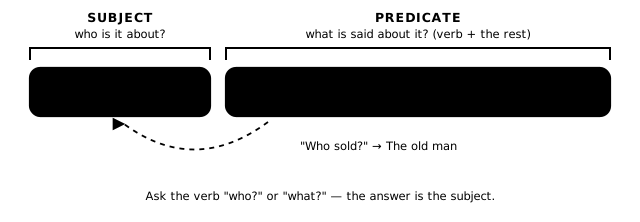
Subject and predicate
Subject = what the sentence is about. Predicate = the verb and everything after it. To find the subject, ask the verb "who?" or "what?". The form of the verb (is/are, go/goes) is always decided by the subject.
- The children in the park | are playing cricket. Who is playing? "The children in the park" — the whole group is the subject, so we use "are".
- Learning English | is not difficult. A subject can also be an activity — "learning English" is not difficult.
The hidden subject
In commands and requests the subject is not visible, but it is there — you.
Sit down. = (You) sit down. Please close the door. = (You) please close the door.
4.2 Hindi is SOV, English is SVO — why the order is fixed
In Hindi we can say "Ram ne Shyam ko maara" or "Shyam ko Ram ne maara" — the meaning stays the same, because "ne" and "ko" show who did what to whom. English has no small markers like these. There, who is doing the action is shown only by position.
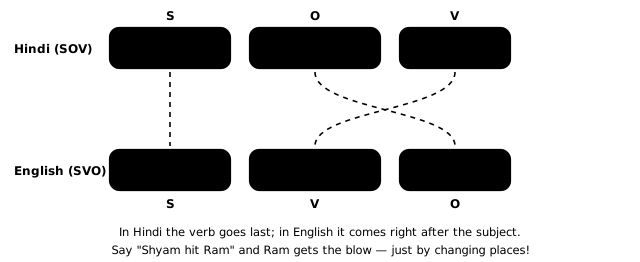
The fixed English order
In English the order is the meaning: Subject → Verb → Object. The verb always comes right after the subject, never at the end. If the words change places, the meaning changes.
| Hindi order (S O V) | English order (S V O) |
|---|---|
| Main chai peeta hoon. (I tea drink) | I drink tea. |
| Wo roz akhbaar padhti hai. (She daily newspaper reads) | She reads the newspaper daily. |
| Bachchon ne khana kha liya. (The children food eaten) | The children have eaten the food. |
| Hum kal Jaipur jaayenge. (We tomorrow Jaipur will go) | We will go to Jaipur tomorrow. |
When you translate in your head
When you turn Hindi into English, first pick up the verb and put it next to the subject. "Main roz subah park me chalta hoon" → I walk in the park every morning. The other words (where, when) come after the verb, at the end.
4.3 Five building blocks — S, V, O, C, A
Every English sentence is built from five bricks. You need to remember their names, because dictionaries, grammar books and this book will all talk using these names.
| Block | Job | Question | Example |
|---|---|---|---|
| S — Subject | what the sentence is about | Who? What? | Ravi plays. |
| V — Verb | an action or being | What does it do / what is it? | Ravi plays. |
| O — Object | what the action falls on | What? Whom? | Ravi plays cricket. |
| C — Complement | says who or what the subject is | Who is it? What is it like? | Ravi is the captain. |
| A — Adverbial | place, time, manner | Where? When? How? | Ravi plays in the evening. |
Object or complement? Try the '=' test
A sentence has five blocks: S, V, O, C, A. To tell an object from a complement, use "=": She became a doctor → she = doctor (complement). She met a doctor → she ≠ doctor (object).
- The tea tastes sweet. tea = sweet → "sweet" is a complement. A complement can be an adjective too.
- The boy broke the glass. boy ≠ glass → "the glass" is the object; the action fell on it.
4.4 Five core patterns
The good news is that thousands of English sentences are really built on just five patterns. The verb decides which pattern is used — some verbs work alone, some need an object, some need two.
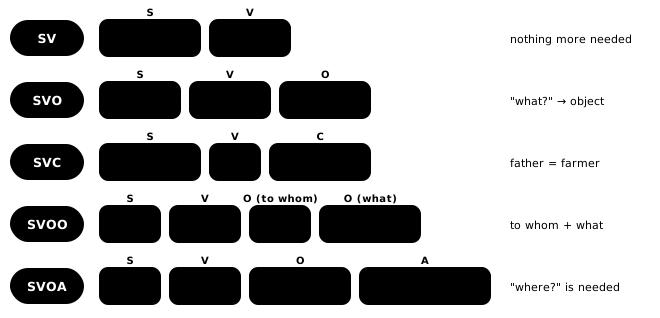
Five patterns
Almost every sentence is one of these five: SV, SVO, SVC, SVOO, SVOA. The verb decides which one applies. Extra words for when, where and how are added on top of these.
| Pattern | Verbs like these | Example |
|---|---|---|
| SV | arrive, sleep, cry, laugh, fall | The guests arrived. |
| SVO | eat, buy, love, read, make | We bought a scooter. |
| SVC | be, become, seem, look, feel | The room looks clean. |
| SVOO | give, send, show, tell, teach, buy | She sent me a photo. |
| SVOA | put, keep, place, leave (where?) | He put the milk in the fridge. |
Extra words don't change the pattern
The baby slept peacefully in the cradle after lunch. — this is still SV. The parts about how, where and when are decoration; if you remove them the sentence is still complete. But in SVOA the A is needed: "He put the milk." feels unfinished — where did he put it?
4.5 Sentences with two objects — to whom and what
With verbs like give, send, show and tell there is one person and one thing. You can arrange them in two ways, and both are correct — you only have to be careful with the small word "to".
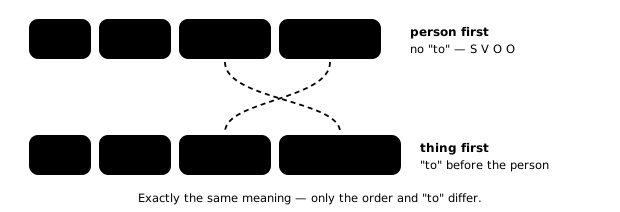
- He told us a story. / He told a story to us. = He told a story to us.
- Papa bought me a cycle. / Papa bought a cycle for me. With buy, make, cook we use "for", not "to".
explain, describe, suggest — the person does not come first
- Wrong: Please explain me the rule.
- Right: Please explain the rule to me.
- Why: explain, describe, suggest and say do not use the SVOO pattern. The thing comes first, then "to" + the person.
4.6 Phrase and Clause — the difference is one pair
To understand a long sentence you have to break it into pieces. The pieces are of two kinds, and there is one way to tell them apart: look inside the piece for a subject + verb pair.
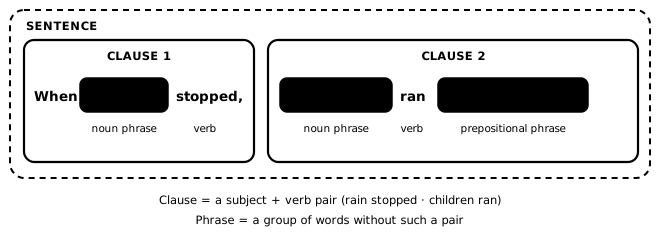
Phrase vs clause
A phrase = a group of words without a subject + verb pair (in the morning). A clause = a group that has its own subject and verb (when the rain stopped). A sentence has one or more clauses.
| Type of phrase | Built around | Example |
|---|---|---|
| Noun phrase | a noun | a very old temple |
| Verb phrase | a main verb + helping verbs | she has been waiting |
| Prepositional phrase | starts with a preposition | under the bridge |
| Adjective phrase | an adjective | The film was really boring. |
| Adverb phrase | an adverb | He spoke very slowly. |
This vocabulary will be useful later
In the clauses chapter we will see how two clauses are joined — with and, but, because, who, which. For now, just be sure of this: a clause has a verb, a phrase does not.
4.7 The mistakes we really make
Common mistakes with order and patterns
- Wrong: Yesterday I market went.
- Right: Yesterday I went to the market.
-
Why: This is the Hindi SOV order ("main market gaya") copied directly. In English the verb comes right after the subject, and after "go" we put "to" before a place.
-
Wrong: This movie very good.
- Right: This movie is very good.
-
Why: In Hindi we can say "ye film bahut achhi", but in English there is no sentence without a verb. The SVC pattern needs a linking verb like "is".
-
Wrong: Myself Rahul.
- Right: I am Rahul. / My name is Rahul.
-
Why: "Myself Rahul" has neither a correct subject nor a verb. "Myself" is never a subject — it only takes the place of an object: I hurt myself.
-
Wrong: My brother he works in Pune.
- Right: My brother works in Pune.
-
Why: One subject per clause. "My brother" is the subject, so "he" is a repeat — remove it.
-
Wrong: Why you are late?
- Right: Why are you late?
- Why: In a question the helping verb comes before the subject. This is a fixed change of order in English; it does not happen in Hindi.
4.8 How to break down any sentence
When a long sentence doesn't make sense, don't panic. Ask these four questions in order — every sentence will open up.
| Step | What to ask | What you get |
|---|---|---|
| 1 | What is the action or state of being? | Verb (V) |
| 2 | Ask the verb "who? / what?" | Subject (S) |
| 3 | After the verb, "what? / whom?" — and the "=" test | Object (O) or Complement (C) |
| 4 | "Where? When? How?" | Adverbial (A) |
- My grandmother makes pickles every summer. V = makes · S = my grandmother · O = pickles · A = every summer → SVO + extra.
4.9 Practice — Sentence structure
Exercise 1
'The baby is sleeping.' — which pattern is this?
- SV
- SVO
- SVC
- SVOA
Hint: Is anything else needed after the verb?
Answer
SV
'is sleeping' is the complete verb, and nothing is needed after it. No object, no complement — so it is SV.
Exercise 2
'My uncle became a pilot.' — what is 'a pilot' here?
- Complement
- Object
- Adverbial
- Subject
Hint: Try the '=' test.
Answer
Complement
uncle = pilot — both are the same person. When the '=' works, it is a complement, not an object.
Exercise 3
'She gave her friend a book.' — which pattern?
- SVOO
- SVO
- SVOA
- SVC
Answer
SVOO
There are two objects — 'her friend' (to whom) and 'a book' (what). So it is S V O O.
Exercise 4
Which of these is a clause, not a phrase?
- because she was tired
- in the morning
- a very tall boy
- under the old bridge
Hint: Look for a subject + verb pair.
Answer
because she was tired
'she was' — here both a subject (she) and a verb (was) are present, so this is a clause. The other three have no such pair; they are phrases.
Exercise 5
'Every morning, my grandfather walks in the park.' — what is the subject?
- my grandfather
- Every morning
- the park
- walks
Hint: Ask the verb: who walks?
Answer
my grandfather
The verb is 'walks'. Who walks? — my grandfather. 'Every morning' is at the start of the sentence, but it tells you the time, not the subject.
Exercise 6
This tea ___ very hot.
Hint: Without a verb the sentence is unfinished.
Answer
is
This is the SVC pattern — tea = hot. You need the linking verb 'is' to join the subject to the complement. In Hindi 'chai bahut garam' is fine, but not in English.
Exercise 7
There is one extra word in this sentence — tap it.
My sister she teaches English in Delhi.
Answer
Wrong word: she.
Corrected: My sister teaches English in Delhi.
'My sister' is already the subject. A second subject 'she' in one clause is a repeat — remove it.
Exercise 8
Find the wrong word.
Please explain me this sentence.
Answer
Wrong word: me.
Corrected: Please explain this sentence to me.
'explain' does not take the two-object pattern. The thing comes first, then 'to me'.
Exercise 9
Put it in the right English order.
Words: drink / every / morning / I / tea
Answer
I drink tea every morning
Subject (I) → verb (drink) → object (tea) → time (every morning). The verb does not go at the end as it does in Hindi.
Exercise 10
Make a sentence in the SVOA pattern.
Words: keys / table / She / on / the / the / put
Answer
She put the keys on the table
S (She) + V (put) + O (the keys) + A (on the table). 'put' needs a 'where', so you can't remove the A.
Exercise 11
Match each pattern to its example.
| A | B |
|---|---|
| SV | The soup is hot. |
| SVO | He told us a story. |
| SVC | The bus arrived. |
| SVOO | Ravi plays cricket. |
Answer
SV — The bus arrived.; SVO — Ravi plays cricket.; SVC — The soup is hot.; SVOO — He told us a story.
arrive needs nothing (SV), play takes an object (SVO), is is followed by an identity or state (SVC), and tell takes a person + a thing (SVOO).
Exercise 12
Now say this line — put the verb 'went' right after the subject.
Yesterday I went to the market
Answer
Say: Yesterday I went to the market
Saying it aloud settles the SVO order on your tongue. The more times you say it correctly, the faster the 'I market went' habit will go.
What next?
Today take any three lines from an English newspaper and find the S, V and O in each. If you do this for five days, your brain will start to break up long sentences by itself when you read them.