Chapter 36: Word formation
One word, ten words — the magic of prefixes and suffixes
The cheapest way to grow your vocabulary is not memorising new words — it is spotting the relatives of the words you already know. Do you know happy? Then you also know unhappy, happiness, happily, unhappiness — you just did not realise it. Pieces added at the start (prefixes) change the meaning, and pieces added at the end (suffixes) change the job of the word. After this chapter, every long new word will look like a set of small pieces.
- 1One root, a whole family — word family
- 2Prefixes — add at the start, change the meaning
- 3Which "not" — un, dis, in, im, il, ir
- 4Suffixes that make nouns — -tion, -ment, -ness
- 5Adjectives and adverbs — -ful, -less, -able, -ly
- 6-ize and some old roots
- 7Six families — in one table
- 8The mistakes we really make
36.1 One root, a whole family — word family
Learning a word together with its family has two benefits: you get four words for the effort of one, and it becomes easy to pick the right form in a sentence. Mistakes like "He spoke happy" or "Her happy was clear" stop right here.
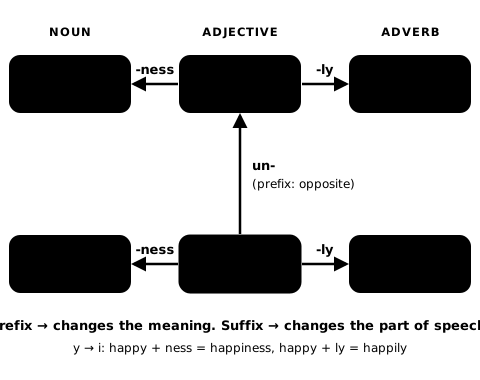
- She looks happy. She smiled happily. Her happiness was clear. One root, three jobs: how she looks (adjective), how she smiled (adverb), what we could see (noun).
Two kinds of pieces
A prefix (at the start) changes the meaning of a word: happy → unhappy. A suffix (at the end) changes the job of a word: happy (adj) → happiness (noun) → happily (adverb).
36.2 Prefixes — add at the start, change the meaning
Seven prefixes are so common that hundreds of everyday English words are built from them. Once you remember what they mean, you can guess unknown words too — misread = to read wrongly.
| Prefix | Meaning | Examples |
|---|---|---|
| un- | not / opposite | unhappy · unfair · unlock |
| dis- | not / opposite | dislike · disagree · disconnect |
| im- / in- | not | impossible · incorrect · invisible |
| re- | again / back | redo · rewrite · return |
| mis- | wrongly | misunderstand · misspell · mislead |
| pre- | before | preview · prepaid · preheat |
| over- | too much | overeat · overload · overconfident |
- I think you misunderstood me. Let me rephrase that. = You understood me wrongly. I will say it again in different words.
- Don't overcook the rice, and please preheat the oven. = Do not cook the rice too long, and heat the oven first.
A prefix never changes the spelling
A prefix is simply stuck on the front — the spelling of the root stays the same. That is why two identical letters sometimes meet: un + necessary = unnecessary, mis + spell = misspell, dis + satisfied = dissatisfied.
36.3 Which "not" — un, dis, in, im, il, ir
There are six prefixes that mean "not", and they cause the most confusion — "unpossible", "unregular". The good news: half of them follow a firm rule, and that rule only looks at the first letter of the root.
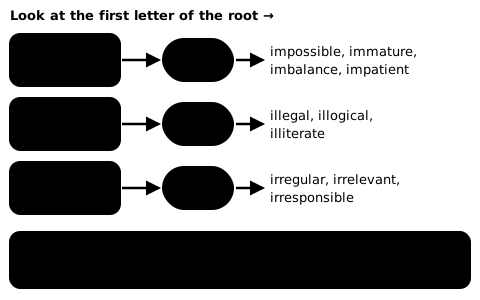
The first-letter rule
p, m, b → im- (impossible) · l → il- (illegal) · r → ir- (irregular). There is no rule for un- / dis- / in- — learn them as pairs with each word. If in doubt, check a dictionary — a word like "unpossible" does not exist.
36.4 Suffixes that make nouns — -tion, -ment, -ness
Formal English, emails and reports are full of nouns — "We made a decision" instead of "We decided". Three suffixes make most nouns: the name of an action (-tion, -ment) and the name of a quality (-ness).
| Word → noun | Suffix | Example |
|---|---|---|
| inform → information | -tion | Thanks for the information. |
| educate → education | -tion | Education changes lives. |
| decide → decision | -sion | It was a hard decision. |
| develop → development | -ment | The city needs development. |
| agree → agreement | -ment | We signed an agreement. |
| pay → payment | -ment | The payment is due today. |
| kind → kindness | -ness | Thank you for your kindness. |
| happy → happiness | -ness | Money can't buy happiness. |
Name of an action, name of a quality
Verb + -tion / -ment = noun (inform → information, agree → agreement). Adjective + -ness = noun (kind → kindness). A final y becomes i before -ness: happy → happiness. Also, a silent final "e" often drops: educate → education, decide → decision.
36.5 Adjectives and adverbs — -ful, -less, -able, -ly
These four suffixes are the heart of description. One noun can give two opposite adjectives (-ful and -less), and if you add -ly to them, they can describe a verb.
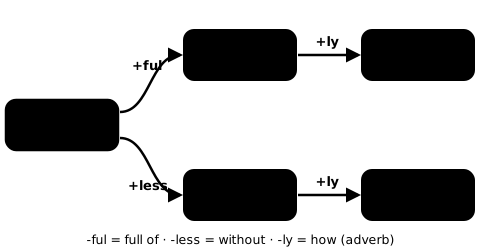
| Suffix | Meaning | Examples |
|---|---|---|
| -ful | full of | careful · useful · hopeful |
| -less | without | careless · useless · hopeless |
| -able | can be done | readable · washable · comfortable |
| -ly | adjective → adverb | quickly · carefully · happily |
One l, two l's
-ful always has only one l: careful, useful, beautiful — never "carefull". But when you add -ly, two l's appear: careful + ly = carefully. Watch out: friendly, lovely, lonely end in -ly but they are adjectives — "a friendly person".
36.6 -ize and some old roots
-ize turns a noun or an adjective into an action (a verb) — you see it everywhere in office English. Many long words are also built from old Latin roots; once you recognise one root, a whole bunch of words makes sense.
| Word | + -ize = verb | Example |
|---|---|---|
| modern | modernize | We need to modernize the office. |
| real | realize | I didn't realize it was so late. |
| summary | summarize | Can you summarize the report? |
| priority | prioritize | Let's prioritize the urgent tasks. |
| apology | apologize | I apologize for the delay. |
The British spelling -ise (realise, apologise) is also perfectly correct, and both are used in India. Just keep to one style in a document.
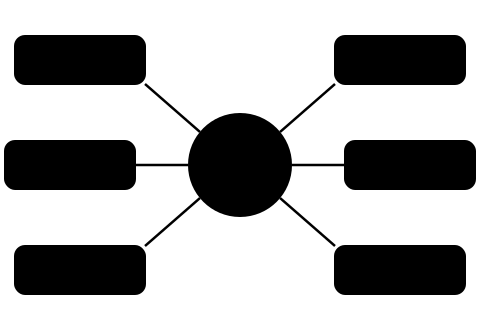
| Root | Meaning | Words |
|---|---|---|
| port | carry | transport · export · portable |
| dict | say | predict · dictionary · contradict |
| spect | look carefully | inspect · respect · spectator |
| vis / vid | see | visible · vision · video |
| scrib / script | write | describe · script · subscribe |
Long word? Break it up
Prefix + root + suffix: in-spect-ion = the act of looking inside (a check); pre-dict-able = can be said in advance. Break an unknown word into pieces — half of the meaning will appear by itself.
36.7 Six families — in one table
These are the families whose forms are most often used wrongly. Read each line aloud from left to right — you will learn four words in one go.
| Verb | Noun | Adjective | Adverb |
|---|---|---|---|
| decide | decision | decisive | decisively |
| succeed | success | successful | successfully |
| create | creation | creative | creatively |
| care | care | careful | carefully |
| differ | difference | different | differently |
| attract | attraction | attractive | attractively |
- She succeeded because she worked carefully. Her success was no accident. Three family members, three jobs — the adverb goes with the verb, the noun stands alone.
The notebook habit
When you write down a new word, write its whole family next to it — verb, noun, adjective, adverb. A box that stays empty (like a common adverb for "differ") is useful information too.
36.8 The mistakes we really make
These mistakes happen because we choose the right root but the wrong form — a verb instead of a noun, an adjective instead of an adverb, or the wrong "not" prefix.
Common word-formation mistakes
- Wrong: This is unpossible.
- Right: This is impossible.
-
Why: "possible" starts with p → im-. In the same way unregular → irregular, unlegal → illegal.
-
Wrong: Her behave in the meeting was rude.
- Right: Her behaviour in the meeting was rude.
-
Why: A noun is needed after "Her ___ was". behave = verb, behaviour (US: behavior) = noun.
-
Wrong: He answered very confident.
- Right: He answered very confidently.
-
Why: To describe a verb (answered) you need an adverb: -ly. The adjective is fine in "He is confident".
-
Wrong: I am very boring in this class.
- Right: I am very bored in this class.
-
Why: -ed = how you feel (bored, tired, interested). -ing = what causes the feeling (a boring class). "I am boring" means I am a boring person!
-
Wrong: Can you repeat it again?
- Right: Can you repeat it? / Can you say it again?
- Why: re- already means "again" — "repeat again" is "again again". In the same way, "back" is unnecessary in "revert back".
36.9 Practice — Word formation
Exercise 1
What is the opposite of 'possible'?
- impossible
- unpossible
- dispossible
- nonpossible
Answer
impossible
The root starts with 'p', so it takes im-. Remember: p, m, b → im-.
Exercise 2
What is the opposite of 'regular'?
- irregular
- unregular
- disregular
- misregular
Answer
irregular
The root starts with 'r' → ir-. In the same way: irrelevant, irresponsible.
Exercise 3
Which of these is an adverb?
- happily
- happiness
- unhappy
- happy
Answer
happily
-ly turns an adjective into an adverb: happy → happily. happiness is a noun, unhappy is an adjective.
Exercise 4
Please drive ___. The road is wet. (care)
Hint: It describes the verb 'drive' — you need an adverb.
Answer
carefully
care → careful (adjective) → carefully (adverb). Two l's, because careful + ly.
Exercise 5
We need to make a ___ by Friday. (decide)
Hint: A noun comes after 'a'.
Answer
decision
decide → decision. The final 'de' becomes '-sion'. 'make a decision' is a fixed pair.
Exercise 6
Thank you for your ___. (kind)
Hint: A noun comes after 'your' — the name of a quality.
Answer
kindness
Adjective + -ness = noun: kind → kindness, dark → darkness.
Exercise 7
One word in this sentence has the wrong form. Tap it.
Her behave in the meeting was very rude.
Answer
Wrong word: behave.
Corrected: Her behaviour in the meeting was very rude.
A noun is needed after 'Her ___ was' — behave is a verb, behaviour is a noun.
Exercise 8
Find the word with the wrong prefix.
Finishing this by tonight is unpossible.
Answer
Wrong word: unpossible.
Corrected: Finishing this by tonight is impossible.
'possible' starts with p → im-possible. The word 'unpossible' does not exist.
Exercise 9
Match each prefix with its meaning.
| A | B |
|---|---|
| re- | before |
| mis- | too much |
| pre- | again |
| over- | wrongly |
Answer
re- — again; mis- — wrongly; pre- — before; over- — too much
rewrite = write again, misread = read wrongly, preview = see before, overeat = eat too much.
Exercise 10
Match each root with its meaning.
| A | B |
|---|---|
| port | look |
| dict | write |
| spect | carry |
| scrib | say |
Answer
port — carry; dict — say; spect — look; scrib — write
transport (carry), predict (say before), inspect (look inside), describe (write to explain).
Exercise 11
Put the words in the right order.
Words: all / confidently / She / questions / the / answered
Answer
She answered all the questions confidently
An adverb (confidently) describes the action of the verb, and it often comes at the end of the sentence.
Exercise 12
Say this sentence — pronounce the full suffix of each word clearly.
It was a careful and creative decision
Answer
Say: It was a careful and creative decision
Say the -ful in 'careful' lightly (kair-fl), and stress the middle of 'decision': di-SI-zhn.
What to do next
Pick five long words from today's newspaper or any article and break them into prefix + root + suffix. Then write out the family of each one. Ten minutes, and your vocabulary quietly grows.