Chapter 10: Verbs
Verb — the heart of the sentence
A verb is a word that shows an action, an occurrence or a state. If you could fix only one thing in all of English grammar, fix the verb — because tense, voice, agreement and making questions all depend on it. This chapter is a little long, but after it many other chapters will start to feel easy.
- 1Types of verb — the whole tree
- 2Main verb and helping verb
- 3Modal verbs — the ones that never change
- 4Transitive and intransitive — does it take an object?
- 5Linking verbs — verbs that build a bridge
- 6The five forms of a verb
- 7Finite and non-finite verbs
- 8Stative verbs — the ones that don't go in the continuous
- 9The mistakes we really make
- 10A short memory map
In one line
A verb shows an action, a state, an occurrence or possession. A verb can show something being done (action), a condition (state), something that happens (occurrence), or having something (possession). Without a verb, a sentence is not complete.
- She writes a letter. Action — something is being done: she writes a letter.
- He is happy. State — no action, just a condition: he feels happy.
- It rained yesterday. Occurrence — something happened, nobody did it: there was rain yesterday.
- They have a car. Possession — someone owns something: the car belongs to them.
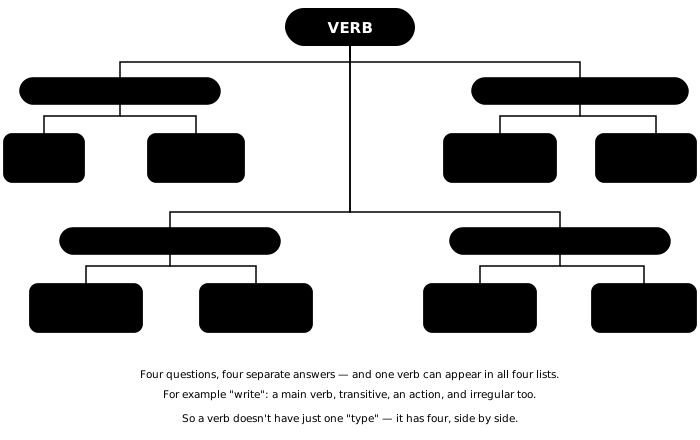
10.1 Types of verb — the whole tree
Verbs can be divided in several ways, and these divisions overlap. One verb can be a "main verb", "transitive" and "irregular" all at once — like write. So don't think of the tree as a competition; think of it as four separate questions.
10.2 Main verb and helping verb
In a sentence, the real meaning comes from the main verb. The small verbs that come with it — is, am, are, has, have, will, do — help to make tenses, questions and negatives. These are called auxiliary or helping verbs.
- She is writing a letter. "writing" is the real action; "is" only shows that it is happening right now.
- Do you know him? "Do" comes first to make the question; the meaning is in "know".
| Helping verb | Forms | Job |
|---|---|---|
| be | is, am, are, was, were, been, being | making continuous and passive |
| have | have, has, had | making perfect tenses |
| do | do, does, did | questions, negatives and emphasis |
All three can also be main verbs
I have a bike. — here "have" is the main verb itself.
I have finished my work. — here "have" is the helper and "finished" is the main verb. Check whether another verb follows — that decides which one it is.
10.3 Modal verbs — the ones that never change
Modals are helping verbs that show possibility, ability, permission or obligation. They have two fixed rules, and remembering both is enough.
The two fixed rules for modals
1. After a modal, the verb is always in its base form — no -s, no -ing, no to.
2. A modal never changes itself — no -s, no -ed. ✓ She can swim. ✗ She cans swim. ✗ She can swims.
| Modal | What it shows | Example |
|---|---|---|
| can | ability, general permission | I can drive. |
| could | past ability, politeness | Could you help me? |
| may | formal permission, possibility | May I come in? |
| might | weaker possibility | It might rain today. |
| will | future, promise | I will call you. |
| would | politeness, imagination | I would like tea. |
| shall | suggestion (formal) | Shall we start? |
| should | advice | You should rest. |
| must | strong obligation | You must wear a helmet. |
| ought to | moral duty | We ought to help them. |
can and could — the difference when asking permission
Can I borrow your pen? — fine among friends.
Could I borrow your pen? — more polite, good with someone senior.
May I borrow your pen? — the most formal, for an office or an interview.
10.4 Transitive and intransitive — does it take an object?
After the verb, ask "what?" or "whom?". If you get an answer, the verb is transitive. If the question makes no sense, the verb is intransitive.
| Verb | Question | Answer | Type |
|---|---|---|---|
| She wrote a poem. | Wrote what? | a poem ✓ | Transitive |
| He slept early. | Slept what? | no answer ✗ | Intransitive |
| They helped us. | Helped whom? | us ✓ | Transitive |
| The baby laughed. | Laughed what? | no answer ✗ | Intransitive |
Many verbs can be both
The bell rang. (intransitive) / She rang the bell. (transitive)
The window broke. / He broke the window. So look at the verb inside the sentence, not in a list.
An intransitive verb needs a preposition
- Wrong: We will reach at Delhi at 9.
- Right: We will reach Delhi at 9.
-
Why: "Reach" is transitive — it takes its object directly. But "arrive" is intransitive, so it needs a preposition: arrive in Delhi, arrive at the airport.
-
Wrong: Let us discuss about the plan.
- Right: Let us discuss the plan.
- Why: "Discuss" is transitive, so the object follows directly. Hindi has "ke baare me" (about), which is why "about" sneaks in. In the same way: enter the room (not enter into), marry her (not marry with her).
10.5 Linking verbs — verbs that build a bridge
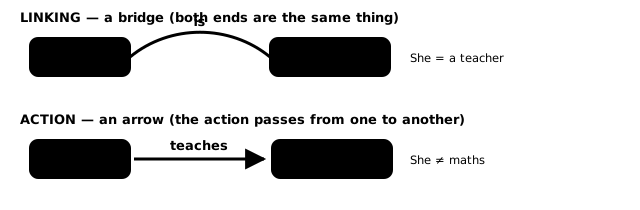
A linking verb shows no action. It connects the subject to its identity or condition — like a bridge.
| Linking verb | Example | Note |
|---|---|---|
| be (is, am, are, was, were) | He is busy. | the most common |
| seem, appear | She seems tired. | it looks that way |
| become, get, turn, grow | The sky turned dark. | change |
| feel, look, smell, sound, taste | This tastes sweet. | the senses |
| remain, stay | He remained calm. | staying the same |
After a linking verb, use an adjective, not an adverb
✓ The food tastes good. ✗ The food tastes well.
✓ She looks beautiful. ✗ She looks beautifully. These verbs describe the subject, not an action. The subject is a noun, and a noun needs an adjective.
10.6 The five forms of a verb
Every English verb has five forms. Dictionaries usually list three — V1, V2, V3 — and these three are what you use to build tenses.
| Form | Name | walk (regular) | write (irregular) | Where it is used |
|---|---|---|---|---|
| V1 | base | walk | write | present, after a modal, with to |
| V1-s | third person | walks | writes | with he / she / it |
| V2 | past simple | walked | wrote | simple past |
| V3 | past participle | walked | written | after have/has/had, in the passive |
| V-ing | present participle | walking | writing | continuous tenses |
The difference between regular and irregular
Regular: V2 and V3 both just add -ed — play → played → played.
Irregular: the word changes inside — go → went → gone. English has about 200 irregular verbs, but 60-70 are enough for everyday use.
Irregular verbs you use every day
| V1 | V2 | V3 | V1 | V2 | V3 |
|---|---|---|---|---|---|
| go | went | gone | eat | ate | eaten |
| see | saw | seen | take | took | taken |
| do | did | done | give | gave | given |
| come | came | come | run | ran | run |
| buy | bought | bought | bring | brought | brought |
| think | thought | thought | teach | taught | taught |
| speak | spoke | spoken | break | broke | broken |
| write | wrote | written | drive | drove | driven |
| begin | began | begun | drink | drank | drunk |
| put | put | put | cut | cut | cut |
Mixing up V2 and V3
- Wrong: I have saw that movie.
- Right: I have seen that movie.
-
Why: After "have / has / had" you always need V3 — seen, gone, done, written. V2 (saw) is only for the past on its own: I saw that movie.
-
Wrong: He did not went to school.
- Right: He did not go to school.
- Why: "did" has already shown the past — so the main verb stays in its base form. We don't show the past twice in one sentence.
10.7 Finite and non-finite verbs
A finite verb changes with the subject and the tense — it is the real verb of the sentence. A non-finite verb doesn't change; it works like a noun or an adjective.
| Type | Form | Example | Job |
|---|---|---|---|
| Finite | changes with subject + tense | She plays. / They played. | the real verb |
| Infinitive | to + V1 | I want to sleep. | works like a noun |
| Gerund | V-ing, used as a noun | Swimming is good exercise. | works like a noun |
| Participle | V-ing or V3, used as an adjective | a broken glass / a running train | works like an adjective |
Only one finite verb per clause
I want to go home. — "want" is finite, "to go" is non-finite. So the tense goes only on "want": I wanted to go home. You never say "to goed" — now you can see why.
After a preposition, use a gerund, not an infinitive
✓ She is good at singing. ✗ good at to sing
✓ I look forward to meeting you. ✗ to meet you
Here "to" is a preposition, not part of an infinitive — so use -ing.
10.8 Stative verbs — the ones that don't go in the continuous
Some verbs show a state, not an action. A state doesn't "go on" — it just is — so we don't put these verbs into -ing.
| Category | Verbs |
|---|---|
| Thinking | know, think (meaning "believe"), believe, understand, remember, forget, mean |
| Feelings | like, love, hate, want, need, prefer |
| Senses | see, hear, smell, taste (meaning "have a flavour") |
| Ownership | have (meaning "own"), own, belong, possess |
| Being | be, seem, appear, cost, weigh, contain |
10.9 The mistakes we really make
The most common Indian-English mistakes with verbs
- Wrong: I am having a car.
- Right: I have a car.
-
Why: When "have" means ownership, it is a stative verb — it doesn't go in the continuous. "I am having" is fine only when an action is happening: I am having lunch, I am having a bath.
-
Wrong: He don't know the answer.
- Right: He doesn't know the answer.
-
Why: He / she / it are third person singular, and their helping verb is "does". And notice — after "does" the main verb stays in the base form: doesn't know, not doesn't knows.
-
Wrong: I am agree with you.
- Right: I agree with you.
-
Why: "Agree" is a complete verb on its own — it doesn't need "am" before it. The Hindi "main sehmat hoon" has "hoon" (am) in it, which is why "am" sneaks in.
-
Wrong: She is knowing the answer.
- Right: She knows the answer.
-
Why: "Know" is stative — knowing is a state, not an action. That is why "I am knowing", "I am understanding" and "I am liking" are all wrong.
-
Wrong: We discussed about the project yesterday.
- Right: We discussed the project yesterday.
-
Why: "Discuss" is transitive — it takes its object directly, with no preposition. Same list: enter the hall, attend the meeting, answer the question, reach home.
-
Wrong: One of my friend don't like coffee.
- Right: One of my friends doesn't like coffee.
-
Why: Two mistakes at once: after "one of" you need a plural noun (friends), but the real subject is "one" — singular — so the verb is singular too: doesn't.
-
Wrong: Please revert back to me soon.
- Right: Please reply to me soon.
-
Why: "Revert" means to go back to an earlier state, not to reply. And "back" repeats the idea. In an office email, write "please reply" or "please get back to me".
-
Wrong: He can plays the guitar very well.
- Right: He can play the guitar very well.
- Why: After a modal the verb is always in the base form. The modal has already taken care of the job, so the verb needs no -s.
10.10 A short memory map
| After this | Verb form | Example |
|---|---|---|
| he / she / it (present) | V1 + s | She goes. |
| do / does / did | V1 | She didn't go. |
| modal (can, will, must…) | V1 | She can go. |
| have / has / had | V3 | She has gone. |
| is / am / are / was / were | V-ing (or V3 in the passive) | She is going. |
| to | V1 | She wants to go. |
| preposition (at, of, in, for…) | V-ing | She is tired of waiting. |
10.11 Practice — Verbs
Exercise 1
She ___ the answer to this question.
- knows
- is knowing
- knowing
- are knowing
Hint: Is this verb stative or an action?
Answer
knows
'Know' is a stative verb — knowing is a state, not an ongoing action. So we don't use it in the continuous, even when we mean right now.
Exercise 2
He ___ live in Mumbai anymore.
- doesn't
- don't
- isn't
- didn't
Hint: The negative for third person singular.
Answer
doesn't
'He' is third person singular, so the helping verb is 'does'. 'don't' goes only with I, you, we, they.
Exercise 3
I have ___ that film twice already.
- seen
- saw
- see
- seeing
Hint: Which form comes after 'have'?
Answer
seen
After have / has / had you always use V3 (the past participle) — seen. 'saw' is V2, which is for the plain past on its own: I saw that film.
Exercise 4
Which sentence is correct?
- She can play the sitar.
- She can plays the sitar.
- She cans play the sitar.
- She can to play the sitar.
Answer
She can play the sitar.
After a modal the verb is in its base form, and the modal itself never changes. So not 'cans', not 'plays', not 'to play'.
Exercise 5
'The soup tastes ___.' — what fills the gap?
- delicious
- deliciously
- deliciousness
- tastily
Hint: 'taste' is a linking verb here.
Answer
delicious
After a linking verb you use an adjective, because it describes the subject — what the soup is like. An adverb would be used only to describe how an action is done.
Exercise 6
I am looking forward to ___ you next week. (meet)
Hint: 'to' here is a preposition, not an infinitive.
Answer
meeting
In 'look forward to', 'to' is a preposition, and after a preposition we use a gerund (-ing). That is why 'to meet' is wrong here.
Exercise 7
He did not ___ to the office yesterday. (go)
Hint: 'did' has already shown the past.
Answer
go
After 'did' the verb stays in the base form, because the past is already in 'did'. We don't show the past twice in one sentence.
Exercise 8
Tap the wrong word in this sentence.
I am having two brothers and one sister.
Answer
Wrong word: having.
Corrected: I have two brothers and one sister.
When 'have' means a relationship or ownership, it is stative — it doesn't go in the continuous. 'I am having' works only for actions like eating or drinking.
Exercise 9
Find the wrong word.
We discussed about the new policy in the meeting.
Answer
Wrong word: about.
Corrected: We discussed the new policy in the meeting.
'Discuss' is a transitive verb — it takes its object directly. 'about' comes in from the Hindi 'ke baare me', but in English it is extra.
Exercise 10
'It rained heavily last night.' — what is the verb showing here?
- occurrence
- possession
- state
- action
Hint: Nobody did anything; it just happened.
Answer
occurrence
Rain isn't something anyone does; it is an event — so it is an occurrence. 'She writes' would be an action, 'He is happy' a state, and 'They have a car' possession.
Exercise 11
Match each sentence with what its verb shows.
| A | B |
|---|---|
| She writes a letter. | occurrence |
| He is happy. | possession |
| It rained yesterday. | action |
| They have a car. | state |
Answer
She writes a letter. — action; He is happy. — state; It rained yesterday. — occurrence; They have a car. — possession
A verb shows one of four things — an action, a state, an occurrence, or possession.
Exercise 12
We ___ a big house in the village. (possession, present)
Hint: Someone owns something.
Answer
have
For possession use 'have / has' — We have, She has. 'have' meaning possession is stative, so we don't say 'We are having a house'.
Exercise 13
Match each verb form with where it is used.
| A | B |
|---|---|
| after have / has | V-ing — going, writing |
| after a modal | V1 + s — goes, writes |
| after is / am / are | V3 — gone, written |
| with he / she in the present | V1 — go, write |
Answer
after have / has — V3 — gone, written; after a modal — V1 — go, write; after is / am / are — V-ing — going, writing; with he / she in the present — V1 + s — goes, writes
The form of a verb is decided by the word before it. Once you remember these four pairs, half the work of tenses is done.
Exercise 14
Put the words in the right order — it uses a modal.
Words: wear / must / helmet / riding / while / You / a
Answer
You must wear a helmet while riding
The order is subject + modal + V1 + the rest. After 'must', 'wear' stays in the base form — never 'wears'.
Exercise 15
Say this line aloud — say 'doesn't' in one breath.
He doesn't know the answer
Answer
Say: He doesn't know the answer
If we say 'does not' as two separate words, the habit of 'he don't' doesn't go away. Saying 'doesn't' as a single word brings out the right form automatically.
What to do next
Take five irregular verbs every day and say all three forms out loud — go went gone, see saw seen. In two weeks the whole list will be on your tongue, and you will already know half of the tenses chapter.