Chapter 27: Rhythm & stress
Rhythm and stress — which word to say strongly
All your sounds can be right, your grammar can be right, and your English can still sound robotic. There is only one reason: we say every word with the same force. English is an uneven language — some words shine, and the rest step back, almost disappearing. People who work on this one thing start sounding "fluent" at once — even if their vocabulary is exactly the same as before.
- 1Word stress — in one word, only one part shines
- 2Sentence stress — which words shine in a sentence
- 3Weak words — how they really sound
- 4One sentence, five meanings — just by changing the stress
- 5Joined words — English "sticks together"
- 6The rise and fall of the voice (intonation)
- 7Daily rhythm drill
In one line
Hindi is a more even-beat language — each syllable gets almost the same time. English is a stress-beat language — the stressed parts are long and strong, and the other parts are weak and short. That is why English spoken with a Hindi beat sounds "flat".
27.1 Word stress — in one word, only one part shines
Every big English word has one syllable that is stressed: you say it longer, louder, and a little higher in pitch. The other syllables are weak and short. If you stress the wrong syllable, the word can become impossible to understand.
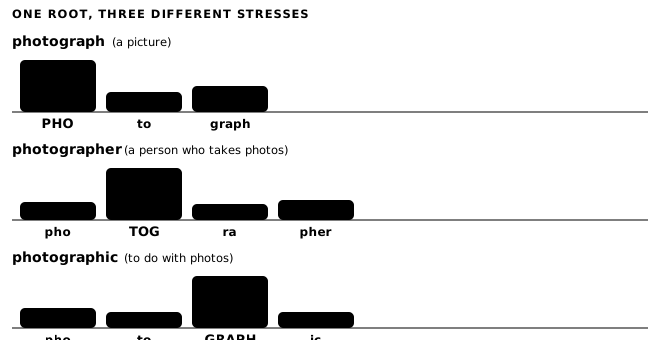
- He is a photographer, and this is his photograph. Both words in one line — you can clearly hear the difference in where the stress falls.
When the stress changes, the meaning changes
Many English words are both a noun and a verb, and the only difference is the stress: in the noun the stress is on the first syllable, in the verb on the second syllable.
| Word | Noun (a thing) | Verb (an action) | Listen |
|---|---|---|---|
| record | RE-cord — a written account | re-CORD — to save on a device | |
| present | PRE-sent — a gift | pre-SENT — to show or give | |
| increase | IN-crease — a rise | in-CREASE — to make bigger | |
| object | OB-ject — a thing | ob-JECT — to disagree | |
| contract | CON-tract — a written agreement | con-TRACT — to shrink | |
| conduct | CON-duct — behaviour | con-DUCT — to carry out |
A small memory map
Noun = stress at the front. Verb = stress at the back. Noun comes first, verb comes later — as if the word itself kept the same order.
Some reliable patterns
| Ending | Where the stress goes | Examples | Listen |
|---|---|---|---|
| -tion / -sion | the syllable just before it | inforMAtion, deciSIon, educAtion | |
| -ity | just before it | aBIlity, opporTUnity, uNIversity | |
| -ic | just before it | ecoNOmic, fanTAStic, speCIfic | |
| -ate (verb) | the third syllable from the end | CElebrate, EDUcate, comMUnicate | |
| -ee | the last syllable | employEE, trainEE, agrEE | |
| Two-syllable nouns | almost always the first syllable | TAble, WINdow, DOCtor, TEAcher |
The stress we get wrong most often
- Wrong: de-VE-lop-MENT — two stresses
- Right: de-VEL-op-ment — only one stress
-
Why: A word has only one stress. Stressing two places makes it sound like two words.
-
Wrong: hos-pi-TAL
- Right: HOS-pi-tal
-
Why: The last syllable becomes a weak "tul". We say the full "TAL" instead.
-
Wrong: in-ter-es-TING
- Right: IN-tres-ting — three syllables, not four
-
Why: The middle "e" almost disappears. That is the work of the schwa.
-
Wrong: com-FOR-TA-BLE (four equal syllables)
- Right: KUMF-tuh-bul
- Why: English speakers swallow the middle "or". Three syllables, stress on the first.
27.2 Sentence stress — which words shine in a sentence
This is the real secret. In a whole sentence, only the words that carry the meaning are said strongly. The other words — the ones that only join the sentence together — are said weakly, quickly, almost swallowed.
| Content words — strong | Function words — weak | |
|---|---|---|
| Which | Nouns, main verbs, adjectives, adverbs, question words | a/an/the, is/am/are/was, can/will/have (helpers), of/to/in/at, and/but, I/he/she/it, that/this (when not stressed) |
| Why | These carry the real information. Cut them out and the message is lost. | These are only the frame. Cut them out and the message is still clear. |
| Test | If you had to send a telegram, which words would you keep? Those are the content words. |
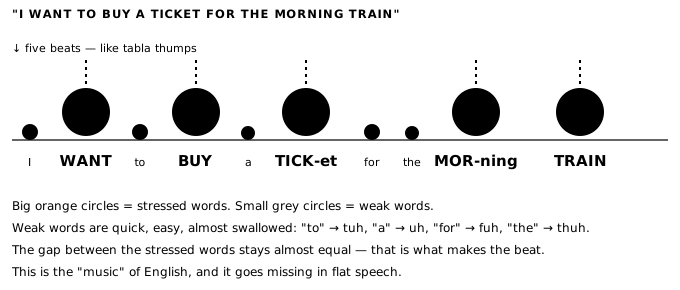
- I want to buy a ticket for the morning train. Five beats. First say only the five big words like thumps, then the whole sentence.
- She was waiting for me at the bus stop. Beats: WAIT-ing · BUS · STOP. "was, for, at, the" are all weak.
- Can you send me the file before the meeting? Beats: SEND · FILE · be-FORE · MEET-ing. "Can you" sounds almost like "kuhnyuh".
27.3 Weak words — how they really sound
When a function word has no stress, its vowel becomes a schwa and the word gets very short. This is not "lazy" English — this is correct English.
| Written | Spoken | In a sentence | Listen |
|---|---|---|---|
| to | tuh | I want tuh go. | |
| of | uhv | a cup uhv tea | |
| and | un / n | bread n butter | |
| for | fuh | waiting fuh you | |
| can | kuhn | I kuhn do it. | |
| at | uht | look uht this | |
| are | uh | What uh you doing? | |
| have (helper) | uhv | I uhv finished. |
One important exception
When you want to put special stress on a function word, you say it in full: "I said I can do it, not I can't." So weakening is the rule, but you can always stress a word when you need to.
27.4 One sentence, five meanings — just by changing the stress
This drill will open your ears for good. It is one sentence — "I didn't say she stole my bag." The meaning changes depending on where the stress falls.
| Stress on this word | Meaning | Listen |
|---|---|---|
| I didn't say she stole my bag. | I did not say it — someone else said it. | |
| I didn't say she stole my bag. | I never said that — you misunderstood. | |
| I didn't say she stole my bag. | Someone else stole it — not her. | |
| I didn't say she stole my bag. | She took it, but did not steal it — maybe she borrowed it. | |
| I didn't say she stole my bag. | The bag belonged to someone else, not me. |
How to practise this
Say it five times, each time stressing a different word. To stress a word means: make it a little longer, a little louder, and a little higher in pitch. When you can hear all five differences yourself, your ear is ready.
27.5 Joined words — English "sticks together"
Native speakers do not pause between words. The end of one word sticks to the start of the next. That is why it sounds like they are "speaking very fast" — in fact they are not fast, the words are joined.
| Written | What you hear | Listen |
|---|---|---|
| What is your name? | Wot-sure-naim | |
| Do you want to go? | Juh-wanna-go | |
| I am going to call him. | Aim-gonna-call-im | |
| Did you eat? | Dijoo-eet | |
| Can I help you? | Kun-ai-help-yoo | |
| Let me know. | Lem-me-no |
Please note
You learn this for listening, not because you must speak this way. You can say the full "What is your name?" — it is perfectly fine, clear and correct. But when someone says "Wot-sure-naim", you will not get stuck — that is the benefit.
27.6 The rise and fall of the voice (intonation)
| Type of sentence | Voice | Example | Listen |
|---|---|---|---|
| A normal statement | Falls at the end ↘ | I live in Pune. | |
| A yes/no question | Rises at the end ↗ | Do you live in Pune? | |
| A WH- question | Falls at the end ↘ | Where do you live? | |
| Counting a list | Rises in the middle ↗, falls on the last item ↘ | I need pens, books and a bag. | |
| Asking politely | A slight rise ↗ — a flat, direct tone sounds harsh | Could you help me, please? |
A habit that sounds harsh
- Wrong: "Give me the file." — flat, with a falling voice
- Right: "Could you give me the file?" — with a slightly rising voice
- Why: It is not only the words — the direction of your voice also makes you polite. A question said with a falling voice sounds like an order.
27.7 Daily rhythm drill
This drill takes 2 minutes. For each sentence, first say only the big words while clapping, then fill in the whole sentence.
- I NEED to FINish this WORK by TOmorrow. Four beats. "to, this, by" are completely weak.
- Could you TELL me where the STAtion IS? Three beats. The voice rises slightly at the end — it is a question.
- The MEEting has been POSTponed to NEXT WEEK. Four beats. Swallow "has been" — "uhz-bin".
- I'm SORry, I didn't CATCH that LAST part. Three beats. You can use this line every day — the most natural way to say "I did not understand".
27.8 Practice — Rhythm and stress
Exercise 1
What is the basic difference between Hindi and English rhythm?
- Hindi is more even-beat, English is stress-beat
- In English every syllable is equal
- The two are exactly the same
- Hindi has stress, English does not
Hint: Which language gives each syllable the same time?
Answer
Hindi is more even-beat, English is stress-beat
That is why English spoken with a Hindi beat sounds flat. In English some words shine and the rest are pushed down.
Exercise 2
Which syllable is stressed in 'photographer'?
- TOG (second syllable)
- PHO (first syllable)
- ra (third syllable)
- pher (fourth syllable)
Answer
TOG (second syllable)
pho-TOG-ra-pher. Notice: in 'photograph' the stress is on PHO, but when the word changes form the stress moves.
Exercise 3
What is the noun/verb stress rule? (record, present, increase)
- Noun on the first syllable, verb on the second
- Noun on the second syllable, verb on the first
- Both on the first syllable
- There is no rule
Hint: Noun first, verb later.
Answer
Noun on the first syllable, verb on the second
RE-cord (a thing) / re-CORD (to do). PRE-sent (a gift) / pre-SENT (to show).
Exercise 4
Which words are said strongly in a sentence?
- Content words — nouns, main verbs, adjectives, adverbs
- Articles and prepositions
- Only the first and last word
- All words equally
Answer
Content words — nouns, main verbs, adjectives, adverbs
The words with real information shine. Words like a/the/of/to/is are only the frame — they get pushed down.
Exercise 5
Where is the stress in 'information'?
- MA — infor-MA-tion
- IN — IN-formation
- for — in-FOR-mation
- tion — informa-TION
Hint: The syllable just before -tion.
Answer
MA — infor-MA-tion
In words ending in -tion and -sion the stress is always on the syllable just before it: deci-SI-on, educ-A-tion.
Exercise 6
What does 'I didn't say SHE stole my bag' mean?
- Someone else stole it, not her
- I said nothing
- The bag was not mine
- She did not steal it, she borrowed it
Answer
Someone else stole it, not her
The stress is on 'she', so the sentence points away from her to someone else. Change the stress, change the meaning.
Exercise 7
How many stressed syllables does one word have? ___
Hint: Write the number.
Answer
ek / 1 / one
One word = one shining syllable. Stressing two places (de-VE-lop-MENT) is the most common mistake.
Exercise 8
In a sentence 'to' has no stress — when spoken it sounds like ___.
Hint: The weak schwa sound.
Answer
tuh / tu / ta
I want tuh go. In function words without stress the vowel becomes a schwa.
Exercise 9
Which word in this sentence should NOT be stressed? Tap it.
I want to buy a ticket.
Answer
Wrong word: a.
Corrected: I WANT to BUY a TICKet — 'a' is a completely weak 'uh'.
The article 'a' is a function word — the weakest word of all. Say 'uh', not 'ay'.
Exercise 10
Match the type of sentence to the direction of the voice.
| A | B |
|---|---|
| I live in Pune. | WH- question, falls |
| Do you live in Pune? | polite, a slight rise |
| Where do you live? | falls at the end |
| Could you help me? | rises at the end |
Answer
I live in Pune. — falls at the end; Do you live in Pune? — rises at the end; Where do you live? — WH- question, falls; Could you help me? — polite, a slight rise
Yes/no questions go up; statements and WH- questions go down. A question with a falling voice sounds like an order.
Exercise 11
Put the sentence in the right order, then say it with the beats.
Words: to / need / I / by / finish / work / tomorrow / this
Answer
I need to finish this work by tomorrow
Beats: NEED · FIN-ish · WORK · TO-morrow. The 'to, this, by' in between are weak.
Exercise 12
A five-beat sentence. First say only the big words while clapping, then the whole sentence.
I want to buy a ticket for the morning train
Answer
Say: I want to buy a ticket for the morning train
WANT · BUY · TICK-et · MOR-ning · TRAIN. 'to, a, for, the' almost disappear.
Exercise 13
Noun-verb stress. Say both forms together.
This is a record. Please record it.
Answer
Say: This is a record. Please record it.
RE-cord (noun) then re-CORD (verb). The difference should be clearly audible.
Exercise 14
The -tion stress. Make the right syllable shine.
I need more information about the decision
Answer
Say: I need more information about the decision
infor-MA-tion, deci-SI-on. In both, the stress is just before -tion/-sion.
Exercise 15
A polite question — let your voice rise slightly at the end.
Could you tell me where the station is
Answer
Say: Could you tell me where the station is
Beats on TELL · STA-tion · IS. If the voice falls it will sound like an order, not a question.
Exercise 16
Now change the stress — stress 'she'.
I didn't say she stole my bag
Answer
Say: I didn't say she stole my bag
Make 'she' longer, louder and a little higher. Keep the other words weak — then the difference is audible.
Exercise 17
A line you can use every day. Three beats.
I'm sorry I didn't catch that last part
Answer
Say: I'm sorry I didn't catch that last part
SOR-ry · CATCH · LAST. Swallow 'I didn't' quickly — aidunt.
What next?
For one week, do just one thing: whenever you listen to English, notice only which words come out strongly. Do not even try to understand the meaning — just listen to the beat. In seven days your ear will change.
Next chapter: Fluency and filler words — the real cure for getting stuck while speaking.