Chapter 29: Fluency
Fluency — learn to pause, drop "basically"
Fluency does not mean speaking fast. Fluency means to keep speaking without panic — even when you pause. The best speakers in the world speak slowly and pause a lot. The difference is that when they pause, they do not fill the gap with "um, uh, basically, matlab" — they stay silent, or they say a ready-made phrase that gives them time to think. That skill is what this chapter teaches.
- 1The filler habit — the plain truth
- 2The skill of silence — pause, do not fill
- 3Phrases that buy thinking time
- 4Speed control — speaking slowly is a strength
- 5Stuck in the middle of a sentence — now what?
- 6After a mistake — do not stop, fix it and move on
- 7A pattern for longer answers
- 8Daily fluency drill — 5 minutes
What fluency really means
Fluency = to keep going, even after a mistake, even after getting stuck. A fluent person is someone who gets stuck in the middle of a sentence and still finishes the thought. Speed, perfect grammar and a big vocabulary all come later.
29.1 The filler habit — the plain truth
We all use fillers. A few are normal — native speakers use them too. The problem starts when they come after every three words, because then the listener hears your habit, not your message. Look at your own list honestly:
| Filler | The real problem | What to do |
|---|---|---|
| basically | It almost always means nothing. In "Basically I went to the market", "basically" does no job. | Remove it completely. The sentence gets better. |
| actually | Its real meaning is "in fact / the truth is". We add it to every sentence, so it loses its meaning. | Use it only when you are correcting a misunderstanding. |
| like | "It was like, you know, like very big." — three times in one sentence. It makes you sound younger and less prepared. | Pause. Silence is better than "like". |
| matlab | The most common Hinglish filler. A Hindi filler in the middle of English conversation is noticed at once. | Replace it: "I mean…" or "What I'm trying to say is…" |
| na / haan / theek hai na | It gets stuck on the end of a sentence: "It is good, na?" | Replace it: "…, isn't it?" / "…, right?" |
| only (in the wrong place) | "I am from Delhi only." — "only" has no meaning here in English. | Remove it: "I'm from Delhi." |
| you know | It is used when you assume the listener knows, but they do not. | Say the whole thing. Or "Let me explain…" |
| umm / uhh | This is the most natural one — but a long "ummmm" shows nervousness. | Stay silent there. Two seconds of silence sounds confident. |
First wrong, then right
- Wrong: Basically, umm, I am, like, working in sales only, matlab since two years.
- Right: I work in sales. I've been there for two years.
-
Why: Break it into short sentences. Three short sentences are much better than one long, stuck sentence.
-
Wrong: Actually the thing is that actually I actually forgot.
- Right: To be honest, I forgot.
-
Why: Only one "signpost" word per sentence. If it comes again and again, it loses its effect.
-
Wrong: It is very good, na?
- Right: It's really good, isn't it?
- Why: Use a question tag in place of "na". It does the same job, but in English.
29.2 The skill of silence — pause, do not fill
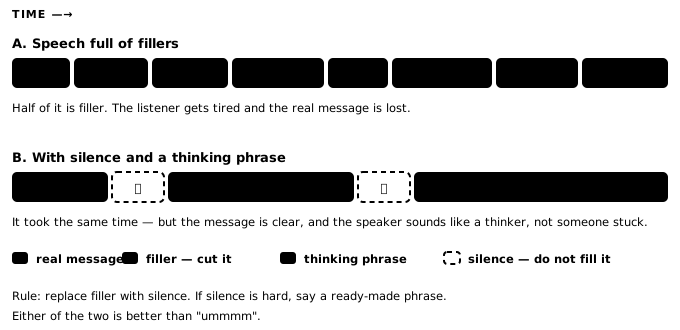
When your brain is looking for the next word, your mouth starts to fill that gap. The real cure is this: let the gap stay empty. Two seconds of silence make you look like a thinker; two seconds of "ummmm" make you look nervous.
29.3 Phrases that buy thinking time
This is the most valuable part of the chapter. Memorise these phrases — so well that they come out without thinking. They give you 2-4 seconds, and the listener feels you are speaking thoughtfully.
| Purpose | Phrase | Listen |
|---|---|---|
| You need time after a question | That's a good question. | |
| Let me think about that for a second. | ||
| Hmm, I haven't thought about it that way. | ||
| Well, it depends. | ||
| Before you begin your answer | The way I see it… | |
| To be honest with you… | ||
| In my experience… | ||
| Explaining it again | What I mean is… | |
| Let me put it another way. | ||
| In other words… | ||
| You got stuck in the middle | Sorry, what's the word… give me a second. | |
| How do I say this… | ||
| I'm blanking on the word — it's the thing you use for… | ||
| You did not understand | Sorry, could you repeat that? | |
| I didn't catch the last part. |
Start with three phrases
Do not try to memorise the whole list. Choose just three today — my suggestion: "That's a good question." · "What I mean is…" · "Sorry, could you repeat that?" Say them 20 times today. Tomorrow they will come out on their own.
29.4 Speed control — speaking slowly is a strength
When we are nervous we speak fast, and in fast speech the sounds run together, and then people cannot understand, and then we get more nervous. This cycle has to be broken.
| Situation | Speed | Why |
|---|---|---|
| Interview, presentation | Slow — slower than everyday speech | Slow speech sounds confident, and gives you time to think. |
| On the phone | Slow + clear | On the phone half the sounds get cut. Say numbers and names letter by letter. |
| Giving your name / email | Very slow, in pieces | "R-A-M-E-S-H. Ramesh." Repeating is polite, not weak. |
| With a friend | Whatever comes easily | Practise here — mistakes cost little. |
- Let me slow down — my name is Ramesh. R for Rakesh, A, M, E, S, H. The clearest way to give your name on the phone. Link each letter to a word.
- Sorry, I'm speaking too fast. Let me start again. Correcting yourself is very professional. There is nothing to be embarrassed about.
29.5 Stuck in the middle of a sentence — now what?
This is the biggest fear: you cannot find a word halfway through a sentence, and your mind goes blank. There are three reliable cures. All three are learnable skills, not luck.
Cure 1 — Say it another way (paraphrase)
Cannot find the word? Describe what the thing does. This is the most powerful skill — it is how people talk about the whole world with 500 words.
| Word you forgot | Say it like this | Listen |
|---|---|---|
| stapler | The thing you use to join papers together. | |
| landlord | The person who owns the house I live in. | |
| deadline | The last date to finish the work. | |
| puncture | There's a hole in my tyre — the air went out. |
Cure 2 — Start again from the beginning
Is the sentence tangled? Do not try to rescue it. With a short apology, start again with a new, short line. "Sorry, let me start that again." Native speakers do this every day. It is not a mistake, it is a method.
Cure 3 — Ask for help
Asking for the English name of something is not weakness — it is the right behaviour for a learner. "What do you call the thing that…?"
"Is that the right word?"
29.6 After a mistake — do not stop, fix it and move on
English has a short, natural way to correct yourself: say the wrong word, then say "sorry" or "I mean", put in the right word, and keep going. You do not need to stop or apologise at length.
- I went there yesterday — sorry, last week. You spotted the mistake, fixed it in one word, and moved on.
- She don't— she doesn't work here any more. The grammar mistake was fixed in the middle. This is the most natural way.
- We have three— I mean four meetings today. "I mean" is the most common and correct tool for corrections.
What not to do
When you make a mistake, do not start the "Sorry, sorry, my English is very poor, sorry" routine. One short apology is enough, and even better is to put in the right word and move on without stopping. If you keep apologising, the listener stops paying attention to your message.
29.7 A pattern for longer answers
A simple trick to sound fluent: do not give one-word answers. In every answer add one piece of information + one reason. This keeps the talk going and also gives you time to think.
| Question | Weak answer | Fluent answer | Listen |
|---|---|---|---|
| Do you like cricket? | Yes. | Yes, I do. I watch most matches, especially the one-day games. | |
| Where are you from? | Delhi. | I'm from Delhi, but I've been living in Pune for three years now. | |
| How was your weekend? | Good. | It was good, thanks. I mostly stayed home and caught up on sleep. | |
| Can you finish it today? | No. | Not today, I'm afraid. I could have it ready by tomorrow afternoon. |
Remember the pattern
Answer + one detail + one reason or what comes next. Three parts, that is all. You do not need more, and with less the talk stops.
29.8 Daily fluency drill — 5 minutes
A one-minute monologue
Set a timer on your phone for 60 seconds. Choose an ordinary topic — your day, your room, your work — and speak for 60 seconds without stopping. Only one rule: silent pauses are fine, but do not switch to Hindi. If you cannot find a word, say it another way (Cure 1). One minute every day. In two weeks you will hear the difference yourself.
- Today I woke up at seven, had tea, and then I checked my phone for a while. Start a monologue like this — short sentences, joined with "and then".
- It's hard to explain, but let me try. Say this line when you get stuck — then make an attempt. It is a completely native line.
29.9 Practice — Fluency
Exercise 1
What is the right meaning of fluency?
- To keep speaking without panic, even when you pause
- To speak very fast
- To speak without a single mistake
- To have a big vocabulary
Hint: It has nothing to do with speed.
Answer
To keep speaking without panic, even when you pause
Good speakers speak slowly and pause a lot. The only difference is that they do not fill the gaps with fillers.
Exercise 2
What is the biggest problem with 'basically'?
- In most sentences it means nothing at all
- It is a wrong word
- It is hard to pronounce
- It is only used in writing
Answer
In most sentences it means nothing at all
Remove it from 'Basically I went to the market' and the sentence gets better. The word is not wrong, the habit is.
Exercise 3
You are thinking of the next word. What is best to do?
- Stay silent, or say a ready-made phrase
- Stretch a long 'ummmmm'
- Start speaking faster
- Say it in Hindi
Answer
Stay silent, or say a ready-made phrase
Two seconds of silence looks like thinking; two seconds of 'ummmm' looks nervous. Both take the same time.
Exercise 4
You cannot remember the English name of a thing. What is the best way?
- Describe what the thing does — 'the thing you use to…'
- Drop the subject
- Use the Hindi word
- Stay silent until you remember
Hint: Cure 1.
Answer
Describe what the thing does — 'the thing you use to…'
Saying it another way is the most powerful skill. It is how people say everything with few words.
Exercise 5
How fast should you speak in an interview?
- Slower than everyday speech
- As fast as possible
- Very fast, to save time
- Fast at first, slow later
Answer
Slower than everyday speech
Slow speech sounds confident and gives you time to think of the next sentence. In fast speech the sounds run together.
Exercise 6
You made a grammar mistake in the middle of a sentence. What is the right way?
- Say 'I mean' or 'sorry', put in the right word and move on
- Say the whole sentence again, saying nothing
- Keep apologising
- Leave the mistake and do nothing
Answer
Say 'I mean' or 'sorry', put in the right word and move on
Native speakers do exactly this: 'She don't— she doesn't work here.' Stopping for a long apology breaks the flow.
Exercise 7
Say 'matlab' in English: What I ___ is…
Hint: The word for explaining again.
Answer
mean
'What I mean is…' — the direct English form of 'matlab', and it gives you thinking time too.
Exercise 8
Fix 'It is good, na?': It's good, ___ it?
Hint: A question tag.
Answer
isn't / isnt / is not
Hindi 'na' becomes a question tag in English: isn't it? / right? / don't you think?
Exercise 9
One word in this sentence is extra — tap it.
I am from Mumbai only.
Answer
Wrong word: only.
Corrected: I'm from Mumbai.
'only' gets added from the Hindi habit of 'hi / sirf'. In English it has no meaning here.
Exercise 10
Find the filler word that should be cut.
Basically I finished the report yesterday.
Answer
Wrong word: Basically.
Corrected: I finished the report yesterday.
Remove it and the sentence is cleaner. Here is the test: if removing it does not change the meaning, it is filler.
Exercise 11
Match each filler to its right English replacement.
| A | B |
|---|---|
| matlab | two seconds of silence |
| na? | nothing — cut it |
| ummmm | What I mean is… |
| basically | isn't it? |
Answer
matlab — What I mean is…; na? — isn't it?; ummmm — two seconds of silence; basically — nothing — cut it
Every Hinglish filler has a clear English form. Learn it once and it starts coming out by itself.
Exercise 12
Build a phrase that buys thinking time.
Words: for / that / about / a / Let / me / think / second
Answer
Let me think about that for a second
It gives you 3-4 seconds, and the listener feels you are thinking carefully.
Exercise 13
Buy time after a question. Speak calmly.
That's a good question. Let me think about that for a second
Answer
Say: That's a good question. Let me think about that for a second
Two phrases together — you have 5 seconds. In an interview this is gold.
Exercise 14
Explain it again — do not say 'matlab'.
What I mean is we should wait one more week
Answer
Say: What I mean is we should wait one more week
A full sentence after 'What I mean is'. A useful phrase in place of filler.
Exercise 15
You cannot find the word — say it another way.
It's the thing you use to join papers together
Answer
Say: It's the thing you use to join papers together
If you forget 'stapler', describe what it does. The talk never stops — that is fluency.
Exercise 16
You got tangled. Make a fresh start.
Sorry, let me start that again
Answer
Say: Sorry, let me start that again
A short apology, then a new short line. Native speakers do this every day.
Exercise 17
Give a fluent answer in place of one word — 'Where are you from?'
I'm from Delhi but I've been living in Pune for three years now
Answer
Say: I'm from Delhi but I've been living in Pune for three years now
Answer + detail + what comes next. Three parts — this is what keeps the talk going.
Exercise 18
You did not understand. Ask politely.
Sorry, could you repeat that
Answer
Say: Sorry, could you repeat that
Voice rises slightly at the end. You will use this line every day — so it should come out without thinking.
Exercise 19
You are stuck but not giving up. Say this line.
It's hard to explain but let me try
Answer
Say: It's hard to explain but let me try
A completely native line. By saying it you also get time to think.
What next?
Today's task: choose three thinking phrases and say them 20 times. And do a one-minute monologue — today, right now.
Next chapter: Everyday conversations — the shop, the auto, the doctor, the phone. You will get ready-made lines that you can use from tomorrow.