Chapter 19: Gerunds & infinitives
Gerund or Infinitive — doing or to do?
When one verb is followed by another verb, the second verb takes either -ing (enjoy reading) or to + V1 (want to read). In Hindi both cases use the same form — "padhna pasand hai", "padhna chahta hoon" — so we usually guess. In this chapter we will not guess; we will learn a sure method.
- 1The first verb decides
- 2Verb + -ing: enjoy, avoid, finish, suggest
- 3Verb + to: want, decide, hope, plan
- 4Both are possible — but the meaning changes
- 5After a preposition, always -ing
- 6The "to" trap — look forward to meeting
- 7The mistakes we really make
In one line
A gerund is a verb + -ing used as a noun (Swimming is fun). An infinitive is to + base verb (I want to swim). In both, the verb becomes the "name of an activity" — like "tairna" in Hindi.
- I enjoy cooking. = I like making food. — enjoy + -ing
- I want to cook tonight. = I would like to make food this evening. — want + to
19.1 The first verb decides
The most important point: you don't choose the form of the second verb — the first verb chooses it. Every verb has its own preference. So the easiest way to remember them is to sort the verbs into three boxes.
The first verb decides
The first verb decides the form of the second verb (-ing or to + V1). A rough guide: -ing looks at an actual action, one that is happening or already happened; to looks at an action that is still ahead.
As the subject, -ing is more natural
Walking is good for health. — the most common and natural.
To walk is good for health. — correct, but it sounds bookish.
19.2 Verb + -ing: enjoy, avoid, finish, suggest
These verbs usually talk about an actual or ongoing activity — one you like, one you avoid, one you finished. Adding "to" after them is the most common mistake.
| Verb | Meaning | Example |
|---|---|---|
| enjoy | to get pleasure from | We enjoyed watching the match. |
| avoid | to stay away from | Avoid eating junk food. |
| finish | to complete | Have you finished writing? |
| suggest | to give an idea | She suggested taking a taxi. |
| mind | to be bothered by | Do you mind waiting? |
| keep | to continue doing | He kept calling me. |
| practise | to train by repeating | Practise speaking every day. |
| give up | to stop for good | My uncle gave up smoking. |
Verbs that take -ing
enjoy, avoid, finish, suggest, mind, keep, practise, consider, give up — always followed by verb-ing, never "to". ✓ I enjoy reading. ✗ I enjoy to read.
How to add a person after suggest
- Wrong: He suggested me to go by train.
- Right: He suggested going by train. / He suggested that I go by train.
- Why: "Suggest" has no "person + to" pattern. Either use -ing, or use "that + person + V1".
19.3 Verb + to: want, decide, hope, plan
These verbs mostly talk about thoughts about the future — wishes, decisions, hopes, plans. The action has not happened yet; it is going to happen. That is why we use "to" — like an arrow pointing at the action.
| Verb | Meaning | Example |
|---|---|---|
| want | to wish for | I want to learn French. |
| decide | to make up your mind | They decided to move to Pune. |
| hope | to expect something good | We hope to see you soon. |
| plan | to make a plan | She plans to start a business. |
| agree / refuse | to say yes / to say no | He refused to sign. |
| promise | to give your word | I promise to call you. |
| manage | to succeed in doing something hard | We managed to finish on time. |
Verbs that take to
want, decide, hope, plan, agree, refuse, promise, manage, need, expect — followed by to + V1. If a person comes in between: want / ask / tell / advise someone to do.
- My mother wants me to become a doctor. = My mother hopes I will become a doctor. — not "that I become"; use "me to become" directly.
- The teacher told us to sit down. tell, ask, advise, allow, remind — all take "person + to".
19.4 Both are possible — but the meaning changes
Some verbs take both forms, and this is the most interesting part. Here, choosing the wrong form does not make a mistake; it gives a completely different meaning — so study these carefully.
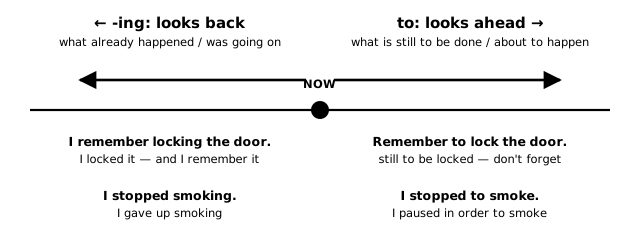
stop, remember, forget, try
-ing = an earlier or actual action: remember meeting (we have already met). to = a later action: remember to meet (we still have to meet). try doing = do it and see what happens; try to do = make an effort.
| Verb | + -ing | + to V1 |
|---|---|---|
| stop | to quit an activity — stop talking | to pause in order to do something else — stop to talk |
| remember | to remember something that happened — remember meeting her | to remember a job still to be done — remember to call |
| forget | to forget a past moment — I'll never forget seeing the Taj | to forget to do something — I forgot to lock it |
| try | to test a method — try restarting the phone | to make an effort at something hard — try to lift the box |
Some verbs show very little difference
like, love, hate, start, begin, continue — both forms work and the meaning stays almost the same: It started raining = It started to rain.
19.5 After a preposition, always -ing
This is the easiest and surest rule in this chapter. After a preposition comes a noun — and when you want a verb there, you have to make it noun-like, that is, -ing.
- I am interested in learning Japanese. = I find learning Japanese interesting.
- She is good at solving puzzles. = She solves puzzles well.
- Thank you for coming. = Thanks, because you came.
- Wash your hands before eating. = First wash your hands, then eat. — after before, after, without, instead of, by — always -ing.
Preposition + -ing
in, at, of, for, about, before, after, without, by, instead of — if a verb follows them, it is always -ing: interested in learning, tired of waiting, without asking. Never "to + V1".
19.6 The "to" trap — look forward to meeting
Not every "to" belongs to an infinitive. Sometimes "to" is really a preposition — and remember the rule from the last section? After a preposition, -ing. You just have to recognise which "to" is which.
The preposition 'to'
look forward to, be used to, get used to, object to, be committed to, when it comes to — in these, "to" is a preposition, so the verb takes -ing: I look forward to meeting you.
- I am used to working late. = Working late is normal for me. (test: used to late nights ✓)
- When it comes to cooking, my father is the best. = On the subject of cooking, my father is better than anyone.
19.7 The mistakes we really make
The most common Indian-English mistakes with -ing and to
- Wrong: I look forward to meet you.
- Right: I look forward to meeting you.
-
Why: This mistake appears at the end of almost every formal email. Here "to" is a preposition (look forward to the meeting ✓), so the verb takes -ing.
-
Wrong: I am interested to learn coding.
- Right: I am interested in learning coding.
-
Why: "Interested" goes with the preposition "in", and after a preposition comes -ing. To express interest, always say "interested in + -ing".
-
Wrong: He suggested me to go home.
- Right: He suggested that I go home. / He suggested going home.
-
Why: "Suggest" does not take "person + to". That pattern belongs to "advise": He advised me to go home.
-
Wrong: I enjoy to travel.
- Right: I enjoy travelling.
-
Why: "Enjoy" is a verb from the -ing box. The Hindi "ghoomna pasand hai" pulls in a "to" — but never after "enjoy".
-
Wrong: Thank you for give me this chance.
- Right: Thank you for giving me this chance.
- Why: "For" is a preposition — the verb after it is always in the -ing form.
19.8 Practice — Gerunds & infinitives
Exercise 1
We have decided ___ a new car.
- to buy
- buying
- buy
- to buying
Hint: Which box does 'decide' belong to?
Answer
to buy
'Decide' is about a decision for the future — a verb from the 'to' box. So decide + to + V1.
Exercise 2
Please avoid ___ your phone while driving.
- using
- to use
- use
- used
Answer
using
'Avoid' always takes -ing — avoid using, avoid eating. 'Avoid to use' is a very common mistake.
Exercise 3
I clearly remember ___ the gas. I'm sure it's off.
- switching off
- to switch off
- switch off
- to switching off
Hint: The action already happened, and you remember it.
Answer
switching off
Turning off the gas happened earlier — and you remember it now. Remembering a past action = remember + -ing.
Exercise 4
The driver stopped ___ some tea, then continued the journey.
- to have
- having
- have
- had
Hint: Why did he stop?
Answer
to have
The driver stopped in order to drink tea — he paused one activity to do another. stop + to = pause so that you can do something. 'Stopped having tea' would mean he gave up drinking tea.
Exercise 5
I look forward to ___ from you soon. (hear)
Hint: This 'to' is a preposition.
Answer
hearing
In 'look forward to', 'to' is a preposition (look forward to your reply ✓), and after a preposition we use -ing. So 'hearing'.
Exercise 6
She is very good at ___ people laugh. (make)
Hint: What comes after 'at'?
Answer
making
'At' is a preposition. After a preposition the verb is always in the -ing form — good at making.
Exercise 7
Tap the wrong word.
My manager suggested me to take a short break.
Answer
Wrong word: me.
Corrected: My manager suggested that I take a short break.
The 'me to' pattern does not work after 'suggest'. Say 'suggested that I take' or 'suggested taking'.
Exercise 8
One word is in the wrong form — find it.
I am interested in join the music class.
Answer
Wrong word: join.
Corrected: I am interested in joining the music class.
'In' is a preposition, so the verb after it takes -ing — joining.
Exercise 9
Match each verb with its correct pattern.
| A | B |
|---|---|
| enjoy | + verb-ing (preposition) |
| want | + to V1 (after a person) |
| interested in | + verb-ing |
| advise someone | + to V1 |
Answer
enjoy — + verb-ing; want — + to V1; interested in — + verb-ing (preposition); advise someone — + to V1 (after a person)
Enjoy belongs to the -ing box, want to the 'to' box. 'In' is a preposition, so -ing. After advise comes a person, and then to + V1.
Exercise 10
Put the words in the correct order.
Words: the / midnight / She / report / at / writing / finished
Answer
She finished writing the report at midnight
'Finish' is followed by -ing — finished writing. Then the object (the report) and the time (at midnight).
Exercise 11
Build this sentence — the 'person + to' pattern.
Words: study / want / parents / me / to / My / abroad
Answer
My parents want me to study abroad
After 'want' comes the person (me) and then to + V1 (to study). We don't say 'want that I study' the way Hindi does.
Exercise 12
Say this last line of an email aloud — mind the word 'meeting'.
I look forward to meeting you
Answer
Say: I look forward to meeting you
This line is written wrongly so often that saying it correctly aloud is the best cure. 'To' is a preposition here, so 'meeting'.
What to do next
Draw three boxes on paper — "-ing", "to", "both". Every time you meet a new verb, put it in one of the boxes. In a month you will have your own sorter, and no more guessing.