Chapter 1: How to use this book
If you feel a little nervous even opening this page — "I don't know anything", "I get stuck when I speak" — you are in exactly the right place. This book is not here to teach you about English. It is here to make you speak English. And there is only one way to learn to speak: by speaking. Starting today, alone in your room, out loud.
- 115 minutes every day — that's all
- 2Say everything out loud — that is the whole game
- 3The 🔊 button and the 🎤 mic — how they work
- 4Where to start — choose your path
- 5When you feel like giving up
- 6A small first step — right now
The one rule of the whole book
Whenever you see an English line in this book, don't just read it with your eyes. Say it with your mouth. English that you only read silently never reaches your tongue. Silent reading gives you understanding. Speaking gives you fluency. They are two different things.
1.1 15 minutes every day — that's all
Studying for two hours once a week does very little. 15 minutes every day does everything. Your brain learns a language by repetition, not by long sessions. Split your 15 minutes like this:
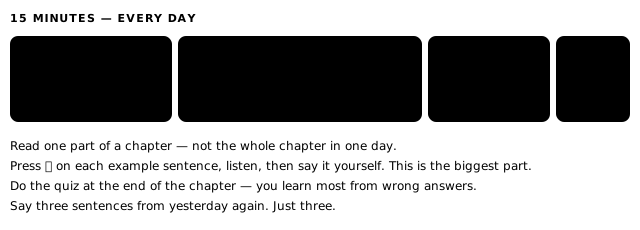
Where to find 15 minutes
Before your bath. On the bus or metro. In bed before sleep. Pick one fixed place and one fixed time — then you won't need to remember at all, because the habit will pull you in.
1.2 Say everything out loud — that is the whole game
People study grammar for years and still get stuck when they speak. Why? Because the grammar went into the brain, but not into the muscles of the tongue. To make English sounds, your lips, tongue and jaw must learn new positions — and muscles learn only by repetition, not by understanding.
- I am learning English, and I am getting better every day. Your first line to say today. Press 🔊, listen, then say it three times yourself.
- I make mistakes, but I keep speaking. = I do make mistakes, but I never stop speaking. Make this sentence your personal rule.
- Could you say that again, please? Use this when you didn't understand — don't be shy. Native speakers say this every day too.
Speaking alone in your room is not 'crazy' — it is a method
Many people stop themselves: "How can I talk to myself? I'll feel silly." The truth is that every fluent speaker has spoken alone first, a thousand times. Close the door, put a mirror in front of you, and speak. Nobody can hear you, so mistakes cost nothing. It is the safest practice you will ever get.
1.3 The 🔊 button and the 🎤 mic — how they work
| Feature | What it does | What you should do |
|---|---|---|
| 🔊 Say button | Reads that line aloud in your device's voice. | Listen first. Then pause and say the same line yourself. Then listen again and compare. |
| Slow voice | Some difficult lines are read slowly, so that every sound is clear. | Say it slowly the first time. Speed will come later — the goal is not fast, the goal is clear. |
| 6 types of quiz | Multiple choice, fill in the blank, spot the mistake, match the sentence, match the pairs, and say it aloud. | Do all of them. Don't skip. The explanation you get after a wrong answer is the most valuable part. |
| 🎤 Speak (mic) | In a "say it aloud" question, the mic listens to your voice and checks it. | The first time, your browser will ask for permission — press "Allow". Sit in a quiet room and speak about 20 cm from your phone. |
What if the mic doesn't work?
No problem — not every browser has speech recognition. In that case the page will simply ask you to listen and repeat. The mic is only a helper, not a requirement. Your own ear is the best judge: listen with 🔊, record yourself in a recorder app, play both, and hear the difference. This is what professionals do.
1.4 Where to start — choose your path
There are three kinds of learners. Find your line:
A. 'I know nothing, I'm starting from zero'
Go in order. Read the next chapter — English Sounds — first, because it is the foundation. Then Grammar basics, then Learn to Speak. One part a day. In three months you won't recognise yourself.
B. 'I know the grammar, but I get stuck when I speak'
This is the most common situation — and grammar is not the cure. Go straight to the "Learn to Speak" section: Pronunciation → Rhythm → Fluency → Everyday conversation. Open the grammar chapters only when one particular thing confuses you.
C. 'I have an interview / I'm joining an office'
First the Interview and office chapter, then Fluency, then Indian English habits (the mistakes that interviewers notice immediately). Leave the rest of the book for later, at your own pace.
If you get lost anywhere
The sidebar has the list of all chapters — open any one you like. The book remembers your progress by itself: every quiz you finish gets a tick on the contents page. No login, nothing to fill in.
1.5 When you feel like giving up
Let me tell you something straight, because no book does: after two or three weeks you will feel that nothing is improving. This is completely normal. Learning a language is not a smooth slope — it is a staircase. Many days feel the same, and then suddenly one day you say a whole sentence without thinking.
- It is normal to feel stuck. I will speak anyway. = Feeling stuck is normal. I will speak anyway. On a day when you don't feel like it, say this line and do just 5 minutes.
- Sorry, my English is improving. Please bear with me. Say this in real life when you get stuck — it means "please be patient with me". People almost always help.
Three habits that do the most damage
- Wrong: "I'll make my grammar perfect first, then I'll speak."
- Right: Start speaking today, mistakes and all — your grammar will improve along the way.
-
Why: People who wait to be perfect before they speak never start at all.
-
Wrong: Thinking in Hindi and translating in your head before you speak.
- Right: Memorise short, ready-made sentences and say them directly.
-
Why: Translating takes 3-4 seconds — and confidence breaks in that gap. That is why this book gives you ready-made lines.
-
Wrong: Only reading with your eyes and never making a sound.
- Right: Say every line aloud at least once.
- Why: This is the difference between this book and all the others. If you read silently, your results will be silent too.
1.6 A small first step — right now
The quiz below is a small beginning. Some questions ask you to answer by speaking. Close the door of your room, and start. Five minutes, that's all.
1.7 Practice — Start
Exercise 1
What is the biggest rule of this book?
- Say every English line out loud
- Finish a whole chapter every day
- Memorise all the grammar first
- Only read carefully
Hint: Which was the biggest block out of the four?
Answer
Say every English line out loud
Reading gives you understanding, speaking gives you fluency. The muscles of the tongue learn only by repetition.
Exercise 2
How much time is best to give each day?
- 15 minutes, every day
- 2 hours, one day a week
- 45 minutes, two days a week
- Whenever I feel like it, as much as I feel like
Answer
15 minutes, every day
The brain learns a language by repetition, not by long sessions. A little every day beats a lot once in a while.
Exercise 3
Which activity takes the most time in the 15 minutes?
- Speaking aloud (6 minutes)
- Reading (4 minutes)
- Quiz (3 minutes)
- Review (2 minutes)
Answer
Speaking aloud (6 minutes)
In the diagram the orange block was the biggest — speaking. Reading was only 4 minutes.
Exercise 4
What should you do when you give a wrong answer in a quiz?
- Read the explanation carefully — that is where the learning is
- Quit the quiz
- Memorise the whole chapter again
- Skip the next quizzes
Hint: What is the biggest benefit of a mistake?
Answer
Read the explanation carefully — that is where the learning is
A right answer only confirms what you know. The 'why' after a wrong answer is the real learning.
Exercise 5
If your grammar is fine but you get stuck when speaking, where should you start?
- Straight from the Learn to Speak section
- From the 8 parts of speech
- From idioms
- From the final test
Answer
Straight from the Learn to Speak section
Getting stuck is not a lack of grammar, it is a lack of practice. Start with pronunciation, rhythm and fluency.
Exercise 6
It is ___ to feel stuck.
Hint: Feeling stuck is a 'common thing' — what word in English?
Answer
normal
'It is normal to…' is a very useful pattern: It is normal to feel nervous. It is normal to make mistakes.
Exercise 7
I make mistakes, ___ I keep speaking.
Hint: The word that joins two opposite ideas.
Answer
but
'but' joins two opposite ideas. Make this whole sentence your personal rule.
Exercise 8
There is one mistake in this sentence — tap the word.
I am learning English since two months.
Answer
Wrong word: since.
Corrected: I have been learning English for two months.
To say how long, use 'for'. 'since' is used when there is a starting point — since June.
Exercise 9
Your first line in this book. Say it aloud — slowly and clearly.
I am learning English
Answer
Say: I am learning English
Start with a short line. Say the 'ning' in 'learning' fully, not 'learnin'.
Exercise 10
Now say your rule.
I make mistakes but I keep speaking
Answer
Say: I make mistakes but I keep speaking
When you say it, 'mistakes' and 'speaking' get a little extra stress — those words carry the meaning.
Exercise 11
Use this when you don't understand. Say it politely.
Could you say that again please
Answer
Say: Could you say that again please
Starting with 'Could you' is the most polite way. Your voice rises slightly at the end — it is a question.
Exercise 12
Today's promise. Say it aloud to finish.
I will practise for fifteen minutes every day
Answer
Say: I will practise for fifteen minutes every day
In 'fifteen' the stress is on the second part — fif-TEEN. In 'fifty' it is on the first — FIF-ty. That is the difference.
What next?
If you are starting from zero, don't skip the next chapter — English Sounds. It is the foundation, and without it everything else will keep sounding a little bit wrong. And remember: door closed, voice loud. 🔊