Chapter 15: The twelve tenses
All 12 tenses — one map
People say "English has 12 tenses", and it sounds like twelve separate things to memorise. The truth is that the 12 tenses are not 12 things — they are just 3 × 4. Three times (past, present, future) and four aspects (simple, continuous, perfect, perfect continuous). That's all. The day this 3 × 4 table settles in your head, the tension about tenses is over.
- 1First understand this: 3 times × 4 aspects
- 2The whole map — 12 tenses on a timeline
- 3The four forms of a verb — the fuel for the whole machine
- 4All twelve formulas in one table
- 5The four present tenses — up close
- 6The four past tenses
- 7The four future tenses
- 8Signal words — words that reveal the tense
- 9The tense mistakes we really make
In one line
A tense tells you when the action happens and in what state it is — finished, going on, or completed before some point. A tense tells you two things: when the action happened, and what its state was at that time.
15.1 First understand this: 3 times × 4 aspects
Every action happens at some time — already gone (past), now (present), or still to come (future). That gives us three columns.
And in each time, the action can be in one of four states. These are the four rows, and this is the real magic:
| State (aspect) | Meaning | Hindi feel |
|---|---|---|
| Simple | It just happened / happens / will happen. A single point, or a habit. | "main gaya" (I went), "main jaata hoon" (I go) |
| Continuous | It was going on / is going on / will be going on at that time. | "main jaa raha tha" (I was going) |
| Perfect | It was / is / will be complete before some point. | "main jaa chuka tha" (I had already gone) |
| Perfect Continuous | It has been going on for a while, and it also tells you for how long. | "main do ghante se jaa raha hoon" (I have been going for two hours) |
How to read the name
The name of a tense is its formula. Read "Past Perfect Continuous" backwards: Continuous means -ing, Perfect means had/have, and Past means the helping verb is in the past form → had been + -ing. Once you can get the formula from the name, there is nothing to memorise.
15.2 The whole map — 12 tenses on a timeline
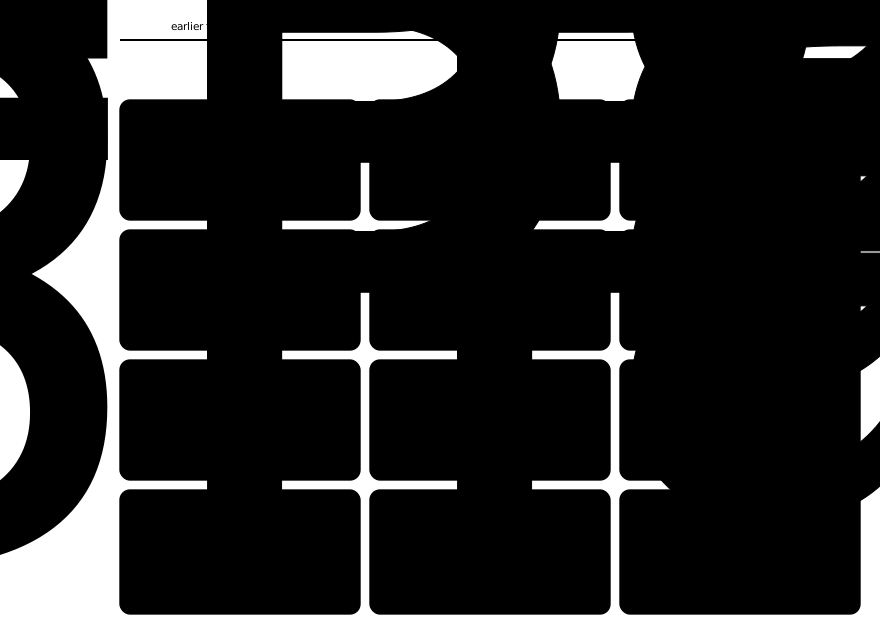
The picture below is the summary of this whole chapter. Look at it carefully once: time runs from left to right, and the orange line in the middle is NOW. In each box, look at the small timeline to see where the action sits — on a point, stretched like a line, or finished before a point.
Past
Present
Future
15.3 The four forms of a verb — the fuel for the whole machine
To make tenses you need only four things. They are called V1, V2, V3 and V-ing. If you know these four forms, the 12 tenses build themselves.
| Form | Name | write | go | eat | play |
|---|---|---|---|---|---|
| V1 | base form | write | go | eat | play |
| V1-s | he/she/it form | writes | goes | eats | plays |
| V2 | past form | wrote | went | ate | played |
| V3 | past participle | written | gone | eaten | played |
| V-ing | present participle | writing | going | eating | playing |
15.4 All twelve formulas in one table
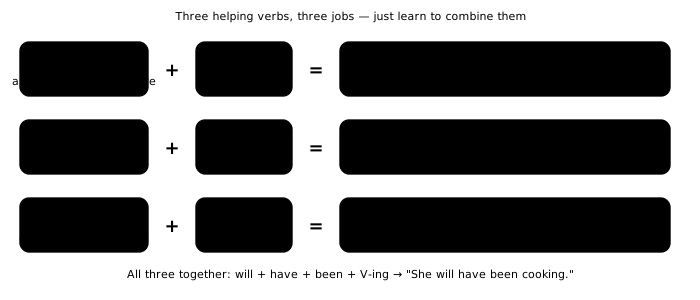
Everything is in one place here. Write it out once and stick it on the wall — in two weeks you will know it.
| Tense | Formula | Example | Use |
|---|---|---|---|
| Present Simple | V1 / V1-s | She writes letters. | habits and facts |
| Present Continuous | am/is/are + V-ing | She is writing a letter. | happening right now |
| Present Perfect | have/has + V3 | She has written the letter. | done, with a result now |
| Present Perfect Cont. | have/has been + V-ing | She has been writing for an hour. | still going on, for how long |
| Past Simple | V2 | She wrote a letter. | finished at a known past time |
| Past Continuous | was/were + V-ing | She was writing a letter. | in progress at a past time |
| Past Perfect | had + V3 | She had written it before I came. | done before another past event |
| Past Perfect Cont. | had been + V-ing | She had been writing since morning. | going on for a while before a past point |
| Future Simple | will + V1 | She will write a letter. | decisions and promises |
| Future Continuous | will be + V-ing | She will be writing at 5 pm. | in progress at a future time |
| Future Perfect | will have + V3 | She will have written it by Monday. | done before a future deadline |
| Future Perfect Cont. | will have been + V-ing | She will have been writing for two hours. | going on for a while up to a future point |
15.5 The four present tenses — up close
Present Simple — habits and facts
This tense is not for "right now". It is for habits, routines, and things that are always true. This is the biggest source of confusion.
- I catch the 8 o'clock bus every day. = Every day, I take the 8 o'clock bus. — a daily habit.
- Water boils at 100 degrees. = It is always true that water boils at 100 degrees. — a fact.
- He does not like coffee. = Coffee is not something he enjoys. — in the negative it is "does not + V1", not "likes".
The -s is only for he / she / it
I write · you write · he writes · we write · they write.
And as soon as do/does or a modal appears, the -s goes away: He does not write**, not "does not writes".
Present Continuous — right now, at this moment
- I am reading this chapter right now. = At this moment, I am reading this chapter.
- We are moving to Pune next month. = The move to Pune next month is already arranged. — for a firm plan, it can be used for the future too.
Some verbs don't go into -ing
- Wrong: I am having a car.
- Right: I have a car.
-
Why: When have means "own", it doesn't take -ing. But when it means "eat/do", it does: I am having lunch — that is perfectly fine. Other verbs like this: know, understand, like, want, need, believe, belong, see (meaning "look").
-
Wrong: I am knowing him since childhood.
- Right: I have known him since childhood.
- Why: "Know" is a state, not an action — so no -ing.
Present Perfect — done, but no time is given
The biggest rule of Present Perfect: it never goes with a past time. If you are saying "yesterday", "last week" or "in 2019", you need Past Simple.
- I have finished my homework. = My homework is done now. — when I did it is not part of the meaning.
- She has just left. = She left a moment ago. — it just happened, and the effect is fresh.
- I have never seen snow. = In my whole life, I have not seen snow. — life experience.
Present Perfect Continuous — "for how long"
Use this tense when you want to say for how long something has been going on. And this is the tense where Indian speakers make their biggest mistake.
'since three years' — the most common mistake
- Wrong: I am working here since three years.
- Right: I have been working here for three years.
- Why: There are two mistakes here. (1) When an action started in the past and is still going on, you need have been + -ing, not am working. (2) for = how long (three years), since = starting from when (2022, Monday, morning).
15.6 The four past tenses
| When to use it | Tense | Example |
|---|---|---|
| A finished action, with a known time | Past Simple | I met him yesterday. |
| A long background action in the past, interrupted by something | Past Continuous | I was cooking when he called. |
| Two past actions — the one that happened first | Past Perfect | The train had left before we reached. |
| How long something had been going on up to a past point | Past Perfect Cont. | She had been waiting for an hour. |
The Past Continuous + Past Simple pair
When telling a story, this pair comes up again and again: the long action in Continuous, the sudden one in Simple.
I was crossing the road when the bike hit me. = I was in the middle of crossing the road, and then a bike hit me.
15.7 The four future tenses
English has several ways to talk about the future, and not all of them use "will". This difference shows up clearly in fluency.
| Form | When | Example |
|---|---|---|
| will + V1 | A decision made now, a promise, a prediction | OK, I will help you. |
| be going to | A plan made earlier, or a result you can already see coming | I am going to start a shop. |
| am/is/are + V-ing | A firm, scheduled arrangement | I am meeting her at six. |
| will be + V-ing | In progress at a later time | At nine I will be travelling. |
| will have + V3 | Complete before a deadline | By May I will have finished it. |
No future in a time clause
After when, if, after, before, until, as soon as, "will" doesn't come — even if you are talking about the future.
I will call you when I reach home. "when I will reach" is wrong. Use will only once in a sentence.
15.8 Signal words — words that reveal the tense
Some words almost always go with one tense. In exams and in speaking, this shortcut is very useful.
| If you see these words | Tense |
|---|---|
| every day, usually, often, always, never, generally | Present Simple |
| now, right now, at the moment, look!, listen! | Present Continuous |
| just, already, yet, ever, never, so far, recently | Present Perfect |
| for + duration, since + point, how long, all day | Perfect Continuous |
| yesterday, last night, ago, in 2019, then | Past Simple |
| while, at that time, all evening | Past Continuous |
| before, after, by the time, already (in the past) | Past Perfect |
| tomorrow, next week, soon, in future | Future Simple |
| by Monday, by then, by the end of… | Future Perfect |
15.9 The tense mistakes we really make
Top tense mistakes — and the right forms
- Wrong: Yesterday I have gone to the market.
- Right: Yesterday I went to the market.
-
Why: "Yesterday" is a definite past time. Present Perfect never goes with a past time — there you need Past Simple (V2).
-
Wrong: He don't know the answer.
- Right: He doesn't know the answer.
-
Why: With he/she/it use does. And after does the verb has no -s: "doesn't know", not "doesn't knows".
-
Wrong: I am working here since 2019.
- Right: I have been working here since 2019.
-
Why: Started in the past + still going on = have/has been + V-ing.
-
Wrong: If I will get the job, I will shift to Mumbai.
- Right: If I get the job, I will shift to Mumbai.
-
Why: After "if" use the present; "will" goes in the main clause. Never in both.
-
Wrong: I am having two brothers.
- Right: I have two brothers.
-
Why: Relationships and possessions are expressed with "have", not "am having".
-
Wrong: She did not came to class.
- Right: She did not come to class.
-
Why: did has already done the work of the past — so the verb stays in V1.
-
Wrong: I will tell you when he will come.
- Right: I will tell you when he comes.
-
Why: In a time clause (when/after/before/until) there is no future — the present is used.
-
Wrong: He has came home.
- Right: He has come home.
- Why: After have/has/had you always need V3, not V2. come-came-come, go-went-gone, see-saw-seen.
Three rules that save 80% of mistakes
1. If you see a past time (yesterday, ago, last…) → V2, not have/has.
2. After have/has/had → V3. After do/does/did → V1.
3. Only one "will" per sentence — never in the if/when part.
15.10 Practice — All 12 tenses
Exercise 1
Yesterday she ___ a new phone.
- has bought
- bought
- have bought
- is buying
Hint: A definite past time is given.
Answer
bought
'Yesterday' is a past time, and Present Perfect doesn't go with a past time — so use plain V2, 'bought'.
Exercise 2
Look! The baby ___ .
- cries
- cried
- is crying
- has cried
Hint: 'Look!' means right now, at this moment.
Answer
is crying
Words like Look! / Listen! / right now mean the action is going on at this moment — so Present Continuous.
Exercise 3
By next March, I ___ in this company for five years.
- will work
- will be working
- will have been working
- am working
Hint: How long, up to a deadline in the future.
Answer
will have been working
To say how long something has gone on up to a future point, use Future Perfect Continuous — will have been + V-ing.
Exercise 4
The film ___ before we reached the hall.
- started
- has started
- had started
- was starting
Hint: Two past actions — which one happened first?
Answer
had started
With two past actions, the one that happened first takes Past Perfect (had + V3). The film started first; we arrived later.
Exercise 5
She ___ (go) to the gym every morning.
Hint: 'every morning' = a habit.
Answer
goes
A habit takes Present Simple, and with 'she' the verb gets -s — goes.
Exercise 6
I ___ been waiting here since four o'clock.
Hint: Which helping verb goes with I?
Answer
have
Use 'have' with I/you/we/they and 'has' with he/she/it. The action started earlier and is still going on, so it is have been + -ing.
Exercise 7
He didn't ___ (come) to the office yesterday.
Hint: didn't has already shown the past.
Answer
come
After 'did / didn't' the verb stays in V1 — not 'didn't came' but 'didn't come'.
Exercise 8
There is one mistake in this sentence — tap the wrong word.
Yesterday I have gone to the market with my mother.
Answer
Wrong word: have.
Corrected: Yesterday I went to the market with my mother.
There is a past time (yesterday), so the Present Perfect 'have' is wrong — plain 'went' is needed.
Exercise 9
Find the wrong word.
My father is having an old scooter.
Answer
Wrong word: having.
Corrected: My father has an old scooter.
When 'have' means 'own', it doesn't take -ing. 'Having lunch' is fine; 'having a scooter' is not.
Exercise 10
One word is wrong — spot it.
Please call me when you reached the station.
Answer
Wrong word: reached.
Corrected: Please call me when you reach the station.
The time is in the future, so the past 'reached' is wrong. After 'when' we use the simple present — 'when you reach'.
Exercise 11
Put the words in the right order — a Past Continuous and Past Simple pair.
Words: off / the / went / a / when / lights / book / reading / was / I
Answer
I was reading a book when the lights went off
The long, ongoing action goes in Past Continuous (was reading), and the sudden one in Past Simple (went off). This is the usual order for telling a story.
Exercise 12
Match each tense to its use.
| A | B |
|---|---|
| I write | done, with a result now |
| I am writing | finished before another past action |
| I have written | going on for a while, still now |
| I had written | a habit or a permanent fact |
| I have been writing | going on right now |
Answer
I write — a habit or a permanent fact; I am writing — going on right now; I have written — done, with a result now; I had written — finished before another past action; I have been writing — going on for a while, still now
Simple = a point or a habit. Continuous = going on. Perfect = complete. Perfect Continuous = how long it has been going on.
Exercise 13
Now say this line aloud — join 'have been' without a pause.
I have been learning English for two years
Answer
Say: I have been learning English for two years
In speech, 'have been' sounds almost like 'hav-bin'. And remember — it is 'for two years', not 'since two years'.
What to do next
Start a small habit today: write three sentences about yourself each day — one past, one present, one future. Then change them into continuous and perfect. In a week the 12 tenses won't be something to memorise; they'll be something you feel.