Chapter 48: Spelling rules
Spelling rules — memorise less, understand more
One wrong spelling in an email — recieve, seperate, definately — and the reader immediately thinks the writer was careless. The good news is that English spelling is not as crazy as it looks. A handful of rules handle most words, and we will memorise the leftover exceptions in one list.
- 1When does a consonant double?
- 2When does the silent e drop?
- 3When does y become i?
- 4i before e — and its exceptions
- 5-able or -ible
- 6British or American — colour or color
- 7The 30 words we misspell most
- 8The mistakes we really make
In one line
Most English spelling follows a few rules about adding endings — double the consonant, drop the e, change y to i. Learn the rules first, then memorise the exceptions. Understand the rules first, then memorise only the exceptions — not the whole dictionary.
48.1 When does a consonant double?
stopped or stoped? beginning or begining? This question comes up in office emails every day. The answer is hidden in three small questions — follow the chart below once.
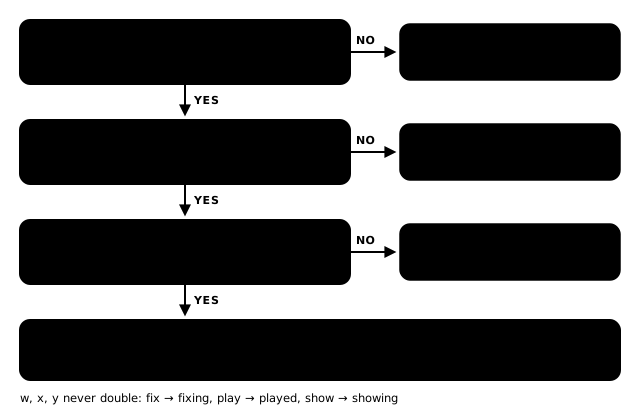
The 1-1-1 rule
One syllable, one vowel, one final consonant + a suffix that starts with a vowel = the consonant doubles: stop → stopped, big → bigger. In a longer word, only when the stress is on the last syllable: begin → beginning, but visit → visited.
- We stopped the meeting at five. stop = one syllable, one vowel (o), one consonant (p) → stopped.
- This is only the beginning. be-GIN — the stress is on the last syllable, so the n doubles: beginning.
- She visited her parents on Sunday. VI-sit — the stress is on the first syllable, so the t stays single: visited.
British twist — travel, cancel, label
In British English, a final l always doubles, wherever the stress is: travelled, cancelled, labelled, modelling. American English keeps it single: traveled, canceled. India follows British English, so in school and at the office write travelled.
48.2 When does the silent e drop?
The last e of make is not pronounced — and that e causes the most mistakes when you add an ending. The rule is simple: look at the first letter of the suffix.
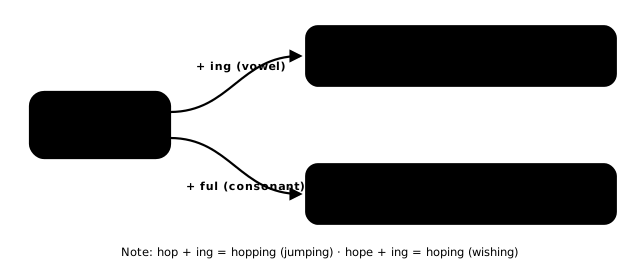
The silent-e decision
The suffix starts with a vowel (-ing, -able, -ed) → drop the e: make → making, use → usable. The suffix starts with a consonant (-ful, -ment, -ly) → keep the e: care → careful, move → movement.
| Word | Vowel suffix (e dropped) | Consonant suffix (e kept) |
|---|---|---|
| make | making | — |
| hope | hoping | hopeful |
| care | caring | careful |
| move | moving | movement |
| use | usable | useful |
| manage | managing | management |
| achieve | achieving | achievement |
Exceptions you must memorise
Words with c / g keep the e so the sound stays soft: noticeable, manageable, courageous.
The e drops for no obvious reason: truly, argument, ninth, awful.
Words ending in ee do not drop the e: seeing, agreeing, fleeing.
48.3 When does y become i?
happyness or happiness? studys or studies? Just look at the letter right before the y — that gives you the answer.
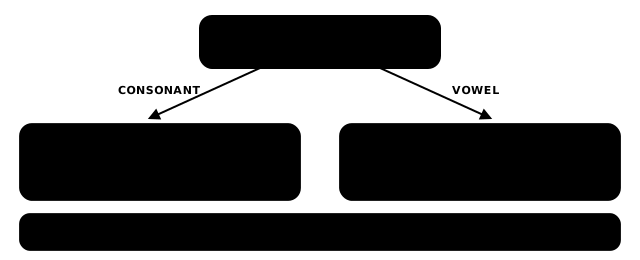
The y rule
Consonant + y → i: happy → happiness, study → studied. Vowel + y → y stays: play → played. And before -ing the y never changes: studying, carrying.
- She studies late and still looks happier than all of us. stud-y → studies (d is a consonant); happ-y → happier.
- The children enjoyed the play. enjo-y → o is a vowel, so the y stays: enjoyed.
Four old exceptions
day → daily, pay → paid, say → said, lay → laid. These have vowel + y, yet the y still became i — just memorise them.
48.4 i before e — and its exceptions
receive or recieve, believe or beleive — mixing up ie and ei is the most common spelling mistake among Indian writers. The old rhyme still works; you just need to remember all of it.
ie or ei — a three-line trick
The "ee" sound → ie: believe, piece, achieve.
Right after c → ei: receive, ceiling, receipt.
The "ay" sound → ei: eight, weigh, neighbour.
| When | Spelling | Examples |
|---|---|---|
| The "ee" sound | ie | believe, achieve, piece, field, chief, niece, brief |
| After c, with the "ee" sound | ei | receive, receipt, ceiling, deceive, perceive |
| The "ay" sound | ei | eight, weight, neighbour, vein, reign |
| Exceptions — learn by heart | ei | seize, weird, either, neither, protein, foreign, leisure, their |
| After c but still ie (the sound is not "ee") | ie | science, ancient, efficient, society |
- I received the receipt from my neighbour. receive, receipt — ei after c. neighbour — the "ay" sound, so ei.
48.5 -able or -ible
acceptable or acceptible? Both sound the same, so your ear does not help. But there is a simple test that works for most words.
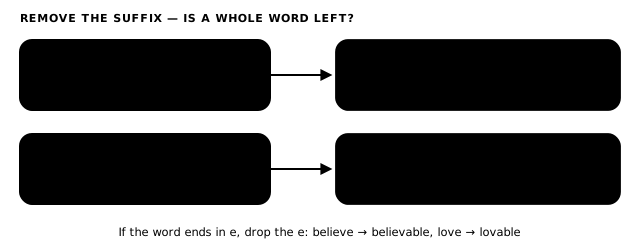
The -able / -ible test
When you remove the suffix and a whole word is left → -able (acceptable, comfortable). When only a broken piece is left → -ible (possible, visible, terrible). This test works for most words.
Some words break the test
responsible, flexible, accessible, sensible — whole words are hidden inside them, yet they take -ible. And noticeable, changeable keep the e so that the c/g sound stays soft. Memorise these six separately.
48.6 British or American — colour or color
There are two spelling systems, and both are correct. But in India, schools, board exams, government work and most newspapers follow British spelling. Trouble starts when software quietly switches to American spelling.
| Pattern | British (India) | American |
|---|---|---|
| -our / -or | colour, favour, behaviour | color, favor, behavior |
| -re / -er | centre, metre, theatre | center, meter, theater |
| -ise / -ize | organise, realise, apologise | organize, realize, apologize |
| -ll / -l | travelled, cancelled, jewellery | traveled, canceled, jewelry |
| -ogue / -og | catalogue, dialogue | catalog, dialog |
| -ce / -se | licence (noun), defence | license, defense |
| -yse / -yze | analyse, paralyse | analyze, paralyze |
| Different words | programme, cheque, tyre, grey | program, check, tire, gray |
The real mistake is mixing them
Writing "color" is not a mistake — the mistake is writing both colour and color in one email. In Word or Google Docs, set the language to English (India) or English (UK). For computers, program is used in both systems, and -ize is not wrong in British English either — just pick one system and keep it throughout the document.
48.7 The 30 words we misspell most
This list comes from mistakes that really show up in Indian offices, colleges and job applications. Each word has a small trick — if you remember the trick, you will remember the spelling.
The double-letter game
| Correct | Common mistake | How to remember |
|---|---|---|
| accommodation | accomodation | Two c's, two m's — the room is big enough to fit both doubles. |
| occurrence | occurence | Two c's, two r's, and -ence at the end. |
| recommend | reccomend | re + commend: one c, two m's. |
| necessary | neccessary | A shirt has one Collar and two Sleeves — one c, two s's. |
| committee | commitee | Everything doubles: mm, tt, ee. |
| embarrass | embarass | So much shame that you need two r's and two s's. |
| beginning | begining | be-GIN + n + ing — the 1-1-1 rule. |
| tomorrow | tommorow | to + morrow: one m, two r's. |
Vowel trouble
| Correct | Common mistake | How to remember |
|---|---|---|
| separate | seperate | "There is a rat in separate." |
| definitely | definately | "Finite" is hiding inside: de-FINITE-ly. |
| privilege | priviledge | No d, no a: pri-vi-lege. |
| grammar | grammer | It ends in -ar; the word has two a's. |
| calendar | calender | It ends in -ar, just like grammar. |
| independent | independant | It ends in -ent: in-de-pen-dent. |
| existence | existance | exist + ence — all the vowels are e. |
| maintenance | maintainance | It comes from maintain, but the "ai" is lost: main-te-nance. |
ie/ei and hidden letters
| Correct | Common mistake | How to remember |
|---|---|---|
| receive | recieve | Right after c comes e-i. |
| achieve | acheive | The "ee" sound and no c — so i-e. |
| believe | beleive | "Never believe a lie." |
| foreign | foriegn | It is an exception — ei. Learn it by heart. |
| government | goverment | govern + ment — don't leave out the n. |
| environment | enviroment | environ + ment — the n is here too. |
| Wednesday | Wensday | Say it in your head as you write: Wed-nes-day. |
Special ones for Indian English
| Correct | Common mistake | How to remember |
|---|---|---|
| until | untill | till has two l's, until has only one. |
| across | accross | a + cross — only one c. |
| truly | truely | The e of true drops (an exception). |
| pronunciation | pronounciation | pronounce has "ou", but pronunciation has only "u". |
| argument | arguement | The e of argue drops. |
| colleague | collegue | col + league — the same spelling as a cricket league. |
| guarantee | gaurantee | g-u-a: u first, then a. |
Five words a week
Don't try to memorise the whole list in one day. Pick five words each week, write each one five times by hand while saying it aloud, and use each of them at least once in that week's emails. The list is finished in six weeks.
48.8 The mistakes we really make
These sentences are like real office emails and applications. Each one has a spelling mistake — and behind each mistake is a rule we have already studied above.
Real spelling mistakes from offices and colleges
- Wrong: I am writting to inform you about the delay.
- Right: I am writing to inform you about the delay.
-
Why: The silent e of write drops → writing (one t). written has two t's — that is a different word.
-
Wrong: We will definately recieve the payment by Monday.
- Right: We will definitely receive the payment by Monday.
-
Why: de-FINITE-ly. And after c it is always e-i: receive.
-
Wrong: Kindly accomodate my request for a seperate room.
- Right: Please accommodate my request for a separate room.
-
Why: accommodate has two c's and two m's. "A rat" is hiding in separate.
-
Wrong: It was a priviledge to work with such a commited team.
- Right: It was a privilege to work with such a committed team.
-
Why: privilege has no d. com-MIT — the stress is on the last syllable, so the t doubles: committed.
-
Wrong: I do not want to loose this oppurtunity.
- Right: I do not want to lose this opportunity.
- Why: lose = to no longer have, loose = not tight. op-por-tu-ni-ty — it begins with "port", with two p's.
Spell-check doesn't catch everything
loose/lose, their/there, its/it's, then/than, affect/effect — these are all real words, so no red line appears. Before sending an email, read it aloud once; the ear catches what the eye misses.
48.9 Practice — Spelling
Exercise 1
One spelling in this sentence is wrong — tap that word.
We will definately send the report today.
Answer
Wrong word: definately.
Corrected: We will definitely send the report today.
'Finite' is hiding inside: de-FINITE-ly. There is no 'a' anywhere in this word.
Exercise 2
Find the word with the wrong spelling.
I have made a seperate folder for each client.
Answer
Wrong word: seperate.
Corrected: I have made a separate folder for each client.
'There is a rat in separate' — sep-A-rate. The middle letter is a, not e.
Exercise 3
One word is spelled wrongly — find it.
The hotel could not give accomodation to all the guests.
Answer
Wrong word: accomodation.
Corrected: The hotel could not give accommodation to all the guests.
accommodation has two c's and two m's. Leaving out one m is the most common mistake.
Exercise 4
Tap the wrong word.
Did you recieve my email about the meeting?
Answer
Wrong word: recieve.
Corrected: Did you receive my email about the meeting?
Right after c comes e-i: receive, receipt, ceiling.
Exercise 5
Which word doubles its final consonant when you add -ing?
- begin
- visit
- open
- happen
Hint: Say each word aloud — where does the stress fall?
Answer
begin
In be-GIN the stress is on the last syllable, so beginning. In VI-sit, O-pen and HAP-pen the stress is on the first syllable — so visiting, opening, happening, with a single consonant.
Exercise 6
Which spelling is correct?
- comfortible
- visible
- acceptible
- dependible
Answer
visible
'vis' alone is not a word, so -ible. comfort, accept and depend are whole words — they take -able: comfortable, acceptable, dependable.
Exercise 7
Which spelling system is used in Indian schools, board exams and government work?
- British
- American
- Both mixed in one document
- There is no rule
Answer
British
India uses British spelling — colour, centre, organise, travelled. American is not wrong, but keep to one system in one document.
Exercise 8
In American English, 'centre' is written ___.
Answer
center
British -re, American -er: centre/center, metre/meter, theatre/theater.
Exercise 9
The silent e drops when the suffix starts with a ___ — as in make + ing = making.
Hint: Consonant or vowel?
Answer
vowel
If the suffix starts with a vowel (-ing, -able, -ed), the e drops: making, usable. If it starts with a consonant (-ful, -ment), the e stays: careful, movement.
Exercise 10
Match each word + suffix to its correct form.
| A | B |
|---|---|
| happy + ness | stopped |
| make + ing | careful |
| stop + ed | played |
| care + ful | happiness |
| play + ed | making |
Answer
happy + ness — happiness; make + ing — making; stop + ed — stopped; care + ful — careful; play + ed — played
happy: consonant + y, so y → i. make: a vowel suffix, so the e drops. stop: 1-1-1, so it doubles. care: a consonant suffix, so the e stays. play: vowel + y, so the y stays.
Exercise 11
Put the words in the right order to make a sentence.
Words: this / colleagues / to / definitely / recommend / my / would / I / hotel
Answer
I would definitely recommend this hotel to my colleagues
Subject (I) + would + adverb (definitely) + verb (recommend) + object. Watch the spelling too: definitely, recommend (one c, two m's), colleagues.
Exercise 12
Now say this line — pronounce each hard word clearly, in parts.
It is necessary to separate the old receipts
Answer
Say: It is necessary to separate the old receipts
Remember the parts: NE-ces-sa-ry, SEP-a-rate, re-CEIPT (the p is silent). Saying words in parts also fixes the spelling in your mind.
What to do next
Make a list called "my spellings" in your phone's notes. Whenever you misspell a word and spell-check catches it, add it to the list. By the end of the month, that list will be your most useful dictionary.