Chapter 60: Final test
Final test — the whole book at once
Nothing new is taught here. This test is only to show which parts of the book have really sunk in and which should be opened again. The questions are mixed on purpose — one about tenses, the next a phrasal verb, then an article. Real life works the same way: nobody warns you that a grammar chapter is coming up.
- 1What is in the test
- 2Before you start — a three-minute warm-up
- 4Where did you go wrong? Go straight back there
How to take it
Do it in one sitting, and think for yourself before looking at the answer. Making a mistake is not bad — why you made it is explained in the "Why" part. If your score is above 80%, the book is yours. If it is below 50, that is fine — start again, but this time stop only at the chapters where you made mistakes.
60.1 What is in the test
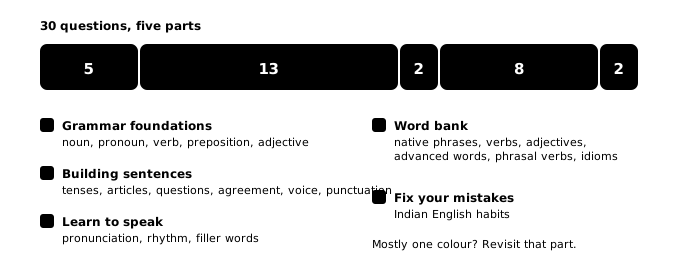
The bar below shows how the 30 questions are spread across the five parts of the book. If your mistakes pile up in one colour, go straight back to that part — there is no need to repeat the whole book.
Six kinds of questions
Choose (MCQ) · fill in the blank (fill) · spot the mistake (spot) · put in order (reorder) · match pairs (match) · say it aloud (speak). The "say it aloud" questions need a microphone. If you don't have one, listen and repeat, then move on — it doesn't affect your score.
60.2 Before you start — a three-minute warm-up
These three mistakes have come up most often in the whole book. Look at them once, say the corrected sentences aloud once, and then start the test.
Three things, one last time
- Wrong: I am working here since three years.
- Right: I've been working here for three years.
-
Why: Use for with a length of time, and since with a starting point. And work that is still going on = have been + -ing.
-
Wrong: She is doctor and she is good in surgery.
- Right: She's a doctor and she's good at surgery.
-
Why: Always use a/an with a profession, and being skilled = good at.
-
Wrong: Tell me where is the lift.
- Right: Could you tell me where the lift is?
- Why: When a question sits inside a longer sentence, the order becomes normal again — the verb goes to the end.
60.3 Final test — the whole book
Exercise 1
In this sentence, which part of speech is 'quickly'? — She finished the report quickly.
- Adverb
- Adjective
- Verb
- Preposition
Hint: It tells how the work was done.
Answer
Adverb
An adverb tells us about a verb — how, when, where. Here 'quickly' tells how 'finished' happened.
Exercise 2
Ravi and I finished the work ___ .
Hint: We did it on our own — the reflexive form.
Answer
ourselves
The reflexive pronoun matches the subject: I → myself, we → ourselves. Note: there is no such word as 'ourself'.
Exercise 3
Which sentence is correct?
- I have been waiting for twenty minutes.
- I am waiting since twenty minutes.
- I wait since twenty minutes.
- I have waited since twenty minutes.
Answer
I have been waiting for twenty minutes.
An action that started earlier and is still going on = have been + -ing. And use 'for' with a length of time, 'since' with a starting point.
Exercise 4
Find the wrong word.
She didn't came to the meeting yesterday.
Answer
Wrong word: came.
Corrected: She didn't come to the meeting yesterday.
'Did' already shows the past, so the verb stays in its first form — didn't come.
Exercise 5
By the time we reached the platform, the train ___ .
- had left
- has left
- left
- was leaving
Hint: Two actions in the past — which happened first?
Answer
had left
When two things happened in the past, the earlier one takes 'had'. This is called the past perfect.
Exercise 6
She ___ the answer, so just ask her.
Hint: Verbs of thinking don't go into the continuous.
Answer
knows
Know, understand, believe, like, want — these don't go into the continuous. 'She is knowing' is wrong.
Exercise 7
Which sentence is correct?
- It took an hour to find a university nearby.
- It took a hour to find an university nearby.
- It took an hour to find an university nearby.
- It took a hour to find a university nearby.
Hint: a/an depends on the sound.
Answer
It took an hour to find a university nearby.
The H in hour is silent, so the sound starts with a vowel — an. University starts with a 'yoo' sound, which is like a consonant — a.
Exercise 8
One word is unnecessary — tap it.
I really enjoy the music in my free time.
Answer
Wrong word: the.
Corrected: I really enjoy music in my free time.
In a general statement, 'the' is not used. 'The music' would mean one particular music that is playing now.
Exercise 9
My sister is very good ___ mathematics.
Hint: Being skilled.
Answer
at
Skilled in a subject = good at. Good with = good at handling things or people.
Exercise 10
One word should be removed — find it.
Let us discuss about the new policy on Monday.
Answer
Wrong word: about.
Corrected: Let's discuss the new policy on Monday.
The word 'about' is already inside discuss. Same family: enter the room, reach Delhi, order two teas.
Exercise 11
The meeting is ___ 4 pm ___ Monday ___ July.
- at / on / in
- in / at / on
- on / in / at
- at / in / on
Answer
at / on / in
Exact time = at, day/date = on, month/year = in. Small to big — that is the order.
Exercise 12
Each of the three teams ___ its own budget.
Hint: Is each singular or plural?
Answer
has
Each, every, everyone, nobody are all singular, even when a plural noun follows.
Exercise 13
Make the question in the right order.
Words: jacket / Where / you / did / that / buy
Answer
Where did you buy that jacket
In a question the helping verb (did) comes before the subject (you), and then the verb is in its first form.
Exercise 14
The order is wrong — tap the word in the wrong place.
Could you tell me where is the lift?
Answer
Wrong word: is.
Corrected: Could you tell me where the lift is?
When a question sits inside a longer sentence, the order becomes normal again — the verb moves to the end.
Exercise 15
Which is the active form of 'The report was approved by the committee'?
- The committee approved the report.
- The report approved the committee.
- The committee was approving by the report.
- The report has approved the committee.
Answer
The committee approved the report.
When changing passive to active, the 'by' part becomes the subject, and the old subject becomes the object.
Exercise 16
Rekha said that she ___ busy that evening.
Hint: In reported speech the tense goes one step back.
Answer
was
When reporting what someone said, the tense goes one step back: 'I am busy' → she said she was busy.
Exercise 17
Which sentence is correct for punctuation?
- It's raining, so take its cover along.
- Its raining, so take it's cover along.
- Its raining, so take its cover along.
- It's raining, so take it's cover along.
Answer
It's raining, so take its cover along.
It's = it is. Its = belonging to it. Here the apostrophe shows a shortened form, not possession.
Exercise 18
Where is the stress in 'village'?
- On the first part — VIL-lage
- On the second part — vil-LAGE
- Equally on both
- Nowhere, all the sounds are equal
Hint: It has two parts — VIL-lage.
Answer
On the first part — VIL-lage
In most two-part English nouns the stress falls on the first part. This rhythm is what creates fluency.
Exercise 19
When speaking, you need time to think. What is best?
- That's a good question — let me think for a second.
- Basically, basically, what happens is…
- Actually, actually, let me tell you…
- Stay silent for twenty seconds
Answer
That's a good question — let me think for a second.
Repeating filler words (basically, actually) lowers confidence. Buying time with one short, complete sentence sounds natural.
Exercise 20
You didn't understand what someone said in a meeting. What is the most natural line?
- Sorry, I'm not following.
- I am not understanding.
- I have a doubt in your talk.
- Please repeat it again.
Answer
Sorry, I'm not following.
'I'm not following' is neutral — you don't look weak, and you don't blame the speaker. In 'repeat it again', 'again' is unnecessary.
Exercise 21
This was lovely, but I should get ___ — it's getting late.
Hint: A soft way to leave.
Answer
going
'I should get going' = I should leave now. More polite and more natural than 'I need to leave'.
Exercise 22
'The new form removed almost all the errors' — which verb fits?
- eliminated
- enhanced
- authorized
- demonstrated
Answer
eliminated
Eliminate = to remove completely. Enhance means to make something good better, and authorize means to give official permission.
Exercise 23
One word is unnecessary — tap it.
After two night shifts I was very exhausted.
Answer
Wrong word: very.
Corrected: After two night shifts I was exhausted.
Exhausted is already a very strong word. For more force, say 'utterly exhausted', not 'very'.
Exercise 24
Which advanced word sounds best when you describe yourself in an interview?
- pragmatic
- enigmatic
- nefarious
- onerous
Answer
pragmatic
Pragmatic = practical, focused on results — a word of praise. Enigmatic would mean nobody can figure you out.
Exercise 25
The music is too loud. Which sentence is correct?
- Please turn it down.
- Please turn down it.
- Please turn down.
- Please it turn down.
Hint: Where does the pronoun go?
Answer
Please turn it down.
Turn down is separable, and the pronoun (it) must go in the middle. 'Turn down it' is never correct.
Exercise 26
The order is wrong — tap the wrong word.
She will look the baby after this evening.
Answer
Wrong word: after.
Corrected: She will look after the baby this evening.
Look after is inseparable — the object comes after the particle, never in the middle.
Exercise 27
Match each idiom to its meaning.
| A | B |
|---|---|
| on the same page | stop work for today |
| the ball is in their court | unlikely, but worth trying |
| call it a day | sharing the same understanding |
| a long shot | now it is their decision |
Answer
on the same page — sharing the same understanding; the ball is in their court — now it is their decision; call it a day — stop work for today; a long shot — unlikely, but worth trying
You hear all four in offices every day. Recognising them matters; using them is optional.
Exercise 28
Match each Indian English habit to its international form.
| A | B |
|---|---|
| Myself Ravi | move the call up |
| I have a doubt | graduated in 2019 |
| prepone the call | I'm Ravi |
| passed out in 2019 | I have a question |
Answer
Myself Ravi — I'm Ravi; I have a doubt — I have a question; prepone the call — move the call up; passed out in 2019 — graduated in 2019
All four are perfectly clear in India — you just need a different gear for an international call.
Exercise 29
Build one clear email line — without 'kindly' or 'needful'.
Words: can / we / so / release / invoice / Could / by / the / Friday / approve / you / payment
Answer
Could you approve the invoice by Friday so we can release payment
The formula: what to do + for whom + by when. All three in one line, and the message is perfectly clear.
Exercise 30
Say this line aloud. Run 'I have been' together smoothly, and put light stress on 'at'.
I have been working here for three years and I am good at my job
Answer
Say: I have been working here for three years and I am good at my job
Three things are right in one line — tense, preposition and word order. In an interview this could be your first answer.
What your score means
Above 80% — the book is yours. Now, instead of more practice, you need real conversation. Talk to someone in English for ten minutes every day.
50 to 80 — your foundation is strong, with a few loose spots. Look at the chart, spot the colour of your mistakes, and go back to only those two or three chapters.
Below 50 — that's fine, and it is not a bad score at all. It only means the book needs one more read. The second time, things settle in much faster, because your mind recognises them.
60.4 Where did you go wrong? Go straight back there
Note your score, but more important is what kind of question you got wrong. The table below shows where to go back.
| The mistake was of this kind | Reopen this chapter |
|---|---|
| a / an / the missing or wrong | Articles — a, an, the |
| since / for, had / have, didn't + verb | All 12 Tenses |
| in / on / at, good in, afraid from | Preposition · The 50 most common mistakes |
| Question order, "where is the lift" | Asking questions |
| has / have, each, news | Subject-verb agreement |
| Passive to active, reported speech | Active and Passive voice · Reporting what someone said |
| it's / its, comma, capital | Punctuation |
| Where the stress falls, filler words | Rhythm and stress · Fluency and filler words |
| A natural phrase felt wrong or odd | From Basic to Native |
| A big verb or adjective in the wrong place | Verb upgrades · Choosing the right adjective |
| turn down it, look the baby after | Phrasal verbs |
| Idiom meaning or use was wrong | Idioms |
| Myself, revert back, prepone, doubt | Indian English habits |
| can / must / should, have to | Modal Verbs |
| enjoy to read, want going | Gerunds & Infinitives |
| who / which / that, joining long sentences | Clauses |
| used to / be used to, I wish, had better | used to, wish, had better |
| get it done, Never have I…, What I need is… | Powerful sentences |
| Couldn't follow fast English (gonna, wanna) | Native speed English |
| 15 or 50, dates, saying rupee amounts | Number, date, time, paise |
| Starting a conversation, giving opinions, talking on calls | Small talk and giving opinions · Phone and video calls |
| The start or end of a presentation | Giving a presentation |
| happy / unhappy / happiness — wrong form | One word, ten words |
| do a mistake, strong rain-type pairs | Which word goes with which |
| Missing a word for doctor, bank, travel or office | Everyday topics · Work and the world |
| affect / effect, lose / loose, borrow / lend | Look-alike words |
| Spelling mistakes | Spelling rules |
| The shape of a paragraph, email or application | From sentence to paragraph · Writing emails · Applications and messages |
| CV bullets, essays or reports | CV and LinkedIn · Essays and Reports |
| Understanding by listening, or dictation | Short Stories · Everyday Stories · Real-World English |
| Want to know your level and next step | IELTS, TOEFL and your level |
One last thing
English is not an exam — it is a habit. The real aim of this book was not for you to memorise every rule. The aim was that when you speak English, you are no longer afraid of "I'll make a mistake". Once that fear goes, everything else will come on its own — a little at a time, every day. Those who speak, learn. Those who fear mistakes stay silent. Be one of those who speak.