Chapter 16: Modal verbs
Modals — can, should, must
In Hindi we add "sakna", "chahiye", "padega", "shayad" to a verb to show our mood. In English this job is done by small helping verbs called modals. They are the heart of everyday conversation — whether you want to ask politely, give advice or make a guess, you can't manage without modals.
- 1How a modal works — three fixed rules
- 2Ability — can, could, be able to
- 3Permission and requests — how polite do you need to be?
- 4Advice and obligation — should, must, have to
- 5Possibility — from might to must, how sure are you?
- 6will, would, shall, need, used to
- 7Past modals — should have, could have, must have
- 8The mistakes we really make
In one line
A modal verb is a helping verb that adds ability, permission, advice, obligation or possibility to the main verb. The main verb tells you the action; the modal tells you what we think about the action.
- I can swim. = I know how to swim. — ability
- You should drink more water. = Drinking more water would be a good idea for you. — advice
- It might rain in the evening. = Perhaps it will rain in the evening. — possibility
16.1 How a modal works — three fixed rules
The good news is that all modals work in the same way. Once you have these three rules firmly in your head, half your mistakes will stop by themselves — whichever modal it is.
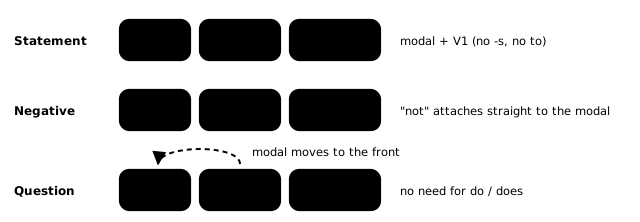
The three rules for modals
1. After a modal, the verb is in its base form (V1) — no -s, no -ing, no "to". 2. A modal never changes itself — there is no "cans" or "musted". 3. A modal makes its own negatives and questions: can't go, Can you go?
Three modal-like verbs come with 'to'
ought to, have to, used to — here "to" is part of them: You ought to apologise. After any other modal there is no "to": You must to go.
16.2 Ability — can, could, be able to
"I can do this" — you say it every day: in job interviews, when filling in forms, with friends. What matters is choosing the right word as the time changes.
| Time | Word | Example |
|---|---|---|
| Now (present) | can | She can speak Tamil. |
| Past, in general | could | I could run fast when I was young. |
| Past, on one particular occasion | was / were able to | We were able to catch the last bus. |
| Later (future) | will be able to | You will be able to drive in a month. |
| In a perfect tense | have been able to | I haven't been able to sleep. |
Ability
Use can for the present and could for the past. Where "can" doesn't fit — the future, the perfect, or after another modal — use be able to: will be able to.
No two modals together
You will can come. ✗ → You will be able to come. ✓
One modal per sentence. If you need another, take a form like "be able to" or "have to".
16.3 Permission and requests — how polite do you need to be?
The word you choose when asking shows how much respect you are giving the other person. "Can I…?" is fine with a friend, but with a boss or a stranger "Could you…?" sounds better.
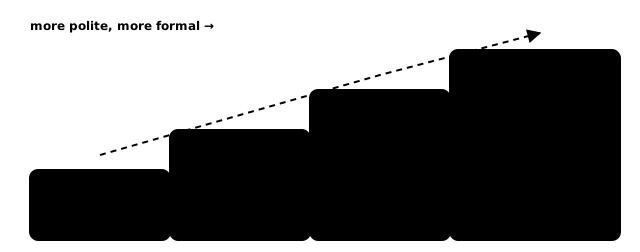
Permission and requests
Permission: Can I (casual) → Could I → May I (formal). Request: Can you → Could you → Would you mind + -ing. "May" is only for asking permission for yourself — there is no "May you…?".
- Could you send me the file by evening? = Would it be possible for you to send the file by this evening? — perfect for the office.
- Would you mind closing the window? = Is it a problem for you to close the window? — answering "No, not at all" means "Sure, I'll do it".
16.4 Advice and obligation — should, must, have to
"I should do it" and "I have to do it" are very different — one is advice, the other is a duty. English makes this difference clear too, and if you pick the wrong word you sound either too harsh or too weak.
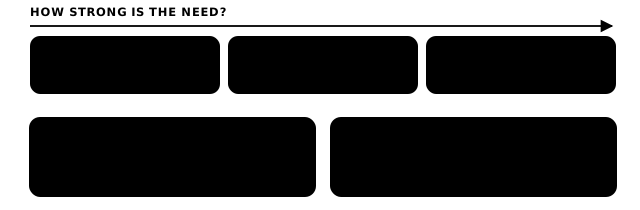
Advice and duty
should / ought to = advice. have to = a rule or a duty forced by the situation. must = a strong need. Note: mustn't = forbidden, but don't have to = not necessary.
- You should see a doctor. = Seeing a doctor is a good idea — it is advice, and the choice is yours.
- I have to wear a uniform at work. = The company requires it — the obligation comes from outside.
- In the past: I had to wait for two hours. "must" has no past form — use "had to".
16.5 Possibility — from might to must, how sure are you?
When you make a guess, the modal shows how sure you are. "She might be at home" and "She must be at home" use different modals. Using them well makes your English sound thoughtful.
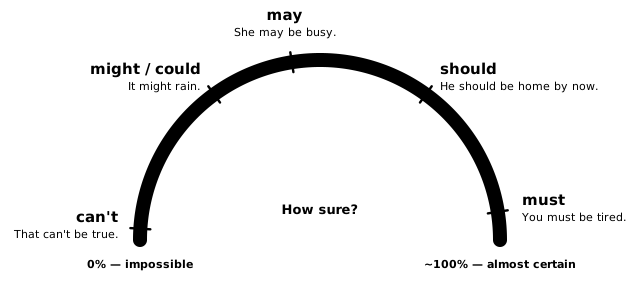
The certainty meter
might / could (perhaps) → may (it's possible) → should (it ought to be so) → must (it surely is). The firm opposite: can't — He can't be at home; I just saw him at the station.
The opposite of a 'must' guess is not 'mustn't'
She must be at work. (I'm sure she's at the office) → the opposite: She can't be at work.
"She mustn't be at work" would mean she is forbidden to be at the office!
16.6 will, would, shall, need, used to
These five modals (or modal-like words) turn up every day, and each has its own special job. Look at them in one place, and you don't need to remember them separately.
| Word | Job | Example |
|---|---|---|
| will | future, promise, instant decision | I will call you tonight. |
| would | polite wish, imagination | I would like a cup of tea. |
| would | an old habit (action) | Dadi would tell us stories every night. |
| shall | an offer or suggestion with I / we | Shall I open the window? |
| need | necessity | You need to sign here. / You needn't worry. |
| used to | was true in the past, but not now | I used to live in Patna. |
used to vs be used to — two different things
used to + V1 = did it in the past: I used to wake up at 9. (not any more)
be used to + -ing = am accustomed to it: I am used to waking up early. In the second one "to" is a preposition, so -ing follows. In questions: Did you use to…? (no -d)
16.7 Past modals — should have, could have, must have
Regret about the past, a missed chance, or a guess about something that already happened — all of these are said with modal + have + V3. The pattern sounds hard, but it comes up all the time in conversation.
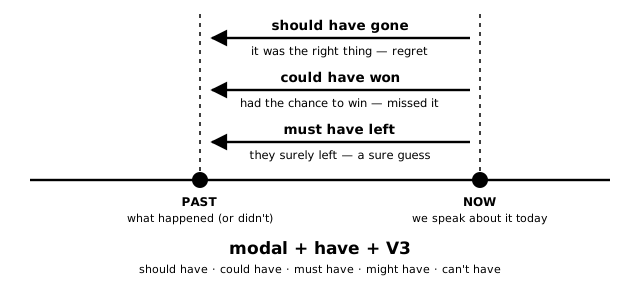
Past modals
modal + have + V3: should have done = it was right to do it, but it wasn't done (regret), could have done = was able to do it, but didn't (missed chance), must have done = surely did it (a sure guess). "have" never becomes "has".
- I should have studied harder. = Studying harder was the right thing to do, but I didn't. (regret)
- The roads are wet. It must have rained last night. = It surely rained last night — a sure guess from the wet roads.
'should've' in speech
In conversation, should have sounds like "should've" (shud-uv). That is why many people write "should of" — which is wrong. In writing, always use have.
16.8 The mistakes we really make
The most common Indian-English mistakes with modals
- Wrong: Can you able to come tomorrow?
- Right: Can you come tomorrow? / Will you be able to come?
-
Why: "can" and "able to" mean the same thing — using both is repetition. Pick one.
-
Wrong: You must to submit the form today.
- Right: You must submit the form today.
-
Why: After a modal comes V1 directly, with no "to" in between. Only ought to, have to and used to have "to".
-
Wrong: May you help me with this?
- Right: Could you help me with this?
-
Why: "May" is used only to ask permission for yourself (May I…?). To ask someone to do something, use Could you / Would you.
-
Wrong: I could not able to attend the meeting.
- Right: I couldn't attend / I wasn't able to attend the meeting.
-
Why: The same repetition — "could" and "able" don't go together. For one particular occasion, "wasn't able to" is the most natural.
-
Wrong: You should have went to the doctor.
- Right: You should have gone to the doctor.
- Why: After "have" you always need V3 — gone, seen, done. "went" is V2, which doesn't belong here.
16.9 Practice — Modals
Exercise 1
She ___ speak four languages.
- can
- cans
- can to
- is can
Hint: Which form of the verb comes after a modal?
Answer
can
A modal never changes — no -s, no 'to', and no 'is' with it. Just 'She can speak'.
Exercise 2
You want to ask your boss politely: '___ you check my report, please?'
- Could
- May
- Must
- Shall
Answer
Could
A polite request to get someone to do something is Could you…? 'May you' is wrong — may is only for asking permission for yourself (May I…?).
Exercise 3
Tomorrow is a holiday, so you ___ come to the office.
- don't have to
- mustn't
- can't
- shouldn't have
Hint: It isn't forbidden — it just isn't necessary.
Answer
don't have to
It's a holiday, so coming in isn't necessary — 'don't have to'. 'mustn't' would mean coming in is forbidden, which isn't the point here.
Exercise 4
He has been working for 14 hours. He ___ be very tired.
- must
- might
- can't
- should have
Hint: A sure guess.
Answer
must
After 14 hours of work, being tired is almost certain. For a sure guess use 'must'.
Exercise 5
When I was a child, I ___ climb trees easily.
- could
- can
- am able to
- will be able to
Answer
could
This is a general ability in the past — so 'could', the past of 'can'.
Exercise 6
I missed the bus. I should have ___ earlier. (leave)
Hint: have + V3
Answer
left
The formula for a past modal is should + have + V3. The V3 of 'leave' is 'left'. It means leaving early was the right thing to do (but I didn't).
Exercise 7
Next year I will ___ able to vote.
Hint: Two modals can't go together.
Answer
be
'will can' is wrong because two modals can't be used together. Ability in the future = will be able to.
Exercise 8
Tap the wrong word.
Can you able to send the document today?
Answer
Wrong word: able.
Corrected: Can you send the document today?
'Can' and 'able to' both mean the same thing, so together they repeat. Drop 'able to', or say 'Will you be able to…?'
Exercise 9
One word is extra — find it.
You must to wear a helmet on the bike.
Answer
Wrong word: to.
Corrected: You must wear a helmet on the bike.
After 'must' comes V1 directly, with no 'to'. 'to' appears only with ought to, have to and used to.
Exercise 10
Match each modal to its job.
| A | B |
|---|---|
| should | perhaps, low certainty |
| mustn't | was true before, not now |
| might | advice |
| used to | forbidden |
Answer
should — advice; mustn't — forbidden; might — perhaps, low certainty; used to — was true before, not now
should = a good idea, mustn't = don't do it, might = perhaps, used to = an old habit that has stopped.
Exercise 11
Make a polite request.
Words: mind / door / Would / the / opening / you
Answer
Would you mind opening the door
After 'Would you mind' the verb takes -ing — opening. It is the most polite way to ask someone to do something.
Exercise 12
Say this line aloud — join 'should have' like 'should've'.
I should have called you yesterday
Answer
Say: I should have called you yesterday
Native speakers say 'should have' as 'shud-uv'. Joining it when you speak makes listening easier too, and fixes the formula (modal + have + V3) in your head.
What to do next
Tomorrow at the office or college, whenever you ask for something, say "Could you" instead of "Can you". And at the end of the day, write one "should have" sentence about yourself — something you should have done but didn't.