Chapter 14: Interjections
Interjection — the words of feeling
An interjection is a word that suddenly lets out a feeling — joy, pain, surprise, regret. It isn't part of the sentence; it stands apart from it, and if you remove it the meaning of the sentence doesn't change at all — only its voice is lost. Among the eight parts of speech it is the smallest, but in everyday conversation it does the most work.
- 1Where an interjection sits in a sentence
- 2Types — by feeling
- 3Punctuation — three fixed rules
- 4Interjection or something else — one word, two jobs
- 5From Hindi to English — pairs for real conversation
- 6Office and formal places — where to hold back
- 7The mistakes we really make
- 8A short summary
In one line
An interjection is a word or short phrase that expresses sudden feeling and stands apart from the rest of the sentence. It does exactly the job that "arre, waah, haaye, achha, ohho" do in Hindi.
- Wow! That was a brilliant catch. = What an amazing catch that was!
- Ouch! That hurt. = A cry of sudden pain. (In Hindi we say "ssss" or "aai".)
- Oh, I forgot my wallet at home. The feeling is mild, so use a comma — not an exclamation mark.
14.1 Where an interjection sits in a sentence
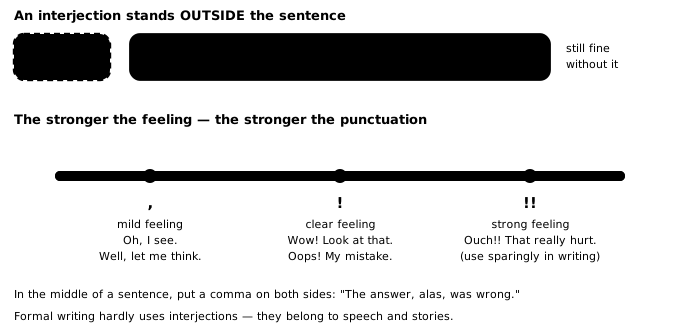
An interjection has no grammatical link with the rest of the sentence. It is not the subject, the verb or the object. So if you take it out, the sentence doesn't break.
Five features of an interjection
1. Strong / sudden emotion — shows a sudden, strong feeling: joy, pain, fear, surprise.
2. Stands apart — stays separate from the rest of the sentence, often at the start.
3. Usually "!" — it is usually followed by an exclamation mark (a comma if the feeling is mild).
4. No grammatical link — no grammatical link to the subject, verb or object; take it out and the sentence is still fine.
5. Same word, different feelings — one word can carry different feelings on different occasions.
- Oh! What a lovely surprise. "Oh" = surprise / happiness.
- Oh! My knee hurts. The same "Oh" = pain.
- Oh! I am so sorry to hear that. The same "Oh" = sorrow. The feeling comes not from the word but from the situation and the tone of voice.
14.2 Types — by feeling
School books teach ten (10) types of interjection. Each type has its English name here too, so you can match it directly with your textbook.
| Type (feeling) | Typical words | Example | In Hindi |
|---|---|---|---|
| 1. Joy (happiness) | Hurrah! Hurray! Yippee! | Hurray! We won the match. | Waah! (We won!) |
| 2. Sorrow (sadness / regret) | Alas! Oh! Ah! | Alas! He could not make it. | Haaye! (What a pity!) |
| 3. Surprise (astonishment) | Oh! Wow! What! Ah! | What! You passed already? | Arre! (Really?) |
| 4. Pain (hurt) | Ouch! Ah! Oh! | Ouch! The tea is hot. | Aai! Ssss! |
| 5. Approval / Appreciation (praise) | Bravo! Well done! Excellent! | Bravo! What a performance. | Shabaash! (Well done!) |
| 6. Anger / Irritation (annoyance, frustration) | Pooh! Bah! | Bah! Another traffic jam. | Uff! (That's too much!) |
| 7. Greeting (saying hello) | Hello! Hi! Hey! | Hello! How are you? | Namaste! (How are you?) |
| 8. Attention (getting someone's notice) | Hey! Look! Listen! | Look! The train is coming. | Arre! (Look!) |
| 9. Calling (calling someone) | O! Ho! Hey! | Hey, Ravi! Come here. | Aye Ravi! (Come here.) |
| 10. Fear (being scared) | Help! Oh! Ah! | Help! There is a snake! | Bachao! (Save me!) |
- Yippee! School is closed tomorrow. Joy — the bouncing happiness of children.
- Well done! You topped the class. Approval — two words, but they do the job of one interjection.
- O God, please help us! Calling — "O" survives today only in prayers and poetry; it is always a capital letter and goes straight before a name.
'Damn!' — a word of anger, but rude
You hear "Damn!" a lot in films, but it is considered rude. Never say it in class, at the office, or in front of elders. To show irritation, "Oh no!", "Ugh!" or "Come on!" are enough.
More feelings in everyday speech
| Feeling | Words | Example | In Hindi |
|---|---|---|---|
| Agreement | Yes! Sure! Indeed! Right! | Indeed, that was clever. | Bilkul! Sahi! |
| Disgust | Ugh! Yuck! Eww! | Yuck! This milk has gone bad. | Chhee! Thoo! |
| Pausing / thinking | Well… Um… Hmm… Er… | Hmm, let me check. | Hmm… Achha… |
| A mistake | Oops! Whoops! My bad! | Oops! I sent the wrong file. | Oho! (A mistake happened.) |
| Relief | Phew! Thank goodness! | Phew! That was close. | Uff! (We escaped.) |
Common interjections and how to use them
| Interjection | When to say it | Example |
|---|---|---|
| Oh! | surprise, pain, sorrow — all three | Oh! I didn't know that. |
| Ah! | understanding, relief, mild pain | Ah, now I understand. |
| Wow! | surprise + admiration | Wow! What a view. |
| Ouch! | your own sudden pain | Ouch! I cut my finger. |
| Hurray! | joy at a win | Hurray! We are on holiday. |
| Bravo! | praising someone's work | Bravo! Great speech. |
| Hello! / Hi! | meeting someone, answering the phone | Hi! Good to see you. |
| Hey! | getting attention, calling (to equals) | Hey! Wait for me. |
| Help! | fear, danger | Help! I can't swim. |
| Oops! | a small mistake | Oops! I dropped it. |
| Phew! | relief | Phew! We made it. |
| Alas! | deep sorrow (bookish) | Alas! The king was dead. |
14.3 Punctuation — three fixed rules
Where to use a comma, where an exclamation mark
1. Strong feeling → exclamation mark, and the next word starts with a capital: Wow! That is amazing.
2. Mild feeling → comma, and the next word starts in lower case: Oh, it's you.
3. In the middle of a sentence → a comma on both sides: The result, alas, was disappointing.
One word, two punctuation marks — the meaning changes
Oh! You came. — surprise; it seems you weren't expecting it.
Oh, you came. — a mild acknowledgement; it seems you knew. Here punctuation works like a volume control for the feeling.
No more than one exclamation mark
In a chat, "Wow!!!" is fine. In an email, an exam or any written work, use just one exclamation mark. Three don't make the point stronger — they make you sound less serious.
14.4 Interjection or something else — one word, two jobs
Many words can be an interjection and also an ordinary part of speech. You decide by checking whether the word is inside the sentence or outside it.
| Word | As an interjection | In its normal role |
|---|---|---|
| well | Well, I am not sure. | She sings well. (adverb) |
| what | What! You are leaving? | What is your name? (pronoun) |
| right | Right, let's begin. | Your answer is right. (adjective) |
| indeed | Indeed! I never expected that. | It was indeed difficult. (adverb) |
| my | My! How you have grown. | This is my bag. (possessive) |
The test for spotting one
Take the word out and read the rest of the sentence. If what remains is complete and correct → it was an interjection. If the sentence is left incomplete → the word was part of the sentence. "Well, I am not sure" → "I am not sure" is complete. ✓ interjection.
"She sings well" → "She sings" changes the meaning. ✗ not an interjection.
14.5 From Hindi to English — pairs for real conversation
We tend to carry Hindi interjections straight into English — "Arre, where were you?" It's understood, but it doesn't sound like English. Here are some useful pairs:
| We say (in Hindi) | In English | When |
|---|---|---|
| Arre! | Hey! / Oh! / Come on! | getting attention or mild surprise |
| Achha? | Really? / Is that so? | on hearing something new |
| Achha, theek hai | Right. / Okay then. | accepting what was said |
| Waah! | Wow! / Brilliant! | praise |
| Haaye! | Oh no! / Alas! (old-fashioned) | sorrow |
| Uff / Chalo bach gaye | Phew! | relief |
| Chhee! | Yuck! / Ugh! | disgust |
| Hmm… dekhte hain | Well… let me see. | while thinking |
| Oho, galti ho gayi | Oops! My bad. | a small mistake |
| Arre nahi! | Oh no! / No way! | on hearing bad news |
The truth about 'Alas', 'Hurrah' and 'Pooh' — old words
School books are full of Alas!, Hurrah! and Pooh!, but today's speech hardly uses them — they sound old-fashioned and theatrical. They are fine in exams and stories; in conversation, use the modern words below.
| Old (bookish) | Say today | Feeling |
|---|---|---|
| Alas! | Oh no! / That's so sad. | sorrow |
| Hurrah! | Yay! / Yes! / Woo-hoo! | joy |
| Pooh! / Bah! | Ugh! / Come on! / Seriously? | irritation |
| O! / Ho! | Hey! / Excuse me! | calling |
14.6 Office and formal places — where to hold back
| Place | Fine | Not fine |
|---|---|---|
| Chat with a friend | Wow! Oops! Yay! Ugh! | — |
| Office email | Well, Right, Indeed (with a comma) | Yay! Yuck! Oops! |
| Interview | Well, … (to buy thinking time) | Hmm… many times |
| Exam writing | in a story / dialogue | in an essay or report |
A useful point for interviews
Instead of answering a question at once, it is perfectly fine to say "Well, that's an interesting question…" — it buys you two seconds to think and makes you look prepared. But don't say it three times in one interview.
14.7 The mistakes we really make
Mistakes that go with interjections
- Wrong: Myself Ravi. Wow, nice to meet you!
- Right: Hello! I am Ravi. Nice to meet you.
-
Why: Two things: "Myself Ravi" is wrong — the subject needs "I". And "Wow" sounds odd when you meet someone; it is meant for admiration. For a greeting, say "Hello" or "Hi".
-
Wrong: Oh! i forgot to call her.
- Right: Oh! I forgot to call her.
-
Why: A new sentence begins after an exclamation mark, so the next word is a capital. With a comma, a small letter would be fine: Oh, I forgot…
-
Wrong: Dear Sir, Wow!!! Thank you for the offer.
- Right: Dear Sir, Thank you very much for the offer.
-
Why: In a formal email, both an interjection and three exclamation marks feel heavy. To show happiness, use words: I am delighted to accept.
-
Wrong: Alas the news was bad.
- Right: Alas, the news was bad.
-
Why: An interjection needs punctuation after it — a comma or an exclamation mark. Without anything, it melts into the sentence and the reader stumbles.
-
Wrong: Ouch, she don't know the answer.
- Right: Oh no, she doesn't know the answer.
-
Why: "Ouch" is only for your own pain, not for someone else's trouble — for that use "Oh no". And "she" takes "doesn't", not "don't".
-
Wrong: Hey! Sir, can you discuss about my marks?
- Right: Excuse me, Sir, could we discuss my marks?
-
Why: "Hey!" is for equals; with an elder or a teacher, say "Excuse me". And "about" doesn't go after "discuss".
-
Wrong: Yuck! This is my cousin brother's cooking.
- Right: Hmm, this is my cousin's cooking — not my favourite.
- Why: "Yuck" is quite harsh — saying it about someone's food in front of them is rude. And "cousin" is a complete word by itself — there is no need to add brother.
14.8 A short summary
Remember four things
1. An interjection stands outside the sentence — take it out and the sentence still works.
2. Strong feeling → ! and a capital next word. Mild feeling → , and a lower-case next word.
3. In formal writing, don't use it — show the feeling in words instead.
4. One exclamation mark is enough.
14.9 Practice — Interjections
Exercise 1
___! We finally won the trophy.
- Hurray
- Alas
- Ouch
- Yuck
Hint: You need a feeling of joy.
Answer
Hurray
Winning brings joy, and for joy we use Hurray / Yay / Wow. Alas is for sorrow, ouch for pain, and yuck for disgust.
Exercise 2
Which sentence is correctly punctuated?
- Oh! I forgot my keys.
- Oh! i forgot my keys.
- Oh i forgot my keys.
- Oh. i forgot my keys!
Hint: What follows an exclamation mark?
Answer
Oh! I forgot my keys.
A new sentence begins after an exclamation mark, so the next word is a capital. With a comma a small letter would be fine — 'Oh, I forgot'.
Exercise 3
'Well, I am not sure about that.' — what is 'Well' here?
- interjection
- adverb
- adjective
- conjunction
Hint: Take the word out and read the sentence.
Answer
interjection
Even without 'Well', 'I am not sure about that' is a complete sentence, so 'Well' stands outside it — an interjection. In 'She sings well' removing it would change the meaning; there it is an adverb.
Exercise 4
Which version is best for an office email?
- I am delighted to accept the offer.
- Wow!!! Thanks for the offer.
- Yay! I accept.
- Oops, I accept.
Hint: In formal places, feelings are shown in words.
Answer
I am delighted to accept the offer.
In formal writing, interjections and several exclamation marks feel heavy. Showing happiness in words sounds more professional.
Exercise 5
___! That water is boiling hot. (a word for pain)
Hint: What do you say at your own sudden pain?
Answer
Ouch
For sudden pain we say Ouch / Ow. Remember — it is only for your own pain; for someone else's trouble we say 'Oh no'.
Exercise 6
___, that was a close call. (a word for relief)
Hint: The sound of breathing out after an escape.
Answer
Phew
'Phew' shows relief — the Hindi 'uff' or 'chalo bach gaye'. It comes from the sound of letting out a breath.
Exercise 7
There is one mistake in this sentence — tap the wrong word.
Hey Sir can you discuss about my result?
Answer
Wrong word: about.
Corrected: Excuse me, Sir, could we discuss my result?
'about' doesn't go after 'discuss'. And 'Hey' is for equals — for a teacher or an elder, say 'Excuse me'.
Exercise 8
Find the wrong word.
Oh no she don't know about the meeting.
Answer
Wrong word: don't.
Corrected: Oh no, she doesn't know about the meeting.
'she' is third person singular, so it takes 'doesn't'. A comma was also needed after the interjection.
Exercise 9
There is one mistake — find it.
Myself Ravi and wow I am happy to be here.
Answer
Wrong word: Myself.
Corrected: Hello! I am Ravi, and I am happy to be here.
The reflexive pronoun 'myself' can't be a subject — you need 'I am'. And 'wow' sounds odd when meeting someone; say 'Hello' as a greeting.
Exercise 10
'Bravo! That was a brilliant speech.' — what type of interjection is 'Bravo'?
- Approval / Appreciation
- Joy
- Surprise
- Calling
Hint: Someone's work is being praised.
Answer
Approval / Appreciation
Bravo!, Well done!, Excellent! are words that praise someone's work (Approval / Appreciation). For your own happiness you use Hurray! or Yippee! (Joy).
Exercise 11
___! There is a snake under the bed! (a word for fear)
Hint: What do you shout to ask for help?
Answer
Help
For Fear, 'Help!' is the clearest interjection. 'Oh!' and 'Ah!' can show fear too, but 'Help!' tells people about the danger immediately.
Exercise 12
In conversation with a friend, what is more natural today instead of 'Hurrah!'?
- Yay!
- Alas!
- Pooh!
- Damn!
Hint: Hurrah is an old, bookish word.
Answer
Yay!
'Hurrah!', 'Alas!' and 'Pooh!' sound old-fashioned today. For joy people now say 'Yay!' or 'Yes!'. 'Damn!' is rude — don't use it.
Exercise 13
Which statement about interjections is WRONG?
- It acts as the subject of the sentence
- It shows a sudden feeling
- It is often followed by '!'
- One word can show different feelings
Hint: Remember the five features.
Answer
It acts as the subject of the sentence
An interjection has no grammatical link with the sentence — it is not a subject or an object. The other three are all its features.
Exercise 14
Match each interjection to its feeling.
| A | B |
|---|---|
| Hurray! | pain |
| Alas! | relief |
| Ouch! | disgust |
| Phew! | joy |
| Yuck! | sorrow |
Answer
Hurray! — joy; Alas! — sorrow; Ouch! — pain; Phew! — relief; Yuck! — disgust
You choose an interjection by the feeling, not by grammar. A word for the wrong feeling sounds odd — like saying 'Alas' to praise someone.
Exercise 15
Put the words in the right order — the interjection comes first.
Words: painting / is / beautiful / this / Wow
Answer
Wow this painting is beautiful
An interjection almost always comes at the start, because the feeling comes out first and the explanation follows. In writing, it is followed by a comma or an exclamation mark.
Exercise 16
Say this line aloud — stretch the 'Oh no' a little, as if you really feel sorry.
Oh no I have missed the train
Answer
Say: Oh no I have missed the train
An interjection gets its effect more from the voice than from the word. Said flat, it sounds like acting; said with feeling, it sounds natural.
What to do next
Interjections aren't for memorising — they're for listening. While watching an English show, notice what people say when they are surprised or relieved — and try one new word the next day. With this, the eight parts of speech are complete; next comes the part about building sentences.