Chapter 8: Pronouns
Pronoun — the words that take a noun's place
A pronoun is a word that takes the place of a noun, so that you don't have to say the same name again and again. They are small words — I, me, my, he, him, who, this — but mistakes in them are the easiest to hear. "Myself Ravi", "Me and my friend went", "Between you and I" — all three are pronoun mistakes, and all three will be fixed in this chapter.
- 1Personal pronouns — the whole table in one place
- 2I or me? — a one-second test
- 3Possessive — the difference between my and mine
- 4Reflexive pronouns — when the action turns back on the doer
- 5Demonstrative pronouns — this, that, these, those
- 6Relative pronouns — who, whom, which, that, whose
- 7The other types — one line each
- 8It must be clear whose place a pronoun takes
- 9The mistakes we really make
In one line
A pronoun is a word used in place of a noun. A word that stands in place of a noun is a pronoun. The noun it replaces is called the antecedent.
- Priya lost her keys, so she called me. "she" = Priya. Say the name once, then use a pronoun — this is natural English.
- This is mine, and that is yours. = This one belongs to me, and that one belongs to you. The whole idea is said without any noun.
8.1 Personal pronouns — the whole table in one place
This is the most important table. Once you understand its columns, the confusion over I/me, he/him, we/us is finished. A column means where the pronoun sits in the sentence.
| Who | Subject (the doer) |
Object (what the action fell on) |
Possessive adj. (with a noun) |
Possessive pron. (on its own) |
Reflexive (oneself) |
|---|---|---|---|---|---|
| The speaker (main) | I | me | my | mine | myself |
| The listener (tum / aap) | you | you | your | yours | yourself / yourselves |
| A boy or man (wo) | he | him | his | his | himself |
| A girl or woman (wo) | she | her | her | hers | herself |
| A thing (wo) | it | it | its | — | itself |
| The speaker and others (hum) | we | us | our | ours | ourselves |
| Several people (wo log) | they | them | their | theirs | themselves |
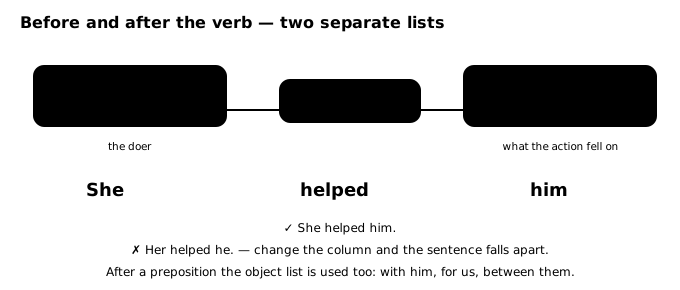
8.2 I or me? — a one-second test
The biggest confusion comes when there are two people: "Ravi and I" or "Ravi and me"? You don't need to remember a rule — take the other person out and read it again.
The take-it-out-and-listen test
Ravi and __ went to the market. → take out "Ravi and" → "I went to the market." ✓ ("Me went" sounds wrong) → so it is Ravi and I.
She invited Ravi and __. → take out → "She invited me." ✓ ("She invited I" sounds wrong) → so it is Ravi and me. Your ear tells you the answer — just remove the other name from the middle.
Three mistakes you hear every day
- Wrong: Me and my friend went to the mall.
- Right: My friend and I went to the mall.
-
Why: Two things: it is the subject, so "I" — and for politeness the other person's name comes first. Test: "Me went" — it sounds wrong.
-
Wrong: Between you and I…
- Right: Between you and me…
-
Why: "Between" is a preposition, and after a preposition the object list always comes — me, him, her, us, them. People get it wrong because they think "I" sounds more correct.
-
Wrong: He is taller than me. (fine in speech)
- Right: He is taller than I am. (better in writing)
- Why: The full sentence is "than I am tall" — so in formal English it is "than I". In speech "than me" is common, but in an exam or an email write "than I am".
8.3 Possessive — the difference between my and mine
There are two lists: one that comes with a noun, and one that stands alone.
| With a noun | Example | On its own | Example |
|---|---|---|---|
| my | This is my pen. | mine | This pen is mine. |
| your | your seat | yours | The seat is yours. |
| his | his bike | his | The bike is his. |
| her | her bag | hers | The bag is hers. |
| our | our house | ours | The house is ours. |
| their | their car | theirs | The car is theirs. |
These never take an apostrophe
its, hers, ours, yours, theirs — adding an apostrophe to these five is always wrong. They are possessive by themselves and don't need an apostrophe to help them.
✗ her's, ✗ our's, ✗ their's, ✗ it's (for the possessive)
8.4 Reflexive pronouns — when the action turns back on the doer
The -self / -selves pronouns are used when the doer and the one the action falls on are the same person.
- She hurt herself while cooking. The one who got hurt is the one who was working — so herself.
- I made this cake myself. Here "myself" adds emphasis — nobody else did it, I did. This use is called emphatic (see below).
- The children behaved themselves at the wedding. There are many children, so -selves.
Emphatic pronouns — the same words, a different job
myself, yourself, himself, herself, itself, ourselves, yourselves, themselves — when these same words come only to add emphasis, they are called emphatic pronouns. They usually come right after a noun or pronoun, or at the end of the sentence. In Hindi they are "khud", "swayam", "apne aap".
- I myself saw the accident. = I saw it with my own eyes — I didn't hear it from someone.
- She herself cooked the whole dinner. = She cooked it personally — not a cook.
- The Principal himself gave us the prizes. = The Principal gave them in person — which made the event feel more important.
| Reflexive | Emphatic | |
|---|---|---|
| Job | turns back on the doer (it is the object) | only adds emphasis — "personally, nobody else" |
| If you remove it? | the sentence becomes unfinished / wrong | the sentence is still complete, only the emphasis goes |
| Position | after the verb or a preposition | right after the subject, or at the end |
| Example | She hurt herself. | She herself called me. |
Remove-it test — reflexive or emphatic?
He cut himself. → "He cut." is unfinished → reflexive.
He himself cut the cake. → "He cut the cake." is complete → emphatic. An emphatic pronoun also never stands alone in the subject's place — "Himself cut the cake" is wrong. The subject first, then the emphasis.
'Myself Ravi' — the best-known Indian English mistake
- Wrong: Myself Ravi Kumar, from Lucknow.
- Right: I am Ravi Kumar, from Lucknow.
-
Why: A reflexive pronoun can never be a subject — to stand in front of one, you first need a normal subject (I). "Myself" creeps in from translating the Hindi "main Ravi" word for word. In an interview this is caught within the first three seconds.
-
Wrong: My friend and myself attended the class.
- Right: My friend and I attended the class.
-
Why: Here you need the subject — I. "Myself" would be used only if I had done something to myself.
-
Wrong: Please send the file to myself.
- Right: Please send the file to me.
- Why: After a preposition comes an object pronoun — to me. In an office email "to myself" sounds formal but is wrong.
8.5 Demonstrative pronouns — this, that, these, those
These four words work like a pointing finger — this one, that one.
| Near | Far | |
|---|---|---|
| One | this | that |
| Many | these | those |
- This is my seat, and those are theirs. = This is my seat, and those seats over there belong to them.
Pronoun or adjective?
If a noun comes right after it, it is an adjective — this book. If it stands alone, it is a pronoun — This is good. Identify it by its job, not by the word.
8.6 Relative pronouns — who, whom, which, that, whose
These join two sentences into one, and slip a small piece of information into the middle. Without them English would sound very choppy.
| Word | Used for | Example |
|---|---|---|
| who | a person — subject | The man who called is my uncle. |
| whom | a person — object (formal) | The man whom I met is a doctor. |
| whose | belonging to (possession) | The boy whose bag was lost is crying. |
| which | a thing / an animal | The phone which I bought is heavy. |
| that | both — for essential information | The book that you lent me is great. |
who or whom — a small trick
If the answer would be he, use who; if the answer would be him, use whom. Both "him" and "whom" have an "m" — remember that pair.
__ called? → He called. → Who called?
You met __? → I met him. → Whom did you meet?
8.7 The other types — one line each
| Type | Words | Example |
|---|---|---|
| Interrogative (questions) | who, whom, whose, which, what | What is your name? |
| Indefinite (not specific) | someone, anyone, everyone, nobody, something, all, few, many | Someone is knocking. |
| Reciprocal (one to the other) | each other, one another | They love each other. |
| Emphatic (emphasis) | myself, herself, themselves… (after the subject) | I myself checked it. |
| Distributive (one by one) | each, either, neither | Each of the boys has a bat. |
Indefinite pronouns and the verb
everyone, everybody, someone, nobody, each, either, neither — these all look like "many", but in grammar they are singular.
✓ Everyone is ready. ✗ Everyone are ready.
✓ Neither of them knows the answer.
8.8 It must be clear whose place a pronoun takes
A pronoun does its job only when the listener knows whose place it is taking. If there are two people, a pronoun can confuse:
✗
Ravi told Mohan that he had failed. (who failed — Ravi or Mohan?)
✓
Ravi told Mohan, "You have failed." (or) Ravi admitted to Mohan that he himself had failed.
8.9 The mistakes we really make
Common Indian-English pronoun mistakes
- Wrong: Myself Ravi, and myself working in an IT company.
- Right: I am Ravi, and I work in an IT company.
-
Why: A reflexive pronoun can't be a subject, and the verb was missing too. A safe formula for an introduction: "My name is ___ . I am from ___ . I work as ___ ."
-
Wrong: She is my cousin sister, and she don't speak Hindi.
- Right: She is my cousin, and she doesn't speak Hindi.
-
Why: "Cousin" is a complete word by itself. And "she" is third person singular, so the helping verb is "does" — she doesn't.
-
Wrong: I am having a car, and it's colour is red.
- Right: I have a car, and its colour is red.
-
Why: Two mistakes: "have" is not put in the continuous when it means possession, and the possessive "its" takes no apostrophe. "it's" is only the short form of "it is".
-
Wrong: Me and my brother are going to Goa.
- Right: My brother and I are going to Goa.
-
Why: It is the subject, so you need "I" — "Me am going" sounds wrong, doesn't it? Putting the other name first is politeness.
-
Wrong: Everyone have submitted their forms.
- Right: Everyone has submitted their forms.
-
Why: "Everyone" looks like many people, but in grammar it is singular — so "has". Using "their" after it is perfectly fine in today's English.
-
Wrong: One of my friend gave I a gift.
- Right: One of my friends gave me a gift.
-
Why: After "one of" comes a plural noun, and after the verb an object pronoun — me, not I.
-
Wrong: The two brothers help themself.
- Right: The two brothers help each other.
- Why: "themself" is not a word. And the meaning has changed too — to help one another you need "each other"; "themselves" would mean each helps his own self.
Three firm rules, that's all
1. Before the verb → I, he, she, we, they. After a verb or preposition → me, him, her, us, them.
2. A -self word never becomes a subject.
3. its, hers, ours, yours, theirs never take an apostrophe.
8.10 Practice — Pronouns
Exercise 1
___ and I went to the station together.
- My sister
- Me
- Myself
- Mine
Hint: Use the take-it-out-and-listen test.
Answer
My sister
There are two people in the subject, and 'I' is already in the right form. For politeness the other person's name comes first — 'My sister and I'.
Exercise 2
This is a secret between you and ___.
- me
- I
- myself
- mine
Hint: What part of speech is 'between'?
Answer
me
'Between' is a preposition, and after a preposition the object pronoun always comes — me, him, her, us, them. 'I' sounds more correct but is wrong.
Exercise 3
Which is the correct way to introduce yourself?
- I am Ravi from Patna.
- Myself Ravi from Patna.
- Myself is Ravi from Patna.
- Me Ravi from Patna.
Answer
I am Ravi from Patna.
The reflexive pronoun 'myself' can't be a subject, and a sentence needs a verb. 'I am ___' has both.
Exercise 4
The girl ___ bag was stolen is in my class.
- whose
- who
- whom
- which
Hint: Whose bag? — possession.
Answer
whose
'Whose' shows possession — belonging to. 'Who' is for a subject and 'whom' for an object, but here we need to say who owns the bag.
Exercise 5
She cut ___ while chopping onions. (she herself)
Hint: The doer and the one the action fell on are the same person.
Answer
herself
The one who got hurt is the one who was working, so you need a reflexive pronoun — herself. With 'her' it would be some other girl.
Exercise 6
The dog hurt ___ paw. (possessive)
Hint: Does it take an apostrophe or not?
Answer
its
The possessive 'its' takes no apostrophe. 'it's' means 'it is', and 'the dog hurt it is paw' is nonsense.
Exercise 7
Tap the wrong word in this sentence.
Please send the report to myself by evening.
Answer
Wrong word: myself.
Corrected: Please send the report to me by evening.
After the preposition 'to' comes an object pronoun — me. 'Myself' would be used if I were sending something to myself, which is not what is happening here.
Exercise 8
Find the wrong word.
Everyone have finished their homework.
Answer
Wrong word: have.
Corrected: Everyone has finished their homework.
'Everyone' looks like many people but is singular in grammar, so 'has'. Using 'their' after it is fine in today's English.
Exercise 9
One word is wrong.
Me and Rohit watched the match yesterday.
Answer
Wrong word: Me.
Corrected: Rohit and I watched the match yesterday.
A subject needs 'I' — 'Me watched' sounds wrong. Take Rohit out and read it, and your ear will tell you.
Exercise 10
In which sentence is 'herself' an EMPHATIC pronoun?
- She herself solved the puzzle.
- She hurt herself.
- She looked at herself in the mirror.
- She introduced herself.
Hint: Take it out — is the sentence still complete?
Answer
She herself solved the puzzle.
'She solved the puzzle' is complete even without it — 'herself' was only adding emphasis, so it is emphatic. In the other three the action turns back on her — reflexive.
Exercise 11
The Prime Minister ___ opened the new bridge. (personally, for emphasis)
Hint: Prime Minister — he.
Answer
himself
To add emphasis, put an emphatic pronoun right after the subject — himself. The sentence is complete even without it.
Exercise 12
Match each pronoun to its type.
| A | B |
|---|---|
| himself | relative |
| those | indefinite |
| which | possessive |
| somebody | reflexive |
| theirs | demonstrative |
Answer
himself — reflexive; those — demonstrative; which — relative; somebody — indefinite; theirs — possessive
A reflexive has -self/-selves, a demonstrative points, a relative joins two sentences, an indefinite talks about an unknown person, and a possessive shows ownership.
Exercise 13
Make the sentence in the right order — it has both a subject and an object pronoun.
Words: notebook / She / me / gave / old / her
Answer
She gave me her old notebook
The order is: subject pronoun (She) + verb (gave) + who received it (me) + what was given (her old notebook). The object pronoun always comes after the verb.
Exercise 14
Say this introduction aloud — build the habit of 'I am' instead of 'myself'.
I am Ravi and I work in Pune
Answer
Say: I am Ravi and I work in Pune
In an interview the first line becomes your identity. Once you are used to starting with 'I am', 'Myself Ravi' will never leave your mouth.
What next?
From today, whenever you feel like saying "myself", stop and think — "do I need I here, or me?" In two days the habit will change. The next chapter is Verb — the heart of the sentence.