Chapter 31: Numbers, dates, time & money
Number, date, time, paise
Saying numbers seems easy — until an auto driver hears "fifteen" instead of "fifty", or a foreign client hears "twelve lakh" and goes quiet. In this chapter you will learn to say numbers, money, years, dates, times and phone numbers clearly and correctly — and how to turn lakh-crore into million. Press 🔊 on every line and repeat it aloud.
- 113 or 30? — the most expensive confusion
- 2Above 100 — hundred, thousand and "and"
- 3Lakh, crore and million — the bridge between two worlds
- 4Decimals, fractions and percentages
- 5Money and prices
- 6Years, dates and ordinal numbers
- 7Telling the time — from o'clock to "7 sharp"
- 8Phone numbers, measurements and temperature
- 9In real life — booking a cab and paying a bill
In one line
-teen: stress at the end, -ty: stress at the start · hundred and · 10 lakh = 1 million · twenty twenty-six · quarter past / half past / quarter to. One small slip with a number = wrong money, wrong train, wrong day.
31.1 13 or 30? — the most expensive confusion
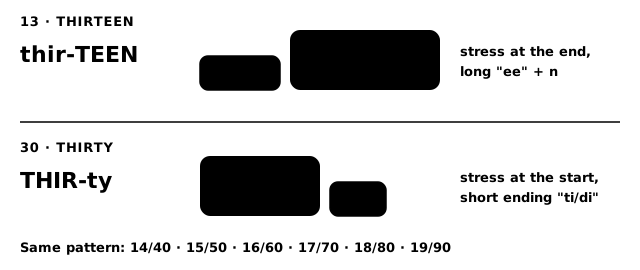
thirteen and thirty, fifteen and fifty — they are different in writing, but Indian speakers often say them the same way. The difference is in two things: where the stress is, and whether the ending is long or short.
| -teen | Listen | -ty | Listen |
|---|---|---|---|
| 13 thirTEEN | 30 THIRty | ||
| 14 fourTEEN | 40 FORty | ||
| 15 fifTEEN | 50 FIFty | ||
| 16 sixTEEN | 60 SIXty | ||
| 18 eighTEEN | 80 EIGHty |
- She's fifteen, not fifty! = She is 15 years old, not 50!
- Platform thirteen, please. = Asking for platform number 13.
If in doubt, break it up
With important numbers like money or a platform, confusion is possible, so make it clear: "Fifteen — one five." or "Fifty — five zero." Native speakers do exactly this on the phone.
31.2 Above 100 — hundred, thousand and "and"
In British and Indian English, and comes after hundred: a hundred and twenty. American English often leaves out the "and". And one firm rule: with a number, hundred / thousand / million never take a plural.
| Number | Say | Listen |
|---|---|---|
| 100 | a hundred / one hundred | |
| 120 | a hundred and twenty | |
| 305 | three hundred and five | |
| 999 | nine hundred and ninety-nine | |
| 1,500 | one thousand five hundred / fifteen hundred | |
| 4,250 | four thousand two hundred and fifty | |
| 70,000 | seventy thousand |
✗
There were three hundreds people at the wedding.
✓
There were three hundred people at the wedding.
hundreds of people
thousands of rupees
- Hundreds of people were waiting at the station. = A very large crowd (we don't know the exact number) was waiting.
31.3 Lakh, crore and million — the bridge between two worlds
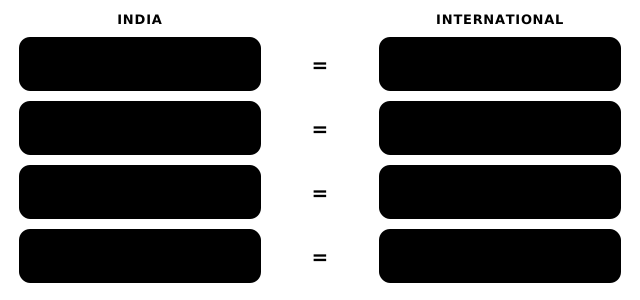
In India we think in lakh and crore, and in Indian English these are perfectly good words. But a foreign client, an international exam (IELTS) or a global meeting needs thousand, million, billion. The commas go in different places too: Indian 1,25,000 = international 125,000.
| Amount | Indian English | International |
|---|---|---|
| ₹1,25,000 | one lakh twenty-five thousand | a hundred and twenty-five thousand |
| ₹8,50,000 | eight and a half lakh | eight hundred and fifty thousand |
| ₹25,00,000 | twenty-five lakh | two and a half million |
| ₹3,00,00,000 | three crore | thirty million |
| ₹1,500 crore | fifteen hundred crore | fifteen billion |
- The bike costs one lakh twenty-five thousand rupees. = The bike costs ₹1,25,000. (Use this when talking within India.)
- That's about a hundred and twenty-five thousand rupees. = The same amount, said for a foreign friend.
- Our app has two and a half million users — that's twenty-five lakh. = Our app has 25 lakh users, said both ways.
- The film made three hundred crore — about thirty-six million dollars. = The film earned 300 crore rupees, which is roughly 36 million US dollars.
✗
My salary is twelve lakhs per annum. (to a US client)
✓
My salary is about 1.2 million rupees a year — roughly fourteen thousand dollars.
31.4 Decimals, fractions and percentages
After the decimal point, say each digit separately: 3.14 = "three point one four", not "three point fourteen". Say 0 as "zero" (in British English also "nought"); and 0.5 can simply be "point five".
| Written | Say | Listen |
|---|---|---|
| 2.5 | two point five | |
| 3.14 | three point one four | |
| 0.75 | zero point seven five | |
| ½ | a half | |
| 1½ | one and a half | |
| ⅓ · ⅔ | a third · two thirds | |
| ¼ · ¾ | a quarter · three quarters | |
| 50% | fifty per cent | |
| 7.5% | seven point five per cent |
- One and a half kilos of tomatoes, please. = Please give me 1.5 kg of tomatoes (in Hindi: "dedh kilo").
- Two thirds of the class passed with distinction. = 2 out of every 3 students got a distinction.
- Prices went up by twelve per cent this year. = Prices rose by 12% this year.
Small points
British/Indian spelling is per cent, American is percent — they sound the same. One and a half hours (plural), but half an hour. And "dedh" = one and a half, "dhai" = two and a half.
31.5 Money and prices
We write ₹250 or Rs 250 — the symbol first; but we say "two hundred and fifty rupees" — rupees after the number. In shops and markets a short form is common too: ₹499 = "four ninety-nine".
| Written | Say | Listen |
|---|---|---|
| ₹50 | fifty rupees | |
| ₹499 | four hundred and ninety-nine rupees / four ninety-nine | |
| ₹2.50 | two rupees fifty (paise) | |
| ₹1,200 | one thousand two hundred / twelve hundred | |
| $3.99 | three ninety-nine / three dollars ninety-nine cents | |
| £15 | fifteen pounds |
- How much is this kurta? — It's eight hundred rupees. = Asking the price, and hearing that it is ₹800.
- Could you do it for six fifty? = Can you lower the price to ₹650? (bargaining)
- The bill comes to two thousand three hundred and forty rupees. = The total bill is ₹2,340.
- Can you split it? That's about six hundred each. = Let's share the bill — about ₹600 per person.
✗
It costs rupees two hundred.
✓
It costs two hundred rupees.
after
'k' is informal only
With friends "fifteen k" (15,000) is fine. In an office email or an interview, say it in full: fifteen thousand. For salary, say "twelve lakh a year" or "twelve lakh per annum", not "12 LPA".
31.6 Years, dates and ordinal numbers
Years — in pairs of digits
Years are usually said in two parts: 19|98 = nineteen ninety-eight. Only 2000 to 2009 use "two thousand (and) …". After 2010 both ways work, but twenty twenty-six is more common.
| Year | Say | Listen |
|---|---|---|
| 1947 | nineteen forty-seven | |
| 1900 | nineteen hundred | |
| 2000 | the year two thousand | |
| 2005 | two thousand and five (US: two thousand five) | |
| 2026 | twenty twenty-six | |
| 1990s | the nineties |
Ordinal numbers — first, second, third
Dates are always said as ordinals: the fifth, not "the five". Watch out for 11/12/13 (eleventh, twelfth, thirteenth) and for 21/22/23 (twenty-first, twenty-second, twenty-third).
| Number | Ordinal | Listen |
|---|---|---|
| 1st · 2nd · 3rd | first · second · third | |
| 5th · 8th · 9th | fifth · eighth · ninth | |
| 11th · 12th · 13th | eleventh · twelfth · thirteenth | |
| 20th · 21st · 22nd | twentieth · twenty-first · twenty-second | |
| 30th · 31st | thirtieth · thirty-first |
Dates — British or American?
| Style | Written | Spoken |
|---|---|---|
| British / Indian | 5 May 2026 | the fifth of May, twenty twenty-six |
| American | May 5, 2026 | May fifth, twenty twenty-six |
| India/UK number | 05/06/2026 | 5 June |
| US number | 05/06/2026 | May 6 |
- My birthday is on the twenty-first of October. = My birthday is on 21 October.
- The exam is on March the third. = The exam is on 3 March.
- I was born in two thousand and five. = I was born in 2005.
- India became independent on the fifteenth of August, nineteen forty-seven. = India became independent on 15 August 1947.
✗
The meeting is on five May.
✓
The meeting is on the fifth of May. / on May fifth.
on
in
Prepositions — the linking words
The 05/06 trap
For a US client, 05/06 = 6 May; for you it is 5 June. In international emails always write the month as a word: 5 June 2026. Problem solved.
31.7 Telling the time — from o'clock to "7 sharp"
There are two ways: digital (seven fifteen) — easy and always correct; and past / to (quarter past seven) — very common in everyday talk. You need to understand both.
| Time | past / to | Digital | Listen |
|---|---|---|---|
| 7:00 | seven o'clock | seven | |
| 7:05 | five past seven | seven oh five | |
| 7:15 | quarter past seven | seven fifteen | |
| 7:30 | half past seven | seven thirty | |
| 7:40 | twenty to eight | seven forty | |
| 7:45 | quarter to eight | seven forty-five |
past and to
For the first 30 minutes: minutes + past + the current hour. For the last 30: minutes + to + the next hour. 15 = quarter, 30 = half. If in doubt, say it digitally: seven forty-five is never wrong.
| Hindi | Time | English |
|---|---|---|
| sawa saat | 7:15 | quarter past seven |
| saadhe saat | 7:30 | half past seven |
| paune aath | 7:45 | quarter to eight |
| dedh baje | 1:30 | half past one |
| dhai baje | 2:30 | half past two |
- The meeting starts at ten sharp. = The meeting starts at exactly ten — not even one minute late.
- Let's meet around six. / Let's meet at six-ish. = Let's meet at about six — the exact time doesn't matter.
- My flight is at eleven forty-five p.m. = My flight is at 11:45 at night.
- The train departs at nineteen hundred hours. = The train leaves at 19:00 (7 p.m.). The 24-hour clock is used in announcements.
- What time is it? — It's half past four. = Asking the time, and hearing that it is 4:30.
✗
I'll come at 7 o'clock in the evening p.m.
✓
I'll come at 7 p.m. / at seven in the evening.
seven o'clock
British 'half seven'
In the UK people say "half seven" and mean 7:30 (half past seven). Not 6:30!
31.8 Phone numbers, measurements and temperature
Phone numbers — one digit at a time, in groups
Say each digit of a phone number separately, in small groups, with a slight pause between groups. Two identical digits = double, three = triple. Say 0 as "oh" or "zero" — both are fine.
- 98450 22301 → nine eight four five oh, double two three oh one. = Two groups of five digits.
- My extension is triple four. = My extension is 444.
- Sorry, was that five oh or five four? = Checking again: was it 50 or 54?
Measurements, temperature and scores
| Written | Say | Listen |
|---|---|---|
| 5'8" | five foot eight / five feet eight inches | |
| 70 kg | seventy kilos | |
| 12 km | twelve kilometres | |
| 2 BHK, 1,100 sq ft | a two B-H-K, eleven hundred square feet | |
| 38°C | thirty-eight degrees (Celsius) | |
| −5°C | minus five degrees | |
| 250/3 (cricket) | two fifty for three | |
| 2–0 (football) | two nil / two-zero |
- It was forty-four degrees in Nagpur yesterday! = Yesterday's temperature in Nagpur was 44°C!
- I'm five foot six and I weigh about sixty kilos. = My height is 5'6" and my weight is about 60 kg.
✗
The office is 12 kms from here. / It's 38 degree.
✓
The office is 12 km (twelve kilometres) from here. / It's 38 degrees.
31.9 In real life — booking a cab and paying a bill
Ankit is booking a cab to the airport, and later paying a bill at a shop. Listen to every line and repeat it — pay special attention to the numbers.
| Who | What they say | Listen |
|---|---|---|
| Agent | What time is your flight, sir? | |
| Ankit | It's at six forty-five a.m. on the thirteenth. | |
| Agent | Sorry — the thirteenth or the thirtieth? | |
| Ankit | The thirteenth. One three. | |
| Agent | Then the driver will pick you up at four sharp. The fare is eight hundred and fifty rupees. | |
| Ankit | Great. My number is nine eight one oh, double seven, four five two six. | |
| Cashier | That's one thousand two hundred and forty, sir. Card or UPI? |
The daily 3-minute drill
Whatever number you see on the way — a car plate, a price in a shop, the time on a clock — say it in English in your head. "Seven forty-five… quarter to eight." Within a week, saying numbers will be a job for your tongue, not your brain.
31.10 Practice — Numbers, dates, time & money
Exercise 1
When is the meeting?
Read this aloud or have someone read it to you:
The meeting has been moved to the thirteenth of March.
- 13 March
- 30 March
- 3 March
- 13 May
Answer
13 March
Transcript: “The meeting has been moved to the thirteenth of March.”
thir-TEEN — the stress is at the end, with a long 'ee'. For 30 it would be THIR-tieth.
Exercise 2
How much does the driver want?
Read this aloud or have someone read it to you:
That will be fifty rupees, please.
- ₹15
- ₹50
- ₹500
- ₹5
Answer
₹50
Transcript: “That will be fifty rupees, please.”
FIF-ty: stress at the start, short ending. In fifteen the stress would be on 'teen'.
Exercise 3
What time does the flight leave?
Read this aloud or have someone read it to you:
My flight leaves at a quarter to nine.
- 8:45
- 9:15
- 8:15
- 9:45
Answer
8:45
Transcript: “My flight leaves at a quarter to nine.”
quarter to nine = fifteen minutes before nine = 8:45 (paune nau).
Exercise 4
What is the price of the flat?
Read this aloud or have someone read it to you:
The flat costs one crore twenty lakh rupees.
- ₹1,20,00,000
- ₹12,00,000
- ₹1,20,000
- ₹1,02,00,000
Answer
₹1,20,00,000
Transcript: “The flat costs one crore twenty lakh rupees.”
1 crore + 20 lakh = 1,20,00,000 (= 12 million).
Exercise 5
How many users is that in lakh?
Read this aloud or have someone read it to you:
Our app now has about one point five million users.
- 15 lakh
- 1.5 lakh
- 150 lakh
- 1.5 crore
Answer
15 lakh
Transcript: “Our app now has about one point five million users.”
1 million = 10 lakh, so 1.5 million = 15 lakh.
Exercise 6
What is Kavya's number?
Read this aloud or have someone read it to you:
Hi, it's Kavya. Please call me back on nine eight four five oh, double two, three oh one.
- 98450 22301
- 98450 23011
- 98405 22301
- 98450 22310
Answer
98450 22301
Transcript: “Hi, it's Kavya. Please call me back on nine eight four five oh, double two, three oh one.”
oh = 0, double two = 22. In a phone number, every digit is said separately.
Exercise 7
When does the train leave?
Read this aloud or have someone read it to you:
Train number one two nine five one will depart from platform four at nineteen hundred hours.
- 7 p.m.
- 9 p.m.
- 7 a.m.
- 9 a.m.
Answer
7 p.m.
Transcript: “Train number one two nine five one will depart from platform four at nineteen hundred hours.”
Nineteen hundred hours = 19:00 = 7 in the evening. Announcements use the 24-hour clock.
Exercise 8
Which platform?
Read this aloud or have someone read it to you:
Train number one two nine five one will depart from platform four at nineteen hundred hours.
- 4
- 14
- 19
- 1
Answer
4
Transcript: “Train number one two nine five one will depart from platform four at nineteen hundred hours.”
platform four. 12951 is the train number, and 19 is part of the time.
Exercise 9
Write what you hear. (Numbers can be digits or words — both are accepted)
Dictation. Have someone read the sentence aloud, then write it down.
The tickets cost two hundred and fifty rupees each.
Answer
The tickets cost 250 rupees each.
two hundred and fifty = 250. Rupees comes after the number.
Exercise 10
Write what you hear.
Dictation. Have someone read the sentence aloud, then write it down.
My birthday is on the twenty-first of October.
Answer
My birthday is on the 21st of October.
Dates are said as ordinals: twenty-first (21st).
Exercise 11
Write what you hear.
Dictation. Have someone read the sentence aloud, then write it down.
I was born in two thousand and five.
Answer
I was born in 2005.
2000–2009: two thousand (and) five.
Exercise 12
Write what you hear.
Dictation. Have someone read the sentence aloud, then write it down.
The shop opens at half past ten.
Answer
The shop opens at half past ten.
half past ten = 10:30 (saadhe das).
Exercise 13
How do people usually say the year 2026?
- twenty twenty-six
- two zero two six
- twenty hundred twenty-six
- two thousand twenty-six hundred
Answer
twenty twenty-six
Years are said in two pairs: 20|26 = twenty twenty-six. ('two thousand and twenty-six' is also correct, but less common.)
Exercise 14
A US client asks your budget. ₹1,25,000 in international English is…
- a hundred and twenty-five thousand rupees
- twelve lakh fifty thousand rupees
- one million two hundred and fifty thousand rupees
- twelve thousand five hundred rupees
Answer
a hundred and twenty-five thousand rupees
1,25,000 = 125,000 = a hundred and twenty-five thousand.
Exercise 15
An American email says the deadline is 05/06. What date do they mean?
- 6 May
- 5 June
- 5 May
- 6 June
Answer
6 May
US style is month/day. That is why you should write the month as a word in international emails.
Exercise 16
7:45 = a quarter ___ eight.
Hint: The next hour is coming.
Answer
to
After 30 minutes: minutes + to + the next hour.
Exercise 17
Tap the wrong word.
There were three hundreds people at the wedding.
Answer
Wrong word: hundreds.
Corrected: There were three hundred people at the wedding.
With a number, hundred stays singular: three hundred people.
Exercise 18
Match the ordinals.
| A | B |
|---|---|
| 1st | twelfth |
| 3rd | twenty-first |
| 12th | first |
| 21st | third |
Answer
1st — first; 3rd — third; 12th — twelfth; 21st — twenty-first
1, 2, 3 and the numbers ending in them (21, 22, 23) are special; 12 = twelfth.
Exercise 19
Say it aloud — make the difference between thir-TEEN and THIR-ty clear.
The train leaves from platform thirteen, not thirty
Answer
Say: The train leaves from platform thirteen, not thirty
thir-TEEN: stress at the end, long 'ee'. THIR-ty: stress at the start, short ending.
What to do next
Say your phone number, your birthday and last month's electricity bill aloud in English — three times. Then use these numbers in a real call in the Phone and video calls chapter, and listen in Native speed English to hear how words join together when people speak fast.