Chapter 42: Commonly confused words
Look-alike words — the ones that trick you every day
Some words are like twin brothers — they look alike, sound alike, but do completely different jobs. loose and lose, then and than, your and you're — these mistakes show up daily, even in the emails of well-educated people. Spell-check does not catch them, because both words are correct — just in the wrong place. This chapter has sixteen pairs, sensibly split into groups, and each group comes with a memory trick.
- 1Three kinds of pairs — recognise them first
- 2The apostrophe ones — its/it's, your/you're, their/there/they're
- 3One sound, two spellings — stationary/stationery, principal/principle
- 4Noun or verb — affect/effect, advice/advise
- 5One letter apart — lose/loose, quite/quiet, then/than, accept/except
- 6Direction pairs — borrow/lend, bring/take, say/tell
- 7Counting and placing — fewer/less, lie/lay
- 8The mistakes we really make
42.1 Three kinds of pairs — recognise them first
Every confusion has a different root, so the cure is different too. First recognise what kind of pair you are dealing with — half the work is done right there.

How to read this chapter
One group at a time. Say the trick of each pair aloud, then make a sentence of your own. If you remember the trick, the pair will never confuse you again.
42.2 The apostrophe ones — its/it's, your/you're, their/there/they're
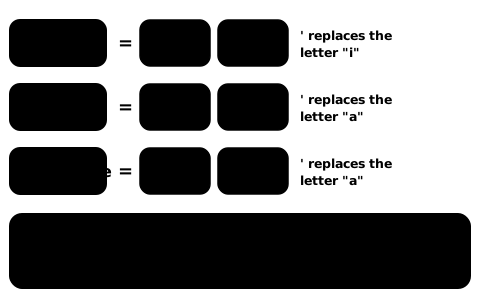
This is the most common written mistake — from WhatsApp to office email. When speaking it makes no difference, because the sound is the same. But in writing, one tiny apostrophe changes the whole meaning.
| Word | Meaning | Example |
|---|---|---|
| it's / its | it is / belonging to it | It's raining. · The phone lost its charge. |
| you're / your | you are / belonging to you | You're late. · Is this your seat? |
| they're | they are | They're coming at six. |
| their | belonging to them | Their car is new. |
| there | in that place / "there is" | Put it over there. · There is a problem. |
Open it up and read
Apostrophe = missing letter. Read "it's" as "it is", "you're" as "you are", "they're" as "they are" — if the sentence still makes sense, keep the apostrophe; if not, use the one without it (its / your / their). Is "Your welcome" the same as "You are welcome"? Yes! So it should be "You're welcome".
42.3 One sound, two spellings — stationary/stationery, principal/principle
These two pairs are pronounced exactly alike — only one letter differs. So the sound will not help you; a picture trick will.

- The bus was stationary, so I bought some stationery from the shop nearby. = The bus was not moving, so I bought pens and paper from the shop nearby.
- Our principal never breaks her principles. = The head of our school never breaks her own rules.
- The principal reason was cost. "principal" is also an adjective = main. It takes -al here too.
One letter, one picture
stationAry = At rest (not moving) · stationEry = Envelope (pen and paper). principAL = a person / main ("your PAL") · principLE = a rule (ruLE).
42.4 Noun or verb — affect/effect, advice/advise
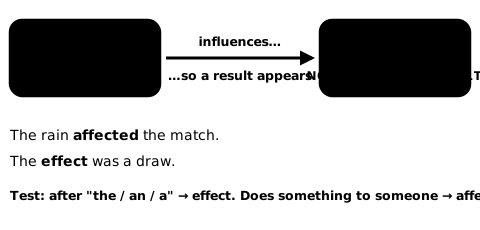
In each of these pairs, one word is an action (a verb) and the other is a thing (a noun). Look at the sentence and ask whether it needs a verb or a noun — the answer comes by itself.
| Word | What it is | Example | Listen |
|---|---|---|---|
| affect | verb — to influence | Stress can affect your sleep. | |
| effect | noun — a result | The medicine had a quick effect. | |
| advice | noun — a recommendation (the "s" sound) | Can I give you some advice? | |
| advise | verb — to give advice (the "z" sound) | I advise you to wait. |
A = Action, -ice = a thing
Affect = Action (verb), Effect = End result (noun). Advice is a thing like ice (noun, "s" sound); advise is an action (verb, "z" sound). Also, advice cannot be counted: "some advice", "a piece of advice" — never "an advice" or "advices".
42.5 One letter apart — lose/loose, quite/quiet, then/than, accept/except
In these pairs one letter moves around, and your eye skips over it while reading. Each pair has a small trick — attach the trick to the word, and the meaning comes by itself.
| Pair | Meaning | Trick |
|---|---|---|
| lose / loose | to misplace, to fail to win / not tight | lose has lost an "o". loose has "oo" — baggy, with more room. |
| quite / quiet | fairly / silent | quite = one syllable (kwait). qui-et = two syllables (kwai-yet) — speak softly in silence. |
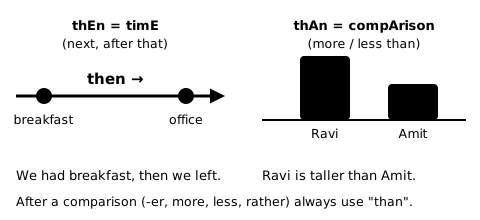
| then / than | next / compared with | thEn = timE, thAn = compArison. |
| accept / except | to agree to take / apart from | accept = take it in. except = exit — keep it out. |
- These jeans are too loose. I must have lost weight! loose = "loos" (the "s" sound), lose = "looz" (the "z" sound). The speaking differs too.
- The library is quite big, and it's always quiet. = Fairly big, and always silent.
- I accept all the changes except the last one. = I agree to all the changes, apart from the last one.
Four tricks
lose has lost an "o" (to misplace) · loose = baggy · quiet = two syllables, silent · quite = fairly · thEn = timE · thAn = compArison · except = exit (out), accept = take in.
42.6 Direction pairs — borrow/lend, bring/take, say/tell
Hindi has separate words for "taking" and "giving", and for "bringing" and "carrying away" — yet in English these get mixed up, because we think with one word like "udhaar" or "le aao". The question here is: which way is the thing moving?
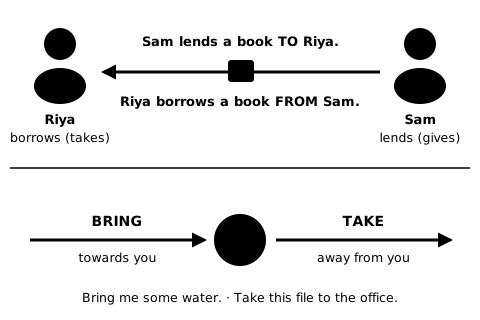
- Could you lend me your pen? / Could I borrow your pen? Both are correct — but never "Can you borrow me…". The person who will give it = lend.
- Please bring your ID card tomorrow, and take the old one home. Towards here (the office) = bring. Away to your home = take.
- She told me the news and said it was a secret. tell + person (told me), say + the words (said it was…). "She said me" is wrong.
Which way is the thing moving?
lend = to give, borrow = to receive (lend to, borrow from). bring = towards the speaker, take = away from them. After tell comes a person (tell me), after say comes the words (say something).
42.7 Counting and placing — fewer/less, lie/lay
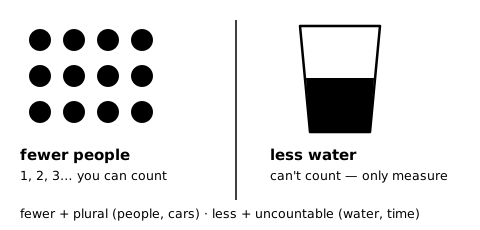
These two pairs look the most "advanced", but the rule is simple. For fewer/less the question is: can you count it? And for lie/lay: is something being put down, or are you lying down yourself?
| Verb | Meaning | Present | Past | Past participle |
|---|---|---|---|---|
| lie | to rest flat yourself | lie · lying | lay | lain |
| lay | to put something down | lay · laying | laid | laid |
| lie | to say something untrue | lie · lying | lied | lied |
- I'm tired. I'm going to lie down for a bit. Lying down yourself = lie. No object follows it.
- Please lay the files on my desk. Putting something down = lay + a thing (the files).
- There were fewer cars today, so it took less time. You can count cars → fewer. You cannot count time → less.
Can you count it? Are you putting something down?
fewer + things you can count (fewer people), less + things you cannot count (less water). After lay there is always a thing (lay the table); after lie there is not (lie down). The biggest trap: the past of lie is "lay" — "Yesterday I lay in bed all day."
42.8 The mistakes we really make
All of these mistakes are taken from real emails, WhatsApp messages and class notebooks. If even one of them is your habit, catch it today.
Common look-alike word mistakes
- Wrong: Can you borrow me your charger?
- Right: Can you lend me your charger? / Can I borrow your charger?
-
Why: The giver lends, the receiver borrows. Never "borrow me".
-
Wrong: I don't want to loose this chance.
- Right: I don't want to lose this chance.
-
Why: To misplace or fail to keep = lose (one o). Loose = baggy — "loose shirt".
-
Wrong: The new rule will effect everyone.
- Right: The new rule will affect everyone.
-
Why: A verb is needed after "will ___ everyone" → Affect = Action.
-
Wrong: My brother is taller then me.
- Right: My brother is taller than me.
-
Why: After a comparison (taller) use than. "Then" is only for time.
-
Wrong: Your welcome!
- Right: You're welcome!
- Why: Open it up and read: "You are welcome" — it fits, so you're.
42.9 Practice — Look-alike words
Exercise 1
Match each word with its job.
| A | B |
|---|---|
| affect | verb — to give advice |
| effect | noun — a recommendation |
| advise | verb — to influence |
| advice | noun — a result |
Answer
affect — verb — to influence; effect — noun — a result; advise — verb — to give advice; advice — noun — a recommendation
A = Action (affect, verb), E = End result (effect, noun). Advice is a thing (noun), advise is an action (verb).
Exercise 2
One letter apart — match each word with the right meaning.
| A | B |
|---|---|
| stationery | head, main |
| stationary | a rule or belief |
| principal | pens, paper, files |
| principle | not moving |
Answer
stationery — pens, paper, files; stationary — not moving; principal — head, main; principle — a rule or belief
E = Envelope (stationery), A = At rest (stationary). The principal is your PAL; principLE = ruLE.
Exercise 3
Tap the wrong word in this sentence.
Can you borrow me your charger for an hour?
Answer
Wrong word: borrow.
Corrected: Can you lend me your charger for an hour?
The other person will give it, so they 'lend'. When you take it, say 'Can I borrow…?'
Exercise 4
Find the spelling trap.
I don't want to loose my job.
Answer
Wrong word: loose.
Corrected: I don't want to lose my job.
To misplace or fail to keep = lose (one o). Loose = baggy.
Exercise 5
The apostrophe is in the wrong place — tap that word.
The dog wagged it's tail happily.
Answer
Wrong word: it's.
Corrected: The dog wagged its tail happily.
Open it up and read: 'wagged it is tail'? Does not fit — so no apostrophe: its = belonging to it.
Exercise 6
I think ___ going to be late. The traffic is terrible.
- they're
- their
- there
- them
Answer
they're
Open it up and check: 'I think they are going to be late' — it fits, so they're.
Exercise 7
Everyone came to the party ___ Rahul. He was ill.
- except
- accept
- expect
- excuse
Answer
except
except = apart from (ex = exit, keep out). accept = to agree to take.
Exercise 8
Please ___ the baby gently on the bed.
- lay
- lie
- lied
- lain
Answer
lay
Putting a thing or a person down = lay + object (lay the baby). Lying down yourself = lie.
Exercise 9
There are ___ people here than yesterday.
Hint: People can be counted.
Answer
fewer
You can count them → fewer. 'less people' is a very common mistake; less is only for uncountable things (less water).
Exercise 10
Please be ___. The baby is sleeping.
Hint: Silent — the word with two syllables.
Answer
quiet
quiet (kwai-yet) = silent. quite (kwait) = fairly.
Exercise 11
Put the words in the right order.
Words: our / rain / heavy / will / affect / The / plans
Answer
The heavy rain will affect our plans
A verb is needed after 'will ___ our plans' — affect (A = Action).
Exercise 12
Say this polite request.
Could I borrow your pen, please
Answer
Say: Could I borrow your pen, please
You are the one taking → borrow. Stress the first part of 'borrow': BOR-row.
What to do next
Open your last ten emails or messages and look for just three things: your/you're, its/it's, then/than. Whenever you find a mistake, write it out once again using this chapter's trick.